Manchester University (in Indiana) seeks a dynamic teacher-scholar to join the Communication Studies program for the 2026-2027 Academic Calendar, continuing the University’s long tradition of scholarship rooted in empathy, listening, dialogue, and general semantics. The successful candidate will teach courses such as: Foundations of Human Communication, Intercultural Communication, Language & Thought, and Persuasion.
Preference will be given to candidates whose teaching and/or scholarship engage with general semantics. This endowed position carries a 25% course release to support faculty-student research and community engagement. Faculty also contribute to the general education curriculum and interdisciplinary initiatives. The standard teaching load is 18 semester hours per year.
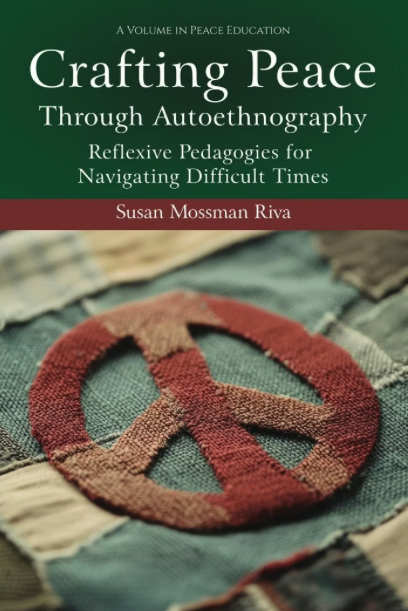
With a foreword by Sheila McNamee and an afterword by Robin Cooper—both scholars from the Taos Institute—the book Crafting Peace Through Autoethography: Reflexive Pedagogies for Navigating Difficult Times is grounded in a social constructionist perspective and offers a reflective framework for navigating complexity in higher education.
In this work, Riva introduces the Transformational Learning Model and feature students’ Transformagram Portfolios—creative, personal expressions of their transformative learning journeys. She also shares how her online courses provide a safe and supportive virtual space for accompanying students through deeply experiential and reflective processes.
At Creighton University, her conflict resolution course uses personal conflict narratives to connect lived experience with theoretical frameworks. Students craft story mandalas and engage with autoethnography as a social science method, deepening their understanding of conflict, identity, and personal transformation.
During 2025, NCA’s Publications Council will nominate an Editor-Elect (or co-Editors-Elect) for the Journal of International and Intercultural Communication. The newly appointed Editor will begin processing manuscripts early in 2027 and will oversee the volumes for 2028-2030. The journal is published four times each year.
Editors of NCA journals occupy a particularly prominent leadership position in the field. In naming editorial boards, selecting reviewers for manuscripts, and making final publication decisions (among other duties), they make a vitally important contribution to the discipline, and they play a key role in maintaining the highest standards of integrity and scholarly inquiry.
The Journal of International and Intercultural Communication (JIIC) is a peer-reviewed publication of the National Communication Association (NCA). JIIC publishes original scholarship that expands understanding of international, intercultural, and cross-cultural communication. Widely interdisciplinary, JIIC features diverse perspectives and methods, including qualitative, quantitative, critical, and textual approaches to intellectual inquiry.
Call for papers: British Association for Applied Linguistics Language Policy Forum, Universidad Complutense de Madrid, Spain, 22-23 April 2026. Deadline: 27 October 2025.
2026 marks 50 years since Joshua Fishman‘s foundational volume Bilingual Education: An International Sociological Perspective(1976), a cornerstone in establishing language policy as a distinct discipline. 2026 also marks 20 years since the publication of An Introduction to Language Policy: Theory and Method, a collection edited by Thomas Ricento and showcasing the leading lights of what had become by then a flourishing research field.
In his volume, Fishman argued that language policy (or more specifically bilingual education) was good for majorities, minorities, language learning, and education. In this spirit, LPF 2026 invites submissions informed by this disciplinary heritage, and those which go beyond it, to examine language policy across different areas of civic and societal engagement. We take a broad approach to language policy; we welcome any submissions related to decision-making about language use.
The Language Policy Forum is international, affordable, and accessible –– a premier international meeting of specialists with extra attention to facilitating access.
ASF invites all U.S. colleges and universities to apply for the Annual Norwegian Lectureship. The award is for one semester and is open to disciplines with a contemporary focus on Public Policy, Conflict Resolution, Environmental Studies, Multiculturalism, or Healthcare. The ASF Norwegian Visiting Lecturer receives a $20,000 teaching and research stipend along with an additional $5,000 travel stipend for lecture appearances outside the host institution. The lecturer must be a Norwegian citizen and a scholar or expert in a field appropriate to the host department or program.
An ethnographic study of ethnic minority students’ multilingualism in rural China: A conversation with Yizhe Jiang.
I have had the good fortune of sharing a conversation recently with Professor Yizhe Jiang (at the University of Macau) about her doctoral dissertation research in Guizhou Province, China. Her research on some important aspects of multilingualism of young ethnic minority students in Rural China involved extensive ethnographic fieldwork and, in my views, its outcome can help shed light on some important aspects of our work in intercultural communication and dialogue. This is the second installment of a series of conversations with colleagues in various disciplines for their insights and perspectives on matters and practices in this regard.
Yizhe, thank you very much for sharing your research work and reflections with us. To better contextualize our conversation for our readers, what is the general focus or thesis of your Ph.D. dissertation research? How is the research focus relevant to intercultural communication or dialogue?
The title of my Ph.D. dissertation is The Nature of Multilingualism of Ethnic Miao and Dong Liushou Ertong in Rural China. This research is based on an ethnographic study of a unique group of children in Guizhou Province (貴州省), China. These children belong to the Miao (or Hmong) and Dong (or Kam) ethnic groups and live in the multiethnic and multilingual Jinping County (錦屏縣), which is part of Qiandongnan Miao and Dong Autonomous Prefecture (黔東南苗族侗族自治州) in Guizhou. They speak their ethnic languages (Miao or Dong), a regional Han Chinese dialect (Jinpinghua), standard Mandarin (Putonghua), and learn English in junior middle school. My study investigated their daily language use and functions at school, as well as their ideologies regarding these different language varieties.
Through many intercultural dialogues, the research highlighted how these children navigated various cultural contexts—Miao, Dong, and Han (the majority ethnic group in China), as well as modern and traditional, formal and informal, urban and rural dynamics.
What motivated you to pursue the subject matter? Why was researching the subject matter important to you, say, professionally and personally?
Due to significant economic disparities between major cities in eastern China and rural areas in the west, my study participants are ethnic minorities and Liushou Ertong (留守兒童), a unique group of children whose parents work in large cities for better incomes. Consequently, these children are often cared for by their grandparents and see their parents only a few times a year. Unlike their urban counterparts raised by their parents, these students show stronger proficiency in their ethnic languages, namely Miao or Dong, as they have to communicate with older relatives in their traditional villages. At school, they naturally switch between ethnic languages, Jinpinghua, and Putonghua for different communicative purposes. Intrigued by their linguistic repertoires and concerned about their living conditions, I am eager to explore their stories and share them with the outside world.
Please briefly describe your project’s field research sites and their relevance to address your questions.
A glimpse of the center of Jinping County (錦屏縣), Guizhou, China, September 2021
I took the above picture in the center of Jinping County, where two large rivers merge—part of the upper reaches of the Yangtze River. The government has implemented strict environmental protection laws and regulations. As a result, there are few large companies and factories in the area, causing most young adults to work outside the county. Consequently, many children here are Liushou Ertong, especially those living in remote villages.
All of my participants were enrolled in a suburban boarding middle school, featuring an equal representation of Miao and Dong students. Due to the accelerating pace of urbanization, fewer children remain in villages in Jinping, resulting in the closure of middle schools in remote areas. After graduating from village elementary schools in six Miao and Dong towns, these students enter the central middle school in suburban Jinping, where they spend five days a week and take a bus home on weekends.
Who were the main human subjects of your project’s field research, such as students, their families, teachers, school administrators, etc.)?
At the center of my study are four ethnic minority Liushou Ertong: Ling, Xian, Min, and Fei (pseudonyms). Ling and Xian are Miao girls from different villages in the same town, while Min is a Dong girl living half an hour away from Fei, a Dong boy from the same mountain range.
To understand the students’ language use at home, I interviewed their grandparents. I also interviewed four teachers: Mr. W, a Dong male history teacher who occasionally uses Dong in formal classes; Mr. W, the vice principal and English teacher who knows the school language policy well; Mr. P, a Dong female who served as their Chinese teacher and frequently communicated with the students’ families; and Mr. L, a Miao female English teacher who taught these students for one year. All are fluent in their ethnic languages and familiar with the students’ language habits.
What have been some of the biggest challenges facing you over the course of your fieldwork and how did you address these challenges?
First, my unfamiliarity with Guizhou Province presented a challenge, as I had never visited it before. To acclimate, I worked as an English teacher for a year, teaching 266 hours to build rapport with students and teachers while learning the local languages.
Second, transportation was an issue since many participants lived in remote villages, with some Dong students residing up to an hour and a half from downtown. The winding mountain roads often made me carsick, so I sometimes invited friends or family to drive with me. I also hosted students in my apartment for TV or homework sessions, fostering communication among diverse linguistic backgrounds.
Another challenge involved language barriers. While I gradually learned the local dialect, Jinpinghua, I struggled with Miao and Dong, which belong to different language families. This often required me to rely on student translations during interviews, necessitating repeated confirmations for clarity.
What were the most memorable moments, events, encounters, etc., that you experienced over the course of your fieldwork? Why were they memorable to you?
While reading this question, many memorable moments came to mind. One afternoon, when I was walking in the mountains with two girls, I discovered a beautiful crystal stone. A girl told me it was a flint, and they introduced me to various herbs along the path. Despite being their teacher, I learned a great deal about nature from these students.
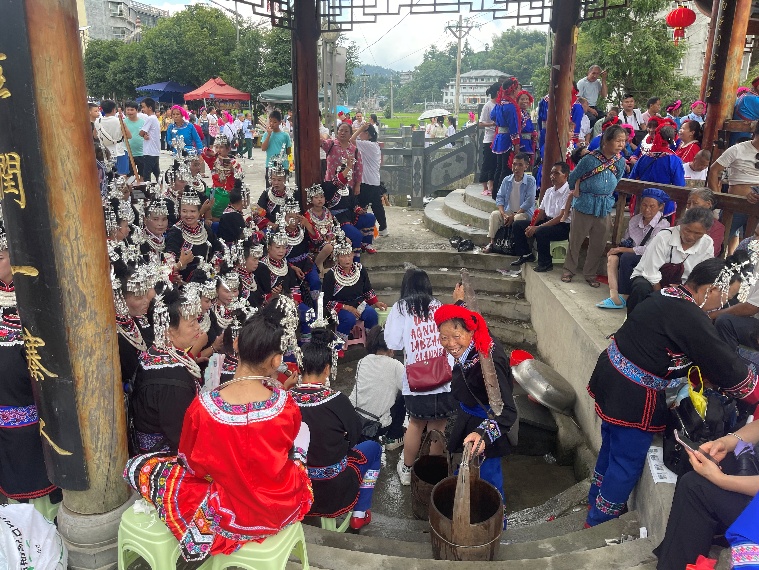
Another highlight was participating in the Miao Tasting Festival, which celebrates rice growing. Jinping is sea of folk songs, with singing competitions and activities during every traditional festival. People dressed in their ethnic attire came from various villages and even neighboring provinces. I captured a photo of some Dong and Miao people in different styles of costumes, resting and chatting by a well.
A Miao tasting festival underway in Ouli Town (偶里鄉), July 2023
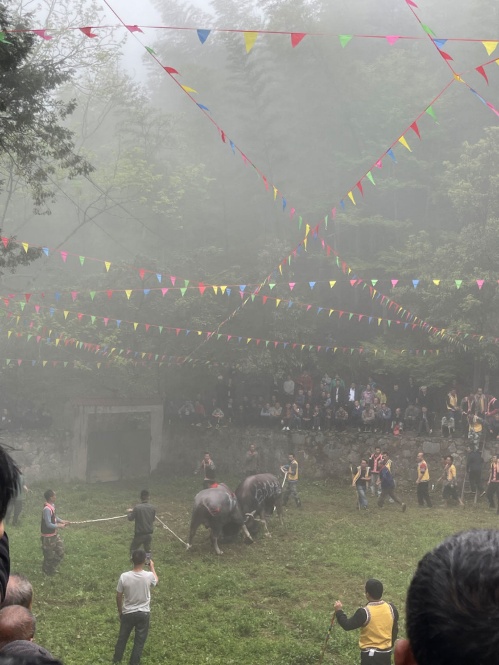
I also attended a bullfighting competition, a favorite among the Dong people, which caused traffic jams even in the mountains.
A bullfighting competition in action in Yandong Town (彥洞鄉), April 2023
The most touching moments were those spent in nature, truly experiencing “field” work. Observing students in rice fields, villages, and forests, I recorded the beautiful sounds of cicadas, birds, barking dogs, crowing roosters, and the sound of fish tails hitting the water in the rice fields, along with the elders singing Dong songs. I dedicated my thesis to this generous, poetic, and mysterious land of Guizhou Province.
What was the one most important lesson that you think you have walked away with from your ethnographic fieldwork?
I believe the most important lesson is to be patient. During my initial round of interviews with the children, they were uncertain about their use of and feelings toward different languages. I felt disappointed, fearing I might not uncover many interesting aspects.
However, as I grew more familiar with them, I discovered numerous intriguing moments. For example, Jinpinghua is commonly spoken in Miao villages near the downtown area, but it was almost inaudible in Dong towns. After spending a year at school, Dong students picked up this dialect from their Miao peers and those from downtown, eventually speaking it fluently.
What advice would you give to colleagues in the field who are interested in conducting ethnographic research in China (especially in rural China), such as things they must consider doing or preparing for and things they should avoid?
I believe the first step is to be patient, as people from these areas may be unfamiliar with being observed and interviewed. Most of them have never been interviewed before and often associate it with something serious and formal. It’s crucial to spend time with them, building close relationships that help them relax, trust you, and understand that your study is not an exam.
You also need to respect local culture and customs. For example, my students’ grandparents always cooked and waited for me to share a meal during my visits. Initially, I felt guilty, but I soon realized this was their custom. They feel sad if guests don’t join them for a meal. So, throughout the rest of my study, I always brought food or cooked with them, which provided many opportunities to observe their conversations in the kitchen.
Additionally, attending their traditional festivals and activities is always fascinating, as it allows you to witness people from different backgrounds gathering and engaging in intercultural communication.
In summary, reflecting upon my learning from Yizhe’s experience and insight, I would like to offer four Key Takeaways, as follows:
First, it is not uncommon that students in China of ethnic minority heritages are bilingual or multilingual, thus presenting unique challenges and opportunities to language or intercultural educators.
Second, rural education in China, especially in regard to world language education in rural China, remains a subject that has yet to receive an extent of academic attention it rightfully deserves.
Third, due to diverse and complex inter-regional or intra-cultural differences, conducting ethnographic research in China requires a great deal of preparation and patience even as the researchers may have come from a Chinese heritage.
Fourth, immersing oneself in ethnographic research, in the manner in which Dr. Jiang has endeavored, can be, and often is, a transformative experience for the researcher.
The Smithsonian Institution holds a Folklife Festival every summer in Washington, DC, as a way to encourage dialogue across cultural groups from around the country and the world. They are currently hiring dozens of temporary positions for the 2026 Folklife Festival. Just to list a few of the positions, those in communications, design and documentation include:
Digital Asset Management Assistant
Graphic Designer
Graphic Design Assistant
Writer/Editor
Lead Photographer
Videographer
In addition, they are looking for interns year-round, although the bulk of the work is in the summer. In the fall, winter, and spring, interns assist with research and planning for the upcoming Festival’s programs—best suited for students in anthropology, ethnomusicology, and language studies as related to the program. In the summer, they also seek interns to work on event production, technical crew, the Festival Marketplace, social media, web production, graphic design, foodways, curatorial team, the Festival Blog, public relations, accessibility, participant and volunteer coordination, video production, and administration.
The Department of Communication in the College of Communication, Media, Design and Information at the University of Colorado Boulder (CU Boulder) invites applicants for a tenure-track, assistant professor position in Rhetoric and Culture of Radical Global Imaginaries. A PhD with a specialization in rhetoric and culture is required at the time of appointment, as is an emerging record of excellence in research related to: Native and Indigenous sovereignty and knowledges, decoloniality and anti-colonialism, rhetoric and law (including in areas such as race and intellectual property, post-apartheid reparations, migrant, immigrant, and refugee rights, critical Artificial Intelligence policy), planetary imaginaries, climate justice, deterritorialization, abolitionist radical imaginaries, and/or international law and policy.
Eligible candidates should be willing and able to teach classes in rhetoric and culture, as well as publish with expertise in one or more of their research areas. Candidates should be prepared to teach undergraduate and graduate courses, and mentor students in their area(s) of specialty. Expectations would include teaching foundational rhetoric courses including rhetorical methods, rhetorical criticism, argumentation and advocacy, as well as courses in the candidate’s area of expertise such as rhetoric, culture, and law.
Communications in Portugal, Study abroad with Rider University, Lawrenceville, NJ, USA, 13-21 March 2026. Application deadline: 15 October 2025.
Rider University is accepting applications through Oct. 15 for a 3-credit communication course exploring intercultural communication, tourism and storytelling to be held across several cities in Portugal. This faculty-led, short-term study abroad course offers students the opportunity to see exotic beaches, epic castles and taste some amazing cuisine, while learning about communication. Students will explore how Communications is connected in the Portuguese culture, from historic cities and traditions to language, food, and festivals. They’ll examine how geography and history shape these experiences and consider the impact of visitors on cultural life.
The Schomburg Center’s Scholars-in-Residence Program provides a limited number of long-term and short-term research fellowships to scholars and writers pursuing projects in African diasporic studies in fields including history, politics, literature, and culture.
Long-term fellowships provide a $35,000 stipend to support academics and independent scholars who work in residence at the Center for a continuous period of six to nine months. Fellows are provided with individual office space, research assistance, and access to the unparalleled resources of the Schomburg Center. In addition to pursuing their own research projects, fellows also engage in an ongoing interdisciplinary exchange of ideas, sharing their research with one another in a weekly work-in-progress seminar. While in residence, they are also exposed to the vibrant intellectual life of the Schomburg through its public exhibitions, panels, screenings, and events.
Short-term fellowships are open to postdoctoral scholars, independent researchers, and creative writers (novelists, playwrights, poets) who work in residence at the Schomburg Center for a continuous period of one to three months. Short-term fellows receive a stipend of $3000 per month.
Both long-term and short-term fellowships are awarded for continuous periods in residence at the Schomburg Center. Fellows are expected to devote their full time to their research and writing. They are expected to work regularly at the Schomburg Center and to participate in the intellectual life of the Scholars-in-Residence Program. Fellows may not by employed during the period in residence, except on sabbaticals from their home institutions. Those selected as Scholars-in-Residence are encouraged to supplement their stipends with funding support from their home institutions or other non-residential fellowships or grants if the requisite approval is received from the Schomburg Center.
Long-term fellows may choose to begin residence at the Center either in September or in January. Terms for short-term fellows are dependent on the availability of space and resources at the Center; the Scholars-in-Residence Program staff will consult with each selected fellow to determine the dates of the fellow’s tenure.
Other fellowship opportunities at the New York Public Library may be of interest, if other topics in their collection are of interest.

 Assistant / Associate / Professor of Communication Studies, Manchester University, North Manchester, IN, USA. Deadline: 17 October 2025.




 Center for Intercultural Dialogue