Bristol U: Afro- and/or Indigenous Futurisms & Education PHD Studentship (UK)

“Studentships“PhD Studentship in Afro- and/or Indigenous Futurisms and Educational Technology, ESRC Centre for Sociodigital Futures, Bristol University, Bristol, UK. Deadline: 6 January 2023.

This PhD position invites applicants with an interest in challenging and pluralising futures-oriented trajectories for educational technology. Specifically, the position will connect with the critical creative scholarship and cultural production in the fields of Afro- and/or Indigenous- Futurisms. These futurisms trouble linear narratives of progress, recognise multiple temporal framings for change and development, acknowledge the history and current impact of coloniality and creatively harness technological innovation to imagine radically transformed futures of justice. The successful candidate will propose a novel, critically engaged proposal that puts the field of educational technology into dialogue with this literature.

They invite proposals that identify new research questions, field sites for study and partners for collaboration in which Afro- and/or Indigenous Futures perspectives might open up new sites of possibility for rethinking or remaking sociodigital futures in education. The choice of research approach is open and might include everything from documentary analysis to ethnography, classroom practice and participatory action research to arts-based practice. They are open to different sites of education– both formal and informal sites of learning are potential candidates for study.
CFP Middle East Dialogue 2023 (USA & Hubrid)

ConferencesCall for proposals: Middle East Dialogue 2023, 16 March 2023, the Historic Quaker Meetinghouse, Washington DC and Hybrid. Deadline: 31 January 2023.

The Policy Studies Organization (PSO) and The Digest of Middle East Studies (DOMES) invite you to submit a proposal for the upcoming conference. The Middle East Dialogue is for policy makers, scholars, business and social leaders, to discuss current issues. Its purpose is to promote multidisciplinary conversation about topics that include, but are not limited to: education and peace initiatives; social, political, and economic reforms; interfaith dialogue; nuclear proliferation; women’s rights, experiences, and challenges; terrorism; geopolitics; entrepreneurship; environmental challenges; economic development; addressing the Biden Administration. Other topic suggestions will be most welcome!

The conference embraces a spectrum of political and religious persuasions to discuss issues in a spirit of tolerance and free discourse.

Key Concept 106 Intercultural Mediation Translated into German

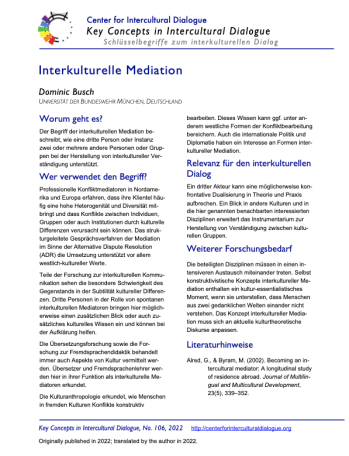
Key Concepts in ICDContinuing translations of Key Concepts in Intercultural Dialogue, today I am posting KC106: Intercultural Mediation, originally written in English in 2022, and now translated into German by the author, Dominic Busch.

As always, all Key Concepts are available as free PDFs; just click on the thumbnail to download the PDF. Lists of Key Concepts organized chronologically by publication date and number, alphabetically by concept, and by languages into which they have been translated, are available, as is a page of acknowledgments with the names of all authors, translators, and reviewers.

KC106 Intercultural Mediation_GermanBusch, D. (2022). Interkulturelle Mediation. Key Concepts in Intercultural Dialogue, 106. Available from:
https://centerforinterculturaldialogue.org/wp-content/uploads/2022/11/kc106-intercultural-mediation_german.pdf

If you are interested in translating one of the Key Concepts, please contact me for approval first because dozens are currently in process. And, as always, if there is a concept you think should be written up as one of the Key Concepts, whether in English or any other language, propose it. As of this writing, 78 have been published in English, but words from Chinese, Portuguese, Japanese, Spanish, Belarusian, German and Arabic have also been introduced (with the discussion provided in English). As of this writing, I have received offers to translate one or more concepts into Arabic, Belarusian, Chinese, Finnish, French, German, Italian, Japanese, Kapampangan, Polish, Portuguese, Russian, Spanish, Tagalog, and Turkish (in alphabetical order). There is even a possibility of videos presenting American Sign Language versions. So if anyone else wants to join in the fun, just let me know.

Wendy Leeds-Hurwitz, Director
Center for Intercultural Dialogue


Creative Commons License
This work is licensed under a Creative Commons Attribution-NonCommercial-NoDerivatives 4.0 International License.

Goethe U: Predoctoral Researcher: Transnational Organization of Senior Care, Labour and Mobility in Central and Eastern Europe (Germany)

“JobPredoctoral researcher in transnational organization of senior care, labour and mobility in Central and Eastern Europe, Goethe University, Frankfurt, Germany. Deadline: 20 December 2022.

The Department of Social Sciences at Goethe University Frankfurt, Germany invites applications for a fixed-term position as a Pre-doctoral researcher in the international project “Researching the transnational organization of senior care, labour and mobility in Central and Eastern Europe” funded by VolkswagenStiftung, starting on 01.03.2023. Employment is limited to a maximum of four years. You will participate in the research work of the collaborative project Researching the transnational organisation of senior care, labour and mobility in Central and Eastern Europe funded by VolkswagenFoundation. You will work in an international team of colleagues from several universities and research institutions. You will contribute to the further development of survey instruments, data collection and analysis (document analysis, expert interviews, field research on the internet and on site in Germany and Poland). In addition, you will be involved in the organisational management of the project. You will also contribute to the dissemination of research results in internationally visible publications. The project provides opportunity for working on an individual PhD project.

You hold a degree (M.A./Diploma) in sociology or a related social science field, have very good knowledge of qualitative research methods and are interested in innovative research methods. You can work independently and have good social skills as well as the ability to work well in a team. The working language within the project is English. Additionally, interviews will be conducted and written texts will be analysed in Polish, so appropriate knowledge of both languages is required. German language skills are an additional advantage.


Toronto Metropolitan U: 2 Research Fellowships (Canada)

“JobCERC in Migration and Integration has 2 different fellowship positions available, Toronto Metropolitan University, Toronto, Canada. Deadline for both: 31 January 2023.

  1. Senior Research Associate: Narratives on Migration

    The Canada Excellence Research Chair (CERC) in Migration and Integration at Toronto Metropolitan University invites applications of interest from early and mid-career researchers who work in the broader field of narratives on migration and integration in Canada and in comparative perspective with a special emphasis on the role of social media in shaping those narratives. The relevant candidate should have related expertise in the field of populism and nativism, public attitudes on migration, and with a focus on how these are being shaped in the current context where communication is dominated by the social media. Candidates with expertise in statistical analysis of public attitudes as well as with expertise specifically on the analysis of social media and related specialized software are particularly encouraged to apply. An applicant must hold a PhD in the social sciences, with a strong publication and research track record on migration. The candidate must demonstrate comparative perspectives as well as analytical thinking beyond case studies. Fluency in English is required; French knowledge and international experience are assets. Previous experience in research fund raising is also an asset.

  2. Research Fellow: Migration, Mobility and the Future of Work

    In addition, they invite applications of interest for a Research Fellow in the broader field of Migration, Mobility and the Future of Work with a special focus on what has been termed ‘digital nomads’. The relevant candidate will have expertise on the issue of ‘placeless work’, remote work, engagement into digital platforms, with a focus on those people who tend to live in one place but work in another. Expertise on Canada is of interest but applications from people working in other countries or also other world regions are strongly encouraged. An applicant must hold a PhD in the social sciences, with a strong publication and research track record in migration. The candidate must demonstrate comparative perspectives as well as analytical thinking beyond case studies. Fluency in English is required; French knowledge and international experience are assets. Previous experience in research fund raising is also an asset.

CFP CARGC: Global Media Studies 2023 (USA)

ConferencesCall for papers: Doing Global Media Studies: Theories, Practices, Reflections, CARGC symposium, University of Pennsylvania, Philadelphia, PA, USA, March 22 – 23, 2023, Hybrid. Deadline: 15 December 2022.

To celebrate the 10th anniversary of the Center for Advanced Research in Global Communication, the 2023 biannual fellows’ symposium will reflect on evolving concepts and methodologies in the field of global communication and media studies. We are witnessing ongoing global crises, from widespread displacements and climate disasters to pandemics and the rising threat of fascism. In light of these circumstances, organizers invite emerging scholars, artists, and activists to explore what a global approach to media and communication can do today. What is at stake in studying global communication and media at this historical moment?

U Oxford PHD Studentship: Migration Studies (UK)

“Studentships“ESRC Migration Studies Studentship, School of Anthropology and Museum Ethnography, University of Oxford, UK. Deadline: 20 January 2023.

Are you interested in studying for a doctorate (DPhil) in a migration-related subject? Do you have a good first degree in a relevant social science subject? If so, have you considered applying for an ESRC Migration Studies pathway competition Studentship, available through the Grand Union Doctoral Training Partnership (DTP)?Applications are invited for entry in October 2023. You must apply for the studentship at the same time as you apply for your degree.

There are two routes you can take:

*The Migration Studies Studentships are not intended for taught master’s degrees on their own. To apply you must be planning to undertake a doctorate. Please also note that successful admission to the doctoral programme is subject to approval by the relevant department’s DPhil Admissions Committee.

The studentships cover stipend and fees for the length of your award; full details can be found on the Grand Union DTP website.

The ESRC awarded the DTP Migration Studies Studentships in recognition of research strength in interdisciplinary migration studies, and the two taught masters are offered by Anthropology and International Development (the MSc in Migration Studies) and International Development (the MSc in Refugee and Forced Migration Studies) respectively. Students on the 1+3 pathway may progress from one of these masters to doctorates in Migration Studies, International Development, Anthropology, Politics and International Relations, Geography, Law, Sociology, Economics or another appropriate department.

NOTE: ESRC = Economic and Social Research Council, the UK’s largest funder of economic, social, behavioral and human data science.

Language, Race, & Islamophobia Podcast

Podcasts

Khan, Kamran. (14 November 2022). Language, Race, & Islamophobia, Surviving Society, S1/E3. [Available on both Spotify and Apple podcasts.]

In this episode Kamran provides an analysis of the connections between the racialisation of language, securitisation and islamophobia for Muslims. Welcome to Surviving Society presents: Legacies of the War on Terror. These episodes tackle complex questions concerning how the war on terror became a war *of* terror for many negatively racialised communities in over the past 21 years. Dr. Kamran Khan is Marie Sklodowska-Curie Fellow  in the Department of Sociology at Københavns Universitet (University of Copenhagen).

This podcast would make a good classroom resource for teaching about stereotypes generally, or Islamophobia specifically. See also KC55: Stereotypes, and KC90: Islamophobia, as well as other Key Concepts in Intercultural Dialogue produced by this Center.

Grant Foundation: Research Grants on Reducing Inequality 2023

Grants

Research grants on reducing inequality, William T. Grant Foundation, New York, NY, USA. Deadline: 11 January 2023.

The William T. Grant Foundation has issued a call for proposals for 2023, including research grants on reducing inequality. This program supports research to build, test, or increase understanding of programs, policies, or practices to reduce inequality in the academic, social, behavioral, or economic outcomes of young people ages 5-25 in the United States. They prioritize studies that aim to reduce inequalities that exist along dimensions of race, ethnicity, economic standing, language minority status, or immigrant origins. They welcome descriptive studies that clarify mechanisms for reducing inequality or elucidate how or why a specific program, policy, or practice operates to reduce inequality. We also welcome intervention studies that examine attempts to reduce inequality. Finally, we welcome studies that improve the measurement of inequality in ways that can enhance the work of researchers, practitioners, or policymakers. They invite studies from a range of disciplines, fields, and methods, and we encourage investigations into various youth-serving systems, including justice, housing, child welfare, mental health, and education.

KC 100: Transcultural Communication Translated into Turkish

Key Concepts in ICDContinuing translations of Key Concepts in Intercultural Dialogue, today I am posting KC#100: Transcultural Communication, originally written by Mohammed Guamguami for publication in 2021, and now translated by Candost Aydın into Turkish.

As always, all Key Concepts are available as free PDFs; just click on the thumbnail to download. Lists organized chronologically by publication date and numberalphabetically by concept in English, and by languages into which they have been translated, are available, as is a page of acknowledgments with the names of all authors, translators, and reviewers.

KC100 Transcultural Communication_TurkishGuamguami, M. (2022). Transcultural communication [Turkish]. Key Concepts in Intercultural Dialogue, 100. Available from: https://centerforinterculturaldialogue.org/wp-content/uploads/2022/11/kc100-transcultural-communication_turkish.pdf

If you are interested in translating one of the Key Concepts, please contact me for approval first because dozens are currently in process. As always, if there is a concept you think should be written up as one of the Key Concepts, whether in English or any other language, propose it. If you are new to CID, please provide a brief resume. This opportunity is open to masters students and above, on the assumption that some familiarity with academic conventions generally, and discussion of intercultural dialogue specifically, are useful.

Wendy Leeds-Hurwitz, Director
Center for Intercultural Dialogue


Creative Commons License
This work is licensed under a Creative Commons Attribution-NonCommercial-NoDerivatives 4.0 International License.

Save