KC #100: Transcultural Communication Translated into French

Key Concepts in ICDContinuing translations of Key Concepts in Intercultural Dialogue, today I am posting KC#100: Transcultural Communication, originally written by Mohammed Guamguami for publication in 2021, and now translated by him into French.

As always, all Key Concepts are available as free PDFs; just click on the thumbnail to download. Lists organized chronologically by publication date and numberalphabetically by concept in English, and by languages into which they have been translated, are available, as is a page of acknowledgments with the names of all authors, translators, and reviewers.

KC100 Transcultural Communication_French_v2Guamguami, M. (2021). Communication transculturelle. Key Concepts in Intercultural Dialogue, 100. Available from: https://centerforinterculturaldialogue.org/wp-content/uploads/2021/05/kc100-transcultural-communication_french_v2.pdf

If you are interested in translating one of the Key Concepts, please contact me for approval first because dozens are currently in process. As always, if there is a concept you think should be written up as one of the Key Concepts, whether in English or any other language, propose it. If you are new to CID, please provide a brief resume. This opportunity is open to masters students and above, on the assumption that some familiarity with academic conventions generally, and discussion of intercultural dialogue specifically, are useful.

Wendy Leeds-Hurwitz, Director
Center for Intercultural Dialogue


Creative Commons License
This work is licensed under a Creative Commons Attribution-NonCommercial-NoDerivatives 4.0 International License.
Save

CFP: Multilingual, Multicultural, Migrant & Diasporic Radio

“Publication Call for Papers: Multilingual, Multicultural, Migrant & Diasporic Radio, for a Symposium in Journal of Radio & Audio Media, to be edited by Anne F. MacLennan  and Masudul Biswas. Deadline: August 1, 2022.

Radio connects communities regionally, nationally, and transnationally. Multilingual, multicultural, migrant & diasporic radio connect communities within larger communities crossing boundaries & barriers. This call for papers is for a symposium to be published in the May 2023 issue of JRAM. Editors invite submission of research on the roles of multicultural, multilingual, migrant, and diasporic radio stations in a multicultural society. The scope of research can be geared towards the community radio stations that serve immigrant, refugee, ethnic minority, or diasporic communities. Research on how mainstream radio stations incorporating multi-lingual programming to reach a wide range of audience can fall within the purview of this special edition.

Expressions of interest prior to submission are appreciated but not required (email Anne F. MacLennan  and/or Masudul Biswas, with Multilingual, Multicultural, Migrant & Diasporic Radio in the subject line). 


Counter-Narratives in Language Education Research (UK but Online)

Events

Counter-Narratives in Language Education Research, Center for Language Education Research, University of Leeds, Leeds, UK (Online), May 18, 2021, 2-4 BST.

Counter-Narratives in Language Education Research will highlight presentations by Dr. Nelson Flores, University of Pennsylvania and Dr. Giovanna Fassetta, University of Glasgow, with contributions from University of Leeds colleagues: Dr. Daniel Fobi, Dr. Kate Spowage and Rumana Hossain.

The speakers’ presentations in diverse areas of language education inquiry will lead to a more general reflection. Among the topics to be discussed:

  • What are the dominant narratives of language (and) education in our respective contexts and domains of inquiry?
  • Which/whose stories are not included in them and why do they need to be
  • How does our research need to change to make space for the multiple, complex and often competing counter-narratives?

KC101 Antisemitism

Key Concepts in ICDThe next issue of Key Concepts in intercultural Dialogue is now available. This is KC#101: Antisemitism, by Daniel Mateo Ordóñez. Click on the thumbnail to download the PDF. Lists organized chronologically by publication date and numberalphabetically by concept in English, and by languages into which they have been translated, are available, as is a page of acknowledgments with the names of all authors, translators, and reviewers.


KC101 AntisemitismOrdóñez, D. M. (2021). Antisemitism. Key Concepts in Intercultural Dialogue, 101. Available from: https://centerforinterculturaldialogue.org/wp-content/uploads/2021/04/kc101-antisemitism.pdf

The Center for Intercultural Dialogue publishes a series of short briefs describing Key Concepts in Intercultural Dialogue. Different people, working in different countries and disciplines, use different vocabulary to describe their interests, yet these terms overlap. Our goal is to provide some of the assumptions and history attached to each concept for those unfamiliar with it. As there are other concepts you would like to see included, send an email to the series editor, Wendy Leeds-Hurwitz. If there are concepts you would like to prepare, provide a brief explanation of why you think the concept is central to the study of intercultural dialogue, and why you are the obvious person to write up that concept.


Creative Commons License
This work is licensed under a Creative Commons Attribution-NonCommercial-NoDerivatives 4.0 International License.

Collegium Helveticum IAS Fellowships (Switzerland)

Fellowships

Collegium Helveticum, ETH Zurich, Zurich, Switzerland. Deadline: 30 April 2021 for Junior fellowships; no deadline for other types.

The Collegium Helveticum is pleased to share the new fellowship programme, starting at 1 September 2021. As an Institute for Advanced Studies (IAS) run jointly by ETH Zurich, the University of Zurich and Zurich University of the Arts, the Collegium seeks to promote exchange and collaboration across disciplinary boundaries. Up to eight scholars and artists will have the opportunity to spend 10 months in 2021/22 as junior fellows at the Collegium Helveticum, located in the ETH Zurich’s historical observatory («Semper Observatory»).

The call is open for early-career researchers working in any academic or artistic disciplines at postdoc or equivalent level (for artists). Junior fellows receive a grant in the form of a full-salaried post at ETH Zurich. The fellows will be able to pursue individual projects and become part of the Collegium’s international network and fellow community. The Collegium’s work and meeting rooms, its new art and exhibition spaces and its various opportunities for exchange and interaction offer ideal conditions for a thriving culture of dialogue and a creative environment for innovative academic and artistic projects.

UNESCO: Communications & Outreach Consultant (France)

“JobCommunications and Outreach Consultant, Social and Human Sciences Sector, UNESCO, Paris, France. Deadline: 29 April 2021.

UNESCO, in partnership with the Institute for Economics and Peace, is developing an ambitious initiative to strengthen the evidence base on intercultural dialogue as an instrument for sustainable and inclusive peacebuilding. More specifically, work is being undertaken to develop a novel dataset, measuring the enabling environment and impact of intercultural dialogue. The ultimate desired impact of the initiative is to strengthen the effectiveness of intercultural dialogue as an instrument for peacebuilding, enhancing the political and financial commitments to support it (by demonstrating its effectiveness), and offering practical insights to improve operational interventions to support it.

After ongoing work to collect and analyse the data is completed, several key outputs will be produced to present the findings, including: 1) a global report, exploring key trends and insights from the data, along with complementary analysis and reflection; 2) an online ‘barometer’, presenting the data by country and domain, along with associated analysis and methodological clarifications; 3) pilot policy dialogues to mobilise country-level operational responses in response to the insights provided by the data.

To raise awareness of these outputs, encourage engagement with the insights they provide, and build support for onward actions to mobilise them operationally, a comprehensive communications and outreach effort will be made. The Communications and Outreach Consultant will be responsible for these efforts, under the direct supervision of an Associate Programme Specialist in UNESCO’s Inclusion, Rights and Dialogue Section, and under the overall responsibility of the Chief of the Inclusion, Rights and Dialogue Section. The Consultant will work in close cooperation with the various services responsible for communications within UNESCO (including the Sector’s Executive Office and Communications Officer, and the Department for Public Information). The consultant will also liaise closely with the communications team at the Institute for Economics and Peace.

Blue Metropolis International Literary Festival 2021 (Canada but Online)

Events

Blue Metropolis International Literary Festival, Montreal, Canada (Online, and later outdoors), April 24-May 2, 2021.

Starting April 24 and running until May 2, the spring programming of the 23rd Blue Metropolis International Literary Festival will be in full swing, along with the TD-Blue Metropolis Children’s Festival. Online and later outdoors, more than 50 eclectic events with 200 artists will delight eyes and minds around the theme, The Challenges of Our Times. Free multilingual events in English, French, Spanish, Portuguese and Arabic take the form of captivating panels, debates and interviews. Events are added daily and will remain online.

This would be a good place for those who wish to find books that start conversations about cultural identity, cultural difference, intercultural communication, and intercultural. 

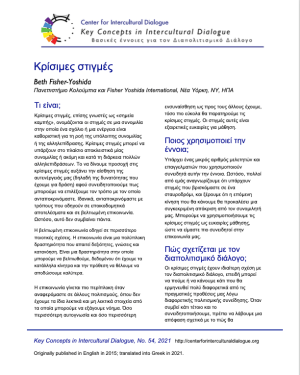
KC54: Critical Moments Translated into Greek

Key Concepts in ICDContinuing translations of Key Concepts in Intercultural Dialogue, today I am posting KC#54: Critical Moments, which Beth Fisher-Yoshida wrote for publication in English in 2015, and which Anastasia Karakitsou  has now translated into Greek.

As always, all Key Concepts are available as free PDFs; just click on the thumbnail to download. Lists of Key Concepts organized chronologically by publication date and number, alphabetically by concept, and by languages into which they have been translated, are available, as is a page of acknowledgments with the names of all authors, translators, and reviewers.

KC54 Critical moments_GreekFisher-Yoshida, B. (2021). Critical moments [Greek]. (A. Karakitsou, trans). Key Concepts in Intercultural Dialogue, 54. Retrieved from: https://centerforinterculturaldialogue.org/wp-content/uploads/2021/04/ce9ac54-critical-moments_greek.pdf

If you are interested in translating one of the Key Concepts, please contact me for approval first because dozens are currently in process. As always, if there is a concept you think should be written up as one of the Key Concepts, whether in English or any other language, propose it. If you are new to CID, please provide a brief resume. This opportunity is open to masters students and above, on the assumption that some familiarity with academic conventions generally, and discussion of intercultural dialogue specifically, are useful.

Wendy Leeds-Hurwitz, Director
Center for Intercultural Dialogue


Creative Commons License
This work is licensed under a Creative Commons Attribution-NonCommercial-NoDerivatives 4.0 International License.
Covid-19: International Perspectives and Transnational Collaboration

EventsCovid-19: International Perspectives and Transnational Collaboration, Institute of Modern Languages Research, School of Advanced Study, University of London, London, UK (Online), 22 April 2021, 18:00-19:30 BST.

During a ‘global’ pandemic, the capacity to learn from the experience of others and share knowledge across borders is essential. Responses to Covid-19 have varied markedly across the globe. The differences in the approaches taken are due to systemic political and economic conditions, but also to cultural and historical factors. One lesson that has emerged clearly is that only a joint transnational effort will enable us to respond efficiently and decisively to the threat of an illness that knows no borders. In this panel discussion, Humanities scholars of languages and cultures will reflect on the handling of the pandemic in their cultural/geographic area of expertise – and suggest lessons to be learned from other nations. They will then go on to explore the place of creative and cultural production in building a more transnationally interlinked post-Covid world – as well as the contributions to be made by research in the Humanities, and specifically Modern Languages.

All are welcome to attend this free event, starting at 6pm BST. The joining link for the online event will be sent out to all those registered prior to the event.

CFP IADA 2021: Practices of Dialogue, Dialogues in Practice (Canada but Online)

Conferences

Call for papers: Practices of Dialogue, Dialogues in Practice, November 1-5, 2021, University of Sherbrooke, Québec, Canada (but online). Deadline: May 15, 2021.

Many fields of research devote themselves to the study of dialogue, whether in linguistics, philosophy, ethics, communication, cultural anthropology, cognitive psychology, sociology, argumentation, pragmatics and logic, among others. Engaging in dialogue sometimes consists in representing, describing and informing others of the existence of something – either a thing in the world, its characteristics, or our subjective mental states. In dialogue, though, more is always occurring or, to say it otherwise, new reality is conjured up in dialogue: values can be shared or confronted, identities are constituted or altered, relations are woven, knowledge is coproduced, errors become common, shared meaning is created and communities are built. But they can also be damaged, sometimes (but not always) beyond repair. One way to grasp what takes place through dialogue in addition to information and representation is to understand dialogue through the lens of practice: dialogue is a set of practices that have meaning beyond their descriptive function, and that are used and surrounded by yet other meaningful practices. Defects and satisfying results can only be considered if we look at practices, in which we can fully grasp our experiences of dialogue.

Studies on dialogue have thus revealed how a practice perspective accounts for both the productivity and creativity that takes place in dialogue, as well as the practical and concrete consequences of dialogue. Others have focused on the conditions, the problems, limits and failures in dialogue, with the aim to develop a better set of practices of/in dialogue. For this conference, organizers invite contributors to look at the manifold connections between dialogue and practice(s).