Culture Buff Intercultural Games

Intercultural PedagogyCulture Buff Games, created by Culture Games, an EdTech developer of interactive games on different cultures, offer games for intercultural trainers (some free, others cost).

Culture Buff GamesThe games leverage visual culture scenarios to help foreign students understand how country-specific culture values manifest in contemporary everyday life and are informed by historical events. Designed by interculturalist trainers, these learner driven interactive games emphasize problem solving and practical application of cultural knowledge. Our games can be trainer facilitated or used as self-directed learning tool. There are multiple sets of games for American Values, British Values, Chinese Values and Indian Values.

From Diversity to Wellbeing: The D.I.V.E.R.S.I.T.Y. Approach (Webinar)

Events
From Diversity to Wellbeing: The D.I.V.E.R.S.I.T.Y. Approach, presented by Vincent Merk, sponsored by SIETAR Tri-State, November 19th at 11:00 am (EST).

In this presentation Vincent Merk will explain what Diversity & Inclusion means for practitioners, educators or researchers around the world. Starting from Diversity as a reality to actively co-create Inclusion, Belonging and, ultimately, Wellbeing to fully co-generate the best diverse, social and psychologically safe environment, where people can thrive and openly speak, question, act (and also make mistakes) and live a healthy life. To give a framework to this process, Vincent Merk identified 9 areas that need special attention when dealing with D&I. These 9 steps showcased are: D.I.V.E.R.S.I.T.Y. Finally, Vincent will make recommendations that can serve as a framework for reflection or guidelines for actions to develop best practices daily, if relevant related to post Covid-19 turbulent times.

KC40 English as a Lingua Franca Translated into Spanish

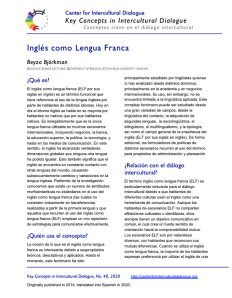
Key Concepts in ICDContinuing translations of Key Concepts in Intercultural Dialogue, today I am posting KC#40: English as a Lingua Franca, which Beyza Björkman wrote for publication in English in 2014, and which  Jhon Eduardo Mosquera Pérez has now translated into Spanish.

As always, all Key Concepts are available as free PDFs; just click on the thumbnail to download. Lists of Key Concepts organized chronologically by publication date and number, alphabetically by concept, and by languages into which they have been translated, are available, as is a page of acknowledgments with the names of all authors, translators, and reviewers.

KC40 ELF_SpanishBjörkman, B. (2020). Inglés como Lengua Franca. (J. E. Mosquera Pérez, Trans). Key Concepts in Intercultural Dialogue, 40. Available from:
https://centerforinterculturaldialogue.org/wp-content/uploads/2020/10/kc40-elf_spanish.pdf

If you are interested in translating one of the Key Concepts, please contact me for approval first because dozens are currently in process. As always, if there is a concept you think should be written up as one of the Key Concepts, whether in English or any other language, propose it. If you are new to CID, please provide a brief resume. This opportunity is open to masters students and above, on the assumption that some familiarity with academic conventions generally, and discussion of intercultural dialogue specifically, are useful.

Wendy Leeds-Hurwitz, Director
Center for Intercultural Dialogue


Creative Commons License
This work is licensed under a Creative Commons Attribution-NonCommercial-NoDerivatives 4.0 International License.

UCL Media & Communications Manager (UK)

“Job
Media and Communications Manager, Institute for Innovation and Public Purpose, University College London, London, UK. Deadline: 30 November 2020.

The UCL Institute for Innovation and Public Purpose (IIPP) is looking for a Media and Communications Manager to contribute to the development and implementation of IIPP’s research strategy and manage its growing grant, consultancy and philanthropic portfolio. Situated in a globally top university, IIPP is demonstrating impact and influence, including training the next generation of civil servants, bringing together leading global policy-making institutions, and establishing partnerships to address global challenges. IIPP applies its critical thinking to four core areas of activity: research and thought leadership; teaching and training; influencing public policy; and engaging the broader public in its work and ideas.

Building IIPP’s brand and its relationships with media and global partners in academia, business, the public sector and civil society organisations will be central to its work. The Media and Communications Manager will be a key role and will lead on the development and implementation of an integrated communication. This role offers an opportunity for a committed Media and Communications Manager to play a key role in this Institute. While the primary purpose of the role is to develop communication strategies and build a supporting communications team, the role holder will be very hands on. The post-holder will be responsible for creating, implementing and monitoring of a comprehensive communication, media and public relations strategy that will enhance IIPP’s image and position within the marketplace and constituent communities whilst also ensuring alignment with UCL and Faculty strategies.

U Melbourne: Australia India Institute (Australia)

“JobDirector and CEO Australia India Institute, University of Melbourne, Melbourne, Australia. Deadline: 23 November 2020.

The Director is expected to lead on increasing the policy and public salience of India as a crucial partner in Australia’s future, and of Australia as a crucial partner in India’s future; and providing thought-leadership on the nature of a closer and mutually-beneficial partnership. Demonstrating a track record of deep engagement in Australia-India relations, we are seeking someone with a highly collaborative style, drawing on the University of Melbourne’s India expertise, India expertise in other universities and sectors, and networks and relationships with leaders in academia, government, non-government organisations, industry and business, to enrich public awareness and discussion of Australia’s and India’s importance to each other.

The Director will be responsible for the operational management of the Institute and must play a leading role in determining the strategic direction of the Institute through the development of a strategic plan and annual program of activities.

Youth’s Voice for the Future of Media & Information Literacy in Asia & the Pacific (Online)

EventsYouth’s Voice for the Future of Media and Information Literacy in Asia and the Pacific, Asian Media Information and Communication Centre, Jakarta, November 18, 2020, 12:00-2:00 PM Jakarta Time, online.

Asian Media Information and Communication Centre, Inc. (AMIC) will be conducting an online discussion with youth entitled, Youth’s Voice for the Future of Media and Information Literacy in Asia and the Pacific. This event has the support of UNESCO Offices in Jakarta, Bangkok and New Delhi. The event will be on Wednesday, November 18, 2020, 12:00PM – 2:00 PM Jakarta Time.

The main objective is to understand how to better integrate media and information literacy (MIL) into education from the perspective of youth in Asia and the Pacific region, taking into consideration specific challenges faced by young women, as well as youth with disabilities, such as internet connectivity and accessibility. Another objective of this exercise is to build and strengthen the network of youth who could be the advocates for developing and expanding MIL in the Asia and the Pacific region.

CID can nominate up to five (5) representatives age 15-24 who are based in Asia and the Pacific to participate in the invite-only online discussion with MIL experts. If you are a CID follower and wish to be nominated, send an email with your name and age as well as the city and country in which you are based. English will be the working language for the event. Be sure to note the time zone, especially if you are physically based in the USA.

SIETAR Italia Call for Events Proposals 2021 (Italy)

Events

Call for Events Proposals for 2021, SIETAR Italia, Milan, Italy. Deadline: 15 November 2020.

Organizers at SIETAR Italia are currently working on the 2021 Programme of Events. Every year they ask members and non-members to deliver workshops, seminars, webinars or talks following their guidelines.

Are you interested in presenting an event in 2021?

The areas of greatest interest are:
•    Companies and organizational challenges
•    Intercultural and multicultural socio-political contexts
•    Development of competencies and training of intercultural professionals
•    Intercultural and interlinguistic communication
•    Intercultural education in the European context
•    Diversity, inclusion, equal opportunities and antiracism

If you have any interesting contribution to offer (in English or Italian) on one of these subjects, please complete the Form for Events Proposals – 2021 Calendar, and send it to SIETAR Italia by the 15th of November 2020. Notices about what has been accepted will be sent by 10th of December 2020.

It is very likely that the emergency context related to COVID-19 will somehow have an impact on the way the events take place also during 2021. Organizers ask, therefore, that you propose your events both for virtual mode and in person mode.

The 2021 Calendar of Events, as well as the one-off events, will be posted on the following channels: the SIETAR Italia website; the GLOBAL SIETAR calendar of events; Eventbrite, through the group’s Newsletter (a mailing list of 2500 contacts), the SIETAR Italia Facebook page, LinkedIn, Twitter, and Instagram, as well as through partners’ communication channels.

Organizers look forward to receiving your proposals with the aim of enhancing intercultural awareness in the business world, in politics, education and in our society as a whole.

CFP History of Communication ICA Preconference (Online)

ConferencesCall for proposals: Exclusions in the History and Historiography of Communication Studies, International Communication Association Remote Preconference, May 27, 2021. Organizers: David W. Park, Jefferson Pooley, Peter Simonson. Deadline: 20 December 2020.

The broader field of communication studies is in a moment when we are—or should be—intensively interrogating patterns of exclusion and hegemony that have continued to constitute it: around global region (de-Westernizing, theory from the South, persistent patterns of American influence/hegemony), race (#communicationsowhite), gender (#metoo, #gendercom, Matilda effects,), and indigeneity/colonization (postcolonial and decolonial initiatives). To frame these exclusions as constitutive is to head off any easy solutions in terms of greater inclusivity, though that needs to be part of the mix; rather, it is to invite us to consider all of the ways in which these and other exclusions have functioned to center certain problems, theories, methods, languages, nations, social identities, and publication venues; and to exclude or marginalize others that are cast as differentially less valuable, lower status, Other, and more. To frame them as constitutive is also to draw attention to how those exclusions are performatively enacted on an ongoing basis through the full range of practices, social and epistemological, through which the field (re)produces itself.

It is time to animate our histories of communication and media studies with similar problematics, recognizing the patterns and performances through which the field(s) has organized itself around constitutive exclusions and continues actively to do so in its historiography. How have particular geopolitical locations (including but not limited to nations) achieved centrality, established standards and status hierarchies, and accumulated advantages and various forms of capital through marginalization and exclusion? How has colonialism and its persistent structural effects fueled communication study around the globe, and how does our historiography maintain that form of dominance and exclusion? How have gender/patriarchy, race/racism, and ethnicity fueled analogous processes? What forms of resistance and counter-hegemonies have arisen or persisted?

Continue reading for full details.

Connecting Communities Through Mutual Cultural Understanding (Webinar)

EventsInternational Education Summit: Connecting Communities Through Mutual Cultural Understanding, World Artists Experiences, November 9, 16, 23, 30, 2020.

Maryland Governor Lawrence J. Hogan proclaimed November as International Education Month. He advocated listening, observing, and sharing “cross-cultural interaction and learning in schools, colleges and communities.” To support the Governor’s initiative, World Artists Experiences will present an International Education Summit “Connecting Communities Through Mutual Cultural Understanding.” 

Multi colored stick figures standing in a circle a

• November 9, 7:00 pm: “Who Are Marylanders?” will explore the rich diversity, demographics, origins, history, and contributions of Marylanders beginning in the 1600s through the present.

• November 16, 7:00 pm: “Connecting Cultures Beginning with Self” will discuss connecting cultures to develop mutual understanding in international communities.

• November 23, 7:00 pm: “Effective Communication in Diverse Cultural Settings will focus on the critical role of communication in daily lives and how misunderstandings in verbal and nonverbal communication emerge.

• November 30, 7:00 pm: “Sharing our Voices: Using Arts in Understanding Cultures” will examine the various ways the arts can be used to bridge cultures.

The summit is free, but prior registration is required. Register on the WAE website.

Melita Garza Profile

Profiles

Melita M. Garza is associate professor in the journalism department in the Illinois College of Media at the University of Illinois, Champaign Urbana.

Melita GarzaShe is an American journalism historian who studies news as an agent of democracy, specializing in English- and Spanish-language news, the immigrant press, and coverage of underrepresented groups. Garza is the author of the award-winning They Came to Toil: Newspaper Representations of Mexicans and Immigrants in the Great Depression (University of Texas Press, 2018). They Came to Toil examines English- and Spanish-language news coverage of immigrants during the longest economic downturn in the United States. She is a founding faculty member of TCU’s interdisciplinary department of Comparative Race and Ethnic Studies (CRES). Her work has been published in Journalism History, American Journalism, and the Howard Journal of Communications.

She earned a Ph.D. from the University of North Carolina at Chapel Hill in 2012 after two decades reporting for the Chicago Tribune, Bloomberg News, and the Los Angeles Times. At the Chicago Tribune, she pioneered the paper’s ethnic affairs beat, and covered immigration, among other topics. Dr. Garza also holds an MBA from the University of Chicago and a B.A. from Harvard University. She teaches journalism history, media literacy, business journalism, and diversity and the media.


Work for CID: Melita Garza serves on the CID Advisory Board.