CID has a New Home Page

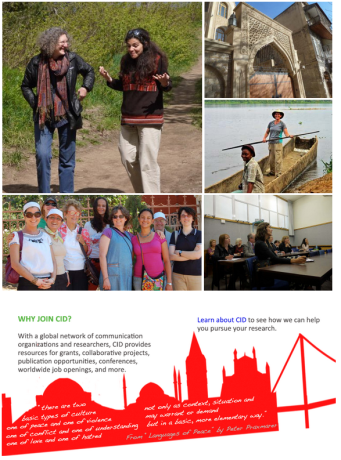
About CIDThe Center for Intercultural Dialogue has been updating the website over the last few months, and a new home page has just been introduced, thanks to the efforts of Minh Cao, Assistant to the Director.

cid_homepage_snapshot

The photos on the home page were chosen to represent a variety of CID activities: talks, micro grants, contributions from readers. For more information about the people or locations mentioned, use the captions to help you find the relevant posts using the search bar. The gradual introduction over the past several months of visual material into the website has almost always been a result of Minh’s efforts: look for embedded videos, graphic designs,  word clouds, more photographs and logos. I am indebted to Minh for making the website user friendly.

Wendy Leeds-Hurwitz, Director
Center for Intercultural Dialogue

Harron Chair talk: Intercultural Dialogue

https://www.youtube.com/watch?v=9YSQPcEFp48%20

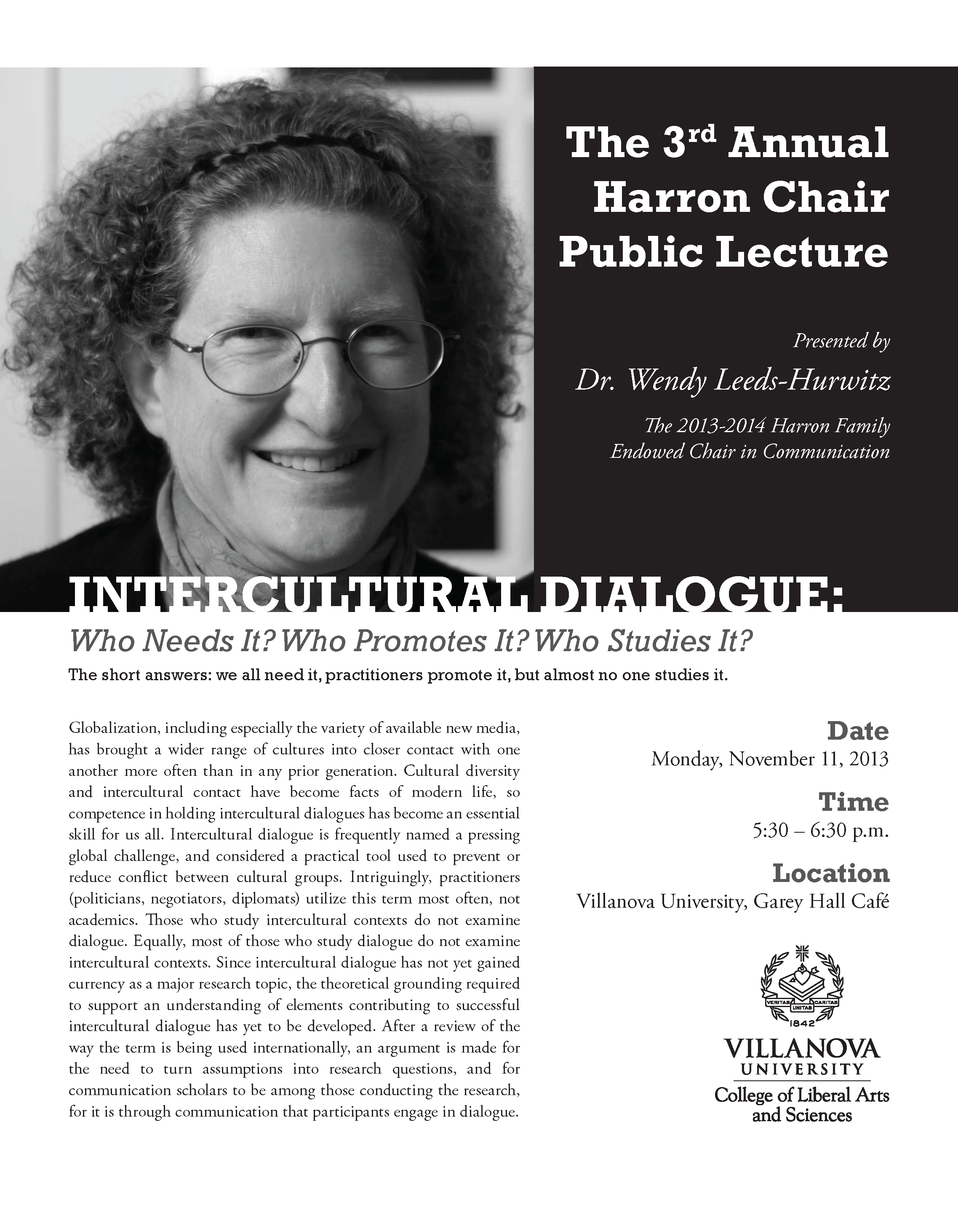
Harron Lecture flyerOn November 11, 2013, I presented the Harron Family Endowed Chair Lecture entitled “Intercultural Dialogue: Who Needs It? Who Promotes It? Who Studies It?” This is the one public lecture expected of the Harron Chair at Villanova University, and this semester I serve in that position. College of Liberal Arts and Sciences Dean Jean Ann Linney provided a brief history of the Harron Family Endowed Chair for the audience, and Dr. Maurice Hall, Communication Department Chair, introduced me. There was a large crowd (more than expected, about 75 – sorry about the lack of chairs for the last dozen to come!) and good questions from not only faculty members but also students. Thanks to Chad Fahs for videotaping, and Minh Cao who set up a new YouTube channel for the Center (more about that in a separate post), you can see an excerpt of the talk (above).

Wendy Leeds-Hurwitz, Director
Center for Intercultural Dialogue

Save

LinkedIn Group Started

About CIDThe Center for Intercultural Dialogue has just started a LinkedIn group to permit more discussion off the website. If you have a profile on LinkedIn, just use “Center for Intercultural Dialogue” as the search term, and you should get to the group.

CID on LInkedIn

Discussions will be open to any topic relevant to intercultural communication or dialogue generally, as well as intercultural dialogue specifically.

Wendy Leeds-Hurwitz, Director
Center for Intercultural Dialogue

University at Albany

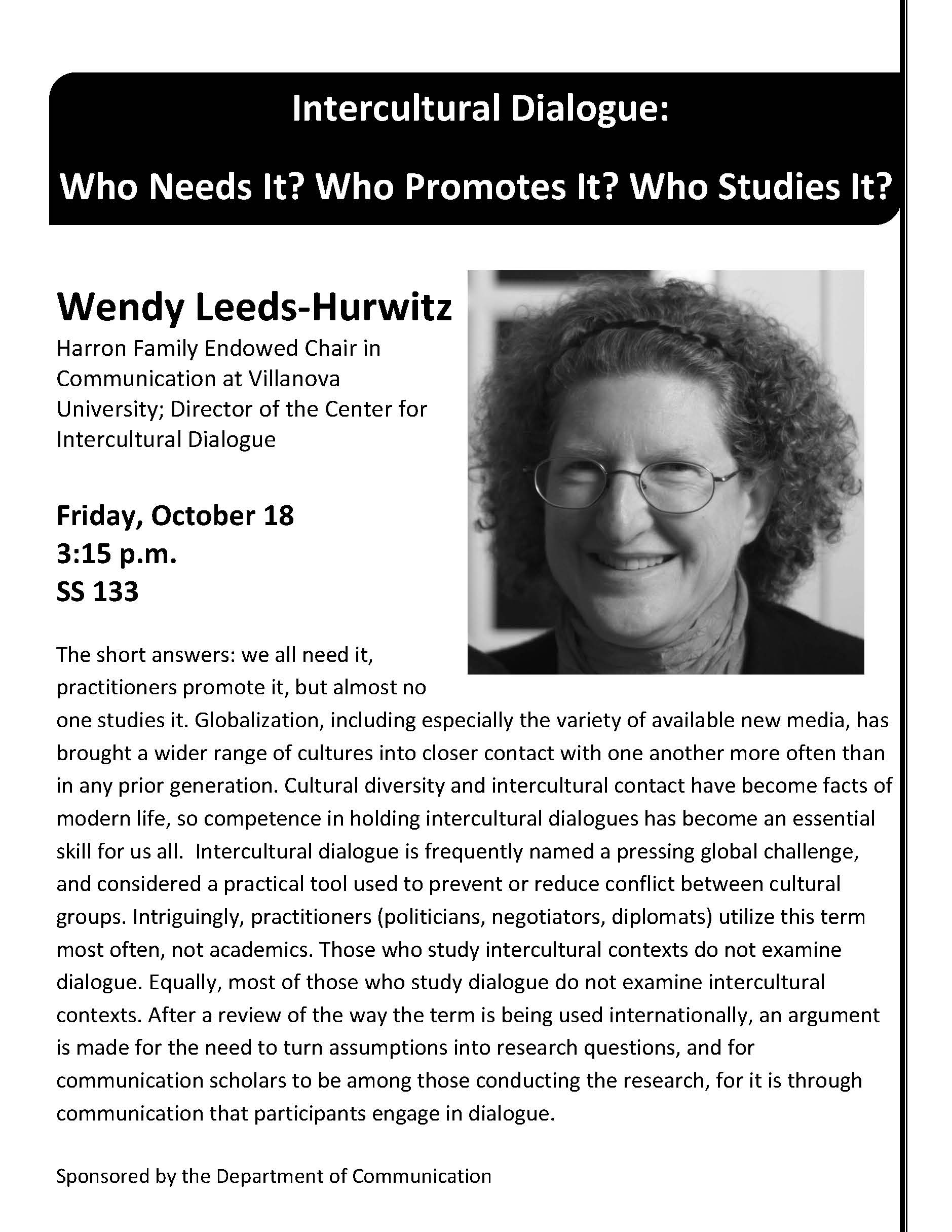
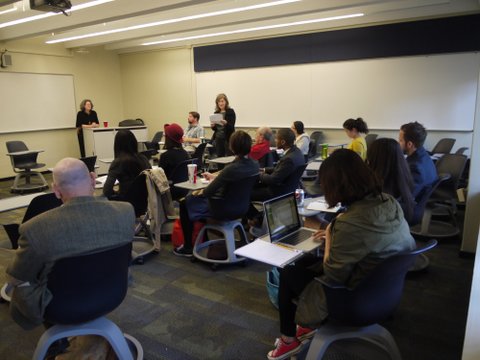
On October 18, 2013 I gave a talk at the University at Albany, State University of New York, entitled “Intercultural Dialogue: Who Needs it? Who Promotes it? Who Studies it?”

Albany flyer

My thanks to Prof. Teresa Harrison for organizing the event, and to Dr. Mihye Seo for integrating my talk into her Proseminar. While there I was able to catch up with several colleagues who I have known for many years (including Profs. Anita Pomerantz, Robert Sanders and Annis Golden) as well as meet several I had not yet met (Drs. Emilie Gould, Matthew Matsaganis).

U at Albany talk

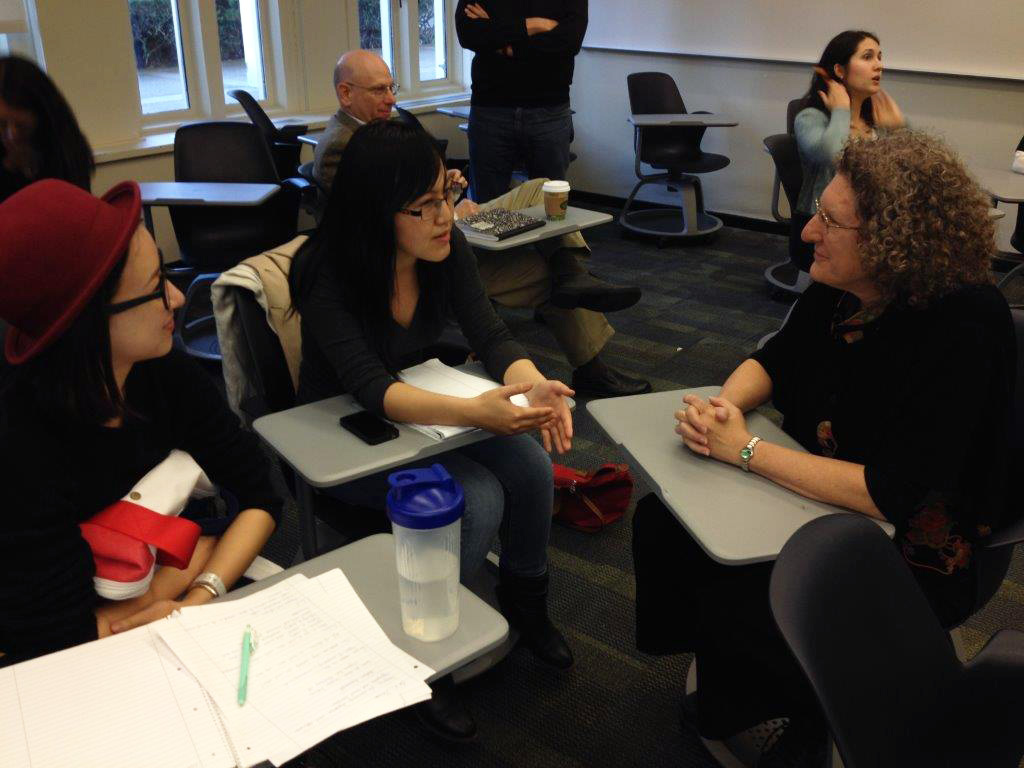
I also had the chance to talk with some of the graduate students, including Erting “Sa Sa” Sa and Sunny Zhao, below.

Albany students

Wendy Leeds-Hurwitz
Director, Center for Intercultural Dialogue

Intercultural Dialogue and New Media Research: An Interview with Robert Shuter

“Interviews”I recently sat down with Robert Shuter, director of the Center for Intercultural New Media Research, to talk about possible overlaps in our areas of interest. Here’s a brief summary.

Intercultural dialogue typically assumes people from different cultural backgrounds interacting face-to-face, with the intention of coming to some understanding of their areas of similarity and especially difference. Intercultural new media research examines the relevance of culture for mediated communication, specifically when using any of the new social media.

There is an obvious need for research into the ways in which technology can be used to facilitate intercultural dialogues. A few possibilities have already been investigated. One approach examines efforts to link students(especially those studying intercultural communication or learning a language) with peers located in different countries. As yet, there is only a little published research on this topic. A very different form of virtual intercultural dialogue involved placing large electronic screens in public spaces in Australia and Korea, facilitating virtual interaction between populations not typically in dialogue, and then analyzing the results.

Other studies have examined virtual collaboration but collaboration is frequently missing requisite dialogic elements like empathy and deep understanding. At the same time, it may lead to intercultural dialogue, and perhaps is a precursor to dialogue. Hence, the question remains: Is intercultural dialogue possible in the virtual world?

One possible answer may be found by considering Fred Casmir’s concept of third culture. Casmir posited that individuals from different cultures can optimize their relationship through the development of a third culture which combines elements of each of their cultures into a new whole. Dialogue is necessary to develop a third culture, which Casmir argues cannot be achieved without empathy and deep understanding of others. Once achieved, a third culture provides an ideal climate to interact because it is mutually accepting, supportive, and cooperative.

As Shuter puts it in a recent publication (2012): “Although third cultures are difficult to create in the physical world, some research suggests that they may be more achievable in virtual communities. McEwan and Sobre-Denton (2011) argue that the ease of technological access to cultural others combined with reduced social and economic costs significantly increase the probability of developing third cultures in the virtual world. Virtual communities, unlike organic ones, do not require leaving ones domicile to be an active member nor are they plagued by face threats due to social errors, according to the authors. In fact, new media provides users with technological tools to manage social distance, which McEwan and Sobre-Denton suggest increase cultural risk taking and experimentation, leading more readily to virtual third cultures.” (p. 225)

Andreas Pöllmann adapts Pierre Bourdieu’s concept of cultural capital to propose the relevance of intercultural capital. Essentially this expands beyond intercultural proficiencies (the typical list of intercultural skills, competencies, sensitivities required for intercultural competence) to include more subtle elements. A few examples to make his proposal concrete: those who are bilingual are especially useful in multilingual groups; those with international work experience can most quickly find their footing when sent to yet another country to conduct business. Such individuals should find their skills and experiences valued, and themselves much in demand, whether as employees or friends. The implications of cultural capital are enormous, as they suggest that those in the third world who are multilingual have something of great value that many in the first world lack. The question will be: how does intercultural capital play out in new media contexts?

Wendy Leeds-Hurwitz, Director
Center for Intercultural Dialogue

See the following articles for references to supplement these comments:

Leeds-Hurwitz, W. (2015). Intercultural dialogue. In K. Tracy, C. Ilie & T. Sandel (Eds.), International encyclopedia of language and social interaction (vol. 2, pp. 860-868). Boston: John Wiley & Sons.

McEwan, B., & Sobre-Denton, M. (2011). Virtual cosmopolitanism: Constructing third cultures and transmitting social and cultural capital through social media. Journal of International and Intercultural Communication, 4, 252–258.

Pöllmann, A. (2013). Intercultural capital: Toward the conceptualization, operationalization, and empirical investigation of a rising marker of sociocultural distinction. Sage Open, April-June 2013, 1-7.

Shuter, R. (2012). Intercultural new media studies: The next frontier in intercultural communication. Journal of Intercultural Communication Research, 41(3), 219-237.

Villanova University – Harron Chair in Comm

For the fall semester 2013, I will be the Harron Family Endowed Chair in Communication at Villanova University, outside Philadelphia, PA. I will teach an undergraduate seminar on Socialization to Cultural Identity, and a graduate seminar on Social Construction Theory. I will also give a public lecture during the semester on intercultural dialogue. I will remain Director of the Center for Intercultural Dialogue simultaneously, as this is a temporary assignment.

Villanova University

This endowed chair rotates, so that a different senior faculty member in Communication is appointed each year for fall semester. Dr. Raka Shome held the position in 2011, and Dr. Yves Winkin held it in 2012; I will be the third to serve in this position. Those interested in applying in future should look for a call for applications, typically issued in August or September for the following year.

Wendy Leeds-Hurwitz, Director
Center for Intercultural Dialogue

Erving Goffman book-collaborative project

One of the international collaborative projects that developed as a result of my 2009 stay at the Collegium de Lyon (France) was a book on Erving Goffman with Prof. Yves Winkin, of the Ecole Normale Supérieure de Lyon, that has been in process for several years. That book has just been published.

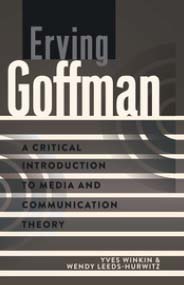
Erving Goffman by Winkin and Leeds-Hurwitz

Winkin, Y., & Leeds-Hurwitz, W. (2013). Erving Goffman: A critical introduction to media and communication theory. New York: Peter Lang.

My thanks to Yves Winkin for inviting me to co-author the book; to Dave Park, the series editor, for considering Goffman an essential communication theorist; and to all the editorial staff at Peter Lang, who were quite efficient once we submitted the manuscript.

Although Erving Goffman never claimed to be a media or communication scholar, his work is definitely relevant to, and has already served as a substantial resource for, those who are. This is the first detailed presentation and analysis of his life and work intended specifically for a communication audience. While primarily an introduction to Goffman’s work, those already familiar with his ideas will also learn something new. In addition to summarizing Goffman’s major concepts and his influence on other scholars, the book includes an intellectual biography, explication of his methods, and an example of how to extend his ideas. Readers are invited to consider Goffman as a lens through which to view much of the pattern evident in the social world. Goffman’s work always appealed to the general public (several of his books became bestsellers), and so this book has implications for those who are interested in the role of media or communication in their own lives as well as those who study it professionally.

For those interested, the book is available either directly from Peter Lang, or from Amazon.

ICA 2013

icaOn June 17, 2013, I was one of three co-authors of a paper entitled “Robert E. Park’s contribution to the history of intercultural communication” for the New Histories of Communication Study Preconference, at the International Communication Association convention in London. My co-authors were Filipa Subtil and José Luis Garcia, who I met last year while in Portugal. Dave Park, Peter Simonson and Philip Lodge did a great job of organizing the preconference. A group photo of 60 of the 80 participants is available here.

And after the preconference came the conference proper. ICA has really worked on becoming a more truly international organization (it’s now up to about 45% international members). As a result, this conference was the perfect ending for the last six months of travel because I connected again with other scholars I had last met in the countries where they live and work: China (Jiang Fei and Kuo Huang), Saila Poutiainen (Finland), John Wilson (Northern Ireland), Saskia Witteborn and Ling Chen (Hong Kong), Todd Sandel (Macau), Tamar Katriel, Esther Schely-Newman and Ifat Maoz (Israel), Cindy Gallois and Jeff Pittam (Australia). And Casey Lum, who I last met in Hong Kong, though he lives in the US. Of course, I also met a variety of friends and colleagues, both international and from the US (Richard Buttny, Theresa Castor, Don Ellis, Larry Gross, Beth Haslett, Evelyn Ho, Klaus Krippendorff, Dave Park, Jeff Pooley, Jeff Robinson, Karen Tracy and Bob Craig, Steve Wilson, Cynthia Stohl, Bill Eadie, Natasha Shrikant, François Cooren (Canada), Akiba Cohen (Israel), Olga Ivanovna Matyash (Russia), among many others – sorry not to be able to name everyone!), as well as several directly connected with this Center or the Council that is its parent organization (Linda Steiner, Brenda Berkelaar, Michael Haley). And I was glad to discover new international colleagues (Sheila Lodge, UK; Marion Wrenn, now at Princeton, but shortly to be in Abu Dhabi; John Laprise, Qatar; Zrinjka Peruško, Croatia; Boguslawa Dobek-Ostrowska, Poland; Raul Fuentes Navarro, Mexico; Peter Putnis, Australia, among others). As a result, some new researcher profiles and guest posts will be appearing on this site over the next month or so. Some of the conversations were about the possibilities permitted by social media and new publishing choices, so stay tuned for additions to this site as a result.

Wendy Leeds-Hurwitz, Director
Center for Intercultural Dialogue

Intercultural dialogue research

I am currently preparing an entry on intercultural dialogue for the International Encyclopedia of Language and Social Interaction. This is a general call for anyone who has published on the topic to send me an email (intercult.dialogue@gmail.com) with a citation you propose for potential mention in the entry. It needs to be a specific discussion of intercultural dialogue, not of intercultural communication more generally. And it needs to be about language and/or interaction, not media, not even social media, given the publication context.

If you want to know what I have already read and am currently considering for inclusion in the discussion, see the list of publications on intercultural dialogue posted to this site (although this includes far more sources than can be mentioned). As a thank you for the time you take in sending in suggestions, I will add all relevant citations received to this publications list, so that others may learn about them.

Thanks!

Wendy Leeds-Hurwitz, Director
Center for Intercultural Dialogue

IUFM d’Auvergne

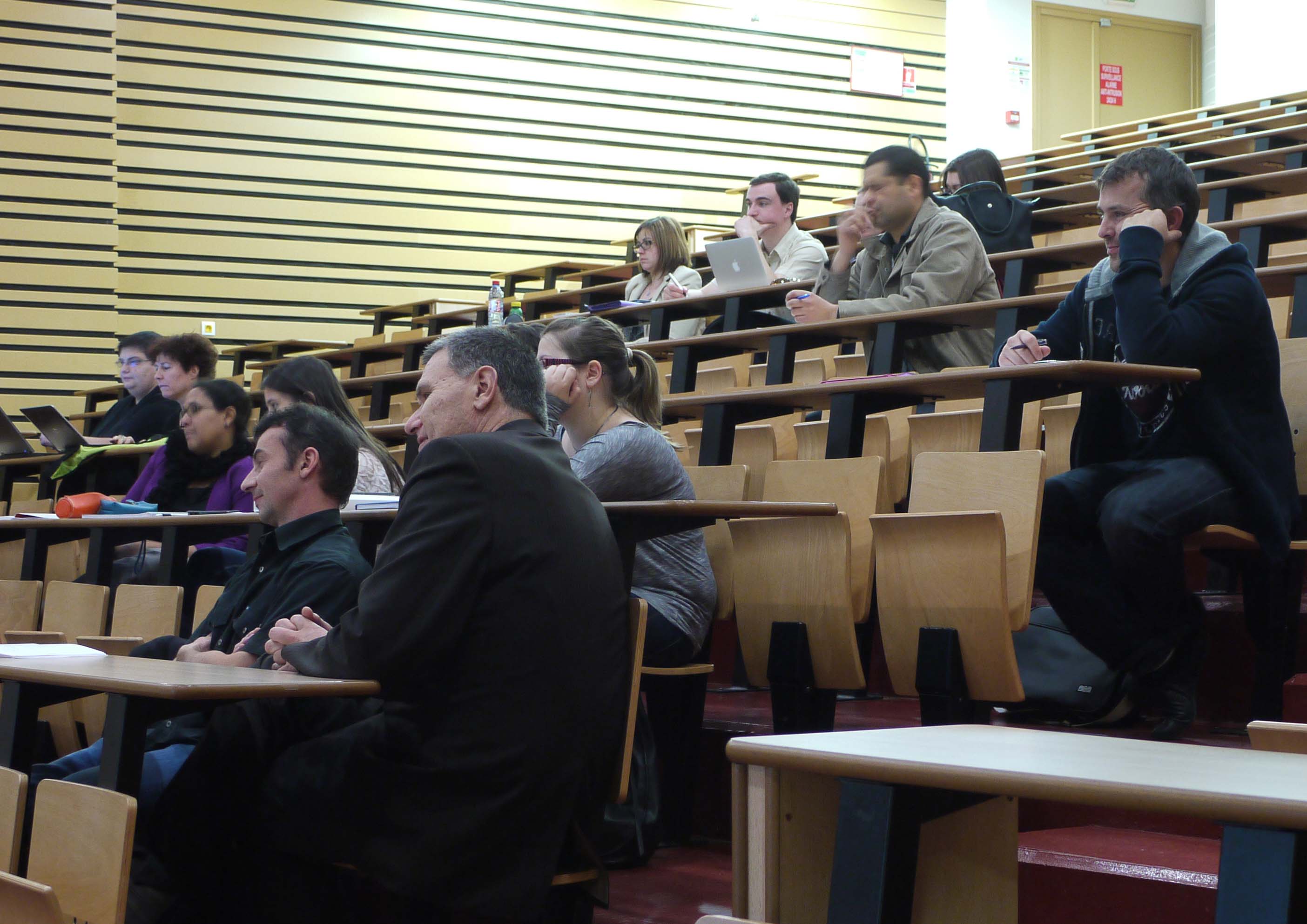
I have just spent a delightful week at the Institut Université Formation des Maîtres (IUFM) d’Auvergne, part of the Université Blaise Pascal de Clermont-Ferrand, in France. While there, I worked with three different groups. On June 4, 2013, I gave a talk and workshop for a general audience of faculty and graduate students entitled “If Learning Matters, How do I Teach Differently?” On June 5, I first worked with the faculty involved with the new diplôme enseigner dans le supérieur  (diploma for higher education pedagogy, the equivalent of a certificate in the US), and then presented a talk entitled “The Transformation of US Higher Education Pedagogy” to the students in that diploma. The talks were related to the book co-authored as a result of a stay at the Ecole Normale Supérieure de Lyon, published last fall, entitled Learning Matters. My focus was on the ways in which the Scholarship of Teaching and Learning (SoTL) has changed teaching and learning in the US, and what implications these changes have for France. Given the new diploma at IUFM, there was interest in learning about the various techniques of student centered learning.

WLH at UBP
My thanks especially to Prof. Didier Jourdan, the Director of IUFM d’Auvergne, for inviting me, and to Dr. Nathalie Younès, Maître de conférences, the responsable (person in charge of) the new diploma, for organizing the events.

WLH at UBP
Younès, Leeds-Hurwitz, Raphael Coudert, Jourdan

Since I was in Clermont-Ferrand for a week, there was also time to see some of the attractions in the area, including not only small medieval villages, but also lakes, and a row of mostly dormant volcanoes (especially Puy-de-Dôme, the tallest) and the town of Royat (a spa town with thermal springs, due to the volcanoes, and also an excellent restaurant, Le Paradis, with a great view of the region).

Nathalie_me
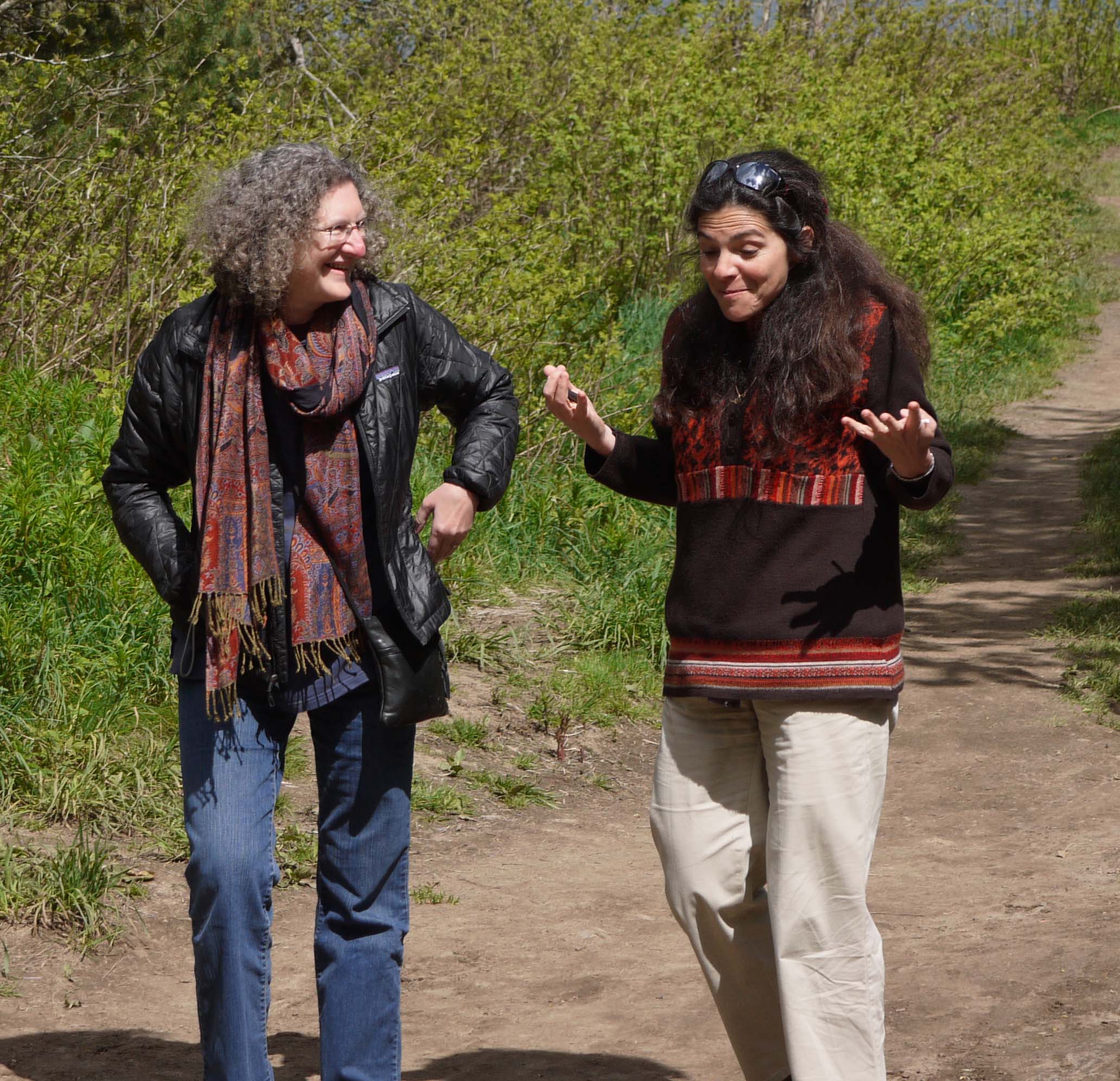
Leeds-Hurwitz and Younès

Wendy Leeds-Hurwitz, Director
Center for Intercultural Dialogue

Save