Research Assistant/Doctorate in Intercultural Communication (Switzerland)

Open Position Announcement:
Research Assistant / Doctorate  in Intercultural Communication

The Institute for Public Communication (IPC), Faculty of Communication Sciences, at the Università della Svizzera italiana (USI) in Lugano, Switzerland,, announces a call for a Research Assistant / Doctorate in Intercultural Communication.

The candidate will join the research team of Prof. Jolanta Drzewiecka at the IPC . He/she will assist Prof. Drzewiecka in her research and teaching duties, and some associated administration (including conference organization, M.A. theses supervision, grant proposal preparation) (50%) and must develop and carry forward a doctoral project in the area of intercultural communication (50%).  Prof Drzewiecka’s research focuses on public memories, media representations of migration, and belonging. The assistant will pursue his/her doctoral projects in these or related areas.

Required qualification: a master’s degree in communication sciences, linguistics, cultural studies, sociology or related disciplines; knowledge of critical and/or cultural studies theories and qualitative research methods; fluency in written and spoken English.  Desirable qualification:  knowledge of one or more Swiss national languages.

The ideal candidate will take ownership of a project and is both a team player and independent. He/she must be flexible, entrepreneurial and dynamic. He/she must enjoy working in a multilingual and multidisciplinary environment.

The position is renewable for up to 5 years based on satisfactory performance. During this period, the appointee will undertake doctoral studies and will have the opportunity to interact with an international network of scholars in the field and become a credible member of the academic community. The research activities will be carried out at USI, where the candidate should be present 4 days a week.

Contact
Please send your application, incl. a letter of motivation (describing qualifications and doctoral project ideas), detailed CV (with names and contact information for 2 references), university transcripts, and a writing sample (5 pages, in English, ideally from an academic paper), to Prof. Jolanta Drzewiecka.

Deadline
The appointment starts February 1, 2016 with a possibility of September 1, 2016 appointment. The call is open until the position is filled.

NOTE: This is the revised version, with additional information, updated October 16, 2015.

CFP New Media, Old Money: Digital Technology, Social Media & the New Challenges to Campaigning and Democracy

New Media, Old Money: Digital Technology, Social Media and the New Challenges to Campaigning and Democracy
DEADLINE EXTENDED TO JULY 17, 2015.

A by-invitation experts’ workshop to be held at The Embassy of Switzerland in the United States of America Washington, DC, September 27-29, 2015.

Electronic media have played a central role in politics almost since their introduction. The role of media in election campaigns is often seen as the origin of media and communication studies. The variety of political systems worldwide, the wide range of media systems that operate within them, and the extensive array of regulatory schemes that govern this association raise thought provoking questions about the role of media in democracy. The media-politics-capital triad has raised concerns about the effect of money on the health and fairness of political and media structures. The use of digital technologies and collaborative media has now become a critical part of these complex relationships.

Increasingly, political campaigns are built around digital strategies rather than on traditional broadcast ad buys. The internet offers many additional groups cheap access to the public sphere and new possibilities for information and discussion. Accordingly, much of the most “impactful” money is spent “online,” calling on expertise in building networks, conversations and communities using social networking platforms, combined with applications designed to amplify messaging as well as volunteers and users generating their own content. In addition, the ability to find, analyze and apply personal information from “big data” is becoming more important than market research and the focus has shifted to the development of comprehensive social media strategies for young, ethnic, gendered and special interest groups. Finally, legacy media and their traditional business models are affected by change as well, raising questions about implications of the internet for journalism and democracy.

As a result, any current understanding of campaign spending and political communication must incorporate not just traditional advertising, but equally spending on internet and social networking platforms and the use of information technologies to identify and reach voters through multiple platforms. The same “Old Money” is being used to try to gain influence, but new media offer new approaches both to enhance and conceal its effects. Moreover, the same media brands with the same powerful owners prevail online as well.

The Institute for Information Policy at Penn State, the Department of Communication and Media Research DCM at the University of Fribourg and the Journal of Information Policy, are pleased to announce this call for paper proposals. Authors of selected papers will be invited to present them during a two day (September 28th and 29th, 2015) by-invitation workshop designed to bring together up to a dozen American and international experts and to be held at the Embassy of Switzerland in Washington, DC. The workshop will open with a reception on September 27th. Presenters at the workshop will be invited to submit their
completed papers for review by the Journal of Information Policy. By focusing on the media-politics-capital triad, and taking place a year before the presidential elections in the US and only weeks before the national elections in Switzerland, the workshop is ideally suited to provide important insights not only for scholarly research but also for policy-makers in both countries.

Invited topics include, but are not limited to:
–       The role of media in election and referendum campaigns
–       The (democratic) need for regulation of media and campaigns
–       The role of money in campaigning and political communication
–       The role of money in media policy and regulation
–       Commercialization of the media and its effect on political coverage
–       Ownership structures of new and old media and their implications for democracy, political communication and media policy
–       Changes of political communication and journalism due to digitization
–       The strategic use of social media by political actors
–       Comparative studies of media regulation, political communication and campaigns
–       New metrics for campaign expenditures in the digital age
–       Political campaign money spending in online campaigns
–       Limitations on campaign spending
–       Limitations on contributions; on sources of contributions; requirements for disclosure; regulation of spending by advocacy groups; by political parties; and by individuals
–       The challenge of diversity of views and voices in the digital age
–       Applying broadcast political speech rules be applied on the Internet
–       Should social media, blogs, listserves and websites be subject to political speech rules?
–       How have the larger changes in the economics of media affected political news and commentary?

Abstracts of up to 500 words and a short bio of the author(s) should be submitted via email by July 17, 2015. Please write “IIPFUWS: Your Last Name” in the subject line.

Accepted presenters will be notified by July 31, 2015.

Peter Praxmarer Profile

ProfilesPeter Praxmarer, lic.oec.publ. (University of Zurich, 1977) and Docteur ès sciences politiques (The Graduate Institute, Geneva, 1984), is, since 2003, Executive Director of EMICC (European Masters in Intercultural Communication), a network of ten European universities specializing in intercultural communication, at Università della Svizzera italiana (USI) Lugano, Switzerland.

Peter Praxmarer
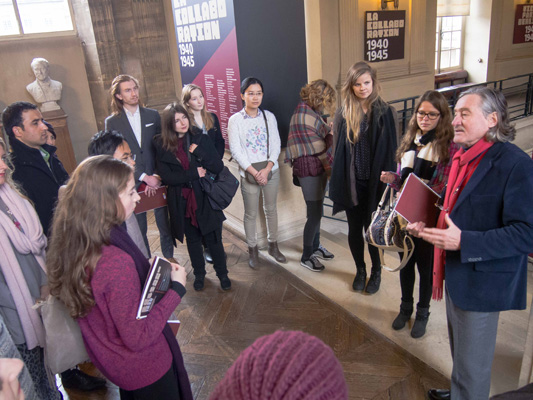
Praxmarer (right) with students of the 2014 Paris Eurocampus in the Archives nationales de France, Paris

For a number of years he taught international politics and relations in the United States (Temple University, University of Pennsylvania, Brown University and University of Rhode Island). He also was a consultant for UNITAR and the United Nations University on issues of social development, and has worked in the private sector (publishing, agriculture, art and antiques). During the wars in ex-Yugoslavia he participated in a fact-finding and assessment mission visiting UN peacekeeping forces in the Krajina region (Croatia), and served as Field and Training Coordinator with the OSCE Mission in Kosovo, for which he has also developed training programs in the field of democratization and good governance.

His main research focus is on epistemological issues (conceptualizations) in IC studies and the social sciences in general. His teaching is mainly on conceptualizations of “The Other”, as well as on intercultural communication in international organizations, and in particular peace communication in post-conflict and emergency contexts. He also works on academic cultures.

During the past ten years he has taught and lectured at more than two dozen universities in Europe and the US, and supervised a number of Bachelor and Master theses for students at different universities.

He also gives workshops and training courses in intercultural communication for different publics, including teachers at various levels, tourism professionals, immigration officials, paramedical personnel, healthcare professionals and managers.


NOTE: Peter Praxmarer passed away quite suddenly on November 5, 2017. He was a good friend to CID and will be sorely missed. A few concrete results of our frequent conversations follow. He wrote Key Concepts in Intercultural Dialogue #39: Otherness and the Other(s), translated it into both German and Italian, compiled a reader with study materials on intercultural communication competence, and prepared a poem, Languages of Peace. He wrote a guest post on Charlie Hebdo and intercultural dialogue, and responded at length to a guest post by Dominic Busch on refugees in Germany. During a Skype call with me, he came up with the concise definition of intercultural dialogue that was turned into CID Poster #3.
– Wendy Leeds-Hurwitz

Post-doctoral Fellowships in Intercultural Dialogue (Switzerland)

Call for Candidates: Post-doctoral Fellowships in Interreligious and Intercultural Dialogue 2015-2016

In the framework of an agreement signed in 2006 between the University of Geneva (UNIGE) and the Foundation for Interreligious and Intercultural Research and Dialogue (FIIRD), the Foundation will grant at least three post-doctoral fellowships for the academic year 2015-2016. They are intended for a research programme set up at the UNIGE, particularly in the Autonomous Department of Protestant Theology and the Humanities Department.

Funded by FIIRD, the fellowships (from 33,800 to 36,566 Swiss Francs maximum for each one) will be granted to young researchers having a doctorate when sending this application, a background in one of the three monotheistic religions (Judaism, Christianity and Islam) and wishing to specialize in the field of interreligious and intercultural dialogue.

The programme aims to set up a research group to deepen the understanding among persons of different religions and to bring forth leaders to respond to Intercultural and Interreligious challenges. Besides the attendance of course and seminars, the program consists of participation in a common bi-monthly seminar organized by FIIRD as well as the carrying out of independent research.

Period of allocation: beginning in September 2015 and continuing until August 2016 (twelve months).

Application deadline: 19 December 2014 for submission of complete files.
UPDATE as of January 7, 2015: Deadline extended to January 31, 2015

For further information about program and eligibility criteria, see the full calls in English and French.

Rosanne Teniente-Micro grant report

This slideshow requires JavaScript.

In Spring 2014, Rosanne Teniente was awarded a micro grant funded by the Association for Business Communication. The following is her report.


This past August I was privileged to have the opportunity to attend the Institute for Peace and Dialogue’s Summer Academy on Peacebuilding and Intercultural Dialogue hosted in Baar, Switzerland. IPD is an organization dedicated to conflict resolution, peacebuilding, and intercultural dialogue, and host conferences and trainings for those interested in peacebuilding and cross-cultural communication. I was there for ten days from August 17th through 27th and was partially funded through a microgrant from ABC, awarded through CID.

To say the least, it was a truly inspiring experience that I will cherish for the rest of my life. The experts invited were all very knowledgeable about their speaking topics, ranging from the Middle East conflict, non-violent communication and civil disobedience, to learning how to influence and persuade others, especially in dealing with conflict. Experts included a former French diplomat, the founder of the Pancevo peace movement in Serbia who was also directly involved in the Otpor movement that brought down Milosevic, as well as a former British colonel who worked on the Transnistrian conflict. There were also several experts in communication topics, ranging from cross-cultural communication, persuasive communication for successful negotiation, and non-violent communication. Every day had enthralling lectures, with great exercises and activities to really involve the participants.

Perhaps what really made the conference as special as it was were the other attendees. There were about thirty other participants, attending from all over the world. Everyone’s unique cultural background and experiences lent to amazing discussion and insight. One gentleman hailed from the Democratic Republic of Congo and was able to share his experiences in such a high-conflict country. Another came from Iraq and was able to eloquently explain the issues of ISIS and how his country is faring in the post-Iraq war years. Other participants were active peace practitioners, working for the United Nations, the Carter Center, and Peace Brigades International. At the end of the conference, we all agreed that one of the most rewarding aspects was that we were all blessed to have met and gotten to know each other during the time there, and to have forged such great connections with people from unlikely places.

I feel so fortunate that I was able to participate in such an event. As a graduate student and military spouse, it would have been very difficult to afford to attend the conference without funding from CID. I was also lucky that my university program was also able assist with a supplementary travel grant. While I did have to cover about half of the cost by myself, the microgrant from CID made it possible to attend, and as I said before, this will be an experience that I carry with me for the rest of my life.

Università della Svizzera italiana 2014

WLH and PraxmarerFrom May 20-30, 2014, I had a wonderful invitation to stay in Cimo, Switzerland (a village just outside Lugano), with Peter Praxmarer, the executive director of the European Master in Intercultural Communication (EMICC), which is coordinated through the Università della Svizzera italiana (known in English as the University of Lugano). He also collaborates with, and teaches for, the Master of Advanced Studies in Intercultural Communication (MIC), as well as a number of other European universities.

My goal was to learn more about the EMICC, an intensive and international semester-long study of intercultural communication jointly offered by ten European universities since 2002. This program is a model of international collaboration for graduate education, and an innovative form of what in the USA is called “study abroad,” ensuring that students not only learn about intercultural communication at a theoretical level, but also practice it. We were able to discuss not only some of the logistics of this program, but also shared interests in intercultural communication more generally, as well as inventing future possibilities for collaboration.

While in Lugano, I was able to connect also with Prof. Bertil Cottier, Director of the Institute for Public Communication at USI. Trained as a lawyer, one of his current interests is in data protection and new technologies. As it turns out, the Institute will be conducting a search for a faculty member specializing in intercultural communication shortly – keep an eye on this website for the details.

I also met with Alexandra Stang, a graduate student at the University of Duisburg-Essen (in Germany) currently studying the Intercultural Campus platform, “an international university network created for intercultural learning.” She was in town to interview Peter Praxmarer, and took the opportunity to interview me as well.

Wendy Leeds-Hurwitz, Director
Center for Intercultural Dialogue

CFP Interactional Competences conference (Switzerland)

Interactional competences in institutional practices
International Conference ICIP2014
University of Neuchâtel (Switzerland), November 21-22, 2014

Plenary speakers: Janet Holmes, Timothy Koschmann, Hanh thi Nguyen, Richard F. Young

Submission deadline: May 1st 2014

Institutionally appropriate communication is a major issue in organizations today. The ability to interact within institutional contexts represents a set of practices society members have available for sharing information and communicating, complaining, negotiating, solving problems, bringing off specific tasks, transmitting knowledge and learning. Responsive to context-specific motivations and at the same time transcending any specific interaction, interactional competences are not abstract abilities but are constructed within rich interactional environments, assessed and interpreted according to collectively shared and valid principles.

The International conference Interactional competences in institutional practices is intended to convene the state of the art in research on interactional competences within institutional contexts (professional interactions; teaching-learning interactions in school and/or in the workplace; professional-non professional interactions). The conference will be held at the University of Neuchâtel in Neuchâtel, Switzerland, from November 21 through November 22 2014.

We envision this to be a series of presentations, with peer-reviewed contributions and invited speakers, focussing on interactional competences in institutional settings and promoting research from the broad range of institutional interactions researchers. We welcome contributions on both theoretical and applied research based on naturalistic observations.

Topics may include, but are not limited to, the following:
*Competence and multimodality
*Competence and learning
*Competence and assessments
*Competence and identity
*Competence and knowledge
*Legitimate competence and mechanisms of institutional legitimization
*Competence, intervention and change

Summer Academy Peacebuilding & ICD

2nd International Summer Academy in Peace-building & Intercultural Dialogue
17.08 – 27.08.2014
Baar, Switzerland

IPD logo

The Institute for Peace and Dialogue is very glad to announce its next International Summer Academy in Peace-building & Intercultural Dialogue, which is going to be held in Switzerland 2014.  Its image as one of the most favourable places for traveling has made it more interesting to offer an exited and comprehensive program for our participants. Our experts, who are professionals in their fields will contribute to this event, with many years of experience in peace and conflict studies.

Nowadays unfortunately several frozen or ongoing conflicts between or within states still exist. Conflicts are different and if we look to the world mankind, how they are facing many new challenges, coupled with new dangerous situations, i.e. terrorist acts, non-legal arming of conflict sides, re-determination of borders, establishing new countries in the world map, non-providing territorial integrity, trafficking of arms, drugs and human; disputes on the implementation of transnational energy projects, democratization and false elections, revolution and internal political conflicts, armed guerrilla movements, violation and discrimination by nationalists, world economic crisis, climate change and unsafely biodiversity etc. Unfortunately the list is long. Conflicts are related and an integral part of human beings, as conflicts cause violation of human rights.

Existing conflicts weaken every kind of cooperation between nations and states. Without mutual cooperation and understanding, the future prosperity of the region would remain only as a good dream. Taking into consideration of peaceful behavior and engagements, we can make a decision on the strict belief, that opportunities for solving conflicts are feasible. Because in every conflict situation and tension forms we consequently face the below mentioned common situations:

1. Desperate situation and non-solving problems are not eternal;
2. It is possible to make common decision which both sides;
3. We can find common values, traditions and similar situation among conflict parties;
4. Protracted conflicts on the same time endanger regional development and prosperity;
5. Any mediation and negotiation actions are better than nothing.

Main Goal
The main goal of the summer academy is to support institutional academic peace education and strengthen peace-building skills and intercultural dialogue of the international society.

Language of the program
The International Summer Academy will be held in English.

Further information, and application, available from the Institute for Peace and Dialogue.

U Lugano (Switz) postdoc

The Institute of Communication and Health at the University of Lugano (Università della Svizzera italiana), Switzerland invites applications for a Post-doctoral Fellow position in the Faculty of Communication Sciences. Funding is provided through research grants from the Swiss National Science Foundation focused on addressing problems arising from limited health literacy and patient empowerment focusing particularly on misuse of prescription medications (P.I.: Dr. K. Nakamoto) and vaccination refusal (P.I.: Dr. P. Schulz). The Fellowship is available for three years and salary is competitive and dependent on experience and qualifications.

We are particularly interested in applicants with backgrounds in communications, psychology, and related disciplines. Application review will begin April 15th, 2013 and continue until the positions are filled. The new Fellow will be joining an active research group including three core faculty members, four post-doctoral fellows, and eight current Ph.D. students. The Institute of Communication and Health has a growing international reputation for its research on health communications and has active collaborations with several universities in Switzerland, the European Union, and the United States.
Interested applicants should send a letter of interest describing research and career interests, curriculum vitae, undergraduate and graduate transcripts, and at least two academic letters of recommendation to:

Ms. Teresa Cafaro
Institute of Communication and Health
Università della Svizzera italiana
Via Giuseppe Buffi 13
6904 Lugano
Switzerland

Save