Key Concept #29: Dialogic Civility by Robyn Penman

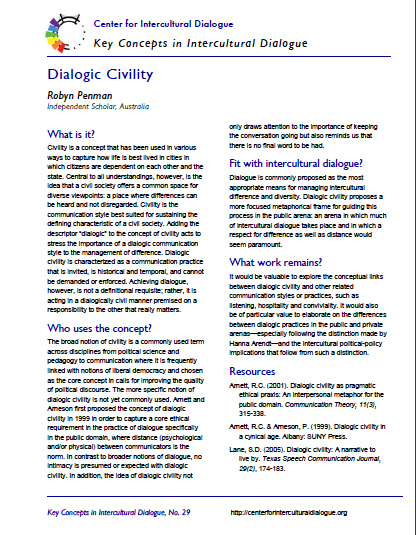
Key Concepts in ICDThe next issue of Key Concepts in intercultural Dialogue is now available. This is KC29: Dialogic Civility by Robyn Penman. As always, all Key Concepts are available as free PDFs; just click on the thumbnail to download. Lists organized  chronologically by publication date and numberalphabetically by concept in English, and by languages into which they have been translated, are available, as is a page of acknowledgments with the names of all authors, translators, and reviewers.

kc29-sm

Penman, R. (2014). Dialogic civility. Key Concepts in Intercultural Dialogue, 29. Available from:
https://centerforinterculturaldialogue.org/wp-content/uploads/2014/08/key-concept-dialogic-civility.pdf

The Center for Intercultural Dialogue publishes a series of short briefs describing Key Concepts in intercultural Dialogue. Different people, working in different countries and disciplines, use different vocabulary to describe their interests, yet these terms overlap. Our goal is to provide some of the assumptions and history attached to each concept for those unfamiliar with it. As there are other concepts you would like to see included, send an email to the series editor, Wendy Leeds-Hurwitz. If there are concepts you would like to prepare, provide a brief explanation of why you think the concept is central to the study of intercultural dialogue, and why you are the obvious person to write up that concept.


Creative Commons License
This work is licensed under a Creative Commons Attribution-NonCommercial-NoDerivatives 4.0 International License.

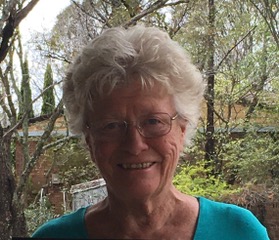
Robyn Penman Profile

ProfilesRobyn Penman (PhD, University of Melbourne) is an independent communication scholar and consultant to government on communication and social policy matters.

Robyn PenmanShe was a Founding Director of the Communication Research Institute of Australia (1987-2000) and an Adjunct Professor in Communication at the University of Canberra (1999-2005). Robyn is a past President (1985-6) and Life Member of the Australian and New Zealand Communication Association, has served on the International Communication Association board (2002-3) and is a Visiting Senior Member, Linacre College, Oxford (1987). She was also the Associate Editor of the Australian Journal of Communication (1984-2003) and has served on the editorial boards of Communication Theory and Human Communication Research. She is currently a board member of the CMM Institute, Co-Director of the Cosmopolis2045 project, and General Editor of CMMi Press.

Robyn has devoted her scholarly career to the development of a practical-theoretic approach to understanding communicating as a relational practice. She has been equally as focused on asking questions about what makes for good communicating, especially in the public, civic sphere, and how this understanding can be used to make better social worlds. She is the author of five books—Communication Process and Relationships, Not the Marrying Kind (with Yvonne Stolk), Reconstructing Communicating: Looking to a Future, Making Better Social Worlds (with Arthur Jensen) and Justice in the Making: Relating, Participating, Communicating—along with many book chapters and journal articles.

Robyn welcomes contact via email.


Work for CID:

Robyn Penman has written KC4: Coordinated Management of Meaning (CMM), KC8: Public Dialogue, KC15: Cultural Pluralism, KC29: Dialogue Civility, and KC37: Dialogic Listening. She has also written two guest posts, Feeling Felt: The Heart of the Dialogic Moment? and Dialogue in the Interests of Justice. And she provided a book review of The coordinated management of meaning: A festschrift in honor of W. Barnett Pearce. Finally, she served as initial graphic design consultant for CID, establishing the format for Key Concepts in Intercultural Dialogue.

Key Concepts #15: Cultural Pluralism by Robyn Penman

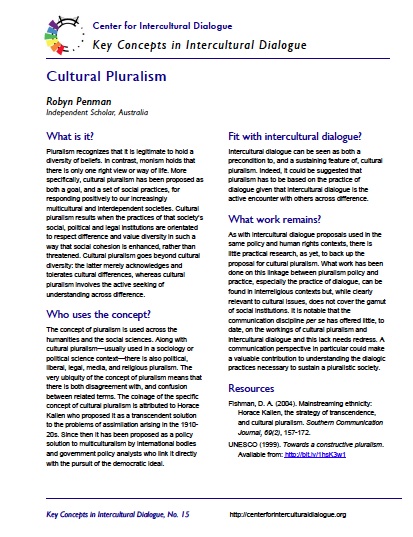
Key Concepts in ICDThe next issue of Key Concepts in intercultural Dialogue is now available. This is KC15: Cultural Pluralism by Robyn Penman. As always, all Key Concepts are available as free PDFs; just click on the thumbnail to download.Lists organized  chronologically by publication date and numberalphabetically by concept in English, and by languages into which they have been translated, are available, as is a page of acknowledgments with the names of all authors, translators, and reviewers.

kc15-sm

Penman, R. (2014). Cultural pluralism. Key Concepts in Intercultural Dialogue, 15. Available from:
https://centerforinterculturaldialogue.org/wp-content/uploads/2014/05/key-concept-cultural-pluralism.pdf

The Center for Intercultural Dialogue publishes a series of short briefs describing Key Concepts in intercultural Dialogue. Different people, working in different countries and disciplines, use different vocabulary to describe their interests, yet these terms overlap. Our goal is to provide some of the assumptions and history attached to each concept for those unfamiliar with it. As there are other concepts you would like to see included, send an email to the series editor, Wendy Leeds-Hurwitz. If there are concepts you would like to prepare, provide a brief explanation of why you think the concept is central to the study of intercultural dialogue, and why you are the obvious person to write up that concept.


Creative Commons License
This work is licensed under a Creative Commons Attribution-NonCommercial-NoDerivatives 4.0 International License.

Key Concepts #8: Public Dialogue by Robyn Penman

Key Concepts in ICDThe next issue of Key Concepts in intercultural Dialogue is now available. This is KC8: Public Dialogue by Robyn Penman. As always, all Key Concepts are available as free PDFs; just click on the thumbnail to download. Lists organized  chronologically by publication date and numberalphabetically by concept in English, and by languages into which they have been translated, are available, as is a page of acknowledgments with the names of all authors, translators, and reviewers.

KC8-sm

Penman, R. (2014). Public dialogue. Key Concepts in Intercultural Dialogue, 8. Available from:
https://centerforinterculturaldialogue.org/wp-content/uploads/2014/03/key-concept-public-dialogue.pdf

The Center for Intercultural Dialogue is publishing a series of short briefs describing Key Concepts in intercultural Dialogue. The logic is that different people, working in different countries and disciplines, use different vocabulary to describe their interests, yet these terms overlap. Our goal is to provide some of the assumptions and history attached to each concept for those unfamiliar with it. As there are other concepts you would like to see included, send an email to the series editor, Wendy Leeds-Hurwitz. If there are concepts you would like to prepare, provide a brief explanation of why you think the concept is central to the study of intercultural dialogue, and why you are the obvious person to write up that concept.


Creative Commons License
This work is licensed under a Creative Commons Attribution-NonCommercial-NoDerivatives 4.0 International License.

Key Concepts in Intercultural Dialogue #4: CMM by Robyn Penman

Key Concepts in ICDThe next issue of Key Concepts in intercultural Dialogue is now available. This is KC4: Coordinated Management of Meaning (CMM) by Robyn Penman. As always, all Key Concepts are available as free PDFs; just click on the thumbnail to download. Lists organized  chronologically by publication date and numberalphabetically by concept in English, and by languages into which they have been translated, are available, as is a page of acknowledgments with the names of all authors, translators, and reviewers.

Key Concept-CMM

Penman, R. (2014). Coordinated management of meaning. Key Concepts in Intercultural Dialogue, 4. Available from:
https://centerforinterculturaldialogue.org/wp-content/uploads/2014/02/key-concept-cmm.pdf

The Center for Intercultural Dialogue is publishing a series of short briefs describing Key Concepts in intercultural Dialogue. The logic is that different people, working in different countries and disciplines, use different vocabulary to describe their interests, yet these terms overlap. Our goal is to provide some of the assumptions and history attached to each concept for those unfamiliar with it. As there are other concepts you would like to see included, send an email to the series editor, Wendy Leeds-Hurwitz. If there are concepts you would like to prepare, provide a brief explanation of why you think the concept is central to the study of intercultural dialogue, and why you are the obvious person to write up that concept.


Creative Commons License
This work is licensed under a Creative Commons Attribution-NonCommercial-NoDerivatives 4.0 International License.

Transformative Power of Dialogue

Review of:
Stephen W. Littlejohn & Sheila McNamee (Eds.). (2014). The coordinated management of meaning: A festschrift in honor of W. Barnett Pearce. Madison, NJ: Fairleigh Dickinson University Press.

by Robyn Penman

In 1980, Barnett Pearce and his colleague, Vern Cronen, published Communication, Action and Meaning, a seminal work introducing scholars to the theory of the coordinated management of meaning (CMM). Over the ensuing decades, CMM theory has continued to grow, reaching a wider and wider audience as the practical and theoretical relevance of Barnett’s work became increasingly acknowledged.

In recognition of Barnett’s outstanding scholarship, a conference, entitled the Transformative Power of Dialogue, was held in his honour in January 2011. The essays in this book collection emerged from that conference. I am one of the contributors to this volume and, as such, this review is more of a commendation than any conventional critical review.

The book opens with an essay written by Barnett shortly before his death, reflecting on what it could take for personal and social revolution to be brought about. As he put it, he has “bet my professional life” on following the risky, high stake path that this evolution “could be promoted by explicit attention to what we are making together in the forms of communication in which we engage” (p. 44).

Barnett’s bet has reaped its rewards, not the least of which is the extent to which he has inspired, encouraged and collaborated with an extraordinary range of scholars and practitioners, a sample of which is contained in the current volume. The very breadth, scholarship and wide-ranging practical import captured in the 15 essays bear witness to the rich offerings to be found in CMM and its broader communication perspective.

For those interested in intercultural dialogue, the central importance placed on dialogue in Barnett’s work, and in the essays in this volume, makes the book especially pertinent. One part of this volume is specifically devoted to the theme of dialogue. The topics include the role of systemic questioning (Victoria Chen), moral conflict and managing difference (Stephen Littlejohn), framing and conflict transformation (Linda Putnam), and generative community dialogue (Stanley Deetz).

Dialogue also emerges as a powerful theme throughout the other parts in the book. For example, I (Penman) consider the core relationship between dialogue and presence and what this means for understanding participation in mediated life. John Lannamann explores the key role of dialogue and its practice in cosmopolitan communication in making better social worlds. And Kim Pearce sums up the volume by talking about the pathway to personal and social evolution in terms of the “life of dialogue…that holds in tension, and compassion, the various stories, actions and people who loves us, or don’t, who are like us. . . . , or aren’t and who may challenge us to the core to remain civil and open” (p. 328).

For anyone interested in dialogue and its role in making better social worlds, this book should be a rewarding read.

Feeling felt: The heart of the dialogic moment?

Guest PostsFeeling felt: The heart of the dialogic moment? by Robyn Penman

In Maria Flora Mangano’s post on A space of relationship for dialogue among cultures she describes how a student was able to talk about his personal experience during the genocide in Burundi because of the space of the relationship that was created for class members to speak without any fear of offence. The experience within this space of relationship was so profound that by time the student finished talking, the class was so “touched they couldn’t speak”.

As I read Maria Flora’s post I was struck by the way the experience was described metaphorically in terms of physical contact: the students were “touched”, the speaker “felt” understood. I know this is a common way of talking about poignant moments in dialogue and other “close” encounters. However, my recent foray into the interpersonal neurobiology (IPNB) research literature has made me more alert to such metaphors and given me reason to draw attention to it here.

Extensive research evidence across the neuroscience field indicates that relationships are crucial to brain development and neural functioning throughout the life cycle. We are, to use Mona Fishbane’s phase, “wired to connect”. The fact that our relationships, and presumably the quality of them, can impact on brain development is, in itself, something to take note of. However, IPNB has taken this broad notion further and fleshed out a number of ideas about how these connections work and what their impact may be. One of these ideas concerns the sense of “feeling felt”.

Daniel Siegel, who coined the term interpersonal neurobiology, uses the concept of “feeling felt” to describe the ability of one person to empathically and authentically encounter another person; especially in the early parent-infant relationship.  According to Siegel, “feeling felt” is characteristic of secure infant-parent relationships: the more infants “feel felt”, the better their attachment and the sounder their development pathway.

While there is still some controversy about the specific role played by neural mechanisms in the ability to be empathic, the concept of feeling felt and its role in childhood development has a great deal of merit. The concept of feeling felt also seems to have merit when we come to adult relationships, and to dialogue specifically.

When I was reading descriptions of the “feeling felt” phenomenon I was struck by the extent to which it resonated with Martin Buber’s sense of “being”. In his discussions of dialogue, Buber made a distinction between “being” and “seeming” in an encounter with another. For Buber, the being person is acting authentically into the encounter and, in acting thus, makes dialogue possible. The moment when two people fully experience each other as “being” in the relationship signifies a dialogic moment. In exactly the same vein we could say that dialogue has occurred when each person feels felt by the other.

The interpersonal neurobiology literature would suggest that this striving to feel felt is part of our neurological make-up. We strive for connection, and we yearn to feel felt from infancy onwards. But, equally important, the existence of this neurophysiological dimension would also suggest that “feeling felt” is a cross-cultural phenomenon. It may be that the way this “feeling felt” is described in different languages differs but the yearning for it may not. It leaves us with an interesting possibility. As scholars, we may not be able to agree on a definition of dialogue but, as participants, we know one when we have one: we feel felt.

References:
Buber, Martin. (1965). Between man and man. New York: Macmillan.
Siegel, Daniel J., & Hartzell, Mary. (2003). Parenting from the inside out. New York: Penguin.

Download the entire post as a PDF.

Sydney 2014

On the way between the US and New Zealand, I was able to stop in Sydney, Australia for a week. Being there permitted me to connect with two people I’d never met but only talked to via email, and one I had not seen in over a decade. Between the three, there was a wide range of interests and career stages.

Lily A. Arasaratnam is Senior Lecturer in Intercultural Communication and Program Director for an MA program at Alphacrucis College in Parramatta, just outside Sydney. I “met” Lily when we both participated in an online dialogue about intercultural communication for the Journal of International and Intercultural Communication which will shortly be published. Her primary research specialization is intercultural communication competence. She is an intercultural expert both because of her PhD and her personal experience: born in Sri Lanka, raised in the Maldives, with US degrees, and now living in Australia, she lives many of the dualities others only try to understand.

Olga Kozar is currently completing her PhD in Applied Linguistics at Macquarie University in Sydney. Her research is on private one-on-one English as a second language lessons conducted via videoconferencing tools such as Skype, especially when learners and teachers have different cultural backgrounds. In her spare time she runs such a language school – with about 1000 students! She was quite helpful in providing technology-related ideas, given that she’s become such an expert. I was delighted to discover that she and Christine Develotte, a colleague from Lyon, France, who does similar work with teaching French online and who I introduced her to via email, have now met in person as well.

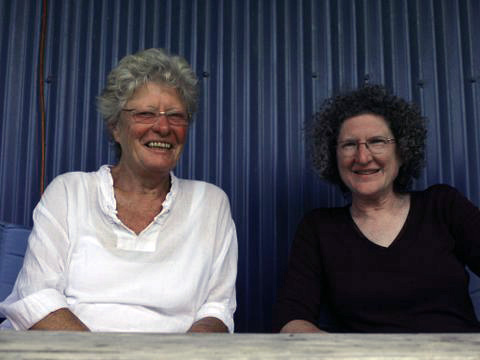
Penman, Leeds-Hurwitz
Robyn Penman, Wendy Leeds-Hurwitz

I was introduced to Robyn Penman by Barnett Pearce so long ago we don’t remember when it would have been; it was a pleasure to have a chance to catch up on the past decade. Currently active with the CMM Institute, formerly with the Communication Research Institute of Australia, Robyn is a pioneering communication scholar, widely respected both for her ability to state theory clearly (as in her early Communication Processes and Relationships, or the more recent Reconstructing Communication) and to apply that theory to practical communication problems (as in Designing Information for People, a co-edited volume). Robyn suggested that, given my current efforts to connect international scholars, my name should now be changed to Ariadne, for her association with webs and weaving.

I look forward to continuing the conversations with all these scholars.

Wendy Leeds-Hurwitz, Director
Center for Intercultural Dialogue

Save