Robyn Penman: What If…? New Ideas for Better Social Worlds

Resources in ICD“ width=

What if…? new ideas for better social worlds by Robyn Penman, on Substack.

Robyn Penman, longtime contributor to the Center for Intercultural Dialogue, has just started publishing a series of essays on Substack. Her focus will be on how to improve our social world.

Offering new ways for making sense of and acting into our social world so that we can collectively make a more just and more democratic society—one that we actually want to live in.

Her focus is not intercultural dialogue explicitly, but her discussion has implications for it. For example: “Our storehouse of stories is our storehouse for meaning-making. This cultural and personal storehouse of meaning provides the rationale for how we act across the economic, political, legal, and personal spheres of our social world.”

Read, and enjoy.

Penman Guest Post: Dialogue in the Interests of Justice

Guest Posts
Dialogue in the interests of justice. Guest post by Robyn Penman.

I propose that the dialogic form can act as an aspirational model: it is an orientation to a way of communicating, a commitment to doing it better and, only occasionally, an accomplishment.

In one way, the link between dialogue and justice seems obvious, at least as far as social justice is concerned. As Kathryn Sorrells (2015) noted in her discussion of social justice Key Concepts on Social Justice, intercultural dialogue is critical to both the process and goal of social justice because it enables us to reach across difference to creatively engage with others. Yet, even appreciating how critical that link is, there is so much more that needs to be considered. In particular, as Sorrell sums up, there is a critical need for more interdisciplinary work on understanding the importance of communication in building relationships and systems based on social justice.

The critical need for taking communication into account is reflected in such questions as: How exactly does the key role of dialogue for meeting social justice goals get played out in practice? How is it possible to even create the conditions for dialogue in unjust circumstances? And what does dialogue have to do with the common idea of social justice as the equitable distribution of resources and rights? These questions open up a whole new vista of possibilities, even to a re-consideration of what justice itself can mean.

Download the entire guest post as a PDF.

Racial Justice, Relational Responsivity

Applied ICDPenman, Robyn. (2022). Racial justice, relational responsivity and responsibility. CMMi Working Papers, No. 2. 

Perhaps it’s important to emphasise here that we are not using the term “dialogue” loosely. We are, in fact, using the term from a very specific perspective — the prescriptive approach that draws on the work of Martin Buber…Amongst other things, this form of dialogue is characterized by the participants acting authentically and genuinely engaging in the process in a mutually collaborative way that ensues the participants can go on together…And most importantly, this approach to dialogue is fundamentally orientated to the call of the other. (p. 16)

This is the first paper to emerge from discussions in the CMMi Social Justice Working Group. In this paper, Robyn Penman considers the issue of racial justice within a relational framework, that includes a relationally-responsive, and responsible, form of understanding emerging from an “us”. Drawing on the various models and heuristics of the Coordinated Management of Meaning (CMM), she shows us how we can develop a different sense of racial justice and how we can expose the pervasive relational dynamics at work in perpetuating injustice.

KC4: Coordinated Management of Meaning Translated into Arabic

Key Concepts in ICDContinuing translations of Key Concepts in Intercultural Dialogue, today I am posting KC4: Coordinated Management of Meaning, which Robyn Penman wrote and first published in English in 2014, which Mohammed Guamguami has now translated into Arabic.

As always, all Key Concepts are available as free PDFs; just click on the thumbnail to download. Lists of Key Concepts organized chronologically by publication date and number, alphabetically by concept, and by languages into which they have been translated, are available, as is a page of acknowledgments with the names of all authors, translators, and reviewers.

KC4 CMM_ArabicPenman, R. (2021). Coordinated Management of Meaning [Arabic]. (M. Guamguami, Trans). Key Concepts in Intercultural Dialogue, 4. Available from: https://centerforinterculturaldialogue.org/wp-content/uploads/2021/07/kc4-cmm_arabic.pdf

If you are interested in translating one of the Key Concepts, please contact me for approval first because dozens are currently in process. As always, if there is a concept you think should be written up as one of the Key Concepts, whether in English or any other language, propose it. If you are new to CID, please provide a brief resume. This opportunity is open to masters students and above, on the assumption that some familiarity with academic conventions generally, and discussion of intercultural dialogue specifically, are useful.

Wendy Leeds-Hurwitz, Director
Center for Intercultural Dialogue


Creative Commons License
This work is licensed under a Creative Commons Attribution-NonCommercial-NoDerivatives 4.0 International License.

KC15 Cultural Pluralism Translated into French

Key Concepts in ICDContinuing translations of Key Concepts in Intercultural Dialogue, today I am posting KC#15: Cultural Pluralism, which which Robyn Penman wrote in English for publication in 2014, and  which Mohammed Guamguami has now translated into French.

As always, all Key Concepts are available as free PDFs; just click on the thumbnail to download. Lists of Key Concepts organized alphabetically by conceptchronologically by publication date and number, and by languages into which they have been translated, are available, as is a page of acknowledgments with the names of all authors, translators, and reviewers.

KC15 Cultural pluralism_FrenchPenman, R. (2021). Le pluralisme culturel. (M. Guamguami, trans). Key Concepts in Intercultural Dialogue, 15. Available from: https://centerforinterculturaldialogue.org/wp-content/uploads/2021/06/kc15-cultural-pluralism_french.pdf

If you are interested in translating one of the Key Concepts, please contact me for approval first because dozens are currently in process. As always, if there is a concept you think should be written up as one of the Key Concepts, whether in English or any other language, propose it. If you are new to CID, please provide a brief resume. This opportunity is open to masters students and above, on the assumption that some familiarity with academic conventions generally, and discussion of intercultural dialogue specifically, are useful.

Wendy Leeds-Hurwitz, Director
Center for Intercultural Dialogue


Creative Commons License
This work is licensed under a Creative Commons Attribution-NonCommercial-NoDerivatives 4.0 International License.

Key Concept #4: Coordinated Management of Meaning Translated into French

Key Concepts in ICDContinuing translations of Key Concepts in Intercultural Dialogue, today I am posting KC4: Coordinated Management of Meaning, which Robyn Penman wrote and first published in English in 2014, which Mohammed Guamguami has now translated into French.

As always, all Key Concepts are available as free PDFs; just click on the thumbnail to download. Lists of Key Concepts organized chronologically by publication date and number, alphabetically by concept, and by languages into which they have been translated, are available, as is a page of acknowledgments with the names of all authors, translators, and reviewers.

KC4 CMM_FrenchPenman, R. (2021). La gestion coordonnée du sens. (M. Guamguami, Trans). Key Concepts in Intercultural Dialogue, 4. Available from: https://centerforinterculturaldialogue.org/wp-content/uploads/2021/06/kc4-cmm_french.pdf

If you are interested in translating one of the Key Concepts, please contact me for approval first because dozens are currently in process. As always, if there is a concept you think should be written up as one of the Key Concepts, whether in English or any other language, propose it. If you are new to CID, please provide a brief resume. This opportunity is open to masters students and above, on the assumption that some familiarity with academic conventions generally, and discussion of intercultural dialogue specifically, are useful.

Wendy Leeds-Hurwitz, Director
Center for Intercultural Dialogue


Creative Commons License
This work is licensed under a Creative Commons Attribution-NonCommercial-NoDerivatives 4.0 International License.

KC8 Public Dialogue Translated into French

Key Concepts in ICDContinuing translations of Key Concepts in Intercultural Dialogue, today I am posting KC#8: Public Dialogue, which Robyn Penman wrote for publication in English in 2014, and which Mohammed Guamguami has now translated into French.

As always, all Key Concepts are available as free PDFs; just click on the thumbnail to download. Lists of Key Concepts organized chronologically by publication date and number, alphabetically by concept, and by languages into which they have been translated, are available, as is a page of acknowledgments with the names of all authors, translators, and reviewers.

KC8 Public Dialogue_FrenchPenman, R. (2021). Le dialogue public. (M. Guamguami, trans). Key Concepts in Intercultural Dialogue, 8. Available from: https://centerforinterculturaldialogue.org/wp-content/uploads/2021/05/kc8-public-dialogue_french.pdf

If you are interested in translating one of the Key Concepts, please contact me for approval first because dozens are currently in process. As always, if there is a concept you think should be written up as one of the Key Concepts, whether in English or any other language, propose it. If you are new to CID, please provide a brief resume. This opportunity is open to masters students and above, on the assumption that some familiarity with academic conventions generally, and discussion of intercultural dialogue specifically, are useful.

Wendy Leeds-Hurwitz, Director
Center for Intercultural Dialogue


Creative Commons License
This work is licensed under a Creative Commons Attribution-NonCommercial-NoDerivatives 4.0 International License.

KC37 Dialogic Listening Translated into Spanish

Key Concepts in ICDContinuing translations of Key Concepts in Intercultural Dialogue, today I am posting KC#37: Dialogic Listening, which Robyn Penman wrote for publication in English in 2014, and which Jhon Eduardo Mosquera Pérez has now translated into Spanish.

As always, all Key Concepts are available as free PDFs; just click on the thumbnail to download. Lists of Key Concepts organized chronologically by publication date and number, alphabetically by concept, and by languages into which they have been translated, are available, as is a page of acknowledgments with the names of all authors, translators, and reviewers.

KC37 Dialogic Listening_SpanishPenman, R. (2021). Escucha dialógica. (J. E. Mosquera Pérez, trans). Key Concepts in Intercultural Dialogue, 37. Available from: https://centerforinterculturaldialogue.org/wp-content/uploads/2021/03/kc37_dialogic-listening_spanish.pdf

If you are interested in translating one of the Key Concepts, please contact me for approval first because dozens are currently in process. As always, if there is a concept you think should be written up as one of the Key Concepts, whether in English or any other language, propose it. If you are new to CID, please provide a brief resume. This opportunity is open to masters students and above, on the assumption that some familiarity with academic conventions generally, and discussion of intercultural dialogue specifically, are useful.

Wendy Leeds-Hurwitz, Director
Center for Intercultural Dialogue


Creative Commons License
This work is licensed under a Creative Commons Attribution-NonCommercial-NoDerivatives 4.0 International License.

KC15 Cultural Pluralism Translated into Portuguese

Key Concepts in ICDContinuing translations of Key Concepts in Intercultural Dialogue, today I am posting KC#15: Cultural Pluralism, which which Robyn Penman wrote in English for publication in 2014, and  which Filipa Subtil has now translated into Portuguese.

As always, all Key Concepts are available as free PDFs; just click on the thumbnail to download. Lists of Key Concepts organized alphabetically by conceptchronologically by publication date and number, and by languages into which they have been translated, are available, as is a page of acknowledgments with the names of all authors, translators, and reviewers.


KC15 Cultural Pluralism_PortuguesePenman, R. (2020). Pluralismo cultural. (F. Subtil, trans). Key Concepts in Intercultural Dialogue, 15. Available from:
https://centerforinterculturaldialogue.org/wp-content/uploads/2021/05/kc15-cultural-pluralism_portuguese-v2.pdf

If you are interested in translating one of the Key Concepts, please contact me for approval first because dozens are currently in process. As always, if there is a concept you think should be written up as one of the Key Concepts, whether in English or any other language, propose it. If you are new to CID, please provide a brief resume. This opportunity is open to masters students and above, on the assumption that some familiarity with academic conventions generally, and discussion of intercultural dialogue specifically, are useful.

Wendy Leeds-Hurwitz, Director
Center for Intercultural Dialogue


Creative Commons License
This work is licensed under a Creative Commons Attribution-NonCommercial-NoDerivatives 4.0 International License.

Penman & Jensen: Making Better Social Worlds

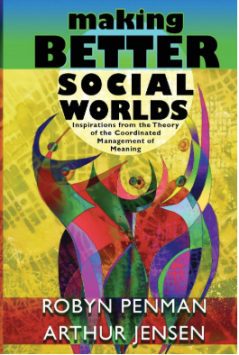
“Book NotesPenman, R., & Jensen, A. (2019). Making Better Social Worlds: Inspirations from the Theory of the Coordinated Management of Meaning. Oracle, AZ: CMM Institute Press.

Barnett Pearce invited us all to make better social worlds. Penman and Jensen show us how to begin—how to cross the wide gap between wanting to make a better social world and actually beginning to do so.  – Wendy Leeds-Hurwitz

Making Better Social Worlds: Inspirations from the Theory of the Coordinated Management of Meaning is a companion volume to the Cosmopolis2045 website. It serves as a fitting first book from the new CMMi Press. The book offers a clear and comprehensive account of how the theory of the Coordinated Management of Meaning (CMM) can be used to help us rise to the challenges of 21st century life with its political turmoil, social divisiveness and increasing moral bankruptcy. Making Better Social Worlds describes how we create our social worlds in communication, that our relationships with people matter deeply to the quality of our lives and that living with difference enriches us. Readers are offered a new mindset that is relationship-orientated, self-reflexive and morally attuned, along with what it means to engage in joint action, dialogue and cosmopolitan communication, to show how changing our communication practices can bring about social and cultural change.