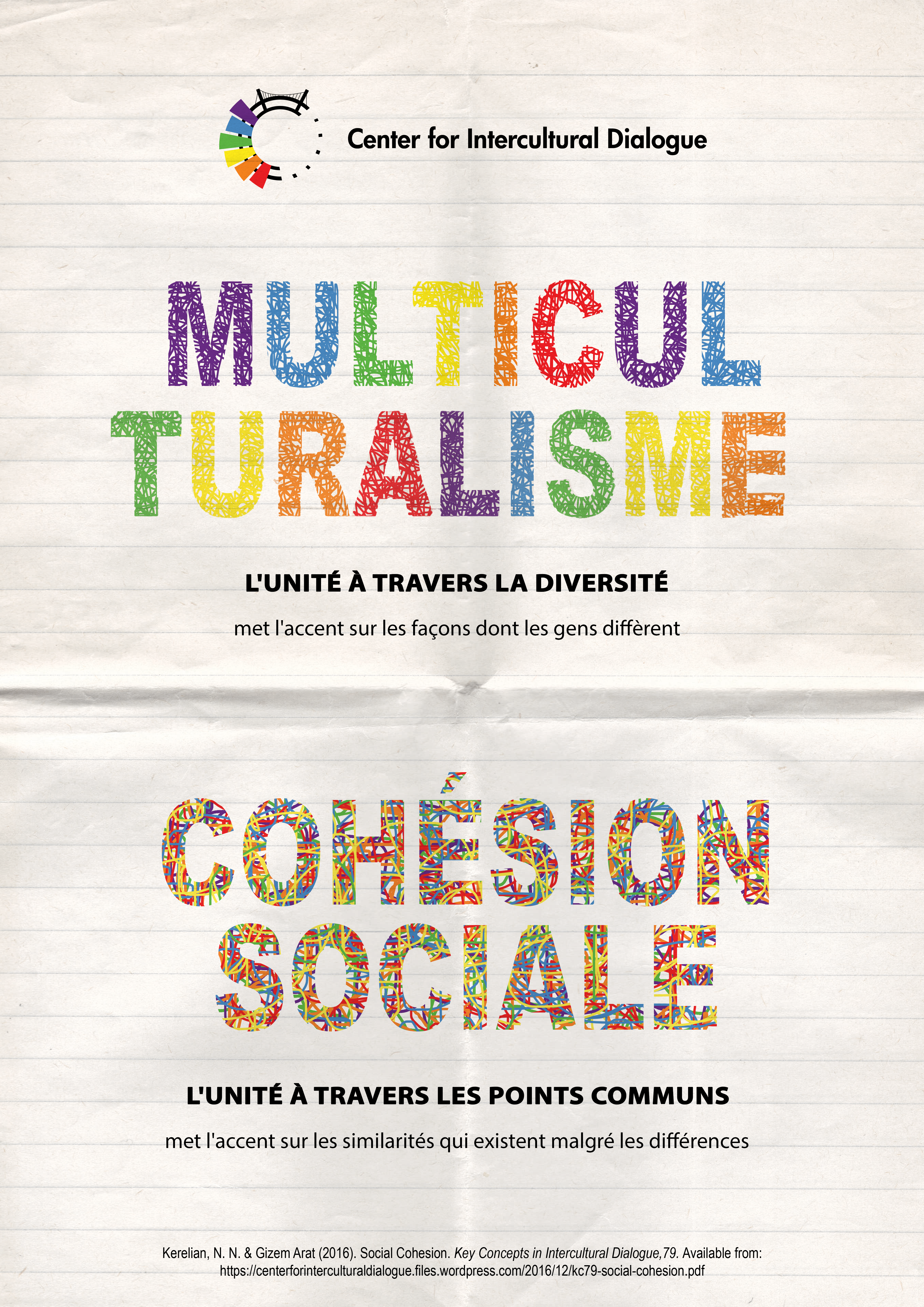
CID Poster 10: Multiculturalism vs. Social Cohesion Translated into French

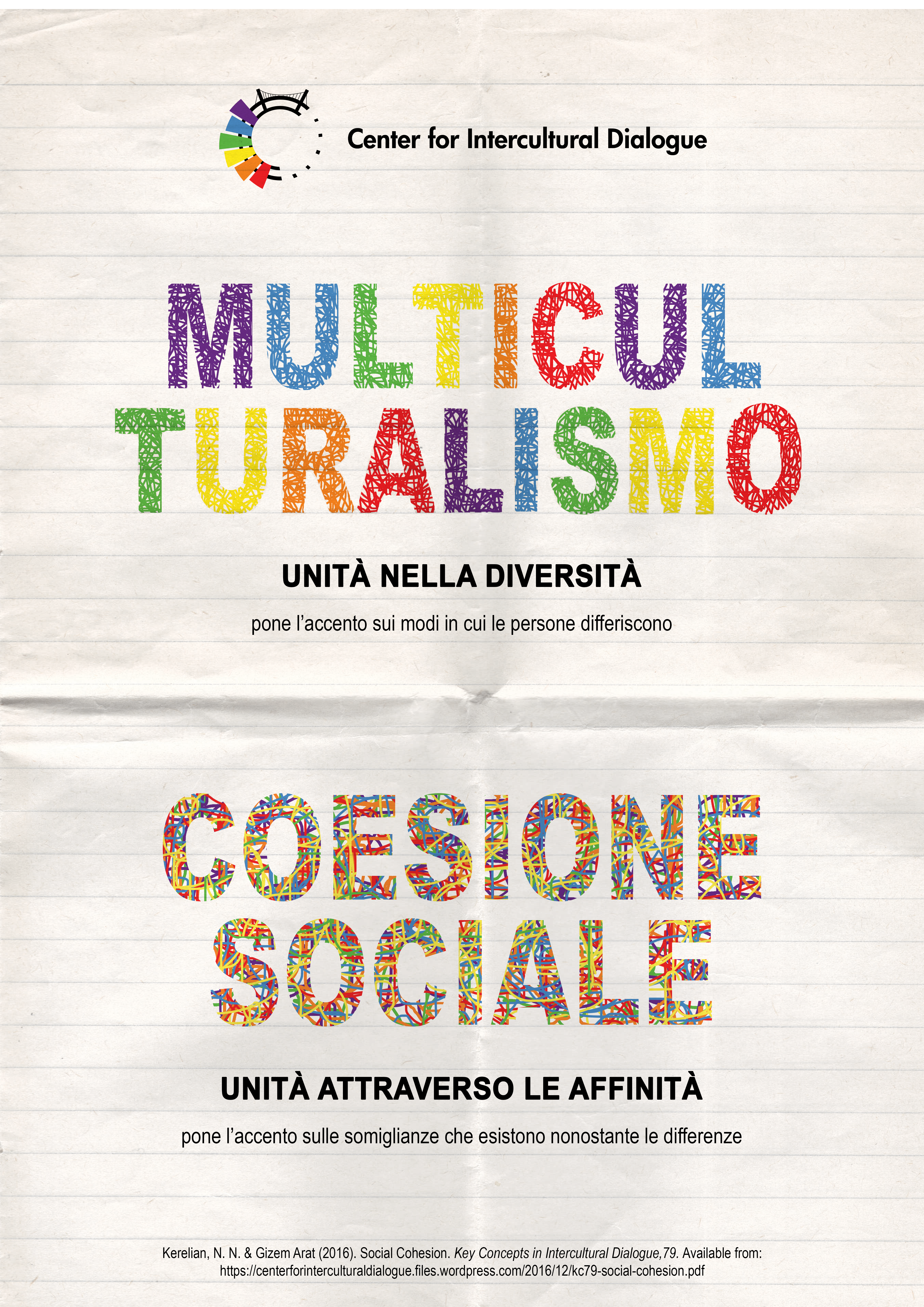
CID PostersThis is another of the posters designed by Linda J. de Wit. The content here combines KC19: Multiculturalism by Polina Golovátina-Mora and Raúl Alberto Mora with KC79: Social Cohesion by Narine Nora Kerelian and Gizem Arat.

The French translation was provided by Léonie Potvin, and the graphic design work necessary to revise was by Yan Qiu. Here then is CID Poster 10: Le Multiculturalisme et la cohésion sociale.

CID Poster 10: Multiculturalism vs Social Cohesion Translated into FrenchJust in case anyone wants to cite this poster, the following would be the recommended format:

Center for Intercultural Dialogue. (2024). Le Multiculturalisme et la cohésion sociale [L. Potvin, trans.]. CID Posters, 10. Available from: https://centerforinterculturaldialogue.org/wp-content/uploads/2024/10/cid-poster-10-multiculturalism-french.png

As with other series, CID Posters are available for free on the site; just click on the thumbnail to download a printable PNG. They may be downloaded, printed, and shared as is, without changes, without cost, so long as there is acknowledgment of the source.

As with other CID Publications, if you wish to contribute an original contribution, please send an email before starting any work to receive approval, to minimize inadvertent duplication, and to learn about technical requirements. As is the case any series, posters should be created initially in English. If you want to volunteer to translate a poster into a language in which you are fluent, send in a note before starting, to receive approval and to confirm no one else is working on the same one.

Wendy Leeds-Hurwitz
Director, Center for Intercultural Dialogue
intercult.dialogue AT gmail.com


Creative Commons License
This work is licensed under a Creative Commons Attribution-NonCommercial-NoDerivatives 4.0 International License.
KC19 Multiculturalism Translated into Simplified Chinese

Key Concepts in ICDContinuing translations of Key Concepts in Intercultural Dialogue, today I am posting KC19: Multiculturalism, which Polina Golovátina-Mora and Raúl Alberto Mora wrote for publication in English in 2014, and which Yan Qiu has now translated into Simplified Chinese.

As always, all Key Concepts are available as free PDFs; just click on the thumbnail to download. Lists of Key Concepts organized chronologically by publication date and number, alphabetically by concept, and by languages into which they have been translated, are available, as is a page of acknowledgments with the names of all authors, translators, and reviewers.

KC19 Multiculturalism translated into Simplified ChineseGolovátina-Mora, P., & Mora, R. A. (2024). Multiculturalism [Simplified Chinese] (Y. Qiu, Trans.). Key Concepts in Intercultural Dialogue, 19. Retrieved from:
https://centerforinterculturaldialogue.org/wp-content/uploads/2024/10/kc19-multiculturalism_sim-chinese.pdf

If you are interested in translating one of the Key Concepts, please contact me for approval first because dozens are currently in process. As always, if there is a concept you think should be written up as one of the Key Concepts, whether in English or any other language, propose it. If you are new to CID, please provide a brief resume. This opportunity is open to masters students and above, on the assumption that some familiarity with academic conventions generally, and discussion of intercultural dialogue specifically, are useful.

Wendy Leeds-Hurwitz, Director
Center for Intercultural Dialogue


Creative Commons License
This work is licensed under a Creative Commons Attribution-NonCommercial-NoDerivatives 4.0 International License.
Multicultural Music: Cultural Connections Over Time

Applied ICD

Williger, Jonathan. (23 May 2023). From Pomona to Heart Mountain: “La Banda Más Chingón en Wyoming.” Folklife Magazine.

“The cultural and geographic lineage of “La Banda Más Chingón en Wyoming” by No-No Boy with Mariachi Los Broncos is culturally layered and deeply American: a mariachi rendition of a folk-country song about a 1940s Japanese American swing band, composed in Wyoming by the son of a Vietnamese refugee from Nashville performed in Southern California. Brimming with ecstatic energy and righteous anger, the song draws connections between recent waves of migration from Central and South America and the long history of Asian American immigration and the discrimination both groups have experienced once they reached American soil.”

This recording is a great example of combining multiple cultural heritages through music. The article explicitly discusses the parallels between current Latin American migrants to the US, and Japanese Americans during World War II.

CERC: Under the Tent (Canada)

Intercultural Dialogue Pedagogy
Under the Tent. Canada Excellence Research Chair (CERC) in Migration and Integration, Toronto Metropolitan University, Toronto, Canada.

“Under the Tent is a multimedia storytelling project that explores how individuals experience a sense of belonging or not belonging under the tent of Canadian multiculturalism…The project began in the fall of 2021 with a call to graduate students from across Canada to collaborate with CERC Migration to produce a creative work that investigated multiculturalism…Through a competitive process, a select group of graduate students were invited to receive training support and mentorship to explore their personal experiences with race and diversity in the production of a creative work using a medium of their choice. They were asked to express criticisms and also new thinking on the future possibilities of multiculturalism.”

What is now available online are 17 of the stories presented as short films, sometimes supplemented by photographs and interviews, describing ways in which each of the authors falls “under the tent” of multiculturalism in Canada. These are divided into 3 acts: Act 1: Negotiating barriers, overcoming differences; Act 2: Connections to the past, the journey ahead; and Act 3: Importance of refuge, reconciliation and empowerment. This would be a useful collection to begin a class discussion, and might well serve as inspiration for a class project.

Planning for Multiculturalism in Architecture

Applied ICD

Anju George. (25 April 2023). Planning For Multiculturalism: The Case For Equity And Justice In Communities. Canada Architecture News.

Intercultural dialogue that provides a platform for authentic dialogue, which engages marginalized people, individually and as a collective force, should normatively take into account critical multiculturalism as a social movement that provides opportunities for minority groups to live together in a diverse society symbolized by mutual respect and understanding.

“Multicultural planning has slowly but steadily been growing in importance. There have been arguments that speak to the failure of multicultural planning advocacy translating into effective multicultural planning practice. Multicultural planning has been discussed with respect to marginalized and/or disenfranchised groups predominantly, but not so much on pluralistic planning pertaining to multi-ethnic groups. As minority groups have often been pushed to the sidelines, inclusive physical and/or spatial planning may actually be the answer to effecting change. But the research on inclusive physical planning within multicultural planning literature is limited at best. The concepts of equity and justice have not been analyzed as much either within the realm of multicultural planning. This article (and my future research) will help to have those discourses within multicultural planning, and can aid in formulating a policy framework for multicultural spaces in Canadian communities than can incorporate the tenets of equity and justice.”

This is an interesting article combining intercultural dialogue with spatial planning that may be of interest to CID followers.

Example of Multicultural Confusion: English-French Toast

Intercultural Pedagogy

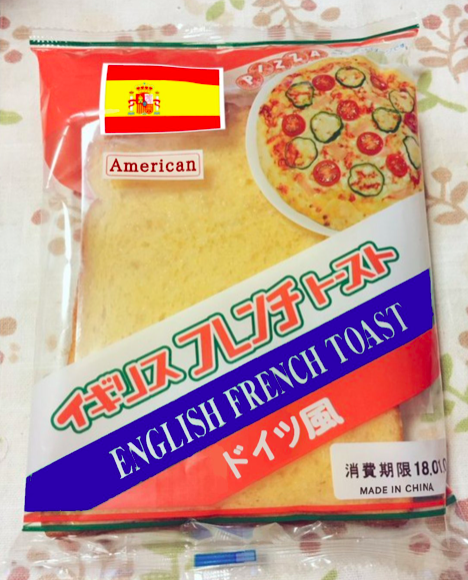
This image is of “English-French toast,” also identified as American and German, marked with the Spanish flag and an image of (Italian) pizza, marketed to the Japanese, and made in China.

This astonishing photo showed up on my Twitter feed, and I was sure others would find it fascinating as well.

English-French toast
Intercultural incompetence and/or misappropriation (?)

The person who posted it, Dr. Duane Watson, a professor of psychology at Vanderbilt University, used it as illustration of what a manuscript can look like after multiple rounds of reviews. But to me, this is a great example of the role of food in intercultural communication, as well as multiculturalism gone wild.  Dr. Byron Ahn, a professor of linguistics at Princeton, mentioned in a comment that, in addition to the English words “English,” “French,” and “American” that show up, the Japanese script translates to “German style.”  And there’s a Spanish flag, and an image of a pizza (presumably Italian), with the word “pizza” next to it. (Is the suggestion perhaps that   buyers might use French toast as the bread layer for a pizza?) So it’s American-Spanish-Italian-English-French-toast made in the German style, marketed to the Japanese, and made in China.

The image is posted here with thanks to both Watson and Ahn, and for anyone who needs a smile today, or who needs an example guaranteed to spark some class discussion.

Wendy Leeds-Hurwitz, Director
Center for Intercultural Dialogue

Cultural Identity and Multiculturalism on Film (Canada)

Intercultural Pedagogyi am… Films about cultural identity, multiculturalism, and integration, available for free from Toronto Metropolitan University, Canada.

Graduate students from across Canada were invited to submit proposals to be part of an exciting opportunity to capture their individual expressions of identity and belonging or not belonging in a three-minute film. Through a competitive selection process, 28 students were selected to receive professional mentorship and support to produce an engaging short film of their unique story. Most of them had little or no filmmaking experience but got busy inside their pandemic bubbles for six months. These short films together weave a tapestry of Canadian identity today. Project led by Toronto Metropolitan University professor Anna Triandafyllidou, the Canada Excellence Research Chair (CERC) in Migration and Integration, and by Gemini award-winning filmmaker and scholar Cyrus Sundar Singh.

For an article explaining more about the project, see: 

Office of the Vice President, Research and Innovation. (2022). Telling stories of identity and multiculturalism through film. Innovation Newsletter, Toronto Metropolitan University.


KC19 Multiculturalism Translated into Portuguese

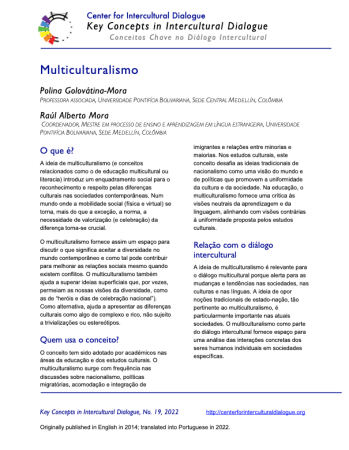
Key Concepts in ICDContinuing translations of Key Concepts in Intercultural Dialogue, today I am posting KC19: Multiculturalism, which Polina Golovátina-Mora and Raúl Alberto Mora wrote for publication in English in 2014, and which Filipa Subtil has now translated into Portuguese.

As always, all Key Concepts are available as free PDFs; just click on the thumbnail to download. Lists of Key Concepts organized chronologically by publication date and number, alphabetically by concept, and by languages into which they have been translated, are available, as is a page of acknowledgments with the names of all authors, translators, and reviewers.

KC19 Multiculturalism_PortugueseGolovátina-Mora, P., & Mora, R. A. (2022). Multiculturalismo. (F. Subtil, Trans.). Key Concepts in Intercultural Dialogue, 19. Retrieved from: https://centerforinterculturaldialogue.org/wp-content/uploads/2022/05/kc19-multiculturalism_portuguese.pdf

If you are interested in translating one of the Key Concepts, please contact me for approval first because dozens are currently in process. As always, if there is a concept you think should be written up as one of the Key Concepts, whether in English or any other language, propose it. If you are new to CID, please provide a brief resume. This opportunity is open to masters students and above, on the assumption that some familiarity with academic conventions generally, and discussion of intercultural dialogue specifically, are useful.

Wendy Leeds-Hurwitz, Director
Center for Intercultural Dialogue


Creative Commons License
This work is licensed under a Creative Commons Attribution-NonCommercial-NoDerivatives 4.0 International License.

KC19 Multiculturalism Translated into Turkish

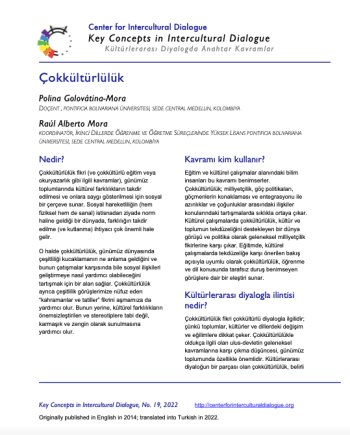
Key Concepts in ICDContinuing translations of Key Concepts in Intercultural Dialogue, today I am posting KC#19: Multiculturalism, which Polina Golovátina-Mora and Raúl Alberto Mora wrote for publication in English in 2014, and which İçten Duygu Özbek has now translated into Turkish.

As always, all Key Concepts are available as free PDFs; just click on the thumbnail to download. Lists of Key Concepts organized chronologically by publication date and number, alphabetically by concept, and by languages into which they have been translated, are available, as is a page of acknowledgments with the names of all authors, translators, and reviewers.

KC19 Multiculturalism_TurkishGolovátina-Mora, P., & Mora, R. A. (2022). Multiculturalism [Turkish] (İ. D. Özbek, Trans.). Key Concepts in Intercultural Dialogue, 19. Retrieved from: https://centerforinterculturaldialogue.org/wp-content/uploads/2022/01/kc19-multiculturalism_turkish.pdf

If you are interested in translating one of the Key Concepts, please contact me for approval first because dozens are currently in process. As always, if there is a concept you think should be written up as one of the Key Concepts, whether in English or any other language, propose it. If you are new to CID, please provide a brief resume. This opportunity is open to masters students and above, on the assumption that some familiarity with academic conventions generally, and discussion of intercultural dialogue specifically, are useful.

Wendy Leeds-Hurwitz, Director
Center for Intercultural Dialogue


Creative Commons License
This work is licensed under a Creative Commons Attribution-NonCommercial-NoDerivatives 4.0 International License.

CID Poster #10: Multiculturalism vs. Social Cohesion (reprise)

CID Posters(We are reprising the series of posters, because it has been several years since they were originally created, and they are much too wonderful to let them not be noticed by newcomers to the site!)

This is a bonus poster, designed by Linda J. de Wit even though she has completed her time as CID intern. This is the second poster to use the Key Concepts in Intercultural Dialogue as the source. The content here combines KC19: Multiculturalism by Polina Golovátina-Mora and Raúl Alberto Mora with KC79: Social Cohesion by Narine Nora Kerelian and Gizem Arat.

CID Poster #10: Multiculturalism vs Social CohesionJust in case anyone wants to cite this poster, the following would be the recommended format:

Center for Intercultural Dialogue. (2017). Multiculturalism vs. Social Cohesion. CID Posters, 10. Available from:
https://centerforinterculturaldialogue.org/wp-content/uploads/2017/09/multiculturalism-social-cohesion.png

As with other series, CID Posters are available for free on the site; just click on the thumbnail to download a printable PDF. They may be downloaded, printed, and shared as is, without changes, without cost, so long as there is acknowledgment of the source.

As with other series, if you wish to contribute an original contribution, please send an email before starting any work to receive approval, to minimize inadvertent duplication, and to learn about technical requirements. As is the case with other CID Publications, posters should be created initially in English. Given that translations of the Key Concepts in Intercultural Dialogue have received so many views, anyone who wishes to translate their own poster into another language (or two) is invited to provide that as well. If you want to volunteer to translate someone else’s poster into a language in which you are fluent, send in a note before starting, to receive approval and to confirm no one else is working on the same one.

Wendy Leeds-Hurwitz
Director, Center for Intercultural Dialogue
intercult.dialogue AT gmail.com


Creative Commons License
This work is licensed under a Creative Commons Attribution-NonCommercial-NoDerivatives 4.0 International License.