
KC 100: Transcultural Communication Translated into Simplified Chinese

Key Concepts in ICDContinuing translations of Key Concepts in Intercultural Dialogue, today I am posting KC100: Transcultural Communication, originally written by Mohammed Guamguami for publication in 2021, and now translated by Yan Qiu into Simplified Chinese.

As always, all Key Concepts are available as free PDFs; just click on the thumbnail to download. Lists organized chronologically by publication date and numberalphabetically by concept in English, and by languages into which they have been translated, are available, as is a page of acknowledgments with the names of all authors, translators, and reviewers.
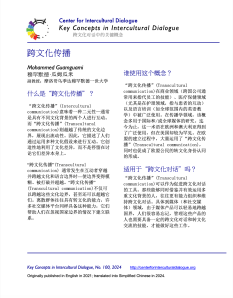
KC100 Transcultural Communication Translated into Simplified ChineseGuamguami, M. (2024). Transcultural communication [Simplified Chinese]. (Y. Qiu, Trans.)  Key Concepts in Intercultural Dialogue, 100. Available from: https://centerforinterculturaldialogue.org/wp-content/uploads/2024/11/kc100-transcultural-communication_simplified-chinese.pdf

If you are interested in translating one of the Key Concepts, please contact me for approval first because dozens are currently in process. As always, if there is a concept you think should be written up as one of the Key Concepts, whether in English or any other language, propose it. If you are new to CID, please provide a brief resume. This opportunity is open to masters students and above, on the assumption that some familiarity with academic conventions generally, and discussion of intercultural dialogue specifically, are useful.

Wendy Leeds-Hurwitz, Director
Center for Intercultural Dialogue


Creative Commons License
This work is licensed under a Creative Commons Attribution-NonCommercial-NoDerivatives 4.0 International License.
Save

KC95 Transnational Media Translated into Simplified Chinese

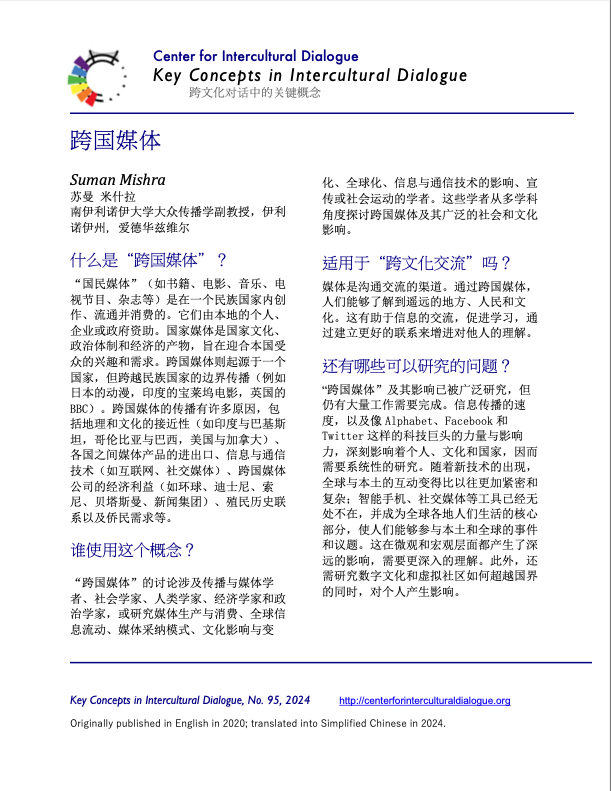
Key Concepts in ICDContinuing translations of Key Concepts in Intercultural Dialogue, today I am posting KC95: Transnational media, which Suman Mishra wrote for publication in English in 2020, and which Yan Qiu has now translated into Simplified Chinese.

As always, all Key Concepts are available as free PDFs; just click on the thumbnail to download. Lists of Key Concepts organized chronologically by publication date and number, alphabetically by concept, and by languages into which they have been translated, are available, as is a page of acknowledgments with the names of all authors, translators, and reviewers.

KC95 Transnational Media Translated into Simplified Chinese

Mishra, S. (2024). Transnational media [Simplified Chinese]. (Y. Qiu, Trans.). Key Concepts in Intercultural Dialogue, 95. Available from: https://centerforinterculturaldialogue.org/wp-content/uploads/2024/10/kc95-transnational-media_sim-chinese.pdf

If you are interested in translating one of the Key Concepts, please contact me for approval first because dozens are currently in process. As always, if there is a concept you think should be written up as one of the Key Concepts, whether in English or any other language, propose it. If you are new to CID, please provide a brief resume. This opportunity is open to masters students and above, on the assumption that some familiarity with academic conventions generally, and discussion of intercultural dialogue specifically, are useful.

Wendy Leeds-Hurwitz, Director
Center for Intercultural Dialogue


Creative Commons License
This work is licensed under a Creative Commons Attribution-NonCommercial-NoDerivatives 4.0 International License.
KC105 Acculturation Translated into Persian

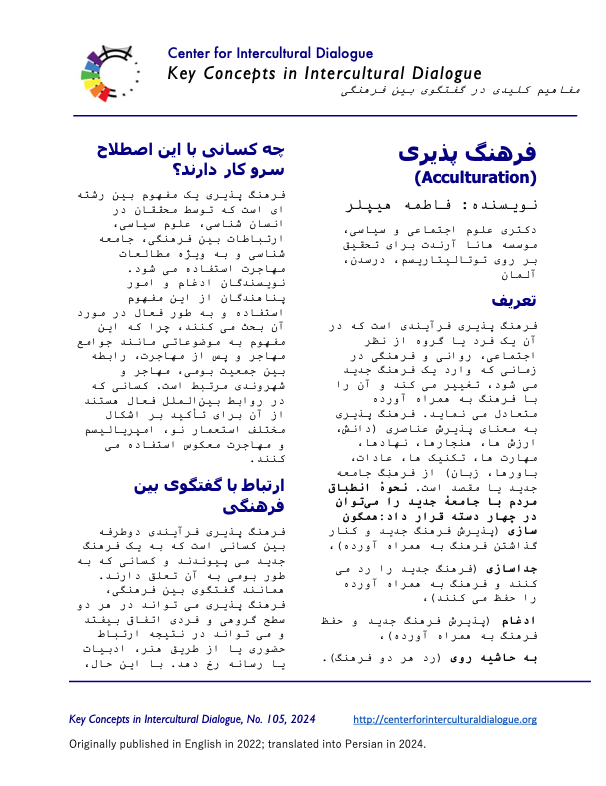
Key Concepts in ICDContinuing translations of Key Concepts in Intercultural Dialogue, today I am posting KC105: Acculturation, which Fatemeh Hippler (Kamali-Chirani) wrote for publication last year, and which she has now translated into Persian.

As always, all Key Concepts are available as free PDFs; just click on the thumbnail to download. Lists organized chronologically by publication date and numberalphabetically by concept in English, and by languages into which they have been translated, are available, as is a page of acknowledgments with the names of all authors, translators, and reviewers.

KC105 Accommodation translated into PersianHippler, F. (2024). Acculturation [Persian]. Key Concepts in Intercultural Dialogue, 105. Available from:
https://centerforinterculturaldialogue.org/wp-content/uploads/2024/10/kc105-acculturation_persian.pdf

The Center for Intercultural Dialogue publishes a series of short briefs describing Key Concepts in Intercultural Dialogue. Different people, working in different countries and disciplines, use different vocabulary to describe their interests, yet these terms overlap. Our goal is to provide some of the assumptions and history attached to each concept for those unfamiliar with it. As there are other concepts you would like to see included, send an email to the series editor, Wendy Leeds-Hurwitz. If there are concepts you would like to prepare, provide a brief explanation of why you think the concept is central to the study of intercultural dialogue, and why you are the obvious person to write up that concept.


Creative Commons License
This work is licensed under a Creative Commons Attribution-NonCommercial-NoDerivatives 4.0 International License.
KC19 Multiculturalism Translated into Simplified Chinese

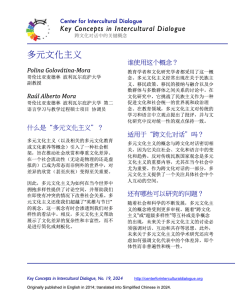
Key Concepts in ICDContinuing translations of Key Concepts in Intercultural Dialogue, today I am posting KC19: Multiculturalism, which Polina Golovátina-Mora and Raúl Alberto Mora wrote for publication in English in 2014, and which Yan Qiu has now translated into Simplified Chinese.

As always, all Key Concepts are available as free PDFs; just click on the thumbnail to download. Lists of Key Concepts organized chronologically by publication date and number, alphabetically by concept, and by languages into which they have been translated, are available, as is a page of acknowledgments with the names of all authors, translators, and reviewers.

KC19 Multiculturalism translated into Simplified ChineseGolovátina-Mora, P., & Mora, R. A. (2024). Multiculturalism [Simplified Chinese] (Y. Qiu, Trans.). Key Concepts in Intercultural Dialogue, 19. Retrieved from:
https://centerforinterculturaldialogue.org/wp-content/uploads/2024/10/kc19-multiculturalism_sim-chinese.pdf

If you are interested in translating one of the Key Concepts, please contact me for approval first because dozens are currently in process. As always, if there is a concept you think should be written up as one of the Key Concepts, whether in English or any other language, propose it. If you are new to CID, please provide a brief resume. This opportunity is open to masters students and above, on the assumption that some familiarity with academic conventions generally, and discussion of intercultural dialogue specifically, are useful.

Wendy Leeds-Hurwitz, Director
Center for Intercultural Dialogue


Creative Commons License
This work is licensed under a Creative Commons Attribution-NonCommercial-NoDerivatives 4.0 International License.
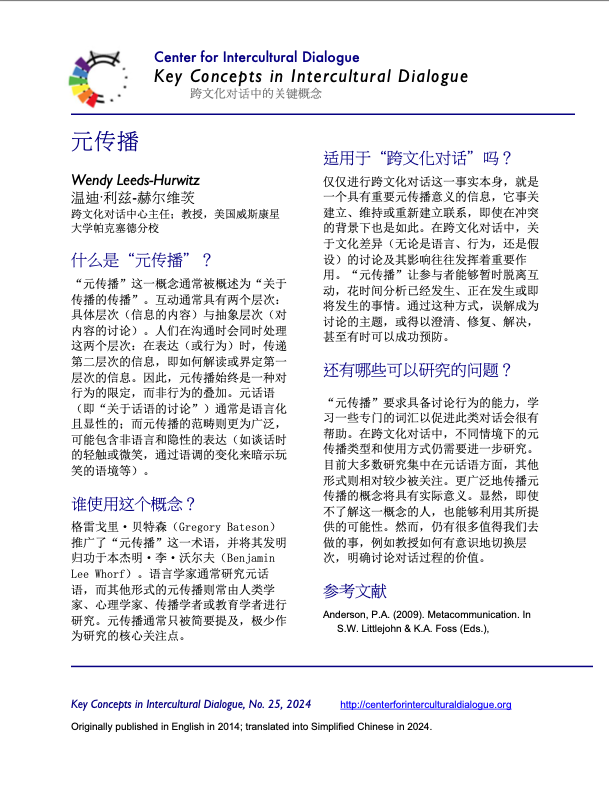
KC25 Metacommunication Translated into Simplified Chinese

Key Concepts in ICDContinuing translations of Key Concepts in Intercultural Dialogue, today I am posting KC25: Metacommunication, which I wrote for publication in English in 2014, and which Yan Qiu has now translated into Simplified Chinese.

As always, all Key Concepts are available as free PDFs; just click on the thumbnail to download. Lists of Key Concepts organized chronologically by publication date and number, alphabetically by concept, and by languages into which they have been translated, are available, as is a page of acknowledgments with the names of all authors, translators, and reviewers.

Key Concept 25: Metacommunication translated into Simplified ChineseLeeds-Hurwitz, W. (2024). Metacommunication [Simplified Chinese]. (Y. Qiu, trans). Key Concepts in Intercultural Dialogue, 25. Available from: https://centerforinterculturaldialogue.org/wp-content/uploads/2024/11/kc25-metacommunication_sim-chinese2.pdf

If you are interested in translating one of the Key Concepts, please contact me for approval first because dozens are currently in process. As always, if there is a concept you think should be written up as one of the Key Concepts, whether in English or any other language, propose it. If you are new to CID, please provide a brief resume. This opportunity is open to masters students and above, on the assumption that some familiarity with academic conventions generally, and discussion of intercultural dialogue specifically, are useful.

Wendy Leeds-Hurwitz, Director
Center for Intercultural Dialogue


Creative Commons License
This work is licensed under a Creative Commons Attribution-NonCommercial-NoDerivatives 4.0 International License.
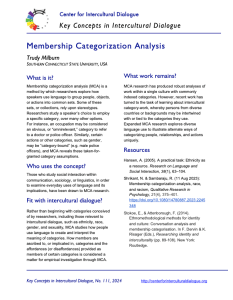
Key Concept 111: Membership Categorization Analysis

Key Concepts in ICD

The next issue of Key Concepts in intercultural Dialogue is now available. This is KC111: Membership Categorization Analysis by Trudy Milburn. As always, all Key Concepts are available as free PDFs; just click on the thumbnail to download. Lists organized chronologically by publication date and numberalphabetically by concept in English, and by languages into which they have been translated, are available, as is a page of acknowledgments with the names of all authors, translators, and reviewers.

Key Concept 111: Membership Categorization AnalysisMilburn, T. (2024). Membership Categorization Analysis. Key Concepts in Intercultural Dialogue, 111. Available from: https://centerforinterculturaldialogue.org/wp-content/uploads/2024/09/kc111-mca-1.pdf

The Center for Intercultural Dialogue publishes a series of short briefs describing Key Concepts in Intercultural Dialogue. Different people, working in different countries and disciplines, use different vocabulary to describe their interests, yet these terms overlap. Our goal is to provide some of the assumptions and history attached to each concept for those unfamiliar with it. As there are other concepts you would like to see included, send an email. If there are concepts you would like to prepare, provide a brief explanation of why you think the concept is central to the study of intercultural dialogue, and why you are the obvious person to write up that concept.


Creative Commons License
This work is licensed under a Creative Commons Attribution-NonCommercial-NoDerivatives 4.0 International License.
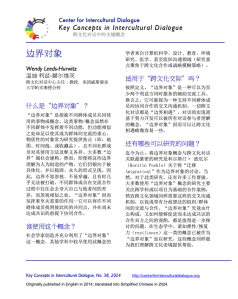
KC 38 Boundary Objects Translated into Simplified Chinese

Key Concepts in ICDContinuing translations of Key Concepts in Intercultural Dialogue, today I am posting KC#38: Boundary Objects, which I wrote for publication in English in 2014, and which Mingshi Cui has now translated into Simplified Chinese.

As always, all Key Concepts are available as free PDFs; just click on the thumbnail to download. Lists of Key Concepts organized chronologically by publication date and number, alphabetically by concept, and by languages into which they have been translated, are available, as is a page of acknowledgments with the names of all authors, translators, and reviewers.

Key Concept 38 Boundary Objects translated into Simplified ChineseLeeds-Hurwitz, W. (2024). Boundary objects [Simplified Chinese]. (M. Cui, trans). Key Concepts in Intercultural Dialogue, 38. Available from: https://centerforinterculturaldialogue.org/wp-content/uploads/2024/09/kc38-boundary-object_sim-chinese.pdf

If you are interested in translating one of the Key Concepts, please contact me for approval first because dozens are currently in process. As always, if there is a concept you think should be written up as one of the Key Concepts, whether in English or any other language, propose it. If you are new to CID, please provide a brief resume. This opportunity is open to masters students and above, on the assumption that some familiarity with academic conventions generally, and discussion of intercultural dialogue specifically, are useful.

Wendy Leeds-Hurwitz, Director
Center for Intercultural Dialogue


Creative Commons License
This work is licensed under a Creative Commons Attribution-NonCommercial-NoDerivatives 4.0 International License.
KC88 Critical Cultural Linguistics Translated into German

Key Concepts in ICD

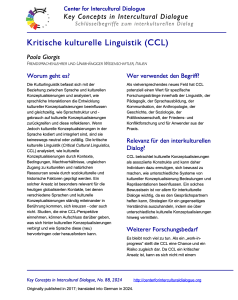
Continuing translations of Key Concepts in Intercultural Dialogue, today I am posting KC88: Critical Cultural Linguistics, originally written by Paola Giorgis for publication in 2017, and now translated by Marlena Pompino into German.

As always, all Key Concepts are available as free PDFs; just click on the thumbnail to download. Lists organized chronologically by publication date and numberalphabetically by concept in English, and by languages into which they have been translated, are available, as is a page of acknowledgments with the names of all authors, translators, and reviewers.

Giorgis, P. (2024). Kritische kulturelle Linguistik. (M. Pompino, trans.) Key Concepts in Intercultural Dialogue, 88. Available from:

The Center for Intercultural Dialogue publishes a series of short briefs describing Key Concepts in Intercultural Dialogue. Different people, working in different countries and disciplines, use different vocabulary to describe their interests, yet these terms overlap. Our goal is to provide some of the assumptions and history attached to each concept for those unfamiliar with it. As there are other concepts you would like to see included, send an email to the series editor, Wendy Leeds-Hurwitz. If there are concepts you would like to prepare, provide a brief explanation of why you think the concept is central to the study of intercultural dialogue, and why you are the obvious person to write up that concept.


Creative Commons License
This work is licensed under a Creative Commons Attribution-NonCommercial-NoDerivatives 4.0 International License.
KC108 Superdiversity Translated into German

Key Concepts in ICD

Continuing translations of Key Concepts in Intercultural Dialogue, today I am posting KC108: Superdiversity, originally written by Constance Mbassi Manga for publication in 2023, and now translated by Marlena Pompino into German.

As always, all Key Concepts are available as free PDFs; just click on the thumbnail to download. Lists organized chronologically by publication date and numberalphabetically by concept in English, and by languages into which they have been translated, are available, as is a page of acknowledgments with the names of all authors, translators, and reviewers.

KC108 Superdiversity in German

Mbassi Manga, C. (2024). Superdiversität. (M. Pompino, trans.) Key Concepts in Intercultural Dialogue, 108. Available from: https://centerforinterculturaldialogue.org/wp-content/uploads/2024/06/kc108-superdiversity_german.pdf

The Center for Intercultural Dialogue publishes a series of short briefs describing Key Concepts in Intercultural Dialogue. Different people, working in different countries and disciplines, use different vocabulary to describe their interests, yet these terms overlap. Our goal is to provide some of the assumptions and history attached to each concept for those unfamiliar with it. As there are other concepts you would like to see included, send an email to the series editor, Wendy Leeds-Hurwitz. If there are concepts you would like to prepare, provide a brief explanation of why you think the concept is central to the study of intercultural dialogue, and why you are the obvious person to write up that concept.


Creative Commons License
This work is licensed under a Creative Commons Attribution-NonCommercial-NoDerivatives 4.0 International License.

KC107 Interculturality Translated into German

Key Concepts in ICD

Continuing translations of Key Concepts in Intercultural Dialogue, today I am posting KC107: Interculturality, originally written by Mélodine Sommier & Malgorzata Lahti for publication in 2023, and now translated by Marlena Pompino into German.

As always, all Key Concepts are available as free PDFs; just click on the thumbnail to download. Lists organized chronologically by publication date and numberalphabetically by concept in English, and by languages into which they have been translated, are available, as is a page of acknowledgments with the names of all authors, translators, and reviewers.

KC107 Interculturality in German

Sommier, M., & Lahti, M. (2024). Interkulturalität. (M. Pompino, trans.) Key Concepts in Intercultural Dialogue, 107. Available from: https://centerforinterculturaldialogue.org/wp-content/uploads/2024/06/kc107-interculturality_german.pdf

The Center for Intercultural Dialogue publishes a series of short briefs describing Key Concepts in Intercultural Dialogue. Different people, working in different countries and disciplines, use different vocabulary to describe their interests, yet these terms overlap. Our goal is to provide some of the assumptions and history attached to each concept for those unfamiliar with it. As there are other concepts you would like to see included, send an email to the series editor, Wendy Leeds-Hurwitz. If there are concepts you would like to prepare, provide a brief explanation of why you think the concept is central to the study of intercultural dialogue, and why you are the obvious person to write up that concept.


Creative Commons License
This work is licensed under a Creative Commons Attribution-NonCommercial-NoDerivatives 4.0 International License.