Marc Hermeking Profile

ProfilesMarc Hermeking (Dr. Phil.), is scientific lecturer in cross-cultural marketing, product development and marketing communications with a special focus on culture & ICT, technical communication and cross-cultural transfer of technology.

Marc HermekingHe is affiliated with the Institute for Intercultural Communication at the University of Munich (LMU), Germany, where he earned his doctoral degree with his inaugural dissertation on the cultural influences on the handling of industrial technology (Kulturen und Technik, 2001). In recent years, he focused on the Influence of culture on all kinds of computer-mediated communication.

Some of his publications are, for example:

(2015). Das Mobiltelefon im Kulturvergleich: Exemplarische Forschungsfelder interkultureller Technik-Kommunikation. In: Banse, G. / Rothkegel, A. (Eds.): Neue Medien: Interdependenzen von Technik, Kultur und Kommunikation (eCulture – Network Cultural Diversity and New Media, vol. 19, pp. 143-161). Berlin: Trafo.

(2013). Kulturelle Aspekte technischer Sicherheit: Interkulturelle Sicherheitskommunikation. In S. Stumpf, E. Schuch & U. Meyer (Eds.), Technik und Kultur: Anwendungsorientierte Beiträge zu einem Spannungsfeld (pp. 51-62). Lengerich: Pabst Science Publishers.

(2012). Cultural aspects of technology and documentation: Contributions from the field of intercultural communication. In A. Rothkegel & S. Ruda (Eds.), Communication on and via Technology (pp. 203-216). Berlin: Mouton de Gruyter.

(2011). Culture, Online Technology and Computer-mediated Technical Documentation: Contributions from the Field of Intercultural Communication. In K. St.Amant & S. Kelsey (Eds.), Computer-Mediated Communication across Cultures: International Interactions in Online Environments (pp. 77-90). Hershey, PA: Information Science Reference/IGI.

(2010). Kultur und Technik: Schnittstellen für die Interkulturelle Kommunikation. In G. Banse G. & A. Grunwald (Eds.), Technik und Kultur: Bedingungs- und Beeinflussungsverhältnisse (pp. 163-178). Karlsruhe: KIT Scientific Publishing.

(2008). Lokalisierung von Webseiten – Interkulturelle Marketing-Kommunikation. MDÜ – Fachzeitschrift für Dolmetscher und Übersetzer, 55(3), 48-53.

(2005, re-issued 2006): Culture and Internet Consumption: Contributions from Cross-cultural Marketing and Advertising. Journal of Computer Mediated Communication, 11(1), 192-216.

(2001). Kulturen und Technik: Techniktransfer als Arbeitsfeld der Interkulturellen Kommunikation. Beispiele aus der arabischen, russischen und lateinamerikanischen Region. Münster/München/New York: Waxmann

See more at his university webpage.


Work for CID:

Marc Hermeking has served as a reviewer for German translations.

Dominic Busch Profile

ProfilesDominic Busch is a Professor of Intercultural Communication and Conflict Research at Universität der Bundeswehr München, Germany. He received his doctorate in 2005 at Europa-Universität Viadrina Frankfurt (Oder), Germany. From 2006 to 2011 he was a Junior Professor in Intercultural Communication at Europa-Universität Viadrina Frankfurt (Oder).

Dominic BuschIn his research on intercultural communication, he explores the epistemological, ontological, and axiological premises of how intercultural communication is approached from an academic angle. To this end, he takes the perspective of discourse analysis. While research on intercultural communication often has strong disagreements between different paradigms, the minimum common ground is that culture and intercultural communication are talked about in both academia and in Western societies’ everyday life. Culture and intercultural communication are thus objects of discourse, and thus first and foremost discursive constructions. Several characteristics of the field of intercultural communication can be observed on the basis of this assumption:

Both everyday discourses and academic discourses around intercultural communication constitute themselves in such a way that their object never ceases to be perpetuated and never disappears – even if this might actually represent a plausible goal of dealing with it. Discourses are shaped by power structures and hegemonies, and this is how core understandings of intercultural communication emerge. Their permanent self-preservation can also be described by the phenomenon of the dispositive after Michel Foucault, as Dominic Busch shows in his 2013 book. Discourse on intercultural communication fabricates problems for which, at the same time, it always provides only partial solutions. Even the strongest paradigm shift cannot overcome this, but will always only reinforce the dispositive.

At the same time, the discourse on intercultural communication is never void of interests, and research is never strictly heuristic: the study of intercultural communication is always based on societies’ aspirations of an ideal coexistence. The perceptions of problems are impossible without visions of how things should actually be better. Visions, however, traditionally do not have a seat in social science research; they are often regarded as unscientific. However, we cannot really understand how research questions are framed and how studies in this field are arranged if authors and readers would not share ideals about how to deal with interculturality, ideals that are only subtly expressed in the texts.

In his research, Dominic Busch aims to show how research on intercultural communication seeks to deal with this dilemma. To this end, it is first necessary to uncover and identify the normative ideas on how to deal with interculturality – which can also be referred to as visions. Based on a discourse analysis of academic texts on intercultural communication over a period of 50 years, Dominic Busch shows in his article “The Changing Discourse of Intercultural Ethics” how these orientations change over time. Instead of a linear development, these re-orientations have been rather circular. Only in recent times a parallel diversification of different orientations in intercultural writings can be observed – along with a new disorientation and open search in an increasingly complex world, questioning old paradigms more and more.

A comparison with overarching social science paradigms and epistemologies, however, reveals how dominant these ethical orientations are. Social research is debating the implementation of post-qualitative research methods with the aim of avoiding exerting epistemic violence through research. This should involve authors reflecting more on their own positionality and instead of researching their partners, they should give voice to these partners themselves. In their article “New Methodologies – New Interculturalities?” Dominic Busch and Emilian Franco explore how papers in the research field of intercultural communication manage these issues by using new methods such as participatory research, autoethnography, and arts-based research. From a critical point of view, Busch and Franco find that many studies often do not really meet the standards of such methodologies. However, Busch and Franco show that, seen as parts of an ethical discourse on interculturality, these new methods serve as a basis for authors’ ethical and visionary reflections on a desirable way of dealing with interculturality.

Intercultural mediation is a powerful example of this visionary orientation in discourses on intercultural communication. A great many different disciplines share some interest in intercultural mediation: These include, for example, cultural anthropology, translation research, foreign language didactics, and political science research on international relations, in addition to research on intercultural communication and conflict management. Upon closer examination, these disciplines often conceive of intercultural mediation in very different ways. However, there is one common vision that unites them: that constructive pathways to intercultural understanding will always exist. This is reason enough from an ethical point of view to further promote and develop such fields of research. The Routledge Handbook of Intercultural Mediation by Dominic Busch provides an insight into this interdisciplinary field and its potentials.

Discourse analysis should therefore not be seen only as criticism, but always as a constructive prospect for development. Even more, the insight into the constructivist character of notions of cultures may open the opportunity (and the responsibility) to encourage forms of intercultural dialogue on a local and on a global level to discuss and to define notions of how positive (intercultural) coexistence may be designed. In these respects, Dominic Busch explores the potential of concepts like intercultural sustainability as well as contributions from cosmopolitanism to intercultural dialogue.

For more detailed information as well as a list of German language publications please visit Dominic Busch’s website.

Selected publications in English:

Busch, D. (Ed.). (2023). The Routledge handbook of intercultural mediation. New York: Routledge.

Busch, D., & Franco, E. (2022). New methodologies—New interculturalities? The visionary discourse of post-qualitative research on the intercultural. Language and Intercultural Communication, 1–13. DOI: 10.1080/14708477.2022.2133136.

Busch, D. (2021). The changing discourse of intercultural ethics: A diachronic meta-analysis. Journal of Multicultural Discourses, 16(3), 189–202. DOI: 10.1080/17447143.2020.1803887.

Busch, D. (2019). Intercultural conflict mediation. In P. Moy (Ed.), Oxford bibliographies in communication. New York: Oxford University Press.

Busch, D., & Möller-Kiero, J. (2017). Sustainability and ethnic peace discourse: In search for synergies from bringing together discourses on intercultural communication and on global sustainability. ESSACHESS: Journal for Communication Studies, 10(1), 217-237.

Busch, D. (2016). Does conflict mediation research keep track with cultural theory? A theory-based qualitative content analysis on concepts of culture in conflict management research. European Journal of Applied Linguistics, 4(2), 181-207.

Busch, D., & Möller-Kiero, J. (2016). Rethinking interculturality will require moral confessions: Analysing the debate among convivialists, interculturalists, cosmopolitanists and intercultural communication scholars. Interculture Journal, 15(26), 43-57.

Busch, D. (2015). Conflict Management in Organizations. In A. D. Smith, X. Hou, J. Stone, R. Dennis, & P. Rizova (Eds.), The Wiley Blackwell encyclopedia of race, ethnicity, and nationalism (pp. 1–5). John Wiley & Sons. DOI: 10.1002/9781118663202.wberen340.

Busch, D. (2015). Culture is leaving conversation analysis, but is it really gone? The analysis of culturalist performances in conversationJournal of Intercultural Communication, 39, 1-17.

Busch, D. (2015). Mediation. In J. M. Bennett (Ed.), The Sage encyclopedia of intercultural competence (pp. 608–611). Sage. DOI: 10.4135/9781483346267.n199.

Busch, D. (2012). Cultural theory and conflict management in organizations: How does theory shape our understanding of culture in practice? International Journal of Cross Cultural Management, 12(1), 9–24. DOI: 10.1177/1470595811413106.

Busch, D. (2010). Shopping in hospitality: Situational constructions of customer–vendor relationships among shopping tourists at a bazaar on the German–Polish border. Language and Intercultural Communication, 10(1), 72–89. DOI: 10.1080/14708470903452614.

Busch, D. (2009). What kind of intercultural competence will contribute to students’ future job employability? Intercultural Education, 20(5), 429–438. DOI: 10.1080/14675980903371290.


Work for CID:

Dominic Busch has written a guest post, Some Observations on Internal Social Discourses on the Recent Increase of Refugee Immigration into Germany, as well as KC76: Intercultural Sustainability and KC106: Intercultural Medication. He has translated KC1: Intercultural DialogueKC2: CosmopolitanismKC76: Intercultural Sustainability, and KC106: Intercultural Mediation into German. He also frequently reviews translations into German.


Universität der Bundeswehr München job ad

Universität der Bundeswehr München announces the vacancy of a Professorship in “Education with a Special Focus on International Comparative and Intercultural Education Research.” The professorship is based in the University’s department of education providing BA and MA courses in education. Both courses concentrate on aspects of intercultural education, media education as well as adult education. Universität der Bundeswehr München is a civic university designed for the provision of degree courses to future officers of the German army (Bundeswehr).

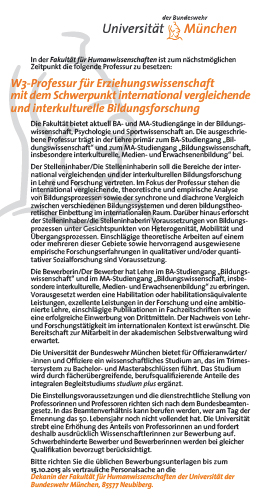
Munich job ad

In der Fakultät für Humanwissenschaften ist zum nächstmöglichen Zeitpunkt die folgende Professur zu besetzen:
W3-Professur für Erziehungswissenschaft mit dem Schwerpunkt international vergleichende und interkulturelle Bildungsforschung

Die Fakultät bietet aktuell BA- und MA-Studiengänge in der Bildungswissenschaft, Psychologie und Sportwissenschaft an. Die ausgeschriebene Professur trägt in der Lehre primär zum BA-Studiengang „Bildungswissenschaft“ und zum MA-Studiengang „Bildungswissenschaft, insbesondere interkulturelle, Medien- und Erwachsenenbildung“ bei.

Der Stelleninhaber/Die Stelleninhaberin soll die Bereiche der international vergleichenden und der interkulturellen Bildungsforschung in Lehre und Forschung vertreten. Im Fokus der Professur stehen die international vergleichende, theoretische und empirische Analyse von Bildungsprozessen sowie der synchrone und diachrone Vergleich zwischen verschiedenen Bildungssystemen und deren bildungstheoretischer Einbettung im internationalen Raum. Darüber hinaus erforscht der Stelleninhaber/die Stelleninhaberin Voraussetzungen von Bildungsprozessen unter Gesichtspunkten von Heterogenität, Mobilität und Übergangsprozessen. Einschlägige theoretische Arbeiten auf einem oder mehreren dieser Gebiete sowie hervorragend ausgewiesene empirische Forschungserfahrungen in qualitativer und/oder quantitativer Sozialforschung sind Voraussetzung.

Die Bewerberin/Der Bewerber hat Lehre im BA-Studiengang „Bildungswissenschaft“ und im MA-Studiengang „Bildungswissenschaft, insbesondere interkulturelle, Medien- und Erwachsenenbildung“ zu erbringen. Vorausgesetzt werden eine Habilitation oder habilitationsäquivalente Leistungen, exzellente Leistungen in der Forschung und eine ambitionierte Lehre, einschlägige Publikationen in Fachzeitschriften sowie eine erfolgreiche Einwerbung von Drittmitteln. Der Nachweis von Lehrund Forschungstätigkeit im internationalen Kontext ist erwünscht. Die Bereitschaft zur Mitarbeit in der akademischen Selbstverwaltung wird erwartet.

Die Universität der Bundeswehr München bietet für Offizieranwärter/-innen und Offiziere ein wissenschaftliches Studium an, das im Trimestersystem zu Bachelor- und Masterabschlüssen führt. Das Studium wird durch fächerübergreifende, berufsqualifizierende Anteile des integralen Begleitstudiums studium plus ergänzt.

Die Einstellungsvoraussetzungen und die dienstrechtliche Stellung von Professorinnen und Professoren richten sich nach dem Bundesbeamtengesetz. In das Beamtenverhältnis kann berufen werden, wer am Tag der Ernennung das 50. Lebensjahr noch nicht vollendet hat. Die Universität strebt eine Erhöhung des Anteils von Professorinnen an und fordert deshalb ausdrücklich Wissenschaftlerinnen zur Bewerbung auf. Schwerbehinderte Bewerber und Bewerberinnen werden bei gleicher Qualifikation bevorzugt berücksichtigt.

Bitte richten Sie die üblichen Bewerbungsunterlagen bis zum 15.10.2015 als vertrauliche Personalsache an die Dekanin der Fakultät für Humanwissenschaften der Universität der Bundeswehr München, 85577 Neubiberg.

CFP Network for International & Intercultural Communication (Germany)

8th annual conference of the Network for International and Intercultural Communication in Dortmund (Germany)
January 14-16, 2016

“Entangled History from a Media Perspective: International and Transcultural Communication History”

Our upcoming event will be a joint conference of the divisions for International and Intercultural Communication and Communication History of the German Association for Communication Studies (DGPuK). The conference will take place in the Institute for Newspaper Research, Dortmund.

Abstracts for presentations are expected to be submitted no later than August 31, 2015 and should be send to niik@zedat.fu-berlin.de

Submissions for the following areas of research are welcome:

1. Contributions to the theory and methodology of transcultural communication and media history as well as to the transformation of media systems and structures in a historical perspective.

2. Research on transnational and transcultural communication history and its phenomena, which can be described as “histoire croisée” or “entangled history”. These can, for example, concern:
•Communication and media in exile and / or in the diaspora
•Cross-border media communication during certain periods or relating to a certain event (“Media Events”)
•Cross-border media production and reception (this also includes issues of cultural homogenization or hybridization)
•Media, communication and migration
•Memory and the media

3. Research on entangled developments of and in various national media systems, such as cross-border implications of digital media and new forms of participation in public media or in terms of political transformation processes. This includes questions of cross-border media and communication policy and regulation.

4. Research on various forms of per se international and transcultural communication in a historical perspective such as
•Public Diplomacy
•International news flows and foreign reporting
•Development communication and development journalism
•Global and translocal protest communication

5. International comparative research on historical media developments that explains differences and similarities in the history of media systems and communication processes, elaborates on relevant contextual factors and discusses appropriate methods.

Monika Kirloskar-Steinbach Profile

Profiles

Monika Kirloskar-Steinbach is professor of philosophy at University of Konstanz, Germany.

She engages with normative issues which are crucial to modern, pluralistic societies in her work on immigration ethics, cultural pluralism, structural injustice, etc. She seeks to relate her work in this field with her research on the new, burgeoning field of intercultural and comparative philosophy. Here, her main focus lies on how the plurality of standpoints driving this discipline of philosophy can be buttressed. In this regard, she also examines the role of intercultural and comparative philosophy in developing (societal) narratives which facilitate cross-cultural understanding.

Kirloskar-Steinbach initiated the bi-annual, peer-reviewed journal Confluence: Online Journal of World Philosophies (Karl Alber Verlag, Munich/Freiburg), which she currently co-edits with Jim Maffie (University of Maryland). She is currently the Vice-President of the Society of Intercultural Philosophy, Germany.

Kirloskar-Steinbach was born and grew up in India.

Some of her publications in English are:

Kirloskar-Steinbach, M., Ramana, G., & Maffie, J. (2014). Introducing Confluence: A thematic essay. Confluence, 1, 7-63.

Kirloskar-Steinbach, M. (2011). Humanistic values in Indian and Chinese traditions. In C. Dierksmeier et al. (Eds.), Humanistic ethics in the age of globality: Normative foundations for business in society (pp. 225-245). Basingstoke: Palgrave Macmillian.

Kirloskar-Steinbach, M. (2002). Toleration in modern liberal discourse with special reference to Radhakrishnan’s Tolerant Hinduism. Journal of Indian Philosophy, 30, 389-402.

Dharampal-Frick, G., Kirloskar-Steinbach, M., Dwyer, R., &  Phalkey J. (Eds.). (In press). Key concepts in modern Indian Studies. New York: Oxford University Press.

Some of her publications in German are:

Kirloskar-Steinbach, M. (In press). Wie lassen sich liberale Ideale auch auf Immigrierte ausweiten? Eine erste Skizze. Zeitschrift für philosophische Forschung.

Kirloskar-Steinbach, M. (2010). Interkulturalität und Menschenrechtsbegründungen. Eine indische Perspektive. In J. Werkner et al (Eds.), Religion, Menschenrechte und Menschenrechtspolitik, Beiträge zu Genese, Geltung und Wirkung eines aktuellen politischen Spannungsfeldes (pp. 219-235). Wiesbaden: Verlag für Sozialwissenschaften.

Kirloskar-Steinbach, M. (2007). Nationale Identität und kultureller Pluralismus. In Zurbuchen, S. (Ed.), Bürgerschaft und Migration. Einwanderung und Einbürgerung aus ethisch-politischer Perspektive (pp. 255-287). Muenster: LIT-Verlag.

Kirloskar-Steinbach, M., Dharampal-Frick, G., & Friele, M. (Eds.). (2012). Die Interkulturalitätsdebatte – Leit-und Streitbegriffe/Intercultural Discourse – Key and Contested Concepts. Freiburg: Verlag Karl Alber.


Work for CID:
Monika Kirloskar-Steinbach wrote KC63: Interkulturelle Philosophie.

Yang Liu Graphic Designs: East Meets West

Academics tend to discuss cultural differences in words. Designers show them visually. Yang Liu grew up in China, but then moved to Germany, becoming a designer. One of her projects, East meets West, consists of a series of comparisons of Chinese vs. German assumptions based on  her own experiences.

Her designs have been exhibited in both China and Germany, as well as being widely available on the internet. For further information, see her own website, or one of the many articles describing her work, including these:

Aw, Jean. (2007). Interview with Yang Liu- 11.13.07. NOTCOT.

Saleme, Shawn. (2013). East Meets West : An Infographic Portrait by Yang Liu. Visual News.

Save

Humanities Postdoctoral Fellowships (Germany)

Humanities Postdocs for Study/Research in Germany

Each academic year, the Andrew W. Mellon Foundation and the Volkswagen Foundation fund up to twelve Post-doctoral Fellowships in the Humanities for stays of 9 to 12 months in Germany. The cooperating institutions are: the Freiburg Institute for Advanced Studies, the Lichtenberg-Kolleg in Göttingen, the Exzellence Cluster and the Zukunftskolleg der Universität Konstanz, the Dahlem Humanities Center, Freie Universität Berlin, the Berliner Zentrum Moderner Orient, the Deutsche Archäologische Institut (DIA) in Berlin, the Staatlichen Museen zu Berlin, the Deutsche Nationalbibliothek in Frankfurt, the Herzog August Bibliothek in Wolfenbüttel, the Deutsche Literaturarchiv in Marbach, the Leibniz Institute of European History Mainz (IEG) and the Leopoldina Centre for the Study of the History of Science and Science Academies at Halle (Saale).

The Fellowships address postdocs at American universities and research institutes working in the Humanities who wish to spend some time in Germany working on a research project.

Visit Volkswagen’s main site for more information. Applications must be filed electronically via the electronic application system. Application deadline is October 15, 2014.

American Academy in Berlin fellowships

Residential Fellowships, American Academy in Berlin

The American Academy in Berlin invites applications for its residential fellowships for 2015/2016, as well as early applications for the academic years 2016/2017 and 2017/2018. The deadline is Monday, September 29, 2014 (12 pm EST or 6 pm CET). Applications may be submitted online or mailed to the Berlin office.

The Academy welcomes applications from emerging and established scholars and from writers and professionals who wish to engage in independent study in Berlin. Approximately 25 Berlin Prizes are conferred annually. Past recipients have included historians, economists, poets and novelists, journalists, legal scholars, anthropologists, musicologists, and public policy experts, among others. The Academy does not award fellowships in the natural sciences.

Fellowships are typically awarded for an academic semester or, on occasion, for an entire academic year. Bosch Fellowships in Public Policy may be awarded for shorter stays of six to eight weeks. Fellowship benefits include round-trip airfare, partial board, a $5,000 monthly stipend, and accommodations at the Academy’s lakeside Hans Arnhold Center in the Berlin-Wannsee district.

Following a peer-reviewed evaluation process, an independent Selection Committee reviews finalist applications. The 2015/16 Berlin Prizes will be announced in late February 2015.

CFP Centre for Global Cooperation Fellowships (Germany)

The Käte Hamburger Kolleg / Centre for Global Cooperation Research (University of Duisburg-Essen, Germany) invites applications for fellowships roughly beginning in April 2015. Fellows will join the Centre for a period of six to twelve months. The fellowships provide a working space in fully equipped offices and a competitive stipend commensurate with applicants? level of professional experience. In order to maximize their engagement with the community at the Centre, during their fellowship terms fellows are expected to routinely spend time in and conduct much of their work from Duisburg, in most cases requiring residency in Duisburg or the Rhein-Ruhr region. They should show interest in contributing to the Centre?s overall line of research and enthusiastically embrace its inter- and multidisciplinary research environment. A successfully completed PhD is required for eligibility for a fellowship.

For this call, the Centre is especially interested in the following topics:
* Global diasporas and regional movements
* Experimental analyses of international negotiations
* Micro-politics of negotiation processes
* Democracy and post-democracy in a global age
* Dynamics of legal pluralities

Applications (in English) should contain a cover letter, your CV, a concise research proposal (3-5 pages) plus one relevant publication. Please indicate your preferred period of stay. Please submit your application electronically using our website. The deadline for application is the 2nd of July 2014. We particularly encourage female researchers and scholars from the Global South to apply.

For further questions, contact Matthias Schuler.

Diversity in Transcultural/Int’l Comm conference (Germany)

Diversity in Transcultural and International Communication
October 2-3, 2014
Haus der Wissenschaft, Bremen, Germany

Conference of the International and Intercultural Communication Section of the German Communication Association (DGPuK) in Cooperation with the Creative Unit “Communicative Figurations” at the University of Bremen
Hosted by the Institute for Media, Communication and Information Research (ZeMKI), University of Bremen
Coordination team: Stefanie Averbeck-Lietz, Rebecca Venema, Gabriele Gerber

The conference addresses both the meta-analysis of “diversity” and an analysis of the organization and practice of diversity. Diversity concepts take different sociocultural categories into account and implement these in organizational and institutional contexts. As such “diversity“ can be seen both as a normative concept and as a social phenomenon. Normative ideas can be found in concepts such as “representation“ (e.g. the representation of social minorities in the media), “participation“ (the participation in public communication of diverse layers and groups within the population), “plurality” or “variety” (among communicators, contents and opinions).

Does our discipline provide the appropriate tools for researching diversity in communication processes? Which theories and concepts are available for the research of communication ethics in inter-national and/or transcultural communication with respect to the phenomenon diversity? Which normative and empirical foundations are they based on? This leads to a second, more application-oriented issue and potential key topic of the conference: diversity as an operational instruction, task and/or practice.

Contributions on the following topics are welcomed:
1. Theoretical Concepts of Diversity
•   State of the art: disciplinary, interdisciplinary and transdisciplinary approaches; basic theories and medium-range theories concerning the research of “diversity”
•   Boundaries and overlaps of terms and theories concerning the concepts of “cosmopolitanism,” “multiculturalism,” “interculturalism,” “transculturalism” and “hybridity” among others
•   The typology and analysis of intercultural communication processes and situations from the point of view of communication ethics
•   International comparisons: Which diversity concepts exist and how do other research communities in other countries research “diversity”? Is diversity research euro-centric?

2. Empirical Research on Diversity
•   Public representations and constructions of social differences and equality in mass media content, in (micro-)blogs, social media, event communication, PR etc.
•   Analysis of public and/or academic discourse on “diversity“
•   Diversity in media professions (public visibility of those working in media professions such as journalism, PR, advertising, film, theatre etc.)
•   Diversity as a Norm of communication ethics (e.g. in international/ intercultural communication)
•   Diversity management in media corporations
•   Case studies on diversity as an element and normative control parameter of diverse communication processes (political communication, journalism, PR, company and organizational communication…)
•   Diversity and justice under circumstances of mediatization and globalisation
•   Diversity as a factor in media and communication politics and policies

Submission and selection of papers
Please send your anonymized proposal for a 20-minute presentation in English (preferred) or German to Prof. Dr. Stefanie Averbeck-Lietz no later than JUNE 10, 2014 (using a single pdf file). The abstract should not be longer than 8000 characters (including blank spaces) and should be assigned to the conference topics. Please add a title page to the abstract containing the name(s) and address(es) of the presenter(s) and the title of the presentation. All submissions will be anonymously peer-reviewed according to the criteria of originality, relevance, theoretical foundation, appropriateness of the methods used, clarity of language, and reference to the conference theme. Submitters will be informed about the outcome of the selection process by July 2014.