San José State University is hosting an Early Summer Study Abroad Program in Jyväskylä, Finland (May 28-June 23, 2014). Participants may earn 3-6 units of credit by taking courses ranging from creative leadership to international business speaking to Russian language and culture. Program costs are approximately $2500, plus airfare, meals and optional arranged excursions to Stockholm, Sweden and St. Petersburg, Russia. Participants must place a modest deposit ($500) toward their total program fees by March 15th.
Please consider participating in this opportunity to earn up to 6 units in the lush, beautiful town of Jyväskylä, Finland. During your three week stay, you can not only explore Jyväskylä, but, through optional guided excursions, also Stockholm (Sweden) and St. Petersburg (Russia). Communication and business students may be able to earn credit in their majors/minors. Courses will be taught in English by international faculty and will include students from around the world. To learn more, please contact Dr. Deanna Fassett at or Dr. Andrew Wood.
From the sign-theoretical approach of C. S. Peirce to the pragmatic analyses of Robert Brandom, matters of communication have figured prominently in pragmatist thought. Beginning with John Dewey and Robert E. Park, pragmatism has also directly influenced communication scholarship; and interest in pragmatist ideas is currently on the rise in media and communication studies. But what roles does ‘communication’ actually play in pragmatisms of various stripes? What are the
distinctive contributions of pragmatism to our understanding and study of communication?
This two-day interdisciplinary conference aims to explore these and closely connected questions. The organisers welcome proposals for papers discussing any aspect of the relationship between pragmatism and communication, ranging from philosophical discussions of the nature and scope of communication to applications of pragmatist ideas in communication studies. Suitable topics include (but are not restricted to):
– Different pragmatist perspectives on communication
– The historical/contemporary contribution of pragmatist thought to the development of communication theory
– The relationship between inquiry and communication in pragmatist philosophy
– Limitations of symbolic communication
– Pragmatism and scientific communication
– Pragmatism and deliberative communication
– Pragmatist philosophy of journalism and the media
– Pragmatic grounds for the possibility or impossibility of objective communication
– Pragmatist ethics of communication and media
– The role of communication in democracy
– Criticisms of pragmatist approaches in communication studies
Please send an extended abstract of 500-1000 words to Aki Lehtinen by 1 March 2014. The submitters of the selected proposals will be informed of acceptance by 15 March 2014. A time slot of 30 minutes will be allotted for each accepted paper.
Confirmed speakers include: Robert T. Craig (University of Colorado, Boulder), Eli Dresner (Tel Aviv University), Klaus Bruhn Jensen (University of Copenhagen), John Durham Peters (University of Iowa), Stephen J. A. Ward (University of Oregon), Merja Bauters (Aalto University), Ahti-Veikko Pietarinen (University of Helsinki / Tallinn University of Technology), and Sami Pihlström (University of Helsinki /University of Jyväskylä).
Organising committee: Mats Bergman, Aki Petteri Lehtinen, Henrik Rydenfelt
The Nordic Interdisciplinary Conference on Discourse and Interaction (NorDIsCo) was established in 2010 to bring together researchers and doctoral students in the Nordic and Baltic region who investigate discourse and interaction from different disciplinary perspectives.
The conference will highlight research on the organization, structures and constitution of texts, talk, discourse and social interaction and provide a forum for discussion and debate across disciplinary boundaries. The theme of this third conference is Discourse, communities and identities in the North.
Hosted at the University of Jyväskylä (Finland), Nordisco 2014 welcomes contributions on any aspects of discourse and social interaction, particularly with respect to discourse, communities and identities in the North.
We encourage participants to explore, from the vantage point of their own research, one or more of the following questions:
*How can discourse studies help us understand developments in today’s communities in the North?
*What kinds of theories, methods, tools and technologies are needed to better understand changing identities and the challenges of communities?
*How can discourse studies help understand, inform, advice and intervene in the lives of communities to promote improved communicative practices?
We invite contributions from different and diverse fields of enquiry, including – but not limited to – discourse studies, conversation analysis, discursive psychology, critical discourse analysis, interaction analysis, rhetoric, narrative analysis, social semiotics, multimodal discourse analysis, gesture studies and communication activism.
Venue and date The conference will be hosted by the Department of Languages and the Centre for Applied Language Studies at the University of Jyväskylä, Finland, on November 12-14, 2014.
Programme The conference will consist of two plenary presentations, panel sessions, parallel paper sessions and a plenary round table discussion with contributions from leading researchers representing different domains of discourse studies.
Elizabeth Lanza (Oslo) and Anna Lindström (Uppsala) are plenary speakers, and Paul McIlvenny (Aalborg), will chair a round table on the future of discourse and interaction studies in the Nordic region. More information about the round table will be given in the second Call for Proposals.
Submissions We invite submissions for panel sessions and paper presentations. Panel sessions consist of several thematically related papers to be scheduled in 90 or 180 minute slots. Paper presentations are organized in parallel sessions with 30 minute slots that include discussion time. We will consider abstract proposals for concluded research projects as well as work-in-progress. If you wish to submit an abstract for consideration by the Scientific Committee, please visit the conference website for more detailed information on the submission process.
The online submission system will open in January 2014. The deadline for proposals for panel sessions is on February 28 and for individual paper presentations April 30, 2014.
Language Presentations can be given in English or in a Nordic language (if preferred). Please indicate your language preference when you submit your abstract.
Review procedure Abstracts will be reviewed for quality, relevance, topicality and originality by the Scientific Committee.
HOW DO I KNOW IF IT’S WORKPLACE BULLYING? CULTURE MATTERS
Project Description
The National Communication Association micro grant provided through the Center for Intercultural Dialogue allowed me to begin a very productive conversation and collaboration with renowned European workplace bullying researcher, Dr. Denise Salin (Hanken School of Economics, Finland). I first connect Dr. Salin after reading her extensive research on workplace bullying and the organization from the European perspective. Dr. Salin and I, along with our project partner, Dr. Suzy Fox (Professor, Loyola University, Chicago) are in the planning stage of a large multi-national research study on conceptions of workplace bullying. Our conversations allowed me to better understand workplace bullying from a European perspective and helped shed light on pertinent issues when investigating bullying from a culture perspective. In order to begin this effort, I needed to raise research funds to allow attendance at the planning meeting in Helsinki, Finland.
Renee Cowan, Denise Salin
Raising Funds for the Trip To fund this international collaboration trip, I estimated I would need $2,400 for airfare and hotel arrangements. I was granted $900 from the National Communication Association through the Center for Intercultural Dialogue and $1200 in a Faculty Research Grant from the University of Texas at San Antonio. This covered the majority of costs associated with the trip and I personally supplemented the remaining sum. Our meeting was highly successful and because of the trip we are advancing through Phase 1 of the project.
The Project During our meeting we discussed and finalized a three-phase international workplace bullying project. From a U.S. human resources perspective, workplace bullying (WB) is defined as “Actions and practices that a ‘reasonable person’ would find abusive, occur repeatedly or persistently, harm or are intended to harm the target, and result in economic, psychological, or physical harm to the target and/or create a hostile work environment” (Fox, Cowan & Lykkebak, 2012, p. 10). While WB is a universal phenomenon, there are institutional, legal, organizational, and cultural factors that necessitate different approaches to bullying in different parts of the world. We determined our guiding research question: based on the assumption that the violation of national, gendered, or other cultural norms will be perceived as rude, crude, or bullying behavior, to what extent will national differences in cultural values and communication norms be associated with differences in behaviors perceived to constitute workplace bullying?
The Center for Intercultural Dialogue grant allowed me to meet with Drs. Salin and Fox to discuss and refine our three-phase intercultural bullying research project. We held this meeting during the week of June 1-8, 2013. During this week-long meeting we were able to discuss important logistics of our international project including securing grants, our project schedule, securing country partners, and specifics of data collection. The meeting was very productive and we are now able to move forward with data collection for Phase 1 in Summer 2013. We hope to complete the full project by Fall 2015. We have secured collaboration from country partners in Argentina, Poland, Bahrain, Turkey, India, Australia, Austria, China, Greece, Mexico, the Caribbean, Puerto Rico and we have collaborators who have expressed interest in the United Kingdom and Israel. What follows are more details on the project:
Phase 1. In this phase we have determined the participating countries and collaborators, gained commitment and alignment of the team members, developed the collaboration protocols and project guidelines, and began creating the interview and survey measures. The two main clusters of materials will be common measures of cultural characteristics and communication norms, an initial set of bullying items based on popular Workplace Bullying measures and semi-structured interview protocols. Focus groups in the U.S. and Finland will be conducted. We have largely completed Phase one and plan to conduct most focus groups by the end of Summer 2013.
Phase 2. Focus group, interview and survey materials will be translated and back-translated, supplemented by culture-specific questions contributed by our country researchers. Each collaborator will conduct interviews with a minimum of 15 respondents, and will include Human Resource professionals, managers who have handled bullying incidents, and union leaders or other employee representatives.
The focus groups and interviews will seek to uncover underlying cultural assumptions, values, norms, and perceptions that contribute to judgments of workplace bullying behaviors. For each culture, we will work with the collaborators to develop a comprehensive and specific set of behaviors that employees in that culture would consider to be workplace bullying. This will be the starting point for the next phase, the survey.
Suzy Fox, Renee Cowan, Denise Salin
The project will produce strong intellectual significance by attending to the question: To what extent are national differences in cultural values, communication norms and gender roles associated with differences in a) behaviors perceived to constitute workplace bullying, b) how individuals and organizations respond to perceived workplace bullying, and c) preferences for organizational and public policies, including specific roles assigned to HR professionals in efforts to counter workplace bullying?
This research will result in several direct outputs that will be beneficial for both U.S.-based and global HR departments: 1) specific guidelines for what should be effective practice in addressing WB from a training standpoint, 2) specific guidelines for anti-bullying policy for global and U.S.-based organizations, 3) guidelines for identifying and addressing WB in both local and multicultural contexts, 4) dispute resolution guidelines and procedures and 5) suggestions for incorporating anti-bullying considerations into organizations’ formal performance management and disciplinary systems. The project’s potential broader impacts are to offer guidance to Human Resource Professionals (HRPs) and managers in defining, recognizing and responding to workplace bullying complaints and situations, and to help multinational corporations develop guidelines that enable people from diverse national backgrounds to work together.
REFERENCE
Fox, S., Cowan, R. & Lykkebak, K. (2012). Revision of the workplace bullying-checklist: workplace bullying policy survey for HR professionals. Proceedings, Academy of Business Research, New Orleans, March 15, 2012.
[NOTE: Renee Cowan’s original project proposal is available here.]
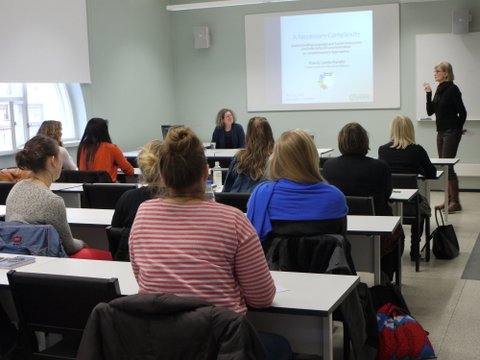
On April 23, 2013, I gave a talk entitled “A Necessary Complexity: Understanding Language and Social Interaction and Intercultural Communication as Complementary Approaches” at the University of Helsinki in Finland.
My thanks to both Dr. Saila Poutiainen (at the University of Helsinki) and Dr. Leena Louhiala-Salminen (at Aalto University, and on the advisory board of this Center for Intercultural Dialogue) for serving as co-hosts, and to the Department of Communication at Aalto University for sponsoring the excellent dinner afterwards.
On April 25, I was able to join the Corporate Communication Evening Seminar at Aalto University, co-sponsored by the Department of Communication and Aalto BIZ Corporate Relations, entitled “Multilingual and intercultural issues in Corporate Communication.” The presenters were Dr. Ulla Connor (Indiana University-Purdue University-Indianapolis) and Pia Friberg (Senior Manager, Wärtsilä Corporation). The former talked about intercultural rhetoric, and the latter described her own experiences with intercultural issues in a multinational corporation. I look forward to continued discussions with all these scholars.
Wendy Leeds-Hurwitz, Director
Center for Intercultural Dialogue
Please consider participating in this opportunity to earn 3 units in the lush, beautiful town of Jyväskylä, Finland. In just three weeks, explore Jyväskylä, and also, through guided excursions, also Helsinki (Finland), Tallinn (Estonia), Stockholm (Sweden) and St. Petersburg (Russia). Communication, Hospitality and Tourism, and Business students may be able to earn credit in their majors/minors. Courses will be taught in English by international faculty and will include students from around the world. Program costs are approximately $2000 plus travel and meals. To learn more, please contact Dr. Deanna Fassett at Deanna.Fassett AT sjsu.edu or Professor Minna Holopainen at Minna.Holopainen AT sjsu.edu
Participants may earn 3 units of credit in 3 weeks by taking courses ranging from creative leadership to international business speaking to Russian language and culture. Anyone, including graduate students, is welcome.
Dr. Renee Cowan, of the Communication Department at the University of Texas at San Antonio, received one of the National Communication Association’s micro grants in Fall 2012 to travel to Finland and meet with Dr. Denise Salin, of the Hanken School of Economics, to plan collaborative work on investigating conceptions of workplace bullying across nations. How bullying and bullying behaviors are understood is likely influenced by the values and beliefs of the larger culture or nation in which the activity has taken place. What constitutes bullying in one culture likely differs from other cultures because of differing value systems. Salin is an international expert on workplace bullying from an organizational perspective who has theorized several important antecedents to bullying in organizations and organizational responses to bullying from the Finnish organizational perspective. Cowan will begin an intercultural conversation with her in an effort to better understand workplace bullying from the European perspective as well as discuss possible collaborations with her on a large multi-national workplace bullying research project. The research question is: based on the assumption that the violation of national, gendered, or other cultural norms will be perceived as bullying behavior, to what extent will national differences in cultural values and communication norms be associated with differences in behaviors perceived to constitute workplace bullying?
The Department of Communication at the University of Jyväskylä, Finland, seeks a permanent Full Professor in Speech Communication. The position is located at the Department of Communication within the Faculty of Humanities. The Department houses four disciplines: Speech Communication, Organizational Communication, Journalism, and Intercultural Communication.
Applicants’ substantive areas of research and teaching must contribute to areas of strength in the Department: media and communication in social processes of change; human interaction, communication and culture; communication and well-being in work and learning environments. More specifically, Speech Communication in the Department of Communication focuses on human social interaction, and the aim is to understand speech and communication behavior and the dynamics of interaction, both in face-to-face and online communication. A variety of phenomena and areas are investigated, such as friendship, couple and family relationships; teams, groups and networks; interpersonal communication in the workplace and in organizational contexts; the connection between social interaction and well-being; persuasion and argumentation; communication ethics.
The University of Jyväskylä, with 15,000 students, has been ranked by the Shanghai-based Academic Ranking of World Universities as one of the top 500 universities in the world. Jyväskylä is located in Central Finland, close to nature, with excellent domestic and international connections.
Deadline for application: 19 October 2012. Applications will be examined by a selection committee which will shortlist a small number of candidates. The employment start date has been set to January 2013, but it is negotiable. The detailed call for applications is here.
For additional information, please contact Director of the Department of Communication Pertti Hurme (email: pertti.hurme at jyu.fi) or Dean Petri Karonen (email: petri.k.karonen at jyu.fi).
Kristen Cvancara
Minnesota State University, Mankato
Fulbright Teaching/Research Scholar Grant in Finland
When planning ahead for my sabbatical, I realized that a Fulbright award was an excellent opportunity for me to achieve the goals of growing professionally and living abroad with my husband and our three children. I applied for a grant in Finland because I wanted to work with a colleague with whom I had been collaborating since 2002. I drafted a plan for a project that would blend our research interests and reviewed it with my Finnish colleague at the 2009 NCA conference in Chicago. With encouragement and support from her and her department (including a letter of invitation), I submitted my Fulbright application in the summer of 2010. In March of 2011, I was notified by letter of the acceptance of that application. My two goals were finally realized in January of 2012 as my family boarded a plane headed for Jyväskylä, Finland, where we would live for the coming 5 months.
While in Finland, I taught two courses and conducted research in the Department of Communication at the University of Jyväskylä. The teaching connected me with students from all over Europe, exposed me to different worldviews, and prompted me to adapt my teaching style in new and unique ways. The research project blossomed into a study involving five countries on four different continents. It was amazing to watch this kind of collaboration develop through conversations, emails, Skype calls, and joint meetings. I had the opportunity to build relationships with Finnish and European colleagues, fellow Fulbrighters, and members of the community where we lived for 5 months. All of these experiences changed me, and my family as well. The challenges and obstacles we faced together forced us to re-evaluate beliefs that we took for granted, revise ineffective strategies, and review our motivations for living outside of our comfort zone. Even when reflecting on the most difficult days, I marvel at the amazing, wonderful experience the Fulbright grant provided us.
A Fulbright experience is worthy of the preparation devoted to crafting a solid application. Check out the following websites for more information on Fulbright grants, the Fulbright Center in Finland, and the Fulbright scholar list to view others from the discipline who have earned grants. I especially encourage individuals with children to apply. In keeping with Senator Fulbright’s initial goals, living abroad with children is a prime opportunity to strengthen their empathy for others and foster a worldview that integrates compassion and understanding.
Donal Carbaugh
University of Massachusetts Amherst
Distinguished Fulbright Professor to Finland
The Fulbright Program is an outstanding resource for collaborating with others on studies of communication, dialogue, and intercultural relations. I have been extremely fortunate over the years to have the support of this program. This began in 1992-1993 when my family and I lived in Finland where I worked with colleagues at the Universities of Tampere and Jyvaskyla, and at the Turku School of Economics. Later, during the 2007-2008 academic year, I held the position of Distinguished Fulbright Professor and Bicentennial Chair of North American Studies at the University of Helsinki. These opportunities have led to longstanding collaborations with colleagues in Finland, to a deepening of studies in intercultural communication and dialogue, and to forging personal relationships that will last a lifetime.
On a related note, on May 11, I will present the closing address at the University of Helsinki’s 14th Biennial Maple Leaf and Eagle conference: “An American West and a Western World: From American Indians to Aristotle and back again.”