Key Concept #53: Conflict Management Translated into Chinese

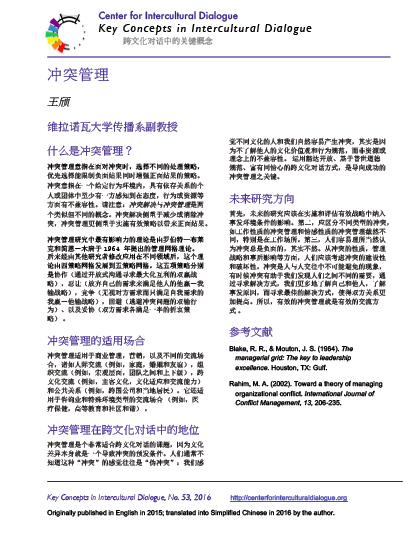
Key Concepts in ICDContinuing translations of Key Concepts in Intercultural Dialogue, today I am posting KC53: Conflict Management, which Qi Wang wrote in English in 2015, and which she has now translated into Simplified Chinese.

As always, all Key Concepts are available as free PDFs; just click on the thumbnail to download. Lists of Key Concepts organized chronologically by publication date and number, alphabetically by concept, and by languages into which they have been translated, are available, as is a page of acknowledgments with the names of all authors, translators, and reviewers.

KC53 Conflict management_ChineseWang, Q. (2016). Intercultural capital [Simplified Chinese]. Key Concepts in Intercultural Dialogue, 53. Available from:
https://centerforinterculturaldialogue.org/wp-content/uploads/2016/12/kc53-conflict-management_chinese.pdf

If you are interested in translating one of the Key Concepts, please contact me for approval first because dozens are currently in process. As always, if there is a concept you think should be written up as one of the Key Concepts, whether in English or any other language, propose it. If you are new to CID, please provide a brief resume. This opportunity is open to masters students and above, on the assumption that some familiarity with academic conventions generally, and discussion of intercultural dialogue specifically, are useful.

Wendy Leeds-Hurwitz, Director
Center for Intercultural Dialogue


Creative Commons License
This work is licensed under a Creative Commons Attribution-NonCommercial-NoDerivatives 4.0 International License.

Conflict Management Questionnaire

Call for participants
Seeking American respondents who are 18 or older to fill out a conflict management questionnaire

Dr. Eura Jung, Steven Young, and Rita Nassuna are researchers from the University of Southern Mississippi and are conducting research comparing the influences of personality, culture, and gender on conflict styles. They are checking to see which factor has the most significant impact on an individual’s conflict management style. If you are 18 or older, please help by taking the 10-15 minute survey. The researchers sincerely appreciate your help.

This project has been reviewed by the Institutional Review Board, which ensures that research projects involving human subjects follow federal regulations. Any questions or concerns about rights as a research participant should be directed to the chair of the Institutional Review Board, The University of Southern Mississippi, 118 College Drive #5147, Hattiesburg, MS 39406-0001, (601) 266-6820. If you have any questions about this survey, please email the researcher Dr. Eura Jung at eura.jung[at]usm.edu. Your time and input are greatly appreciated!

The Conflict Conference 2016 (Texas)

Call for submissions: The Conflict Conference 2016

The Conflict Conference (TCC) will hold its 2015 conference at the University of Texas at Austin (UT-Austin) on April 8-9, 2016. TCC is a multidisciplinary annual conference promoting the study of conflict and conflict resolution. We invite Papers, Panel Proposals, and Posters on any relevant topic such as apologies, advocacy, dispute resolution, peace, negotiation, reconciliation, mediation, restorative justice, conflict management, and ethics.

The DEADLINE for submissions is January 24th 2016. Notices of acceptance will be sent no later than February 7th, 2016.

・PAPER PROPOSALS must include the author’s name and institutional affiliation, the title of the paper, and an abstract of no more than 150 words for the program. In addition, proposals must include a 600-word extended abstract without personal information. Abstracts should be based on research that is clearly in progress (if not yet completed), with a well-formulated research question, and with a good description of the types of data used (if the work is empirical) and of the approach.

・PANEL PROPOSALS must include a maximum 150-word abstract for the program, names, titles, and abstracts for each participant.

・POSTERS must include the author’s name and institutional affiliation, the title of the paper, and an abstract of no more than 150 words.

A clear description of a research design may be acceptable, as this can lead to useful discussions in the early stages of a project. Documents must be attached to an email as a Word (.doc or .docx) or PDF document.

TCC welcomes submissions from students. Please indicate student status in all paper proposals. Please send all proposals to TCC via email.

Conference events will be held on Friday, April 8th and Saturday, April 9th 2016 on the UT-Austin campus. A registration fee of USD $75.00 (two Austin artisan lunches, coffee, and refreshments included) is required.

Master in Human Rights and Conflict Management (Pisa, Italy)

Call for Applications for the XIV Edition of the Master in Human Rights and Conflict Management – Scuola Superiore Sant’Anna (Pisa, Italy)- 2016

Applications shall be submitted online at www.humanrights.sssup.it
Applications for admission by non EU citizens shall be sent no later than July 2, 2015 (1st round of selection) or September 17, 2015 (2nd round of selection)
Applications for admission by EU citizens shall be sent no later than October 15, 2015

Description:
The Master in Human Rights and Conflict Management is designed to provide students from different cultures and backgrounds with a deep understanding of the linkages between human rights and conflict management theory and practice. The curriculum, strongly field oriented, prepares participants for working with NGOs, governments, aid agencies, the UN system and regional organisations, also operating in the context of complex emergencies and joint operations.

Structure:
The Programme is divided into two didactic modules, running between mid January and the end of July 2016, followed by an internship or field experience of min. 3 and max. 6 months, starting from August 2016, and a presentation of the students’ final dissertation in spring 2017.

Key features:
*
1 year post-graduate professionalizing and field-oriented programme
*Interdisciplinary nature of the programme with a methodology characterized by a combination of theory and practice
*Lecturers and trainers chosen among high level academics, diplomats, international organizations officers and NGOs activists, thus offering a wealth of both academic and field expertise
*Mandatory internship/field experience in leading organisations working in the areas of human rights protection/promotion, conflict prevention/resolution, humanitarian assistance or development, either in the field or at Headquarters
*Career service with specific sessions on career coaching and recruiting session with UNV
*International and multicultural student environment

Why should I apply?
You should apply if you are looking for a professionalizing and mission/field-oriented international master programme, as offered by the Scuola Superiore Sant’Anna, an example of academic excellence in training and research. If your training needs include practical skills, besides relevant theoretical knowledge, as well as internship/field-experience with prestigious international organizations, this training programme is highly relevant for you.

Curriculum:
The curriculum is strongly multidisciplinary and field oriented and includes courses in: International Law, International Humanitarian Law, International Human Rights Law, Geopolitics, HRs philosophical dimension, Economic Development, Theories and Techniques of Conflict Management, International PK and PB operations, International HR Field operations, International Election Observation missions, International Humanitarian operations, International Project Development, Personal security, Stress Management, Preventive Medicine & First Aid, Essentials of Research and Writing, Career coaching.

Internship:
The internship is meant to supplement the in-class training with a relevant hand-on experience, to be carried out with a renowned organization working in the areas of human rights protection/promotion, conflict prevention/resolution, humanitarian assistance or development, either in the field or at headquarters.

Tuition fee:
The tuition fee for the full Programme is 7.500,00 euros, payable in two installments. It covers the following: attendance costs and participation to field trips, didactic material (in electronic format), tutorship, lunch (on class and exam days), access to all facilities of the Scuola (including library and computer rooms). It does not include accommodation costs in Pisa and during the internship, nor travel expenses.

The Master Programme offers one scholarship in memory of Gualtiero Fulcheri – former UN Assistant Secretary General – covering the full tuition fee and to be awarded to the most deserving applicant. Depending on financial availability, reduced tuition fee might be offered to citizens from non-OECD countries who are eligible for a study visa for Italy .

Contact
For further details, download the brochure, visit the website, or contact:
Master in Human Rights and Conflict Management
Scuola Superiore Sant’Anna
Via Cardinale Maffi, 27 56126 Pisa – ITALY
E-mail: humanrights@sssup.it
Tel. +39 050 882653
Fax +39 050 882665

Key Concept #53: Conflict Management by Qi Wang

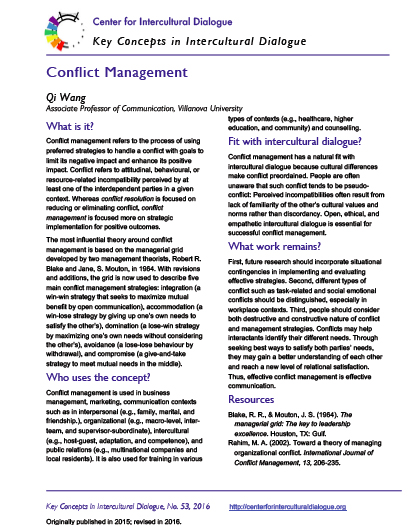
Key Concepts in ICDThe next issue of Key Concepts in intercultural Dialogue is now available. This is KC53: Conflict Management by Qi Wang. As always, all Key Concepts are available as free PDFs; just click on the thumbnail to download. Lists organized  chronologically by publication date and numberalphabetically by concept in English, and by languages into which they have been translated, are available, as is a page of acknowledgments with the names of all authors, translators, and reviewers.

KC53 Conflict ManagementWang, Q. (2015). Conflict management. Key Concepts in Intercultural Dialogue, 53. Available from https://centerforinterculturaldialogue.org/wp-content/uploads/2016/12/kc53-conflict-management-v2.pdf

The Center for Intercultural Dialogue publishes a series of short briefs describing Key Concepts in Intercultural Dialogue. Different people, working in different countries and disciplines, use different vocabulary to describe their interests, yet these terms overlap. Our goal is to provide some of the assumptions and history attached to each concept for those unfamiliar with it. As there are other concepts you would like to see included, send an email to the series editor, Wendy Leeds-Hurwitz. If there are concepts you would like to prepare, provide a brief explanation of why you think the concept is central to the study of intercultural dialogue, and why you are the obvious person to write up that concept.


Creative Commons License
This work is licensed under a Creative Commons Attribution-NonCommercial-NoDerivatives 4.0 International License.

U New Mexico job ad: Interpersonal/Conflict Management

Communication Lecturer III Search Announcement: Interpersonal/Conflict Management/ Mediation
University of New Mexico

The Department of Communication & Journalism at the University of New Mexico invites applications for a full time, 9-month appointment at the rank of Lecturer III to begin August 1, 2015. The department seeks to hire a lecturer with knowledge and experience teaching interpersonal communication, conflict management, and mediation. The successful candidate will coordinate the teaching assistants and part-time instructors who teach sections of CJ 221 (Interpersonal Communication) and CJ 320 (Mediation). In addition, this lecturer will teach other courses at the undergraduate level that meet teaching needs in the department’s concentrations (interpersonal, organizational, intercultural, environmental, media studies, and public communication). Graduate teaching is a possibility, depending on the lecturer’s areas of specialty and department need.

This is a renewable teaching appointment based on the lecturer’s performance. The position involves 70% teaching and 30% service, and the teaching load involves 7 courses each year.

Minimum Qualifications: Ph.D. in Communication or related field completed by August 1, 2015, and three years post-secondary teaching experience.

Preferred Qualifications: (a) A strong record of effective teaching across the communication curriculum; (b) Experience teaching interpersonal communication, communication and conflict, and mediation; (c) Experience directing/coordinating teaching assistants and/or part-time instructors; (d) Experience/interest in developing and teaching courses in on-line or condensed formats; (e) A demonstrated commitment to diversity, equity, inclusion, student success, and working with broadly diverse communities, as well as a desire to mentor students from diverse backgrounds; and (f) Evidence of participation in professional and/or communication associations.

Application Process: A complete application consists of: (1) letter of interest identifying qualifications related to the position announcement; (2) a complete academic resume, including current position; (3) evidence of teaching effectiveness, including course syllabi and teaching evaluations; (4) a statement of teaching philosophy; and (5) letters of recommendation sent from three academic sources. The letters of recommendation should be sent by the authors in a PDF attachment to Nancy C. Montoya, department administrator, Communication & Journalism.

Incomplete applications will not be considered.

To apply, please go to the UNM website and reference Posting Number: 0827867. For best consideration, please apply by December 8, 2014. The position will remain open until filled.

The University of New Mexico is an Equal Opportunity Affirmative Action employer and educator.

For more information contact Dr. Judith Hendry, Search Chair. The departmental website provides additional information about the goals, mission, courses, and the student population.

CFP International Association for Conflict Management

IACM 2015 Call for Conference Submissions

The 28th Annual Conference of the IACM (International Association for Conflict Management) will take place from 28 June to 1 July 2015 at the Hilton Clearwater Beach, Florida, USA. This is a resort-style conference on one of the most beautiful beaches in the United States.

IACM was founded to encourage scholars and practitioners to develop and disseminate theory, research, and experience that is useful for understanding and improving conflict management in family, organizational, societal, and international settings. The conference will present new and unpublished negotiation and conflict management work.

For details, down load the full conference call.


TechChange course: Technology for Conflict Management

TechChange course

Course Description

During the last ten years access to mobile phones and internet has increased dramatically worldwide, including regions affected by conflict and violence. These developments provide conflict management and resolution professionals with a variety of new tools for monitoring violence, sustaining dialogue during peace processes, and localizing peacebuilding efforts. This course will cover the use of mobile phones, digital mapping, and social media in conflict management and peacebuilding. Case studies from Kenya, Syria, Uganda and Myanmar, live discussions with experts from international organizations, academia and government, and instructor moderated discussions will make up the core of the learning experience. Participants will also get hands-on experience with mapping software during a simulation the final week of the course. By the end of the course, participants should expect to have developed an understanding of how different pieces of technology work, be able to do basic assessments of technology integration for their organizations, and some basic hands-on experience with crowdsourcing technologies.

NOTE: This course is NOT offered by the Center for Intercultural Dialogue, but by TechChange. Visit their website for further information and to register.

Andrew R. Smith Profile

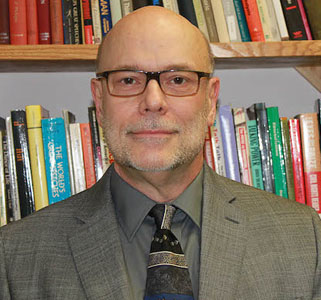
ProfilesDr. Andrew R. Smith is Professor and Graduate Program Head in the Department of Communication Studies at Edinboro University (PA), where he has been teaching since 1993.

Andrew Smith

He also coordinates the web-based Graduate Certificate in Conflict Management. He served, for the 1998-99 academic year, as Senior Fulbright Fellow in Communication and Culture at the Faculty of Letters, Department of English, Mohammed V University in Rabat, Morocco.

He returns regularly to Morocco to conduct seminars and research as a member of Research Group on Language, Culture and Development at the Center for Doctoral Research, Mohammed V University, supported by various granting agencies. In 2011 he was awarded a Fulbright Specialist grant to continue this work. Other faculty appointments include Villanova University, Southern Illinois University, Lewis and Clark College, and The Tokyo Center for Language and Culture. In 2009 he was inaugurated as a Fellow in the International Communicology Institute.

He is coeditor (with Lenore Langsdorf) of and contributor to Recovering Pragmatism’s Voice: The Classical Tradition, Rorty and the Philosophy of Communication (SUNY Press), and recently authored the monograph Epistemology and Ethics in Human Science Research (a primer for graduate student research). He has published essays in Communication Theory, Human Rights Quarterly, Cultural Critique, Russian Journal of Communication, Human Studies, Text and Performance Quarterly and other journals and edited volumes. Recent publications concern freedom of expression, assembly and movement in authoritarian regimes, intercultural conflict, and public discourse in Morocco specifically. Forthcoming essays address issues pertaining to the aftermath of the “Arab Spring” with regard to the mass displacements of people of many nationalities throughout North Africa and the Middle East, and the increasing presence of “cyber-baltagiya” that sabotage websites of dissidents in the Arab world generally. Current research focuses on developing a theory of intractable conflict from a communicological perspective. Many of his papers are available for download.

Andrew teaches courses in intercultural and intractable conflict, language and human conduct, the language of war, freedom of speech, communication ethics, critical/interpretive and qualitative research methods, and related courses at the graduate and undergraduate levels. He has directed over 30 Masters theses and co-supervises dissertations through the Fulbright joint supervision program in association with the Moroccan American Center for Educational and Cultural Exchange.


Work for CID:

Andrew Smith wrote KC18: Intractable Conflict.