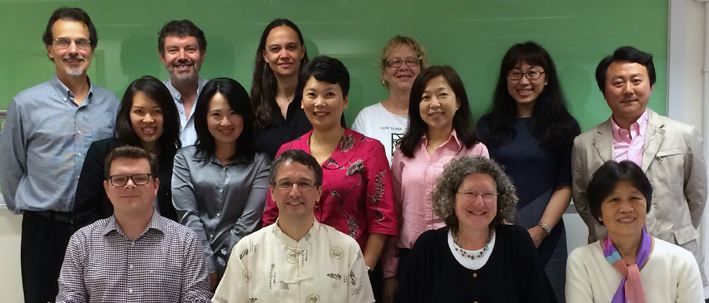
Left to right, front row: Croucher, Sandel, Leeds-Hurwitz, L. Chen; middle row: V. Chen, Dawis, Lijadi, P. Lu, Huang, Jiang; back row: Buttny, Corbett, Witteborn, Young
The Roundtable on Intercultural Dialogue in Asia was held at the University of Macau on March 28-30, 2014. The organizers were Todd Sandel (Communication, University of Macau), John Corbett (English, University of Macau) and Wendy Leeds-Hurwitz (Center for Intercultural Dialogue). By design, this was a small event, designed to answer the question of whether, and in what ways, intercultural dialogue might be a useful term for discussing intercultural interactions in Asia. Sessions focused on such topics as what concepts aid in the study of intercultural dialogue, how intercultural competence fits with intercultural dialogue, and what needs to happen next, and various publication outlets. At least one special journal issue will result.
Martin Montgomery (Dean, Faculty of Arts and Humanities) officially welcomed participants on behalf of the University of Macau. Participants included Saskia Witteborn (Chinese University of Hong Kong), Richard Buttny (Syracuse University, currently doing research in Malaysia), Stephen Croucher (University of Jyväskylä, Finland), Ling Chen (Hong Kong Baptist University), Jiang Fei (Chinese Academy of Social Sciences), Huang Kuo (International Publishing Group, Beijing), Aimee Dawis (University of Indonesia), Vivian Hsueh Hua Chen (Nanyang Technological University, Singapore, and University of Tasmania-Launceston, Australia), Peih-ying (Peggy) Lu (Kaohsiung Medical University, Taiwan), Melody Lu (Sociology, University of Macau), Priscilla Young (Peking University HSBC Business School, Shenzhen), and Anastasia Aldelina Lijadi (Psychology, University of Macau). Multiple masters and doctoral students in both Communication (Julie Zhong, Fiona Ng, Hazel Wan) and English (Carl, Dai Guangrong and Betty, Liu Suiling) managed some of the logistics, helping international visitors get around the city, picking up lunches, and serving as photographers and videographers. Administrative Staff, Barbara Chin (Communication) and Tina Chao (English) also spent many hours preparing documents and making travel, hotel, and other arrangements.
The highlight of the conference (at least for me) was gaining a sense of intercultural issues across Macau, Hong Kong, Taiwan, mainland China, Singapore, Malaysia and Indonesia, and simultaneously across disciplinary, theoretical and methodological boundaries. Since this was a small group, there were lots of opportunities for participants to connect, and at least one journal special issue and several new research collaborations are being planned, as well as a future conference. Most immediately, researcher profiles for more of the roundtable participants already are being posted to this website, and half a dozen have committed to writing Key Concepts in Intercultural Dialogue, to be posted over the next few weeks and months.
A short highlights video was prepared and is readily available. In addition, Aimee Dawis sent in a photo of coverage about the Roundtable in the International Daily News, a Chinese newspaper with the highest circulation in Indonesia:
Thanks to Aimee for arranging for this article, and to the University of Macau for being such a wonderful host institution for this event.
Wendy Leeds-Hurwitz, Director
Center for Intercultural Dialogue
This endowed chair rotates, so that a different senior faculty member in Communication is appointed each year for fall semester. Dr. Raka Shome held the position in 2011, and Dr. Yves Winkin held it in 2012; I will be the third to serve in this position. Those interested in applying in future should look for a call for applications, typically issued in August or September for the following year.
Wendy Leeds-Hurwitz, Director
Center for Intercultural Dialogue
I applied for one of the Center for Intercultural Dialogue‘s microgrants funded by the National Communication Association to explore the possibilities of meeting with researchers in London. Currently, I am looking at using communication methods to better implement and evaluate the roll out, implementation and uptake of HIV biomedical interventions among gay and bisexual men in the United States. Because of the disproportionate impact of HIV in the United States on certain groups, my work focuses on African American, Latino and HIV-positive gay men – all populations that experience persistent structural barriers in the healthcare system.
Matching funds The Hofstra University School of Communication supported this project with a faculty research support grant. The matching funds covered the costs of housing and food while at the host institution.
Local host The Global Forum on Men who have Sex with Men (MSM) hosted a Pre-Conference focused on gay and bisexual men at the International AIDS Conference 2012 in Washington, DC. I chaired the panel on HIV, community mobilization and immigrant MSM. On the panel, Ibidun Fakoya, Research Fellow at University College London presented her formative assessment of African gay men living with HIV in London. Ibidun Fakoya works with Dr. Fiona Burns on the advancing Migrant Access to health Services in Europe (aMASE). aMASE uses a multi-site Community Advisory Group to assess clinical and health care access for migrants in Europe with some focus on MSM and substance users. As such, aMASE is constructing a framework for effectively working with mobile and marginalized populations in assessing healthcare. In follow up conversations and through social media, a relationship emerged on common research interests. Through these conversations, the project emerged and additional meetings were made through Ibidun Fakoya and social media. In the past few years, I have developed a network of other advocates and researchers who are active on twitter and whose specialty is health disparities and the gay, lesbian, bisexual and transgender communities.
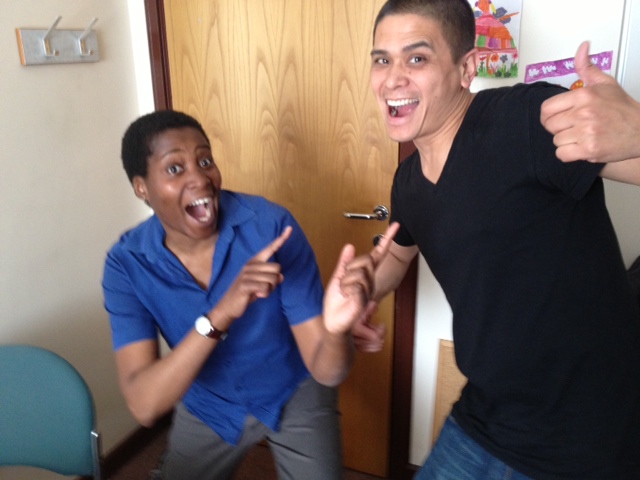
Ibidun Fakoya, Andrew Spieldenner
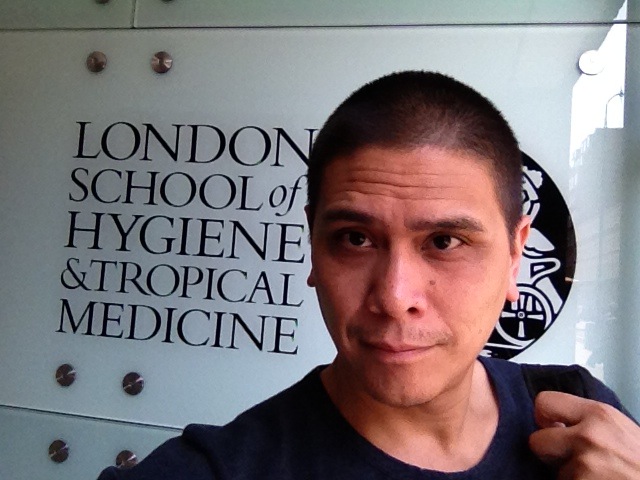
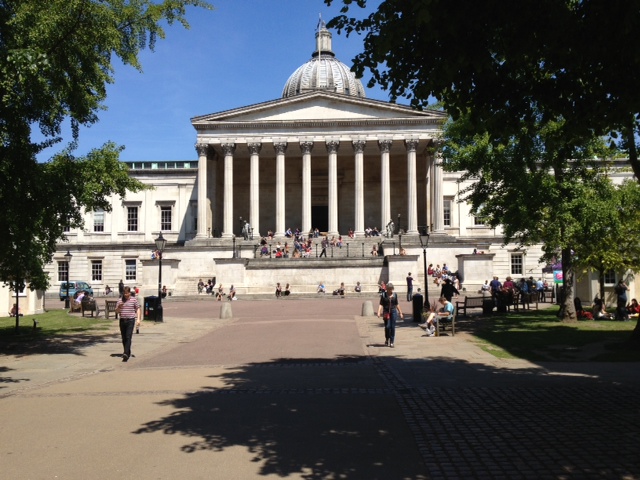
Trip itinerary My colleagues were generous with their time. I visited University College London, Birkbeck College and the London School of Hygiene and Tropical Medicine. Each meeting opened up other doors to consider – with other researchers, community groups, medical providers, and health policy institutions.
Ibidun “Ibi” Fakoya and Dr. Fiona Burns of University of College London aMASE project were my primary hosts. Ibi and I met with the Community Mobilization Coordinator to discuss the Community Advisory Group and the implementation of the research survey in multiple countries in clinic and community settings. We brainstormed on possible community partners to achieve the target survey populations in the United Kingdom (UK), Germany, Spain and Italy. I was able to review the processes that aMASE has implemented to get a shared research tool and protocols across all partner sites. In addition, Ibi and I reviewed social marketing and health messaging in order to develop marketing materials. Ibi was instrumental in coordinating with the other researchers for my trip.
At the University College London, I met with Professor Graham Hart on HIV and gay men in the London and New York City, focusing on the vastly different healthcare systems in the two countries. Professor Hart is Dean of the School, and he has extensively researched HIV and gay men. Professor Hart was interested in how the differing healthcare systems and social attitudes about health impact the treatment and service environment for gay men of varied racial/ethnic and socioeconomic backgrounds. He gave several referrals to visit community groups and health policy institutions.
Professor Matthew Weait of Birkbeck College is an expert on HIV criminalization laws. We discussed the ways that HIV criminalization laws operate in various countries, and how cultural views frame the laws. We also examined the concurrent passage of gay marriage legislation in Maryland alongside an enhancement of the state’s HIV criminalization law. We discussed the importance of translating research and policy into accessible language in order to mobilize community members.
Matt Weait, Andrew Spieldenner
Dr. Catherine Dodds and Dr. Ford Hickson of the Sigma Research Group are currently housed at the London School of Hygiene and Tropical Medicine. The Sigma Research Group has been on the forefront of research in the UK on gay men and HIV. They have conducted surveys at gay prides in the UK for over a decade, and have implemented several Community-Based Participatory Research (CBPR) projects alongside community partners. We had an intense discussion about harm reduction in HIV, the limits to current public health discourse on gay men and HIV, methods of conducting CBPR projects (including the use of Skype), and how communication – as a field – can be used in public health research.
Further activities There are several future activities possible in the future. Many of these involve future correspondence and research support. We acknowledged that there were several meetings about HIV and our respective fields that may be of interest to the others. Dr. Hickson, Dr. Dodds and Professor Weait committed to ongoing communication about projects and possible next dates for meetings when we happened to be in the same event (such as the International AIDS Conference 2014).
Ibidun Fakoya and I sketched out two different research projects to advance, and we are looking to collaborate over the next two years on these projects.
Finally, I plan to return to Europe summer of 2014 on another project, where I will be renewing my relationships with these researchers.
[NOTE: Andrew Spieldenner’s original project proposal is available here.]
HOW DO I KNOW IF IT’S WORKPLACE BULLYING? CULTURE MATTERS
Project Description
The National Communication Association micro grant provided through the Center for Intercultural Dialogue allowed me to begin a very productive conversation and collaboration with renowned European workplace bullying researcher, Dr. Denise Salin (Hanken School of Economics, Finland). I first connect Dr. Salin after reading her extensive research on workplace bullying and the organization from the European perspective. Dr. Salin and I, along with our project partner, Dr. Suzy Fox (Professor, Loyola University, Chicago) are in the planning stage of a large multi-national research study on conceptions of workplace bullying. Our conversations allowed me to better understand workplace bullying from a European perspective and helped shed light on pertinent issues when investigating bullying from a culture perspective. In order to begin this effort, I needed to raise research funds to allow attendance at the planning meeting in Helsinki, Finland.
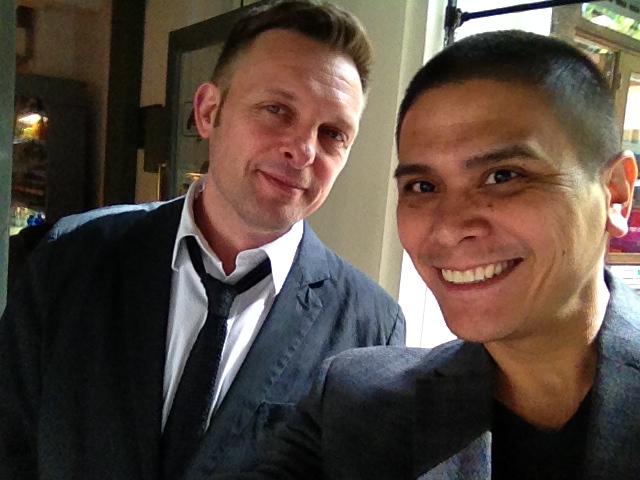
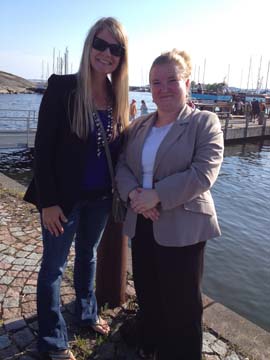
Renee Cowan, Denise Salin
Raising Funds for the Trip To fund this international collaboration trip, I estimated I would need $2,400 for airfare and hotel arrangements. I was granted $900 from the National Communication Association through the Center for Intercultural Dialogue and $1200 in a Faculty Research Grant from the University of Texas at San Antonio. This covered the majority of costs associated with the trip and I personally supplemented the remaining sum. Our meeting was highly successful and because of the trip we are advancing through Phase 1 of the project.
The Project During our meeting we discussed and finalized a three-phase international workplace bullying project. From a U.S. human resources perspective, workplace bullying (WB) is defined as “Actions and practices that a ‘reasonable person’ would find abusive, occur repeatedly or persistently, harm or are intended to harm the target, and result in economic, psychological, or physical harm to the target and/or create a hostile work environment” (Fox, Cowan & Lykkebak, 2012, p. 10). While WB is a universal phenomenon, there are institutional, legal, organizational, and cultural factors that necessitate different approaches to bullying in different parts of the world. We determined our guiding research question: based on the assumption that the violation of national, gendered, or other cultural norms will be perceived as rude, crude, or bullying behavior, to what extent will national differences in cultural values and communication norms be associated with differences in behaviors perceived to constitute workplace bullying?
The Center for Intercultural Dialogue grant allowed me to meet with Drs. Salin and Fox to discuss and refine our three-phase intercultural bullying research project. We held this meeting during the week of June 1-8, 2013. During this week-long meeting we were able to discuss important logistics of our international project including securing grants, our project schedule, securing country partners, and specifics of data collection. The meeting was very productive and we are now able to move forward with data collection for Phase 1 in Summer 2013. We hope to complete the full project by Fall 2015. We have secured collaboration from country partners in Argentina, Poland, Bahrain, Turkey, India, Australia, Austria, China, Greece, Mexico, the Caribbean, Puerto Rico and we have collaborators who have expressed interest in the United Kingdom and Israel. What follows are more details on the project:
Phase 1. In this phase we have determined the participating countries and collaborators, gained commitment and alignment of the team members, developed the collaboration protocols and project guidelines, and began creating the interview and survey measures. The two main clusters of materials will be common measures of cultural characteristics and communication norms, an initial set of bullying items based on popular Workplace Bullying measures and semi-structured interview protocols. Focus groups in the U.S. and Finland will be conducted. We have largely completed Phase one and plan to conduct most focus groups by the end of Summer 2013.
Phase 2. Focus group, interview and survey materials will be translated and back-translated, supplemented by culture-specific questions contributed by our country researchers. Each collaborator will conduct interviews with a minimum of 15 respondents, and will include Human Resource professionals, managers who have handled bullying incidents, and union leaders or other employee representatives.
The focus groups and interviews will seek to uncover underlying cultural assumptions, values, norms, and perceptions that contribute to judgments of workplace bullying behaviors. For each culture, we will work with the collaborators to develop a comprehensive and specific set of behaviors that employees in that culture would consider to be workplace bullying. This will be the starting point for the next phase, the survey.
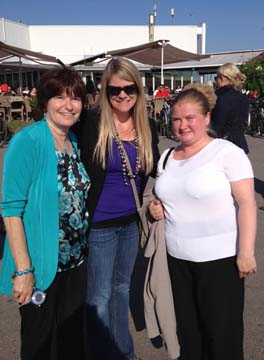
Suzy Fox, Renee Cowan, Denise Salin
The project will produce strong intellectual significance by attending to the question: To what extent are national differences in cultural values, communication norms and gender roles associated with differences in a) behaviors perceived to constitute workplace bullying, b) how individuals and organizations respond to perceived workplace bullying, and c) preferences for organizational and public policies, including specific roles assigned to HR professionals in efforts to counter workplace bullying?
This research will result in several direct outputs that will be beneficial for both U.S.-based and global HR departments: 1) specific guidelines for what should be effective practice in addressing WB from a training standpoint, 2) specific guidelines for anti-bullying policy for global and U.S.-based organizations, 3) guidelines for identifying and addressing WB in both local and multicultural contexts, 4) dispute resolution guidelines and procedures and 5) suggestions for incorporating anti-bullying considerations into organizations’ formal performance management and disciplinary systems. The project’s potential broader impacts are to offer guidance to Human Resource Professionals (HRPs) and managers in defining, recognizing and responding to workplace bullying complaints and situations, and to help multinational corporations develop guidelines that enable people from diverse national backgrounds to work together.
REFERENCE
Fox, S., Cowan, R. & Lykkebak, K. (2012). Revision of the workplace bullying-checklist: workplace bullying policy survey for HR professionals. Proceedings, Academy of Business Research, New Orleans, March 15, 2012.
[NOTE: Renee Cowan’s original project proposal is available here.]
Earlier this year, the National Communication Association allocated funds to be distributed as micro grants for intercultural dialogue through the Center for Intercultural Dialogue, and the competition occurred throughout the fall of 2012. Far more applications were submitted than could be funded, thus demonstrating demand for this sort of grant, and interest in international travel for research purposes. All proposals went through a process of peer review, and the results are now completed. Grants will be awarded to:
Follow their names to see descriptions of their projects, and learn the wide range of countries to which they will now travel and topics they will investigate.
As each project is completed, a final report describing how these scholars made contact with their local hosts, and what they did as a result of their travel, will be provided.
My thanks to all of the applicants. Hopefully that those who we are unable to fund still will be able to take their trips and conduct their research. Further grant possibilities from other sources are listed under grants. In addition, NCA provides several types of information for grant seekers, including additional funding opportunities as well as help with the process.
Thanks to members of the Advisory Board who reviewed proposals on the Center’s behalf: Donal Carbaugh (USA), Janice Hume (USA), Nazan Haydari (Turkey), and Leena Louhiala-Salminen (Finland) for their time and effort in this important effort. Thanks also NCA for providing the funding to support these important projects. This entire process will serve as a valuable pilot for future grants the Center will be pursuing, in order to fund additional projects by other Communication scholars. As further grants are obtained, they will be listed on the Center’s site.
Wendy Leeds-Hurwitz, Director
Center for Intercultural Dialogue
These micro grants are intended to support either or both of the two types of activities described in the mission of the Center: study of intercultural dialogues by Communication scholars, and/or participation in intercultural dialogue through academic interactions between Communication scholars based in different countries, or different linguistic and cultural regions. These grants are sufficient to provide seed funding only: no more than $1000 maximum can be awarded to any one individual. The goal is to encourage international, intercultural, interlingual collaborative research by giving enough funding to offset the cost of airfare only, while providing opportunity (and cause) for matching grants from universities.
If you already have lots of international connections, this grant is not for you – obviously you don’t need it. But if you are at a small college, or if you are a new scholar, and have not yet established significant international connections related to research, you are the intended audience for this competition. If you have been reading publications by an international scholar on a topic of potential relevance to your own research, consider a short trip to discuss ways to collaborate on a future project. If you do not know who has been doing relevant work, check the sources you’ve been reading lately, ask your colleagues, and/or think about who you know from graduate school or who you met (or heard present) recently at a conference. Find someone with similar interests who takes a different stance by virtue of being based in a different cultural context.
The intention is to support the development of new intercultural, professional connections. Thus continuing collaborations are ineligible. Those based in the US are expected to propose travel outside the country. International scholars currently living outside their country of origin are asked to establish a new affiliation in a different region rather than proposing a return to their homeland. We recognize that much interesting work can be done within a country between cultural groups, however this grant program focuses on connecting researchers who are not yet connected, across cultural regions that are typically disconnected. This rationale of cross-cultural connection must be explicit in the project description.
Applicants will need to describe their project, provide a brief resume, a short note from their department chair documenting their current status, and one from the host scholar expressing interest in holding conversations related to research. The initial deadline for review of proposals is November 15, 2012. If funds remain after the initial set of grants are awarded, March 15, 2013 will be the second deadline.
December 18, 2012 UPDATE: The micro grants for intercultural dialogue have now been awarded, and all funding is being distributed as a result of the first round of applications, so there will not be a second round. See here for the results.
On November 20, 2011 I presented “Learning to walk like a local: Applying Goffman’s theory of face to pedestrian behavior” at the National Communication Association convention held in New Orleans, LA. My co-author for the paper was Prof Yves Winkin, Director of the Institut Français de l’Education in Lyon, France, and we divided up the presentation. My thanks to Prof. Beth Haslett for organzing the panel, and inviting us to participate.
While at NCA I met with several members of the Advisory Board of the Center for Intercultural Dialogue (Profs Donal Carbaugh and Barbara Hines) as well as the Center’s Technology adviser, Dr. Brenda Berkelaar, and the President of the Council of Communication Associations, Prof. Patrice Buzzanell. I also met with dozens of scholars about the Center, participated in business meetings for several divisions of NCA and, of course, attended sessions. A number of those who participated in the NCA Summer Conference on Intercultural Dialogue in 2009 were at NCA, and I had a chance to talk with at least half a dozen. Several people made very good suggestions for additions to the website – so look for what’s new in the coming months!
Wendy Leeds-Hurwitz, Director
Center for Intercultural Dialogue
Assistant Director
Center for Intercultural Dialogue (NOTE: the Center at the University of Oregon, not the one sponsored by the Council of Communication Associations!)
Posting: 11180
Location: Eugene, Oregon
Open Until Filled
Salary: $45,000 – $50,000 ($22,500 – 25,000 at 0.5 FTE)
The Center for Intercultural Dialogue is recruiting for the position of Assistant Director. This is an Officer of Administration part-time (0.5 FTE), renewable, non-exempt position, beginning July 27, 2011 and ending July 26, 2012.
Responsibilities:
The Assistant Director is responsible for overseeing the development and administration of UO and grant-funded projects and programs for the Center, mostly but not limited to those involving the UNESCO Chair in Transcultural Studies, Interreligious Dialogue, and Peace. Specific responsibilities include:
*Oversee the planning and coordination of UNESCO Chair conferences and network events, as well as Center programming, including public receptions, lecture and film series, symposia, and conferences; assist in the development of new programming.
*Maintain regular correspondence with faculty and community board members, UNESCO headquarters, and Chairs within the Interreligious Dialogue for Intercultural Understanding network.
*Write and manage grants and other funding proposals including program development, implementation, budget tracking and reporting.
*Coordinate project communications in order to strengthen the profile of the Center on campus, nationally and internationally, including brochures, newsletters, website maintenance, etc.
*Manage all accounting activities and fiscal records, including all office procurement and contracts, bill paying, processing journal vouchers, travel reimbursements, etc.
*Supervise all Graduate Teaching Fellows/Assistants, interns, and volunteers.
Qualifications:
*Bachelor’s degree required (advanced degree preferred)
*Minimum five years administrative experience, preferably within a higher education environment
*Substantial event and/or program planning experience required.
*Experience overseeing the production of marketing collateral including designing, writing, and editing newsletters or other publications.
*Office management experience including procurement and contracting, and human resource management experience essential.
*Budget creation and management experience required.
*Demonstrated ability to communicate effectively verbally and in writing
*Grant writing experience preferred.
*International experience through study, employment, travel or resident abroad preferred.
*Ability to write and speak in French useful.
*Demonstrated expertise in working with faculty, staff, and students with diverse backgrounds and cultures. Must be flexible and able to work well on a team as well as individually.
Salary range: $22,500 – 30,000 at 0.5 FTE based on qualifications and experience; The University provides excellent benefits, including comprehensive medical and dental insurance coverage, retirement plans, and paid leave policies. There is the possibility of an increase in FTE in 2012 or later depending on additional funding.
To ensure equal consideration, the following documents must be received by Wednesday, June 29, 2011, 5:00 p.m. However, the position is open until filled:
*a cover letter which addresses the applicant’s qualifications and interest in the position
*current resume
*names, addresses and phone numbers of at least three professional references.
Inquiries should be directed to Kelley Totten at (541) 346-4150 or ktotten@uoregon.edu.
Completed applications should be mailed to:
Center for Intercultural Dialogue
Search Committee – attn: Kelley Totten
6202 University of Oregon
Eugene, Oregon 97403-6202
Or hand delivered to:
110 Gerlinger Hall
University of Oregon
The University of Oregon is an equal opportunity, affirmative action institution committed to cultural diversity and compliance with the Americans with Disabilities Act. Candidates with a demonstrated commitment to promoting a diverse learning and working environment are encouraged to apply.



 Center for Intercultural Dialogue