CFP ICTs, Governance & Peacebuilding in Africa

Call for chapter proposals: ICTs, Governance & Peacebuilding in Africa

New information technologies (ICTs) such as mobile phones hold great potential to affect peacebuilding, statebuilding, governance, transparency, and accountability in Africa. ICTs ubiquity and ability to interact with older media enables citizens to experiment with innovative ways of influencing politics.  Despite strong assertions in the existing research regarding the usefulness of ICTs (and media more generally) in political and post-conflict transition, governance, and development, there is very little understanding of how people and communities in Africa actually use these ICTs, and how these uses contribute to governance and peacebuilding.

The Annenberg School for Communication at the University of Pennsylvania and the Programme in Comparative Media Law and Policy at the University of Oxford are currently seeking papers for a forthcoming workshop and an edited volume. Authors are asked to provide critical analyses of how the public uses, makes sense of, and engages with ICTs, and the relationship between ICTs, the public, and governance or peacebuilding. Strong preference will be given to chapters that provide empirical evidence for the arguments put forth. Analyses should be applicable to Africa, and chapters focused on Eastern Africa are especially welcome. Academics from African universities are particularly encouraged to apply.

Funding will be provided for successful authors to attend the workshop, which will be held either in New York, USA or Oxford, UK in June or July 2014.

For chapters incorporating empirical research, we are particularly interested in qualitative methodologies (case studies, ethnography, interviews, etc.) but all approaches are acceptable.

Contributions may focus on, but are not limited to:

• The use of crowd-sourcing in conflict-affected regions • The role of ICTs in accountability or transparency initiatives • Local perspectives on citizen ‘voice’ and the use of ICTs • The use of ICTs in transitional justice processes • The intersection or merging of old and new technologies to impact peacebuilding or governance • ICT innovation at the grassroots level

Abstracts (max. 2000 words) and author biography (max. 100 words) are due by March 6, 2014.

Please send abstracts, as well as any questions, to Libby Morgan.

Notification of selected authors: March 20, 2014
Deadline for submission of rough papers in APA format: June 15, 2014
Deadline for submission of final papers in APA format (6,000-8,000
words): August 15, 2014

This book is being funded by a grant from the Carnegie Corporation of New York and is part of a multi-year research project on ICTs, Statebuilding and Peacebuilding in Eastern Africa.

Intercultural Innovation Award 2014

The BMW Group and the United Nations Alliance of Civilizations (UNAOC) have started, under the  Intercultural Innovation Award , their annual search for grass-root organizations engaged in innovative cross-cultural work.

Ten organizations with grassroots projects that promote intercultural understanding in new and sustainable ways will be awarded funding and strategic support by the BMW Group and the UNAOC. To be considered, organizations must apply online by Wednesday, 30 April, 2014 at 5:00 pm New York City time.

The top ten finalists will be invited to present their projects at the 6th UNAOC Global Forum in August 2014 in Bali, Indonesia. A total of 100,500 USD is offered to the awardees, of which 40,000 USD goes to the winning project.

Venice Academy of Human Rights 2014

Venice Academy of Human Rights 2014 – “Judicial Legitimacy and the Rule of Law”
7-16 July 2014

Online applications are accepted until 4 May 2014. The Academy offers an “early bird” registration with a reduced participation fee until 15 March 2014.

Key Facts
Participants: Academics, practitioners, PhD/JSD and master students
Type of courses: Lectures, seminars, workshops and discussion sessions
Number of hours: up to 35 hours of courses
Location: Monastery of San Nicolò, Venice – Lido, Italy
Fees: 500 EUR (early bird until 15 March), 600 EUR (16 March – 4 May 2014)

Venice Academy of Human Rights
The Venice Academy of Human Rights is an international programme of excellence for human rights education, research and debate. It forms part of the European Inter-University Centre for Human Rights and Democratisation (EIUC). The Academy offers interdisciplinary thematic programmes open to academics, practitioners, doctoral and master students with an advanced knowledge of human rights. Participants attend morning lectures, participate in discussion sessions and workshops and can exchange views, ideas and arguments with leading international scholars and experts. This includes the opportunity for a number of participants to present and discuss their own “work in progress” such as drafts of articles, chapters of books or doctoral theses and receive comments from faculty members (including P. Alston, A. Føllesdal, G. Ulfstein and J. Waldron) and peers. At the end of the programme, participants receive a Certificate of Attendance issued by the Venice Academy of Human Rights.

CFP IMéRA (France) residencies

IMéRA (Institute for Advanced Study of Aix-Marseille University) is issuing calls for applications for residencies in 2015 and 2016

*Call for individual applications opened to scientists and artists, for residence schemes scheduled between 23 February 2015 and 13 July 2016 (duration 5 or 10 months);
*Call for team applications opened to scientists and artists, for residence schemes scheduled between 23 February 2015 and 13 July 2016 (duration 2, 3 or 4 weeks) ;
*In connection with the LabexMed programme, call for individual applications opened to scientists for residence schemes scheduled between 15 September 2014 and 17 July 2015 (duration 5 or 10 months).

IMéRA residence proposals are open to researchers (senior and junior) of all origins in terms of nationality and disciplines. IMéRA will consider applicants from the Mediterranean rims in a particularly favourable way.

Deadline : April 7, 2013

Applications can only be submitted on IMéRA’s website.

IMéRA (Mediterranean Institute for Advanced Research) is an Université d’Aix-Marseille [Aix-Marseille University – AMU] Foundation. As such, it is a member of Réseau Français des Instituts d’Etudes Avancées (RFIEA) [French Advanced Study Institutes Network] as well as of réseau Eurias [Eurias network] and of the European Network of University-Based Institutes.

Conf on ICTs in Education Greece 2014

International Conference on Information Communication Technologies in Education (ICICTE)
Kos, Greece-July 3rd-July 5th

This call is for papers, workshops and poster sessions examining the theoretical and practical applications of technology in education at all levels in both the public and private sectors.

If you are interested in presenting a paper, please submit your proposal online. All proposals are peer reviewed by members of the Scientific Committee.

Proposals must be submitted by February 21, 2014. Notification on whether the proposal has been accepted will be sent by February 28, 2014.

Completed manuscripts must be submitted by March 28, 2014 and will also be double-blind peer reviewed by the Scientific Committee. Comments will be forwarded to the authors, and final manuscripts, with editorial changes, must be received by April 30, 2014. Papers presented at the conference will be published in the proceedings under the title Information Communication Technologies in Education. Papers received after the deadline will not be included in the proceedings.

Papers must not exceed 10 pages (including abstract, references, tables, figures and diagrams). Papers exceeding the stated limits will be returned to the authors for revision. Please consult the Manuscript Preparation Guidelines at the conference web site before submitting the final version of your paper.

All presented papers will be considered for the ICICTE 2014 selected papers issues of Campus-Wide Information Systems and the Journal of Cyber Ethics in Education.

Tribal Liaison/Prof of Practice -U San Diego

The University of San Diego (USD) is a Roman Catholic institution committed to advancing academic excellence, expanding liberal, professional and scientific knowledge, creating a diverse and inclusive community, and preparing leaders dedicated to ethical conduct and compassionate service. USD invites applications for the position of Tribal Liaison/Professor of Practice starting August 15, 2014. This is a full- time, benefit-based, 10-month position with two integrated areas of duties: half of the position serves as the University’s Tribal Liaison, supervised by the Associate Provost for Inclusion & Diversity; half as Professor of Practice, supervised by the Dean of the College of Arts & Sciences and the appropriate Department Chair.

The Tribal Liaison responsibilities include linking the University and its resources to the many tribal communities in its service area. Federally-recognized American Indian Tribes are considered sovereign nations, which underscores the need for appropriate interpretation of law and cultural protocol. Key responsibilities are becoming the campus expert in University and Tribal protocol issues, and developing and implementing programs, activities and networks that connect the University to urban- and reservation- based American Indian communities. The Tribal Liaison will advise on and implement best practices for the recruitment and retention of American Indian students, staff, and faculty at USD, function as a liaison between the campus community and American Indians and Tribal Nations in the larger San Diego County area and beyond, and work to build collaborative relationships among those entities. The Tribal Liaison will provide guidance and assistance to administrators, faculty and staff regarding tribal events, issues, educational needs, and protocol.

The Professor of Practice position is a non-tenure track instructional appointment in the College of Arts & Sciences. Responsibilities include: 1) teaching four courses per academic year; 2) holding one office hour per week per course taught; 3) performing departmental and/or college service duties as needed. Teaching duties include: designing syllabi and selecting instructional materials in coordination with the Chair; leading lectures and discussions, preparing and grading examinations, mentoring students in office hours, and assigning final grades.

A Master’s degree or equivalent in an academic discipline, with expertise in American Indian Studies, Ethnic Studies, or a relevant field required. A Doctoral or terminal degree preferred. This is a 10-month assignment paid over 12 months. For a full description of the position, qualifications, and other information, visit the University of San Diego Human Resources jobs website and reference job number IRC#12831. Inquiries should be directed to Esteban del Rio, Ph.D., Associate Provost, Inclusion & Diversity.

TO APPLY, complete BOTH of the following:
• Search IRC#12831 and choose the “Apply Now” button on the jobs website and follow instructions. If you have any questions or difficulties regarding the website, please contact the Employment Services Team.

• Submit via email:
1) a cover letter that includes relevant teaching experience, research, and direct experience working with and in American Indian communities;
2) resume/vita;
3) sample syllabi; and
4) have three reference letters submitted directly by your recommenders.

Review of applications begins February 28, 2014. Priority will be given to those who apply before that date. Applications will be reviewed until the position is filled.

USD is an Equal Opportunity employer, and is especially interested in candidates who can contribute to the diversity and excellence of our academic community.

The University of San Diego offers domestic partner benefits.

Huang Kuo Profile

Profiles

Dr. Huang Kuo is an Associate Professor at English Service of China Radio International (Beijing).

Huang Kuo

Before joining CRI, Dr. Huang worked as Associate Professor at the Center for International Communication Studies, China International Publishing Group (Beijing), Associate Professor at Heilongjiang University (China), Lecturer and Tutor in Macquarie University (Australia), and Lecturer in Beijing Normal University, Zhuhai campus (China).

She has a PhD in Music, Media, Culture and Communication Studies from Macquarie University, Australia, and MA in Communication from Westminster University, UK. Her research interests include international communications, audience studies, and new media. She has published many papers for journals and book chapters, and authored the books Chinese Boxes: Reality TV and Audience Participation (2014) and Multimedia Technology: How It Changes Classroom and Communication (2008).

Representative publications:

Huang, K. (2014). Chinese Boxes: Reality TV and Audience Participation. Lambert Academic Publishing.

Huang, K. (2014). Renewal of International Communication in the Context of Big Data Processing [大数据背景下国际传播的战略思考] in Zhengrong Hu et al (Eds.) Blue Book of International Communication: Annual Report on the Development of China’s International Communication (2014) (pp. 254-260). Beijing: Social Sciences Academic Press.

Huang, K. (2013). Participative Chinese audiences: A Case Study of the Reality Show Switching Spaces. Studies in Communication Sciences, 13(2), 117–128.

Jiang, F., & Huang, K. (2013). Community Media in China: Communication, Digitalization, and Relocation. Journal of International Communication 19(1), 59-68.

Huang, K. (2013). A Functional Approach towards Political Communication in Social Media—A Case Study of 2012 US Election [社交媒体的政治传播功能研究——以2012年美国大选的社交媒体战略为例]. International Communications [对外传播].1, pp.48-50.

Huang, K. (2012). How Family Factors Influence Teenagers in Internet Adoption [家庭因素对青少年互联网使用的影响] in Wenge LI et al (Eds.) Annual Report on the New Media Use by Minors in China 2011-2012, Blue Book of Teenagers [青少年蓝皮书:中国未成年人新媒体运用报2011-2012] (pp. 50-71). Beijing: Social Sciences Academic Press.

Huang, K. (2012). On Strategy Transformation of Western Media in International Communication [西方媒体国际传播战略转型的趋势及启示]. International Communications [对外传播], 7, 35-37.

Huang, K., & Jiang, F. (2012). How New Media Subvert and Reconstruct Chinese ‘Quan-Shi’ Culture [新媒体对中国“权势”文化的颠覆与重构], Exploration and Free Views [探索与争鸣], 7.

Huang, K., & Jiang, F. (2011). Transnational Media Corporations and National Culture as a Security Concern in China. In V. Bajc & W. de Lint (Eds.), Security and Everyday Life (pp. 212-235). New York: Routledge.

Huang, K. (2009). Multimedia Technology: How It Changes Classroom and Communication. VDM Verlag Dr. Müller Aktiengesellschaft & Co. KG.

Huang, K., & Chitty, N. (2009). Selling Participation to Audiences in China. Global Media Journal—Canadian Edition, 2(1), 123-147.

Huang, K., & Jiang, F. (2009). Understanding Diaspora Cultures in the Context of Globalization. International Journal of the Humanities, 7 (10), 115-130.


Work for CID:

Huang Kuo was one of the participants in the Roundtable on Intercultural Dialogue in Asia, co-sponsored by CID.

Jiang Fei Profile

ProfilesDr. Jiang Fei is Dean of the School of International Journalism and Communication at the Beijing Foreign Studies University. He has a Ph.D. from the Department of Literature, Media & Communication studies from Sichuan University (Chengdu, China).

Jiang Fei

Previously he was Professor at the Institute of Journalism and Communication, Chinese Academy of Social Sciences, where he also served as  Director of the Department of Communication Studies, and Director of the Global Media and Communication Research Center. He is also the Secretary General of the Communication Association of China (CAC), and associate editor for the Journal of China Media Report Overseas.

Prof. Jiang has taught at several universities in China and has given invited lectures at the Chinese University of Hong Kong, Taiwan National Chengchi University, and Lugano University (Switzerland). He was visiting scholar at Stockholm University (Sweden), Toronto University (Canada), University of British Columbia (Canada), Royal Roads University (Canada), Macquarie University (Australia) and the Annenberg School for Communications, University of Pennsylvania (USA). His research interests include communication theory, new media and intercultural communication studies, cultural studies, and post-colonial theory. He has published many papers for journals and book chapters, and authored three books on intercultural communication.

Books

Jiang, F. (2011). Communication and Culture [传播与文化]. Beijing: Chinese Communication University Press.

Jiang, F. (2005). Intercultural Communication in the Post-colonial Context [跨文化传播的后殖民语境]. Beijing: China Renmin University Press.

Jiang, F. (Ed.). (2005). Transnational Media in China [海外传媒在中国]. Beijing: CFLACPC (China Federation of Literary and Art Circles Publishing Corporation).

Representative Book Chapters and Journal Articles

Jiang, F. (2013). On the three waves of China’s communication studies: A commemoration of the 30th anniversary of Schramm’s visit to China & China’s communication studies in post-Schramm times. Studies in Communication Sciences, 13(2), 107–116.

Jiang, F. (2013, coauthored), Strategic Studies on International Media Development and the Enlightenment to China [国际主流媒体发展战略研究及其对中国国际传播的启示], Modern Communication [现代传播]. Issue 2.

Jiang, F. (2012). An Intercultural Communication Study from China’s Perspective [跨文化传播研究的中国视角]. In A. Fung (Ed.), The Imagination of Chinese Communication [华人传播想像](pp.137-194). Hong Kong: The Chinese University of Hong Kong Press.

Jiang, F. (2012, coauthored). Reviewing Chinese Communication Studies 2011 [2011年传播学研究综述]. In Tang Xujun (Ed.), China Journalism and Communication Annual [中国新闻与传播年鉴]. Beijing: Social Science Academic Press.

Jiang, F. (2011, coauthored). Transnational Media Corporations and National Culture as a Security Concern in China. In V. Bajc & W. de Lint (Ed.), Security and Everyday Life (pp. 212-235). New York: Routledge.

Jiang, F. (2009, coauthored). Understanding Diaspora Cultures in the Context of Globalization. International Journal of the Humanities, 7(10), 115-130.


Work for CID:

Jiang Fei was one of the participants in the Roundtable on Intercultural Dialogue in Asia, co-sponsored by CID.

Key Concepts in Intercultural Dialogue #2: Cosmopolitanism by Miriam Sobre-Denton

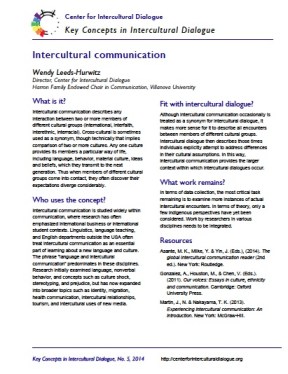
Key Concepts in ICDThe second issue of Key Concepts in intercultural Dialogue is now available. This is KC2: Cosmopolitanism by Miriam Sobre-Denton. As always, all Key Concepts are available as free PDFs; just click on the thumbnail to download. Lists organized  chronologically by publication date and numberalphabetically by concept in English, and by languages into which they have been translated, are available, as is a page of acknowledgments with the names of all authors, translators, and reviewers.

CosmopolitanismSobre-Denton, M. (2014). Cosmopolitanism. Key Concepts in Intercultural Dialogue, 2. Available from:
https://centerforinterculturaldialogue.org/wp-content/uploads/2014/02/key-concept-cosmopolitanism.pdf

The Center for Intercultural Dialogue is publishing a series of short briefs describing Key Concepts in intercultural Dialogue. The logic is that different people, working in different countries and disciplines, use different vocabulary to describe their interests, yet these terms overlap. Our goal is to provide some of the assumptions and history attached to each concept for those unfamiliar with it. As there are other concepts you would like to see included, send an email to the series editor, Wendy Leeds-Hurwitz. If there are concepts you would like to prepare, provide a brief explanation of why you think the concept is central to the study of intercultural dialogue, and why you are the obvious person to write up that concept.


Creative Commons License
This work is licensed under a Creative Commons Attribution-NonCommercial-NoDerivatives 4.0 International License.

CID is on Wikipedia

About CIDIn case there has been any doubt, the Center for Intercultural Dialogue definitely exists – and we know this because now there is a Wikipedia entry saying so!

CID Wikipedia entry

This was created as one response to the National Communication Association’s call for increased entries on communication-related topics by communication specialists. (Details may be found on the NCA Wikipedia Initiative page.) For those who have not yet created an article on Wikipedia, the official standards are quite stringent about what is sufficiently “notable” to merit an article. (Of course, that doesn’t mean all articles currently posted meet those standards.) And there is an elaborate formal system to learn in order to participate in the site. But in today’s world, there is a sense in which any serious endeavor should be represented there, so it seemed worthwhile creating an article.

Minh Cao gets credit for taking the time to first learn the guidelines, and post the first draft. For those who have not yet created articles, a warning: this took 3 drafts over 2 months, and help from 4 different editors at Wikipedia, before approval was granted for a substantially shorter article than originally envisioned. Apparently such delay and critique are common.

Wendy Leeds-Hurwitz, Director
Center for Intercultural Dialogue