
The Fulbright Scholar competition for academic year 2016-2017 is now open. Specific opportunities in Communication are available this year in Ghana, Finland, Swaziland, Bulgaria, and Ukraine, but there are another 400 opportunities for which Communication scholars can potentially compete, since many leave the specialization open. The current competition will close on August 3, 2015. A description of the activities of some of those who have completed Fulbrights in Communication has previously been posted to this site. (If you have completed a Fulbright in Communication and would like to have your name and description added, contact CID.)
CFP Cultural Mapping: Debating Cultural Spaces and Places (Malta)
Call for Papers & Posters
Cultural Mapping: Debating Cultural Spaces and Places conference
22nd-23rd October 2015
Malta
Abstracts due Friday, March 27, 2015
The Valletta 2018 Foundation, responsible for implementing the European Capital of Culture (ECoC) project in Valletta and Malta in 2018, will be holding the Second International Conference on Cultural Relations in Europe and the Mediterranean. The conference is titled ‘Cultural Mapping: Debating Spaces and Places’ and will bring together academics and practitioners to exchange experiences and debate cultural mapping practices, as well as to explore practical and conceptual approaches to cultural mapping within a global context (with a particular emphasis on the Euro-Mediterranean context). The conference will seek to develop a better understanding of how various mapping practices are developing over time. The Valletta 2018 Foundation will be collaborating with the Centre for Social Studies, University of Coimbra.
Academics, researchers, artists and PhD students are invited to present papers or posters discussing their work within this field or addressing the conference themes, during the conference. Abstracts (400 words) are to be submitted via email by no later than Friday 27th March 2015. Conference proceedings will be published in due course.
EIUC Researcher for Project “Frame” job ad (Venice)
VACANCY ANNOUNCEMENT:
JUNIOR RESEARCHER for the PROJECT “FRAME” (Fostering Human Rights Among European Policies)
The European Inter-University Centre for Human Rights and Democratisation (EIUC) is an inter-disciplinary centre of excellence supported by the EU, aiming at pursuing the continued promotion of human rights and democratisation through education, specialised training, and research cooperation. With reference to its research activities, EIUC is looking to appoint a highly qualified individual to participate in the unique large scale FP7 research project “FRAME” involving 20 universities in the EU and worldwide on the topic of human rights in EU external relations and internal policies.
Functions and tasks
The FRAME Junior Researcher will work as a member of the research unit dedicated to the FRAME project. He/she will work under the supervision of the EIUC Secretary General and FRAME Senior Researcher, and with a team composed of other researchers.
The FRAME Junior Researcher will have to conduct research aiming at:
· Contributing to the further elaboration and improvement of the created theoretical framework assessing EU policy tools for the integration of human rights considerations in internal and external policies;
· Examining the potential for adapted or new policy tools in order to increase effectiveness and/or consistency of policies;
· Contributing to the development together with a team – based on the results of FRAME’s research as conducted by all research teams involved – a policy toolbox to be used by EU policy makers and integrating existing, adapted and new policy tools in order to enhance human rights protection within the EU and in third countries,
· Contributing to and participating in the FRAME-related dissemination and educational activities.
Profile/requirements
The FRAME Junior Researcher should be in the process of completing his/her doctoral dissertation or possess a Doctoral degree (PhD/JSD) in law or political science/international relations (or other relevant subjects to FRAME’s context) from a leading university with outstanding grades;
In addition, the FRAME Junior Researcher should possess and demonstrate the following:
· Clear interest and expertise in European Union law and politics, human rights and international organisations law and practice, and in particular instruments of the EU internal human rights policy,
· Openness to interdisciplinary research, excellent analytical skills as demonstrated by writing samples, and ability to summarize and present large amount of information in an intelligent way;
· Ability to organise your own research activities while working as part of a research team, and to handle different tasks at the same time while keeping strict deadlines;
· Native level of English (working language of the project);
· Excellent and culturally sensitive communication and diplomatic skills;
· Efficient use of the standard Microsoft Office software (Word, Excel, PowerPoint),
The FRAME Junior Researcher will be required to take up the position on 1 September 2015 and finishing on 30 September 2016 (with the possibility of renewal subject to performance until the end of the project duration – 30 April 2017). The gross salary will depend on qualifications and seniority.
Workplace: Venice. Other locations may be considered upon condition of travelling to Venice when required.
Please send a cover letter, details of referees, and detailed curriculum vitae to the FRAME Senior Researcher Karolina Podstawa, and in CC to the EIUC Senior Project Manager Elisabetta Noli by 19 April 2015.
Applied ICD: 3-D Printers and Prosthetic Hands from the US to South Africa
Sometimes the most extraordinary intercultural collaborations result from contacts made through social media. The following story started through a connection made through YouTube, between an artist in the US and a carpenter in South Africa, using the latest technology (3-D printers) to create a prosthetic hand.
“A former school supplies salesmen and special effects artist, Ivan Owen in December 2011 shared a video on YouTube of a giant puppet hand that he had made. That video was seen by Richard Van As, a carpenter in South Africa who had cut off some of his fingers with a table saw. He asked Mr. Owen to help devise a prosthesis, and over two years, the pair came up with a workable design. A 3-D printer, they figured, would make the prosthesis cheap and easy to produce. When Mr. Van As learned of a boy in South Africa who also needed a prosthetic hand, they made one for him, too. The idea caught on.”
Mroz, Jacqueline. (February 16, 2015). Hand of a superhero. New York Times.
State of the art prosthetics cost a lot, and children grow so quickly that often people decide they just aren’t feasible. e-Nable has changed that by matching technology and volunteers to over 1000 recipients, many children, in dozens of countries to date.
Key Concept #53: Conflict Management by Qi Wang
 The next issue of Key Concepts in intercultural Dialogue is now available. This is KC53: Conflict Management by Qi Wang. As always, all Key Concepts are available as free PDFs; just click on the thumbnail to download. Lists organized chronologically by publication date and number, alphabetically by concept in English, and by languages into which they have been translated, are available, as is a page of acknowledgments with the names of all authors, translators, and reviewers.
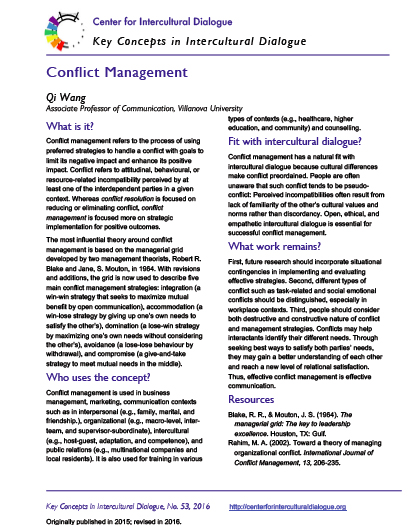 Wang, Q. (2015). Conflict management. Key Concepts in Intercultural Dialogue, 53. Available from https://centerforinterculturaldialogue.org/wp-content/uploads/2016/12/kc53-conflict-management-v2.pdf
The Center for Intercultural Dialogue publishes a series of short briefs describing Key Concepts in Intercultural Dialogue. Different people, working in different countries and disciplines, use different vocabulary to describe their interests, yet these terms overlap. Our goal is to provide some of the assumptions and history attached to each concept for those unfamiliar with it. As there are other concepts you would like to see included, send an email to the series editor, Wendy Leeds-Hurwitz. If there are concepts you would like to prepare, provide a brief explanation of why you think the concept is central to the study of intercultural dialogue, and why you are the obvious person to write up that concept.

This work is licensed under a Creative Commons Attribution-NonCommercial-NoDerivatives 4.0 International License.
CFP Discourses and Societies on the Move (Portugal)
Call for proposals
2nd International EDiSo Symposium: Discourses and Societies on the Move
Coimbra, Portugal, 18-20 June 2015
The call for papers for the different work sessions in the 2nd International EDiSo Symposium is now open. You are invited to send your individual proposals for the different thematic panels, independent proposals, proposals for participation in data analysis workshops, or for poster presentations. If you belong to a research group, you can still participate in our roundtables for research groups.
Please note! The language used to describe each session does not condition the language used in the presentations. We accept proposals in any EDiSo language.
– Papers in Thematic Panels [“Painéis Temáticos” , PT]: Designed for senior or junior researchers interested in presenting their research outcomes and exchanging ideas with colleagues who hold similar interests. These proposals will need to specify the panel they would like to be included in. Please select your panel here.
– Individual Papers [“Comunicações Livres” , CL]: Designed for senior or junior researchers interested in presenting their research outcomes. If you consider that your research does not fit into any of the thematic panels proposed, you may still present your work as an individual paper.
– Participation in Data Analysis Workshops [“Oficinas de Análise de Dados” , OAD]: Designed mainly for junior researchers or those with research in progress who wish to participate in practical sessions about research methodology and to obtain feedback on their work. Please select your data analysis workshop here.
– Posters: Designed for sharing research results, research in progress, or studies in the early stages that could benefit from open discussion with other researchers. More information here.
– Roundtables for research groups: following the conversation started at the 1st EDiSo Symposium in Seville (2014), the goal is basically to present and discuss research perspectives, share tasks, viewpoints… with the goal of creating synergies and opportunities for collaboration. Please take a look at the roundtable topics here.
The deadline for proposal submissions is March 15th 2015.
EDiSo has a small budget available to partially cover some travel and lodging costs. If you are a graduate student and have not secured funding from other sources, please specify this in your registration form, and please include in your email a statement indicating that you would like to be considered for this grant, which will be awarded through a lottery process. This information will not affect the evaluation of your proposal.
Information on the submission of proposals here.
For further details, send an email to the organizers.
CFP JIIC issue: Memory, Culture and Difference
Journal of Intercultural and International Communication
Special issue: Memory, Culture, and Difference
Special issue editors:
Jolanta A. Drzewiecka, The E. R. Murrow College of Communication, Washington State University
Susan Owen, Communication Studies, University of Puget Sound
Peter Ehrenhaus, Communication and Theater, Pacific Lutheran University
Recent events highlight the continuing importance of memory and forgetting to negotiations of identities and allegiances cross cultural borders.
Most recently, the protests against the fatal shooting of Michael Brown in Ferguson, and reactions to them, exposed different memories, forgetting, and willful ignorance of violence against African Americans. Last year, scholars working at the US Holocaust Museum concluded after long research that many more ordinary people participated in the genocide of Jews in many more sites and in mundane ways than had been previously thought. But this is not how Shoah is remembered. Such examples abound and highlight difference, hegemonic closure and contestation as key factors shaping memories.
Memories define who belongs and who does not, as well as who and what are worth remembering, and who and what are not. Creative, limited and purposeful, memory serves present needs and expresses points of contention, anxiety and negotiation within and among groups. Some memories attain cultural legitimacy and become interpretive frames through which groups shape their identities and their engagement in other cultural practices. There are memories that luxuriate in public repetition and affirmation by official commemorations. Other memories are forgotten and/or purposefully pushed away, ignored, and denied only to reemerge at cultural junctures for however brief contentious moments. At the same time, counter-memories hold tenaciously against prevailing versions of the past.
Memory has not been a key focus area for intercultural scholars, with some notable exceptions. Thus, this special issue will address intersections between and among memory, culture and difference. We seek submissions that explicate memory as a site of struggle, exchange, engagement, and contestation in ways that highlight intercultural communication. Submissions should propose theoretical innovations on the basis of critical and in-depth analyses written in an engaging style. They should address culture as a fluid zone of struggle over meaning and difference as relational and dynamic including race, ethnicity, gender, national, sexual orientation, class and other relations.
Submissions addressing the following and other topics are welcome:
Memories and group identities, belonging, and relations;
Communities of memory;
Place and emplacement of memories: museums, memorials, ruins and other memory sites;
Media representations (news and entertainment);
National, cosmopolitan, transnational, and diasporic memories: how memories circulate, intersect, and contest each other, how they are rearticulated, how they shape belonging within different scales (local, national, regional, global), how they reaffirm or contest these scales;
Relationships between history and memory;
Affect, power and ideology;
Technologies of memory;
Memories and their political uses;
Remembering, forgetting, amnesia;
Cultural trauma
Submission information
Manuscripts are due by June 1st, 2015. Manuscripts must be double-spaced throughout, prepared in accordance with APA 6th ed. and should not exceed 9000 words, inclusive of notes and reference matter. To facilitate the blind, peer review process, all identifying references to the author(s) should be removed. Manuscripts need to adhere to the instructions for authors for the Journal of International and Intercultural Communication, and uploaded to ScholarOne Manuscripts. We ask that submitting author(s) indicate on the title page “for consideration in the special issue on memory.” Direct inquiries regarding the special issue to Jolanta A. Drzewiecka, A. Susan Owen, and Peter Ehrenhaus at memoryspecialissue@gmail.com
China Internship Program Summer 2015 (Shanghai)
6-week internship program in Shanghai, China, in summer 2015. Six course credits are transferrable through Villanova University.
Quick highlights–
LANGUAGE: No language requirement.
PROGRAM: 3-credit internship and 3-credit comm class.
COST: $7,500; competitive scholarships available.
INCLUDED: Tuition, all cost related with internship placement and visa application, all accommodations with breakfasts, all inner-China domestic travel expenses, meals, and accommodations, etc.
EXCLUDED: Airfare, spending money and some meals.
WHO SHOULD GO: Freshmen, students with no internship (or international) experience before, and any student motivated to become a global citizen and aspire after international workplace experience.
DATES: June 19 to July 26, 2015.
APPLICATION DEADLINE: March 5, 2015.
CONTACT: Dr. Qi Wang at Villanova University.
Multilingual Signs and Intercultural Pedagogy
When visiting Macau, I was surprised by seeing trilingual street signs (Chinese, Portuguese and English), a rare phenomenon in the US. A recent article in ELT Journal by Chiou-Ian Chern and Karen Dooley documents how such signs can serve as a resource to language teachers and learners. They conclude: “Environmental print . . . has become a useful, if politically complex, resource for learning English in contexts where language teachers once lamented the paucity of English input outside the classroom.” (p. 122).
Chern, C.-I., & Dooley, K. (2014). Learning English by walking down the street. ELT Journal, 68(2), 113-123. Available from: http://eltj.oxfordjournals.org/content/68/2/113.full
(The full article is available to download for free as I write this, though that may temporary.)
Wendy Leeds-Hurwitz, Director
Center for Intercultural Dialogue
CFP Qualitative Research in Communication (Bucharest)
International Conference
Qualitative Research in Communication
September 23-25, 2015
Bucharest, Romania
This conference is dedicated to exploring qualitative methodology as an approach which enriches interdisciplinary understanding of communication phenomena. It aims to provide a venue for discussing related theories and methods, for presenting the results of research projects, and for assessing emerging trends. An additional goal is to provide international researchers with a stimulating environment for cultivating current and future collaborative projects. We invite communication scholars and interdisciplinary colleagues to contribute papers in all of these areas, but particularly welcome those addressing the following themes: mediated interpersonal communication, intergenerational communication, communication and emotion, language and social interaction, digital media, and applied communication.
Accepted papers will be programmed for one of three themed panels (see below), or in the open sessions.
1. Ageing, Communication and Technology
Panel head: Mireia Fernández-Ardèvol, IN3 – Open University of Catalonia, Barcelona (Catalonia), Spain
Ageing populations are experiencing a world that is increasingly mediated by digital devices, and influenced by their proliferation. Related questions include: How do digital and mobile technologies mediate the communication experiences and practices of older people? Does ICT use contribute to the development of personal autonomy of seniors (and if so, how)?
This panel is organized in collaboration with the ACT Project [http://actproject.ca/ ]
2. Communication and the Emotion Economy
Panel head: Liz Yeomans, Leeds Business School, Leeds Beckett University, UK
Increasingly, emotion is viewed as more than an individual psychological state, and as a social and cultural phenomenon which is also constituted ‘outside’ the individual. An ’emotion economy’ perspective encourages us to view communication as part of a system of emotion expression, exchange, circulation, and distribution. New, related codes and rituals are subsequently developed in interpersonal, organizational, intercultural, political, and mediated contexts. Related questions include: What are the distinctive forms and practices of which constitute the emotion economy? How may qualitative methods distinctively advance this research program?
3. Digital Explorations: Research with and about Digital Media
Panel head: Ana Adi, Quadriga University of Applied Sciences in Berlin, Germany
The rise in global popularity of the Internet, its increased adoption both by organisations and individuals, and the rise of ‘big data’ regimes all present numerous opportunities for qualitative researchers. Related questions include: How, generally, are traditional research methodologies challenged and transformed by online application? By the specific context of social media platforms? How do new digital research tools (e.g., crowd-sourcing, visualization, etc.) influence the design of qualitative projects, and the collection and analysis of qualitative data?
Keynote speakers for the conference will include:
Kim Sawchuk, Professor in Communication Studies, Concordia University, Canada; Bryan C. Taylor, Professor in Communication, University of Colorado Boulder, USA; Eugene Loos, Professor at Amsterdam School of Communication Research ASCoR, Department of Communication Science, University of Amsterdam, The Netherlands.
Important conference deadlines include:
April 7th, 2015: Abstract submission;
May 15th, 2015: Notification of authors via email; June 20th, 2015: Full paper submission; August 30th, 2015: Notification of authors.
Abstracts
Paper abstracts (max. 300 words, followed by 3-5 keywords) should be submitted for review in MS Word format (.doc, .docx). Please use the abstract template. Please mention whether you desire consideration for programming on one of the three themed panels. Only one paper for each participant (i.e., as a first author) will be accepted. Submit abstracts as attachments to email messages to Corina Buzoianu. The official language of the conference is English.
Publication
All conference papers are subject to a peer-review process. All accepted papers will be published in a hard-copy, conference proceedings volume (i.e., with ISBN). Selected papers will be published in a special issue of the Romanian Journal of Communication and Public Relations.
Conference Fees:
The conference fee is 100 Euro/participant (approx. $114 USD). The fee includes conference attendance, conference bag, publication in conference proceedings, and consideration for publication in the Romanian Journal of Communication and Public Relations, refreshments during coffee breaks and lunch.
Conference Venue:
National University of Political and Administrative Studies, College of Communication and Public Relations, 30A Expozitiei Boulevard, Bucharest, Romania.
Sponsoring Programs and Institutions:
National University of Political Studies and Public Administration, Romania; ACT project, Concordia University, Canada; University of Colorado Boulder, USA.
For details and inquires please send an e-mail to Corina Buzoianu.
 Center for Intercultural Dialogue