New Europe College IAS: Fellowships 2025-26 (Romania)

FellowshipsFellowships, Institute for Advanced Study, New Europe College, Bucharest, Romania. Deadline: 10 January 2025.

New Europe College – Institute for Advanced Study in Bucharest (Romania) launches the annual competition for the 2025/2026 NEC Fellowships. Romanian and international postdoctoral scholars in all fields of the humanities and social sciences (including law and economics) are invited to apply. About 20 – 25 fellowships are available.

What they offer: A monthly stipend of 850 Euros (tax free); accommodation in Bucharest, comprising living quarters and working space; reimbursement of travel costs from the home/residence country to Bucharest and back. Depending on the program, fellows are offered a lump sum for a research trip to an institution of their choice. Fellows have free access to the NEC library and electronic resources.

What they expect: Fellows are expected to work on their projects and take part in the scientific events organized by NEC; presence at the weekly seminars discussing the progress of the Fellows’ work is compulsory. At the end of their Fellowship, Fellows are expected to hand in a research paper, reflecting the results of their work over the duration of the Fellowship. The papers will be included in the NEC yearbook.

Eligibility: NEC Fellowships are open to postdoctoral level scholars, Romanian and international, in all fields of the humanities and social sciences.

Duration: For Romanian citizens: a full academic year (10 months, starting in October 2025); for non-Romanian citizens: a full academic year or one term (5 months, starting in October 2025 or March 2026).

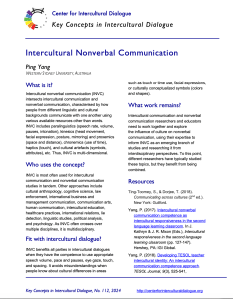
KC112 Intercultural Nonverbal Communication

Key Concepts in ICDThe next issue of Key Concepts in intercultural Dialogue is now available. This is KC112: Intercultural Nonverbal Communication, by Ping Yang. Click on the thumbnail to download the PDF. Lists organized chronologically by publication date and numberalphabetically by concept in English, and by languages into which they have been translated, are available, as is a page of acknowledgments with the names of all authors, translators, and reviewers.

Key Concept 112: Intercultural Nonverbal Communication

Yang, P. (2024). Intercultural nonverbal communication. Key Concepts in Intercultural Dialogue, 112. Available from: https://centerforinterculturaldialogue.org/wp-content/uploads/2024/12/kc112-intercultural-nonverbal-communication.pdf

The Center for Intercultural Dialogue publishes a series of short briefs describing Key Concepts in Intercultural Dialogue. Different people, working in different countries and disciplines, use different vocabulary to describe their interests, yet these terms overlap. Our goal is to provide some of the assumptions and history attached to each concept for those unfamiliar with it. As there are other concepts you would like to see included, send an email to the series editor, Wendy Leeds-Hurwitz. If there are concepts you would like to prepare, provide a brief explanation of why you think the concept is central to the study of intercultural dialogue, and why you are the obvious person to write up that concept.


Creative Commons License
This work is licensed under a Creative Commons Attribution-NonCommercial-NoDerivatives 4.0 International License.

Pew Research Center: Research Associate, Global Attitudes (USA)

“JobResearch Associate, Global Attitudes, Pew Research Center, Washington, DC, USA. Deadline: open until filled; posted 3 December 2024.

Pew Research Center’s Global Attitudes team conducts cross-national survey research on major international issues such as attitudes toward the U.S. and American foreign policy, views of China, democracy, religious practice and attitudes, as well as how people view conditions in their countries and their own lives. The bulk of the team’s work focuses on one large annual survey (25+ countries) but periodically the team also employs secondary data, qualitative data and experimental data.

The Pew Research Center’s Global Attitudes team has an immediate need for a Research Associate. This position will be involved in all aspects of the survey research process, including: drafting a questionnaire, script testing, managing a cross-national translation and verification process, data quality control, vendor relations, reviewing fieldwork and technical reports, and more. Ideally, a Research Associate will gradually be able to not only participate in but manage these tasks.

A Research Associate will also be involved in analysis and writing reports and other products. Reports on the Global Attitudes team are highly collaborative and a Research Associate will be expected to assist in background research, producing charts and tables, statistical analysis, and number checking, in addition to writing. The Research Associate may serve as a spokesperson for the Global Attitudes team and will discuss our research with key audiences such as the media and policymakers.

This position works closely with other researchers on staff and reports to the Associate Director of Global Attitudes Research.

UNESCO: Intercultural Learning at Museums and Heritage Sites (France but Remote)

“JobIndividual Specialist on Intercultural Learning at Museums and Heritage Sites, UNESCO, ​France (but remote). Deadline: 31 December 2024.

In the framework of the “Fostering Positive Social Transformations in AlUla” project in partnership with the Royal Commission for AlUla (Saudi Arabia), UNESCO is developing a set of activities to create a vision and guidance for promoting intercultural dialogue and learning at museums and heritage sites. While supporting AlUla’s aspiration of becoming a global destination for art, culture and nature tourism and creating the world’s largest Living Museum, this initiative will also develop a longer-term vision for promoting intercultural understanding through heritage, thus contributing to UNESCO’s strategic objective of building inclusive, just and peaceful societies. This project is also in line with the UNESCO’s Recommendation concerning the Protection and Promotion of Museums and Collections, their Diversity and their Role in Society, adopted in 2015, which underlines the key role of museums and heritage preservation in fostering intercultural dialogue, social integration and cohesion.

One of the key objectives of this project is to promote the role of museums and heritages sites as spaces for intercultural dialogue and learning by designing a visitor experience that would enable the participants to develop intercultural competencies through engaging in live dialogue and sharing their cultural inheritance with each other. This experience will be designed during the Intercultural Training Week for museum and heritage site management professionals that will be held in Paris on 17-21 February 2025.

In particular, this experience will build upon UNESCO’s work to promote intercultural competencies through the UNESCO Story Circles methodology which has been used for several years to equip individuals with knowledge, skills and attitudes for effective and appropriate communication across differences, such as listening, empathy, critical thinking, cultural self-awareness, respect for diversity, and a sense of common humanity.

As part of this project, UNESCO will produce a publication which will serve as a guide for museums and heritage sites in promoting intercultural dialogue and learning.

Under the overall authority of the Chief of the Section for Inclusion, Rights and Intercultural Dialogue and the direct supervision of the Programme Specialist, and in close coordination with the Associate Project Officer, the Individual Specialist shall:

  • Lead the design and development of the publication exploring the role of museums and heritage sites in promoting intercultural learning – through examining the existing case studies and developing future guidance;
  • Make sure the publication describes key approaches and methodologies in intercultural learning;
  • Highlight the role of museums and heritage sites as key spaces for intercultural dialogue and learning;
  • Provide an overview of the existing initiatives promoting intercultural learning at museums and demonstrating how heritage can foster dialogue through an evidence-based approach;
  • Ensure the publication features several successful case studies promoting intercultural understanding at scale from around the world;
  • Outline the methodology and proposed impact assessment tools for the visitor experience designed as part of this project, providing a structured algorithm for replicating this experience in various cultural and institutional contexts.

The final publication will be launched at UNESCO at the end of the project will be freely accessible through the UNESCO Digital Library.

The Individual Specialist will work remotely. The period of assignment is approximately 90 days distributed over the period of 11 months from 1 February to 31 December 2025, to ensure that the publication captures the key stages of project development.

Coastal Carolina U: Coordinator of Education Abroad Programs (USA)

“JobCoordinator of Education Abroad Programs, Coastal Carolina University, Conway, SC, USA. Deadline: open until filled; posted 2 December 2024.

Coastal Carolina University is currently accepting applications for the following full-time position: Coordinator of Education Abroad Programs in the Center for Global Engagement. Coastal Carolina University is seeking an engaging, global-minded and culturally aware individual to work as a part of the education abroad team in their Center for Global Engagement (CGE). As education abroad is a vital part of Coastal Carolina University’s new strategic plan, the Coordinator of Education Abroad Programs will play an important role in the expansion and growth of education abroad. This position oversees their comprehensive advising services utilizing an empowered advising approach. This valued colleague will also have responsibility with innovative faculty/staff travel with students’ program and assist with submission of all of Coastal’s study/intern abroad applications. In this role, this colleague will have the creativity to design signature events to generate greater awareness of education abroad at Coastal Carolina, and this colleague will also assist in managing and supporting vital administrative policies to ensure a successful study abroad experience from beginning to end.


SALTO-Youth: Value the Difference Resource Pack

Resources in ICD“ width=

Value the Difference Resource Pack, SALTO-Youth, ERASMUS+ Youth.

Value the Difference Resource Pack has been prepared by SALTO-Youth (Support, Advanced Learning and Training Opportunities for Youth), with funding from ERASMUS+ Youth. Value the Difference is intended for youth workers, containing information and tools to engage young people across many topics relating to cultural diversity. This resource pack explores the topic of cultural diversity and many of the related and complex issues people in Europe face today, so together we can embrace and celebrate each one of those differences.

It is designed as a starting point for exploration of cultural diversity by youth workers (or anyone who works with young people).

The resource pack contains nine chapters, each offering background information, case studies and practical examples of how to engage young people with the topics:

  • Media
  • Migration and Cultural Diversity
  • Asylum Seekers and Refugees
  • Mediation
  • Cross Community
  • Identity
  • Youth Subcultures
  • Citizenship
  • Intercultural Competence

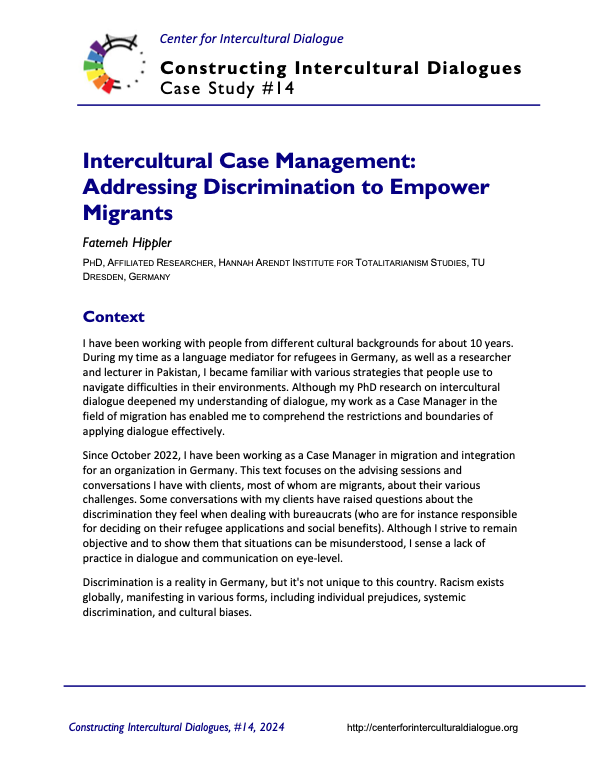
Constructing ICD #14: Intercultural Case Management: Addressing Discrimination to Empower Migrants

Constructing ICDThe next issue of Constructing intercultural Dialogues is now available, “Intercultural Case Management: Addressing Discrimination to Empower Migrants” by Fatemeh Hippler.

Case management in the context of migration refers to a structured process that helps migrants navigate the complexities of resettlement, integration, and legal processes. Key components include assessment, planning, and monitoring. A crucial component of case management is empowerment, which involves helping migrants build the skills and confidence needed to navigate their new environment independently over time. It fosters autonomy and self-sufficiency, allowing migrants to take control of their lives and decisions.

As a reminder, the goal of this series is to provide concrete examples of how actual people have managed to organize and hold intercultural dialogues, so that others may be inspired to do the same. As with other CID series, these may be downloaded for free. Click on the thumbnail to download the PDF.

Constructing ICD 14: Intercultural Case Management: Addressing Discrimination to Empower MigrantsHippler, F. (2024). Intercultural case management: Addressing discrimination to empower migrants. Constructing Intercultural Dialogues, 14. Available from: https://centerforinterculturaldialogue.org/wp-content/uploads/2024/10/constructing-icd-14.pdf

If you have a case study you would like to share, send an email to the series editor, Wendy Leeds-Hurwitz.


Creative Commons License
This work is licensed under a Creative Commons Attribution-NonCommercial-NoDerivatives 4.0 International License.

DFG Fellowships and Funding for Refugee Researchers (Germany)

Fellowships

The Deutsche Forschungsgemeinschaft (DFG, German Research Foundation) supports researchers who have fled their home countries by making it easier for them to join research projects and apply for funding under the Walter Benjamin Programme. Deadline: open.

The following requirements must be met in principle:

  • The person has not been outside their home country for more than three years at the time of application and

  • they have residential status in connection with an asylum procedure within the EU and are recognised as being at risk, or

  • in lieu of proof of residency status, they are able to present credible third-party evidence of being at risk no more than 12 months prior to application.

This way, the DFG also underlines its solidarity with researchers from Ukraine and Russia who had to flee their home country due to the current war situation triggered by the Russian attack. By integrating them swiftly in the German research system, the aim is to enable them to maintain continuity in their academic work.

In acute crisis situations, proposals can be submitted without proof of the respective status after consultation with the DFG.

Individuals are only eligible for sponsorship if they have not previously been sponsored through the Philipp Schwartz Initiative of the Alexander von Humboldt Foundation and the Federal Foreign Office or under any comparable programme for integration in the academic system or have been employed in the German academic system via a fellowship or a position for a total of two years or more.

Royal Holloway U London: PHD Studentship in International Relations (UK)

“Studentships“

PhD Studentship in International Relations, Royal Holloway, University of London, UK. Deadline: 7 January 2025.

The Department of Politics, International Relations, and Philosophy (PIRP) is an established centre of teaching and research excellence. Their research spans continents, covering all areas of the world and addressing current, pressing public policy problems. They house several research units and centres, including the Centre for International Public Policy, the Centre for Islamic and Western Asian Studies and the Democracy and Election Centre. Research units and networks emphasize Democracy, Elections and Campaigning; Public Policy; Contemporary Political Theory; New Political Communication; International Security; and Gender and Politics.

PIRP has an active PhD programme with several dozen students. Entering first-year students form a cohort and together take a professional development module that covers all aspects of progressing through the PhD programme alongside preparing for careers in academia and beyond.

PIRP offers a fully-funded studentship on a competitive basis, via the South East Doctoral Training Arc (SEDarc). They welcome applicants interested in proposing projects in politics and international relations that match one of five challenge themes: living sustainably; healthy, thriving communities; inclusive economic growth; secure, effective, and trusted organizations; and transformative technologies for society. The project is open to specific research focuses and may be co-developed between the student and the academic supervisor.

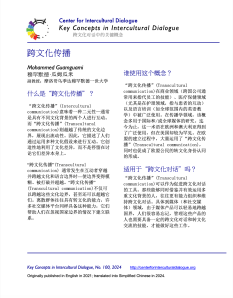
KC 100: Transcultural Communication Translated into Simplified Chinese

Key Concepts in ICDContinuing translations of Key Concepts in Intercultural Dialogue, today I am posting KC100: Transcultural Communication, originally written by Mohammed Guamguami for publication in 2021, and now translated by Yan Qiu into Simplified Chinese.

As always, all Key Concepts are available as free PDFs; just click on the thumbnail to download. Lists organized chronologically by publication date and numberalphabetically by concept in English, and by languages into which they have been translated, are available, as is a page of acknowledgments with the names of all authors, translators, and reviewers.

KC100 Transcultural Communication Translated into Simplified ChineseGuamguami, M. (2024). Transcultural communication [Simplified Chinese]. (Y. Qiu, Trans.)  Key Concepts in Intercultural Dialogue, 100. Available from: https://centerforinterculturaldialogue.org/wp-content/uploads/2024/11/kc100-transcultural-communication_simplified-chinese.pdf

If you are interested in translating one of the Key Concepts, please contact me for approval first because dozens are currently in process. As always, if there is a concept you think should be written up as one of the Key Concepts, whether in English or any other language, propose it. If you are new to CID, please provide a brief resume. This opportunity is open to masters students and above, on the assumption that some familiarity with academic conventions generally, and discussion of intercultural dialogue specifically, are useful.

Wendy Leeds-Hurwitz, Director
Center for Intercultural Dialogue


Creative Commons License
This work is licensed under a Creative Commons Attribution-NonCommercial-NoDerivatives 4.0 International License.

Save