Key Concept #61: ВЫХАВАННЕ by Liubou Uladykouskaja

Key Concepts in ICDThe next issue of Key Concepts in intercultural Dialogue is now available. This is KC61: BblXABAHHE by Liubou Uladykouskaja. As always, all Key Concepts are available as free PDFs; just click on the thumbnail to download. Lists organized  chronologically by publication date and numberalphabetically by concept in English, and by languages into which they have been translated, are available, as is a page of acknowledgments with the names of all authors, translators, and reviewers.

Key Concept #61 BblXABAHHE by Liubou Uladykouskaja

Uladykouskaja, L. (2015). ВЫХАВАННЕ. Key Concepts in Intercultural Dialogue, 61. Available from: https://centerforinterculturaldialogue.org/wp-content/uploads/2015/04/kc61-d0b2d18bd185d0b0d0b2d0b0d0bdd0bdd0b5.pdf

The Center for Intercultural Dialogue publishes a series of short briefs describing Key Concepts in Intercultural Dialogue. Different people, working in different countries and disciplines, use different vocabulary to describe their interests, yet these terms overlap. Our goal is to provide some of the assumptions and history attached to each concept for those unfamiliar with it. As there are other concepts you would like to see included, send an email to the series editor, Wendy Leeds-Hurwitz. If there are concepts you would like to prepare, provide a brief explanation of why you think the concept is central to the study of intercultural dialogue, and why you are the obvious person to write up that concept.


Creative Commons License
This work is licensed under a Creative Commons Attribution-NonCommercial-NoDerivatives 4.0 International License.

Liubou Uladykouskaja Profile

Profiles
Liubou Uladykouskaja
is the Founder and Director General of the Institution “Intercultural Dialogue” in Minsk, Belarus.

Liubou Uladykouskaja

In spring 2015 she is also a Fulbright Scholar at the University of Florida, in Gainesville. She earned her PhD in Belarusian Studies in 1993. She is the author of 320 publications on the problems of intercultural dialogue, nation building, identity, preservation of  cultural originality, democratic transformation, globalization, and the USA, including six books: Spiritual Ideals in the Modern Belarusian Culture and Values of Globalism (2009), How to Preserve Cultural Originality (2010), Discovery of My America, Or Why do the Belarusians Need the USA? (2012), and Intercultural Dialogue: American Paradigm (2014).

She established the Center for Intercultural Dialogue (2010), the Inter-Cultural Dialogue Department of the Academy of Sciences of Belarus (2011), NG Institution “Intercultural Dialogue” (2012), the Laboratory for Intercultural Communication at Belarusian State University (2013). She also has initiated and successfully implemented multiple civic society activities (organization and running of constantly working exhibitions, libraries, art galleries, clubs, ex. the Terminological Commission at the Ministry of Education, the American Club in Minsk, the Belarusian Club of Christian Intellectuals, the Discussion Club “Disputant” at the scientific magazine Higher Education) and international projects, including 190 international conferences, seminars, round tables and presentations. She has participated in joint civic and scientific projects in Poland, Great Britain, Germany, Luxembourg, France, USA, Sweden, Norway, Italy, Lithuania, Latvia, and Ukraine. She’s worked as a Chief of the Research Laboratory for Intercultural Communication (Belarusian State University), as Department Chair, Institute of Sociology, as a Director of the Center for Multicultural Education and Deputy Director, a Chief Administrative Unit for Science (Belarusian State University), as a Director of the F. Skaryna National Scientific and Educational Center, in the Ministry of Education and Science of Belarus (supervising social science and humanities curricula at universities), as a Lecturer in Belarusian Studies. Uladykouskaja also worked as a journalist, including radio and TV performances.


Work for CID:

Liubou Uladykouskaja wrote KC61: ВЫХАВАННЕ and then translated it into Belarusian and Russian.

Europe-China Dialogue: Media and Communication Studies Summer School 2015 (Beijing)

Europe-China Dialogue: Media and Communication Studies Summer School 2015
Beijing, China
July 1, 2015 to July 10, 2015

After the successful experience of last summer, the China Media Observatory at the Università della Svizzera Italiana (USI) in cooperation with School of Journalism and Communication at Peking University will operate the SECOND edition of the Europe-China Dialogue: Media and Communication Studies Summer School in Beijing between July 1st and July 10th, 2015.

The program is open to the full variety of academic work in the field of communication and media studies for young scholars, PhD and graduate students who have strong academic interests, especially for those with a background in international communication, intercultural communication, Chinese/European media and culture/language studies. The Summer School aims to bring together researchers from Europe and China to debate contemporary issues in media, communication and cultural studies in Chinese and European media industry.

Inspired from the ECREA Doctoral Summer School, this summer school aims to provide: a highly qualified international setting where academics from several European countries and China will present and discuss their most recent research; and a highly supportive international setting where scholars can present their current work, receive feedback on their research projects from international experts and meet scholars and academics from other countries, establishing valuable contacts for the future.

The learning format of the Summer School is divide into three parts:
1) Lectures: each of the invited professors will have 1-2 lectures related to their research necessities. Proposed lecturers and topics will include:

European Faculty
Prof. Giuseppe Richeri, European Media Market & Public Broadcasting Service in Europe; Università della Svizzera Italiana, Lugano, Switzerland;
Prof. Emili Prado, The European Audio-visual Media Industry, Universitat Autònoma de Barcelona, Spain;
Prof. Pierre Musso, Modelling of imagination, innovation and creation, Télécom ParisTech/ université de Rennes II, France;
Prof. Stefano Iacus, Sentiment Analysis in Communication Studies, University of Milan, Italy;
Prof. Gabriele Balbi, Introduction to European Media History, Università della Svizzera Italiana, Lugano, Switzerland;
Dr. Guido Keel, The Current State and Future Development of Journalism In the Western World, Zurich University of Applied Science, Switzerland;
Dr. Sharif Mowlabocus,
Mastery of the Swipe: Smartphone Use and the Connection to Neoliberalism and Late Capitalism: A Psychodynamic Approach , University of Sussex, U.K.
Prof. Jia Wenshan, Intercultural Communication,  Dialogic Civilization and the Construction of an Inclusive World Order, Champman University, United States.

Chinese Faculty
Prof. Lu Shaoyang,
The Film Policies and Market in China, Peking University;
Prof. Wu Jing, Critical Approach to Media Culture Studies, Peking University;
Prof. Xu Jing, Media and Public Opinion in China, Peking University;
Prof. Wang Xiuli, “Made in China” and national image, Peking University;
Prof. Guo Zhenzhi, Chinese Media: History and Current Development, Tsinghua University;
Prof. Jin Jianbin, Social Media Literacy in the Case of China, Tsinghua University;
Prof. Shi Anbin, China’s Charm Campaign: Opportunities and Challenges, Tsinghua University;
Prof. Jiang Fei, The Chinese Version of “Soft Power” from the Intercultural Perspective, Chinese Academy of Social Sciences.

2) Student Feedback Workshops: participating students will present their research projects and receive structured, qualified and multi-voiced feedback on their work from Summer School lecturers and scholars, allowing students to structurally improve the quality of their academic work and stimulate their further research interests;

3) Media Dialogue: Two dialogues with media experts from European and Chinese media organization will be set in the Summer School. Director of Austrian Press Council (Mr. Alexander Warzilek, Vienna) and expert of China Radio International (Dr. Huang Kuo, Beijing) are invited to the 2015 Summer School.

We enrolled 30 students in 2014, including young scholars, PhD and graduate students from China, U.K., Sweden, Canada, Italy, and Singapore. Moreover, we plan to enroll the same number of students in 2015. Ideally, the composition of selected students will be 15 from European institutions and 15 from Chinese institutions.

To apply
All participants are required to email an abstract (about 500 words) of their research projects before May 1st, 2015. The confirmation will be sent by May 10th, and the full draft of research projects should be sent before June 15th, 2015.

Admission fee and payment
550 euros per student including accommodation for 10 days nearby the Campus, all lunches and two dinners (welcome and farewell) and the city visiting tour. 350 euros per student for those who do not require accommodation.

Scholarship awards of 200 euros will be given to the two best student participants, and they will get the chance to be recommended to the ECREA Summer School 2016 as well as the Swiss Government Excellence Scholarships Programme.

Organizers:
China Media Observatory at USI  China Media Observatory aims at the systematic monitoring of the evolution of the system of media and communications in China according to the main economic, political as well as social and cultural dimensions. In function of the activities it carries out, the Observatory encourages the exchanges for teaching and research purposes and establishes collaboration agreements with European universities, which have started permanent research activity on media in China, as well as with Chinese universities, that are interested in collaborating and exchanges with our university in the scientific and teaching field. 

School of Journalism and Communication, Peking University Peking University is a pioneer in modern Journalistic education in China. In 1918, Peking University started the first Journalistic course and founded the Journalism Research Institute that was the first of its kind in China. In 1952, Peking University opened the first Journalism Studies program since the founding of the People’s Republic of China and the new School of Journalism and Communication was established in 2001. Founded in 1898, Peking University was the first national comprehensive university in China and became a centre for progressive thought in China across time. Mao Zedong, Chen Duxiu, Hu Shi and many other leaders of China all gained professional experience here. In 2014, The Chinese University Alumni Association and China Education Center considered it as No.1 among national universities. Internationally, both the Times Higher Education World University Rankings and the World Reputation Rankings recently placed Peking University at 45th position worldwide.

Programme Contacts
Coordinator in Europe: Zhan ZHANG
Coordinator in China: Prof. Jing XU

CFP International Conference on Communication in Healthcare (New Orleans)

13th International Conference on Communication in Healthcare 2015
The Primacy of Healthcare Communication
New Orleans, Louisiana, October 25-28, 2015

Deadline: Monday, May 4, 2015
Notification of Acceptance: Late June 2015

Gain knowledge, share ideas, and improve patient-provider outcomes while connecting with like-minded professionals. The International Conference on Communication in Healthcare (ICCH) offers diverse workshops, symposia, poster sessions, and high-profile keynote speakers to inspire the ongoing work of improving communication in healthcare.  ICCH brings together researchers, educators, and applied healthcare professionals from across North America and Europe to share the latest research and teaching methods related to communication and relationships in health care. This interdisciplinary event offers a wealth of information for academicians, physicians, nurses, pharmacists, counselors and other professionals interested in healthcare communication.

Prospective authors can submit abstracts and proposals through our electronic submission process. We encourage submissions from educators, researchers and learners from all healthcare fields. Please click here for detailed guidelines and selection criteria for scientific abstracts, workshops, symposia, and special interest group submissions. Accepted abstracts will be published in Medical Encounter, a journal of the American Academy on Communication in Healthcare.

Submission categories at this year’s ICCH include:
*Teaching and evaluating clinical communication skills
*Patient education and health behavior change
*Shared decision-making and patient/family engagement
*Patient-Centered Medical Home
*Community-based research
*Humanities, ethics, and professionalism
*Research methodology
*Technology and social media
*Health literacy and numeracy
*Risk communication and medical decision-making
*Underserved populations and health disparities
*Diversity and cross-cultural communication
*Linguistics and sociolinguistics
*Communication in quality and safety
*Implementation science and knowledge translation in health communication
*Team and inter-professional communication
*Other communication-related topics

Presented by the American Academy on Communication in Healthaare (AACH)

IAMCR: Hegemony or Resistance? The Ambiguous Power of Communication (Montreal)

IAMCR: Hegemony or Resistance? The Ambiguous Power of Communication
July 12-16, 2015, Université du Québec à Montréal (UQAM), Canada

This year’s International Association for Media and Communication Research (IAMCR) conference theme seeks to explore the ambiguous relationship of communication towards hegemony and resistance. It relates, for example, to the various ways in which communication has been described not only as a value of our times – echoing an ideal for social transparency and communality – but also as a threat in terms of global domination. This ambiguity has prompted debates in academia about communication being at the same time a value and a tool, a space of consent and one of struggle, and having (more authentic) local and global dimensions.

For example, recent demonstrations around the world, such as Occupy Wall Street, the Arab Spring, the chilean students’ protest, or the Los Indignados movement, as well as the Québec student’s strike and Idle no more in Canada, have triggered discussions and reflections about the utopia of communication. Massively supported by digital media and organised around the ideal of building more authentic forms of community, these mass movements of “global solidarity” have mobilized communication as a value that challenges authorities, financial or economic globalisation and dominant representations of the world-as-we-know-it. These movements draw on the argument that global corporate media and cultural industries have distanced us from more faithful forms of communication. In this sense, they echo what John Durham Peters has described as our obsession for communication as a “registry of modern longings,” whether based on democracy, social and economic justice, or “the mutual communion of souls.” While embracing these arguments, protest movements have a paradoxical relationship to communication, resisting its role in the domination of global cultural industries and capitalism while at the same time applauding its capacity to foster values and communality that would otherwise have been lost. They often do so through disruptive communication practices using communication technologies or cultural productions.

While multiple sites of resistance are spreading around the world, much of the debates about communication technologies mark an increasing suspicion towards the new media’s capability for empowerment. The crisis unveiled by the Edward Snowden case, the importance of Big data and the NSA’s large-scale espionage practices, just to name a few examples, reveal part of the ambiguous relationship that the public maintains with the media. Despite a general consensus over the past few years, which is critical of the use of communication technologies for surveillance and ideological purposes, few people have really changed their own use of communication devices. Political reform promises, as well as the social, economic and cultural prominence of new technologies seem to contribute to the maintenance of a negotiated status quo. Such situations are far from exceptional and examples abound of what Antonio Gramsci referred to as hegemonic domination by consent, where communication not only represents an instrument for control, but also a space for the expression of the majority – “organs of public opinions […] that are artificially multiplied” – that legitimate these practices.

Beyond these examples, this year’s conference theme concentrates on this ambiguous power of communication. What are the finalities of communication with regards to opposing forces acting at micro, meso and macro levels? To what extent can media and communication “change our living world”? How can communication contribute to the empowerment of individuals and groups in their local contexts? How do modern forms of communication interact with the ideal of democracy, considered as much an apparatus for manipulation as for freedom? If communication has power, what is the nature of this power? How do media represent hegemonic processes and acts of resistance? In what ways do entertainment, social media, journalism or public relations act as symbols of resistance or control for corporations and civil society? In what ways does media and communication research constitute in itself a site of hegemonic domination or of resistance? Contributions may include empirical research from a wide variety of terrains, or methodological and theoretical papers from a large scope of epistemological perspectives.

– Registration fees depend on your country of residence, when you register (earlybird, regular or late), and whether you are a member of IAMCR. Consult the registration fees.

– IAMCR members enjoy significantly discounted fees.

– All students -regardless of IAMCR membership status – can register with reduced fees. If you register as a student, you  will be required to show proof of your student status (a student card or a letter from your university) at the registration desk in Montreal.

Dublin III Training Workshop by EIUC (Venice)

Dublin III, two years on. Asylum seekers and refugees in the EU and beyond

Dates: 19-21 June 2015
Deadline for enrollment: 21 May 2015
Deadline for early bird enrolment: 25 April 2015
Location: Monastery of San Nicolò, Venice Lido (Italy)
Training Responsibles: Paolo De Stefani
Project Manager: Elisabetta Noli

Introduction
Two years into the endorsement of the “Dublin III regulation”, international protection provided by the EU to the increasing number of asylum seekers fleeing their countries is being challenged. Efficacy of these norms and policies is under scrutiny, as well as the complex relationship between the EU and its member states when it comes to concrete implementation. Is Dublin III – and more broadly the common European asylum system – meeting human rights concerns emerging from the migration crisis and the many recent humanitarian disasters? What are the dilemmas faced by European lawyers and legal practitioners when it comes to everyday application of EU and international legal standards on asylum?

The training seminar on “Dublin III, two years on. Asylum seekers and refugees in the EU and beyond” is set to analyze these important questions. It is designed to provide participants with an overview of the European asylum system and foster cross-border cooperation and networking among legal practitioners from all EU and non-EU countries involved in the application of the relevant national, EU and international standards. Mutual trust between legal practitioners from all EU countries is essential to ensure the coherent application of EU legislation across the Union as well as to provide a platform for exchange of good practices and, where relevant, critical analysis and reform proposals.

The course aims at reaching this primary objective by involving distinguished scholars and practitioners in a thorough overview of the legal instruments at stake, and facilitate comparative analysis of experiences and challenges.

The ultimate objectives of the training seminar are to:
*provide participants with an overview of the common European asylum system and of the existing international human rights instruments setting universal principles on asylum, refugee status, migration;
*allow a comparative analysis of this normative system;
*create a forum for exchange of best practices;
*foster cross-border cooperation and networking among legal practitioners from all EU countries involved in the implementation of the EU norms.

Save

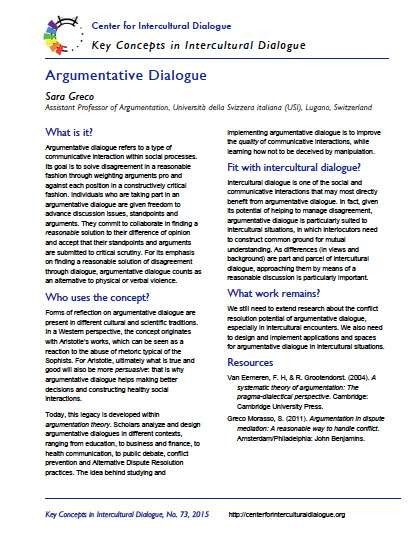
Key Concept #60: Deliberation by Leah Sprain

Key Concepts in ICDThe next issue of Key Concepts in intercultural Dialogue is now available. This is KC60: Deliberation by Leah Sprain. As always, all Key Concepts are available as free PDFs; just click on the thumbnail to download. Lists organized  chronologically by publication date and numberalphabetically by concept in English, and by languages into which they have been translated, are available, as is a page of acknowledgments with the names of all authors, translators, and reviewers.

Key Concept #60: Deliberation by Leah Sprain

Sprain, L. (2015). Deliberation. Key Concepts in Intercultural Dialogue, 60. Available from: https://centerforinterculturaldialogue.org/wp-content/uploads/2015/04/kc60-deliberation.pdf

The Center for Intercultural Dialogue publishes a series of short briefs describing Key Concepts in Intercultural Dialogue. Different people, working in different countries and disciplines, use different vocabulary to describe their interests, yet these terms overlap. Our goal is to provide some of the assumptions and history attached to each concept for those unfamiliar with it. As there are other concepts you would like to see included, send an email to the series editor, Wendy Leeds-Hurwitz. If there are concepts you would like to prepare, provide a brief explanation of why you think the concept is central to the study of intercultural dialogue, and why you are the obvious person to write up that concept.


Creative Commons License
This work is licensed under a Creative Commons Attribution-NonCommercial-NoDerivatives 4.0 International License.

Leah Sprain Profile

Profiles
Leah Sprain
is an Assistant Professor of Communication at the University of Colorado Boulder.

Leah Sprain

Her research focuses on democratic engagement, studying how specific communication practices facilitate and inhibit democratic action. Her research and teaching draw on language and social interaction perspectives to explore deliberation, environmental communication, and social movement activism. Outreach and praxis are crucial to democratic engagement thus much of her research is collaborative and focused on the practice-theory interface. As an ethnographer of communication, she has conducted extended fieldwork in Nicaragua and the United States. She co-edited Social Movement to Address Climate Change: Local Steps for Global Action, and her work appears in the Journal of Applied Communication Research, Environmental Communication: A Journal of Nature and Culture, and Communication Theory. She received her BA from Pacific Lutheran University, and MA and PhD from the University of Washington.

Key Publications:

Carcasson, M. & Sprain, L. (in press). Beyond problem solving: Re-conceptualizing the work of public deliberation as deliberative inquiry. Communication Theory.

Sprain, L., Carcasson, M., & Merolla, A. (2014). Experts in public deliberation: Lessons from a deliberative design on water needs. Journal of Applied Communication Research, 42, 150-167.

Sprain, L. & Gastil, J. (2013). What does it mean to deliberate? An interpretive account of jurors’ expressed deliberative rules and premises. Communication Quarterly, 61, 151-171.

Sprain, L. & Boromisza-Habashi, D. (2013). The ethnographer of communication at the table: Building cultural competence, designing strategic action. Journal of Applied Communication Research, 41, 181-187. [Introduction to a Special Forum on Ethnography of Communication in Applied Communication Research]

Witteborn, S. & Sprain, L. (2010). Grouping processes in a public meeting from an ethnography of communication and cultural discourse analysis perspective. International Journal of Public Participation, 3, 14-35.

Endres, D., Sprain, L., & Peterson, T. R. (Eds.) (2009). Social movement to address climate change: Local steps for global action. Amherst, NY: Cambria Press.


Work for CID:
Leah Sprain wrote KC60: Deliberation.

CFP Waterhouse Family Institute 2015-16 Research Grants

Villanova University‘s Waterhouse Family Institute for the Study of Communication and Society (WFI) is pleased to both CALL FOR GRANT APPLICATIONS for 2015/16 and to celebrate the recipients of the WFI 2014/15 Research Grants.

The WFI-endowed by Mr. Lawrence Waterhouse, Jr., and housed within Villanova University’s Department of Communication-was founded on the principle that scholars, activists, and practitioners of communication have an important role to play in the creation of a socially just world. One of the ways that we enact this mission is through the annual funding of research grants. These grants support the scholarly work of Communication scholars across the world, work examining communication, its impact on the world around us, and its ability to create social change and social justice.

OUR 2014/15 WFI RESEARCH GRANT RECIPIENTS:
For 2014/15, the WFI awarded 7 research grants, totaling roughly $60,000, to support a strong and diverse collection of projects linking communication and social change/social justice.

CALL FOR 2015/16 WFI RESEARCH GRANT APPLICATIONS Our next application deadline for WFI Research Grants is now in place! Applications for 2015/16 WFI Research Grants will be due Tuesday, May 5, 2015.

Communication scholars across the nation, and across the world, are invited to apply for funds to support initial or ongoing phases of scholarly research aimed at presentation and publication. Although we do not limit our grants to a specific methodological orientation or subdisciplinary focus, all projects supported by the WFI have two things in common: they make communication the primary, and not secondary, focus, and they engage communication in terms of its impact on the world around us, its ability to create social change. WFI Research Grants are available to faculty at any institution of higher education, postdoctoral researchers, doctoral candidates, and other doctoral-level scholars. However, eligibility to apply for the WFI grant program is limited to those in Communication or a closely related discipline. Awards are typically in the range of $5,000-10,000, and may be applied to the hiring of graduate assistants, acquisition of resources or equipment, travel, and/or any other appropriate research related expenses. However, these funds may not be used to provide or supplement salaries. For more details on the WFI and this research grant process-including specific information on the grant application requirements, see the WFI website.

Questions concerning eligibility, or the nature of projects supported, please contact the Director of the WFI, Dr. Bryan Crable.

Communication of Scientific Research (Summer School, Czech Republic)

Summer School for Communication of Scientific Research

CRS Summer School 2015

The first Summer School for Communication of Scientific Research (CSR) will be offered at the University of West Bohemia, in Pilsen, Czech Republic. [Click on the image above to download the flyer.]

Location: The Institute of Applied Language Studies of the University of West Bohemia
Term: 7 – 11 July 2015 (daily from 10.00 a.m.to 6.00 p.m.)
Programme: 7 hours per day of theoretical and practical lessons on the basics of theory of communication applied to scientific research; construction of written and oral texts, analyses of written and oral texts prepared by participants, small groups work session and class discussion

CSR: Communication of Scientific Research is different from the general communication of science, which implies the explanation of scientific matters to people who have not a scientific background (public and not specialized media). “CSR” is a discipline dedicated to the professionals of science, people who do know the matter, as they study, do research and work in this context. It does not depend on the disciplines, as it is not based on the contents of science, but on the tools used to communicate. “CSR” courses aim to start to fill a gap: a need for a more formal education on communication among young scientists.

Target audience: PhD students, post-doctoral fellows of different countries and disciplines (natural, social and human sciences)
Number of participants: maximum 20
Structure of the course: an intensive course of 5 days, with 7 hours per day, of theoretical and practical lessons dedicated to written and oral communication of scientific research.
Language: English
Application form due May 31, 2015
Registration Fee: 350 euro per person

Lecturer:
Maria Flora Mangano earned her PhD in biochemistry in Italy, at the University of Milan, in 1999; then she left the research laboratory to study science communication. In 2003 she started to teach communication through meetings and courses dedicated to trainees at scientific faculties of Italian universities. In 2014 she began a second PhD in humanities and intercultural studies at the University of Bergamo (Italy). Her website and the articles she publishes are attempting to start filling a gap: the need for more formal education of communication among scientists. It is a challenge for scientific disciplines, where so much research is done with such a little communication. She has published a handbook of communication of scientific research. It has been written both in Italian (1st ed. 2008; 2nd ed. 2013) and Spanish (2009). It is 100 pages long, and designed for science professionals: young scientists, including PhD students and postdoctoral fellows. It is offered to scientists as a tool to understand how to communicate their research, either written or oral, better. The handbook specifically deals with various forms including a scientific paper, poster, PhD thesis and scientific presentation. Maria Flora Mangano teaches communication of scientific research at Italian universities and organizes regular “schools.” Three courses dedicated to the communication of scientific research have already been held in Pilsen, at the University of West Bohemia, in 2014 and 2015. July 2015 will be the first summer school.

History and more details, including the complete Schedule are available. For further information about the course, please send an email.