China Internship Program Summer 2015 (Shanghai)

6-week internship program in Shanghai, China, in summer 2015. Six course credits are transferrable through Villanova University.

Quick highlights–

LANGUAGE: No language requirement.

PROGRAM: 3-credit internship and 3-credit comm class.

COST: $7,500; competitive scholarships available.
INCLUDED: Tuition, all cost related with internship placement and visa application, all accommodations with breakfasts, all inner-China domestic travel expenses, meals, and accommodations, etc.
EXCLUDED: Airfare, spending money and some meals.

WHO SHOULD GO: Freshmen, students with no internship (or international) experience before, and any student motivated to become a global citizen and aspire after international workplace experience.

DATES: June 19 to July 26, 2015.

APPLICATION DEADLINE: March 5, 2015.

CONTACT: Dr. Qi Wang at Villanova University.

Multilingual Signs and Intercultural Pedagogy

When visiting Macau, I was surprised by seeing trilingual street signs (Chinese, Portuguese and English), a rare phenomenon in the US. A recent article in ELT Journal by Chiou-Ian Chern and Karen Dooley documents how such signs can serve as a resource to language teachers and learners. They conclude: “Environmental print . . . has become a useful, if politically complex, resource for learning English in contexts where language teachers once lamented the paucity of English input outside the classroom.” (p. 122).

Chern, C.-I., & Dooley, K. (2014). Learning English by walking down the street. ELT Journal, 68(2), 113-123. Available from: http://eltj.oxfordjournals.org/content/68/2/113.full

(The full article is available to download for free as I write this, though that may temporary.)

Wendy Leeds-Hurwitz, Director
Center for Intercultural Dialogue

CFP Qualitative Research in Communication (Bucharest)

International Conference
Qualitative Research in Communication
September 23-25, 2015
Bucharest, Romania

This conference  is dedicated to exploring qualitative methodology as an approach which enriches interdisciplinary understanding of communication phenomena. It aims to provide a venue for discussing related theories and methods, for presenting the results of research projects, and for assessing emerging trends. An additional goal is to provide international researchers with a stimulating environment for cultivating current and future collaborative projects. We invite communication scholars and interdisciplinary colleagues to contribute papers in all of these areas, but particularly welcome those addressing the following themes: mediated interpersonal communication, intergenerational communication, communication and emotion, language and social interaction, digital media, and applied communication.

Accepted papers will be programmed for one of three themed panels (see below), or in the open sessions.

1. Ageing, Communication and Technology
Panel head: Mireia Fernández-Ardèvol, IN3 – Open University of Catalonia, Barcelona (Catalonia), Spain

Ageing populations are experiencing a world that is increasingly mediated by digital devices, and influenced by their proliferation. Related questions include: How do digital and mobile technologies mediate the communication experiences and practices of older people? Does ICT use contribute to the development of personal autonomy of seniors (and if so, how)?

This panel is organized in collaboration with the ACT Project [http://actproject.ca/ ]

2. Communication and the Emotion Economy
Panel head: Liz Yeomans, Leeds Business School, Leeds Beckett University, UK

Increasingly, emotion is viewed as more than an individual psychological state, and as a social and cultural phenomenon which is also constituted ‘outside’ the individual. An ’emotion economy’ perspective encourages us to view communication as part of a system of emotion expression, exchange, circulation, and distribution. New, related codes and rituals are subsequently developed in interpersonal, organizational, intercultural, political, and mediated contexts. Related questions include: What are the distinctive forms and practices of which constitute the emotion economy? How may qualitative methods distinctively advance this research program?

3. Digital Explorations: Research with and about Digital Media
Panel head: Ana Adi, Quadriga University of Applied Sciences in Berlin, Germany

The rise in global popularity of the Internet, its increased adoption both by organisations and individuals, and the rise of ‘big data’ regimes all present numerous opportunities for qualitative researchers. Related questions include: How, generally, are traditional research methodologies challenged and transformed by online application?  By the specific context of social media platforms? How do new digital research tools (e.g., crowd-sourcing, visualization, etc.) influence the design of qualitative projects, and the collection and analysis of qualitative data?

Keynote speakers for the conference will include:
Kim Sawchuk, Professor in Communication Studies, Concordia University, Canada; Bryan C. Taylor, Professor in Communication, University of Colorado Boulder, USA; Eugene Loos, Professor at Amsterdam School of Communication Research ASCoR, Department of Communication Science, University of Amsterdam, The Netherlands.

Important conference deadlines include:
April 7th, 2015: Abstract submission;
May 15th, 2015: Notification of authors via email; June 20th, 2015: Full paper submission; August 30th, 2015: Notification of authors.

Abstracts
Paper abstracts (max. 300 words, followed by 3-5 keywords) should be submitted for review in MS Word format (.doc, .docx). Please use the abstract template.  Please mention whether you desire consideration for programming on one of the three themed panels. Only one paper for each participant (i.e., as a first author) will be accepted. Submit abstracts as attachments to email messages to Corina Buzoianu. The official language of the conference is English.

Publication
All conference papers are subject to a peer-review process. All accepted papers will be published in a hard-copy, conference proceedings volume (i.e., with ISBN). Selected papers will be published in a special issue of the Romanian Journal of Communication and Public Relations.

Conference Fees:
The conference fee is 100 Euro/participant (approx. $114 USD). The fee includes conference attendance, conference bag, publication in conference proceedings, and consideration for publication in the Romanian Journal of Communication and Public Relations, refreshments during coffee breaks and lunch.

Conference Venue:
National University of Political and Administrative Studies, College of Communication and Public Relations, 30A Expozitiei Boulevard, Bucharest, Romania.

Sponsoring Programs and Institutions:
National University of Political Studies and Public Administration, Romania; ACT project, Concordia University, Canada; University of Colorado Boulder, USA.

For details and inquires please send an e-mail to Corina Buzoianu.

Multilingual Perspectives on Professional Discourse in Europe

Multilingual Perspectives on Professional Discourse in Europe
Date: 10-Sep-2015 – 11-Sep-2015
Location: Ghent University, Belgium
Call Deadline: 01-Mar-2015

Sponsor:
Ghent University: Department of Translation, Interpreting and Communication; Department of Linguistics

The UGhent research groups Intercomm and Lang+ are pleased to announce they will be co-hosting a conference entitled Multilingual Perspectives on Professional Discourse in Europe , which will take place at Ghent University, Belgium on 10-11 September 2015. The topical and methodological scope of this conference has been kept as wide as possible, though a number of foci of attention have been included. The communicative context will be restricted to Europe and main topics include multilingual internal and external, written or oral communication in organizational and institutional settings (meetings, hearings, emails, press releases, annual reports, etc.).

Specific attention will be paid to:
– Multilingualism and identity construction in a professional context
– Multilingualism and enactment of power in a professional context
– Speech act realizations in multilingual professional settings
– Change management communication in multilingual professional settings
– Localized financial reporting from a multilingual perspective
– Language policy in international organizations
– Science communication in multilingual professional settings
– (interpreter mediated) service encounters in multilingual settings
– Public service interpreting

The conference is open to a variety of theoretical and (multi-)methodological approaches, such as ethnographic, sociolinguistic, (intercultural and cross-cultural) pragmatic and corpus-based approaches.

Keynote Speakers:
Yves Van Vaerenbergh:
Srikant Sarangi
Celia Roberts
Anne Kankaanranta

Final Call for Papers:
We welcome papers on any of the subjects listed above or on any other topic related to professional communication in Europe from a multilingual/intercultural perspective. We especially welcome papers that re-examine theoretical frameworks, explore new methodologies and discuss the merits and flaws of data triangulation and/or focus on practical applications.

Presenters will be allowed 20 minutes, plus 10 minutes for questions and discussion. The working languages of the conference will be English and French.

Proposals (abstracts of max. 400 words excluding references), written in English or French, must be sent in PDF format. Deadline for receipt of abstracts is 1 March 2015. All abstracts will be double-blind peer-reviewed and should include sufficient details to allow reviewers to judge the scientific merits of the work. Notifications of acceptance will be communicated by end of April 2015.

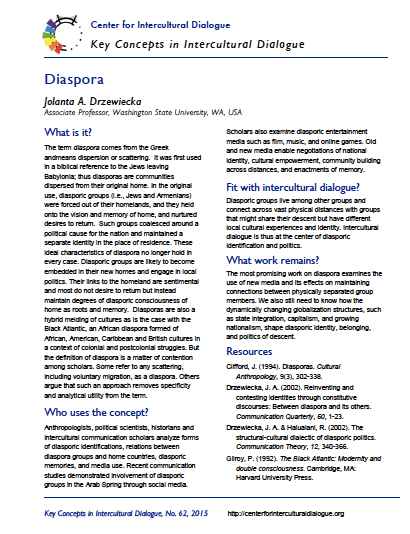
Key Concept #52: Harmony by Guo-Ming Chen

Key Concepts in ICDThe next issue of Key Concepts in intercultural Dialogue is now available. This is KC52: Harmony by Guo-Ming Chen. As always, all Key Concepts are available as free PDFs; just click on the thumbnail to download. Lists organized  chronologically by publication date and numberalphabetically by concept in English, and by languages into which they have been translated, are available, as is a page of acknowledgments with the names of all authors, translators, and reviewers.

Key Concept #52: Harmony by Guo-Ming Chen

Chen, G.-M. (2015). Harmony. Key Concepts in Intercultural Dialogue, 52. Available from: https://centerforinterculturaldialogue.org/wp-content/uploads/2015/02/key-concept-harmony.pdf

The Center for Intercultural Dialogue publishes a series of short briefs describing Key Concepts in Intercultural Dialogue. Different people, working in different countries and disciplines, use different vocabulary to describe their interests, yet these terms overlap. Our goal is to provide some of the assumptions and history attached to each concept for those unfamiliar with it. As there are other concepts you would like to see included, send an email to the series editor, Wendy Leeds-Hurwitz. If there are concepts you would like to prepare, provide a brief explanation of why you think the concept is central to the study of intercultural dialogue, and why you are the obvious person to write up that concept.


Creative Commons License
This work is licensed under a Creative Commons Attribution-NonCommercial-NoDerivatives 4.0 International License.

CFP International Communication and Development

Call for papers
Global Media Journal — Canadian Edition 2016: Volume 9, Issue 1
International Communication and Development

Guest Editors:
Dr. Jean-Jacques Bogui
Dr. Carmen Rico
Dr. Christian Agbobli
Dr. Oumar Kane
(Université du Québec à Montréal)

In the late 1950s, a reflection on the potential of the media as a vector for development opened a communicational perspective on international development issues. For the proponents of this approach, it was enough to inject into the social body a certain amount of technical knowledge, which facilitated the flow of information causing a positive reaction of Third World populations to social, technological, and economic progress. Critics of this approach were numerous and took shape in the response of dependency theories. The emergence of international communication and development research field was partly the result of this heated debate.

This field of research has experienced a second wave due to work of the MacBride Commission initiated by the United Nations Educational, Scientific, and Cultural Organization (UNESCO). The work of this committee focused on communication systems, such as the impact of international communication on national development and influence of transnational corporations in Third World countries. The oppressive cultural North/South relations resulting from the stranglehold of North media organizations over those of Third World has attracted attention. The commission called for a North/South dialogue to promote the New World Information and Communication Order (NWICO) and encouraged the promotion of alternative media as opposed to mass media. The 1980 MacBride report entitled Many Voices One World that resulted from the work of the commission crystallized debates and issues around the question of an information and communication order at the core of which were the international news agencies.

In the early 1990s, a new approach to the field of international communication and development emphasized the importance of telecommunications infrastructure in the development process. The World Summits on the Information Society (WSIS) held in Geneva (Switzerland) in 2003 and in Tunis (Tunisia) in 2005 gave prominent attention to the question of the digital divide between the North and the South. Thus, an important debate appears in this field. On one hand, views based on econometric studies defend the thesis that there is a correlation between the rate of equipment telecommunications infrastructure and economic development, given that information and communication technologies are another chance to allow Third World countries to catch up with the West (leapfrogging). On the other hand, critics of a techno-deterministic utopia fiercely oppose this theoretical approach.

In the last few years we assisted to a broadening of the problematization with the inclusion of social and political aspects (sustainable development, gender issues, human rights, ICT and social movements, public sphere, governance, postcolonial studies, etc.).

This special issue dedicated to international communication and development will revisit this field of study. It will also address new approaches that have emerged in the context of globalization and emerging technologies. This special issue seeks theoretical, analytic, critical, empirical, and comparative submissions that specifically discuss, but are not limited to, the following topics:
-Information Technology and development
-Digital divide and digital solidarity
-Digital technologies and world conflicts
-Communication and international politics
-Globalization of information
-Communication and cultural diversity
-Imperialism and cultural domination

The Global Media Journal — Canadian Edition welcomes high-quality, original submissions on related topics to the above theme. Authors are strongly encouraged to contribute to the development of communication and media theories, report empirical and analytical research or present case studies, use critical discourses, and/or set out innovative research methodologies. The Journal is a bilingual (English and French) open-access online academic refereed publication that aims to advance research and understanding of communication and media in Canada and around the globe.

Deadline: March 15th, 2016
Submissions: Papers (5,000 to 7,500 words), review articles of more than one book (2,500 to 3,000 words), and book reviews (1,000 to 1,200 words).
Method:  All manuscripts must be submitted electronically as Word Document attachments, directly to Dr. Jean-Jacques Bogui.
Guidelines Available
Decision: April 30th, 2016
Publication: June 15th, 2016

AFS-AAI-SIETAR 2015: Learning to Live Together, Intercultural Education (Bali)

AFS-AAI-SIETAR 2015 Conference
Learning to Live Together – Intercultural Education: From Ideas to Action
15-17 April, 2015, Bali, Indonesia

The AFS-AAI-SIETAR 2015 Conference will once again bring together key stakeholders working on interculturalism including researchers, policy makers, experts, practitioners, teachers, university students and administrators from the Asia Pacific region to address regional perspectives on intercultural education.

Up to 100 participants are expected to take part in the two – day event organized by AFS Intercultural Programs, the AFS Asia Pacific Initiative(AAI) and Society for Intercultural Education,Training and Research (SIETARIndonesia hosted by Bina Antarbudaya,The Indonesian Foundation for Intercultural Learning (AFS Indonesia), in Bali attending a combination of keynote speeches, presentations, panels and workshops.

CFP Multicultural Media and Immigrant Integration

CALL FOR PAPERS
Global Media Journal — Canadian Edition Vol 8, Iss 2 (2015) Multicultural Media and Immigrant Integration
Guest Editor: Dr. Rukhsana Ahmed, University of Ottawa

Multicultural media, also known as “ethnic media”, consisting of print, broadcast, and electronic media and intended for ethno-cultural communities, are important resources for immigrants. These diverse forms of media play an important role in meeting different information needs of immigrants.
For example, multicultural media are important sources of, and channels for the delivery of settlement, government, ethno-cultural, and home country news, information, and services for immigrants.

The proliferation of multicultural media during recent decades has produced much scholarly and journalistic works, which have focused on multicultural media’s function in helping immigrants adapt and adjust to the new host country and preserve their cultural heritage, as well as in contributing to their social isolation in the host country. The role of multicultural media in immigrants’ inclusion/segregation in the host society remains a growing concern among researchers and practitioners. With the changing media landscape through the rise of the Internet, the proliferation of digital media and the growth of mobile devices, as well as international migration increasing in scale, it has become all the more important for researchers and practitioners to further discuss, debate, and document different aspects of the role of multicultural media in the integration of immigrants.

This special issue of the Global Media Journal — Canadian Edition aims to address opportunities and challenges that multicultural media represent for immigrant integration, from a multidisciplinary perspective, including communication, media studies, information studies, geography, political science, political economy, sociology, law, international relations, and other fields. To that end, the special issue will consider theoretical, analytic, critical, empirical, and comparative submissions on topics that include, but not limited to:
▪ challenges of multicultural media ▪ concepts and theories relevant to the study of multicultural media ▪ immigrants’ access to, and experiences with multicultural media ▪ multicultural media and immigrants’ civic engagement ▪ multicultural media and immigrants’ healthcare, socio-economic, and security issues ▪ multicultural media and social inclusion: sense of belonging and community building ▪ multicultural media uses and gratifications ▪ multiculturalism, integration, and social cohesion ▪ the role of multicultural media in immigrants’ integration into society

The Global Media Journal — Canadian Edition welcomes high- quality, original submissions on related topics to the above theme. Authors are strongly encouraged to contribute to the development of communication and media theories, report empirical and analytical research or present case studies, use critical discourses, and/or set out innovative research methodologies. The Journal is bilingual (English and French) open-access online academic refereed publication that aims to advance research and understanding of communication and media in Canada and around the globe.

Deadline: September 15th, 2015
Submissions: Papers (5,000 to 7,500 words), review articles of more than one book (2,500 to 3,000 words), and book reviews (1,000 to 1,200 words).
Method: All manuscripts must be submitted electronically as Word Document attachments to Dr. Rukhsana Ahmed.
Guidelines available
Decision: October 30th, 2015
Publication: December 15th, 2015

Study Abroad in Finland (2015)

Summer Study Abroad Opportunity in beautiful Jyväskylä Finland
29 May-17 June 2015

Undergraduate and graduate students are invited to apply for San Jose State University‘s Summer Study Abroad Program at Jyväskylä University of Applied Sciences in Jyväskylä, Finland. Earn up to 6 units of credit in three weeks with a combination of two on-ground courses and a hybrid course. Courses are especially designed for students in communication studies and business, but all majors are invited to join.

Consider participating in this opportunity to visit the lush, beautiful town of Jyväskylä, Finland, hosted by faculty at San José State University.  In just three weeks, you can not only explore Jyväskylä, but, through optional guided excursions, also visit Helsinki (Finland), Stockholm (Sweden) and St. Petersburg (Russia).  Courses will be taught in English by international faculty and will include students from around the world.  Program costs are approximately $2500 plus travel and meals.

Historically, the program has hosted majors from the departments of Communication, Hospitality and Tourism, and Business, but we welcome anyone interested in international exchange!
Deadline for application: March 1, 2015.

To learn more, contact Dr.  Oona Hatton.

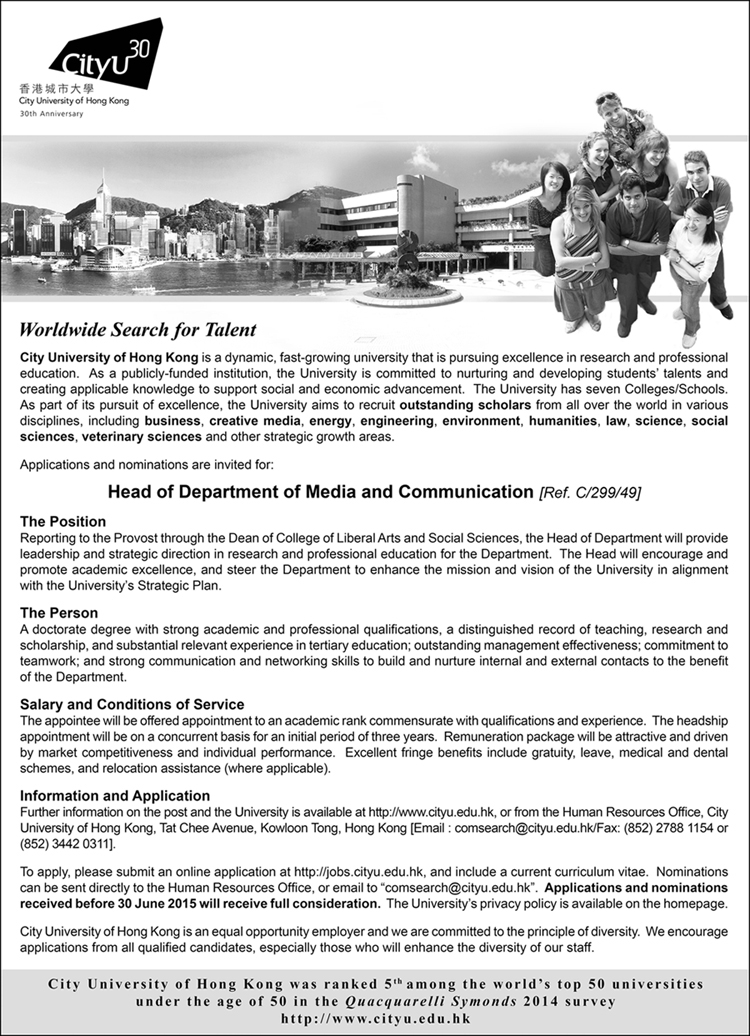
Webster University – Vienna job ad

Director at Webster University – Vienna

Webster University, a private, nonprofit university with its home campus in St. Louis, Missouri, U.S.A., seeks an experienced, dynamic, and collaborative leader to serve as director of its Vienna, Austria campus.  Nominations and applications are invited.

Founded in 1915, Webster University is the only Tier 1, private, nonprofit university with campus locations around the world.  Webster University – Vienna was established in 1981, the second international campus in Webster’s network of campuses.  Today, Webster has U.S.-style campuses in Geneva, Switzerland; Leiden, the Netherlands; Vienna, Austria; London, United Kingdom; Bangkok and Cha-am/Hua Hin, Thailand; and Accra, Ghana.  Graduate programs are also offered in Shanghai, Chengdu, and Beijing, China.  The newest international location, in Athens, Greece, has launched with study abroad programs.

Webster University – Vienna, in addition to its U.S. accreditation, is also accredited as an Austrian private university.  The campus is home to approximately 600 undergraduate and graduate students from more than 90 countries and host to several study abroad students each term. Undergraduate students choose from five majors from Webster University’s colleges/schools of arts and sciences, business, and communications. Undergraduate certificates are also offered, in subjects such as Digital Media – Design & Production, Entrepreneurship, and Web Site Design.  The Webster Scholars Program provides challenging curriculum for gifted students.  Graduate offerings include programs in business, finance, international relations, marketing, and psychology.

In September 2014, Webster University – Vienna relocated to its new home, the Palais Wenkheim, near the Danube Channel.  Constructed in 1826, the five-story building houses 17 classrooms, as well as library facilities, computer labs, student services and administrative and faculty offices.

The director of Webster University – Vienna serves as the senior executive officer of the Vienna campus, providing overall leadership and strategic direction aligned with the university’s mission and vision and the directives of the Office of the Provost, Senior Vice President and Chief Operating Officer.  Reporting to the Associate Vice President for Academic Affairs and Director of International Programs, the director of Webster University – Vienna is responsible for external outreach, enrollment enhancement, fiscal management, administration, personnel, facilities, planning, services, and activities for the Vienna campus.

Webster University – Vienna is poised for growth and excellence, and the director will play a vital role in leading the campus to grow enrollment and reach the next level of academic and operational excellence.  He/she will develop and foster relationships with the business, government, and not-for-profit communities to enhance recognition of Webster University, its students and programs.  He/she will work with internal and external constituencies, interacting with faculty, staff, students, and alumni, to champion the institution’s mission to transform students for global citizenship and individual excellence.  The director will collaborate and work closely with Webster University’s other international campus directors, the deans of Webster University’s five colleges and schools, senior staff of the Office of the Provost, and the leadership of the offices of Global Marketing & Communications, Information Technology, and Alumni & Development.

The director will possess the following professional and personal attributes:
– Terminal degree (e.g., Ph.D., Ed.D., J.D., other doctorate); master’s degree with significant experience and proven organizational leadership will be considered
– Ability to provide strategic vision and inspiration for Webster University – Vienna and to engage constituents in the development and achievement of shared goals
– Ability to cultivate and maintain supportive external relationships with alumni and donors; the business, government, and nonprofit communities; industry partners; and the various constituents of Webster University – Vienna
– Ability to work collaboratively on common strategic goals with academic and administrative leaders from around the Webster network, including directors of the other international campuses, the deans of the schools and colleges, the Office of the Provost, and other primary offices at the main campus in St. Louis
– Knowledge of and experience in European, U.S. and Austrian academic leadership; familiarity with or willingness to become familiar with shared governance, accreditation processes, and higher education law and policy
– Commitment to high quality, innovative, U.S.-style student-centered  learning and to providing students with transformative education for individual excellence and global citizenship
– Commitment to diversity and inclusion and demonstrated ability to work successfully in a diverse, multi-cultural, complex international  organization
– Excellent communication skills, including public speaking, persuasive speaking and presentation skills; ability to advocate for Webster University, its students, and programs
– Fluency in English and German

Applicants must possess or be able to obtain employment credentials required to work in Austria.

Applications and Nominations:  Applicants should send 1) a letter of interest which addresses the required qualifications; 2) an expanded résumé or curriculum vitae; and 3) names of three professional references to Vienna Director Search, or Vienna Director Search, Office of Human Resources, Webster University, 470 East Lockwood Ave., St. Louis, Missouri, 63119-3194, U.S.A.  Nominations may be sent to the same addresses.

Review of applications will begin February 9, 2015 and will continue until the position is filled.

Starting Date:  June 2015 or as mutually agreed.

Webster University is an Equal Opportunity/Affirmative Action educator and employer.  We are committed to maintaining a culturally and academically diverse faculty and staff of the highest caliber.  We strongly encourage applications from those who identify as diverse in terms of gender, race, ethnicity, national origin, sexual orientation, disability, and/or veteran status.