Director, Collegium de Lyon job ad (France)

Director – Collegium de Lyon
Université de Lyon recruits the Collegium de Lyon Director

The Collegium de Lyon is an international and multidisciplinary Institute for Advanced Study (IAS), focusing on social sciences without excluding exact sciences. Its purpose is to create an academic community based on a culture of excellence, supporting exchanges between disciplines, cultures and languages.

The Institute benefits from Lyon’s overall academic environment, coupling its research to the scientific and educational potential of the city (universities and grandes écoles, research networks, institutions), with the vision of developing cross-disciplinary reflections and launching pioneering research.

The Collegium de Lyon’s primary ambition is to link the Institute’s research program to the diffusion of knowledge for action. In the domain of public policy, it should therefore act as an intermediary between the research sphere and political and social issues. Research undertaken within the Institute should comprise reflections informing the construction of public policy: urban policy and planning, health policy and risk management, cultural policy, international relations and urban powers, development of heritage sites, etc and should be linked with Université de Lyon strategic themes : Global Health and society / Sciences and Engineering for sustainable development / Humanities and urbanity.

ROLE
Promotion of the Collegium Strategy and responsibility for its implementation:
• Source of proposals for the Board of Directors and the Academic Board to lay out the strategy and to update it;
• Implementation of the Collegium strategy defined by the Board of Directors;
• Development of public and private partnerships with national and international actors;
• Setting out and execution of the fundraising and sponsorship strategy, in collaboration with the Fondation pour l’Université de Lyon;
• Steering of the Program of Action deployment.

Coordination of the academic animation:
• Scientific animation of the Collegium in collaboration with the territorial partners
• Definition of the communication strategy

Management
• Interface with the Fondation pour l’Université de Lyon
• Preparation with the Université de Lyon President of the Board of Directors meetings
• Budget preparation and implementation based on Board of Directors decisions.

REQUIREMENTS
• Extensive knowledge of scientific communities in humanities and social sciences
• Bilingual French/English. Knowledge of any other language is an asset;
• Project management and public-private partnerships skills;
• Good knowledge of national and international funding mechanisms;
• Knowledge of national and international research networks;

Successful fundraising experience would be an asset as well as a good knowledge of Université de Lyon academic sphere.

CONDITIONS
The position is open to all European candidates. This is a half-time position, with a two-year and renewable contract starting on March 15th, 2016.

How to apply
To apply for this post please provide a cover letter and a CV detailing your work experience and skills and your main scientific publications.

All applications should be sent before February 19th, 2016 to Université de Lyon President by email.

CFP The Communication Histories Project (France and England)

The Communication Histories Project

Call for Papers
SFSIC Congress: 8th-10th June 2016, Metz, France
IAMCR/AIECS/AIERI Conference: 27th-31st July 2016, Leicester, England

The International Association for Media and Communication Research (IAMCR) and the Société Française des Sciences de l’Information et de la Communication (SFSIC) will organize a series of events to encourage the building of international bridges between researchers across different communities.

The first workshop in this series will be dedicated to research in the histories of communication studies.

We invite contributions which are concerned with the ways in which contemporary social problems are addressed by our research into communication, information, and media.

We call for original historical analyses of the concepts, paradigms, methods, institutions, educational programmes, features and figures which have structured communication studies, and which are firmly located in the many contexts which have produced them.

Our aim is to gather a diversity of perspectives on the history of our field, that together will demonstrate its complexity and interdisciplinarity, as well as historical contestations and counter-narratives.

It is anticipated that there will be publications emerging from this project.

We call for interested colleagues to submit a 1,000-word proposal for presentation in a specific workshop at the SFSIC Congress (June 8-10th, 2016, in Metz, France) and/or IAMCR/AIECS/AIERI conference (July 27th-31st, 2016, in Leicester, UK). As these are separate workshop, the resulting papers will not be included in the conference proceedings.

Proposals will be accepted in English, French and Spanish, and should be sent for review by February 29th, 2016. Please make sure to specify if you are making a proposal for the SFSIC Congress, the IAMCR/AIECS/AIERI Conference, or for both events.

Send proposals to chp@iamcr.org, chp@sfsic.org

U Toronto Scarborough job ad: Technological Change

The Department of Arts, Culture and Media at the University of Toronto Scarborough invites applications for a tenure-stream appointment in Media Studies at the rank of Assistant Professor. The appointment will begin July 1, 2016.

Applicants are required to have a Ph.D. in Media and Communication Studies or a relevant field by the time of the appointment or shortly thereafter. We are interested in candidates with research strengths in the critical study of technological and institutional changes taking place within and across media industries. The ideal candidate will have a national/regional/local media focus while keeping a global/transnational perspective. Expertise in Canadian media and industries is preferred, but other areas, including North America, Europe and East Asia, would also be of interest. Expertise in one or more of the following is especially welcome: digital cultural production; media industries/policies in the context of digitalization; digital communication technologies and corporate power.

Candidates must demonstrate a record of excellence in research. The successful candidate will be expected to conduct innovative research at the highest international level and to establish an outstanding research program. S/he will have an established or emerging record of scholarly accomplishment including publications in leading academic journals and/or with leading academic presses, or will provide evidence of excellence in research as demonstrated in presentations at significant conferences, awards for work in the field and strong endorsements by referees.

The Department of Arts, Culture and Media is a unique multi-disciplinary research and teaching environment, with programs in Art History, Arts Management, Journalism, Media Studies and New Media Studies, Music and Culture, Studio, and Theatre and Performance Studies. The candidate selected will be expected to maintain a strong program of research and to articulate and implement a vision for developing new research initiatives and relationships that fit within this diverse context.

Candidates must demonstrate a record of excellence in teaching. The successful candidate will teach and supervise students at both the undergraduate and graduate levels. S/he will have an established or emerging record that encompasses a range of large lecture and seminar courses in media and globalization, political economy of media, and the candidate’s specific area(s) of media focus. Excellence can be demonstrated through very strong course evaluations, a coherent statement of teaching philosophy that is linked to excellent pedagogical practice, or demonstrated excellent performance in other teaching related activities, including experience leading successful workshops or seminars, or excellent conference posters or presentations. The successful candidate will participate in curriculum development, program administration, and departmental and university committee work, in order to contribute to departmental planning and to take a leadership role in program and curriculum development in Media Studies and the Joint Program in New Media Studies. Experience in these areas is most welcome.

Salary will be commensurate with qualifications and experience.

The appointment is at the University of Toronto Scarborough, which is a research-intensive institution with an interdisciplinary commitment, a multicultural student body, and a modern campus. The University offers the opportunity to conduct research, teach, and live in one of the most diverse cities of the world. In addition to being a full member of the Department of Arts, Culture and Media at the University of Toronto Scarborough, the successful candidate will be a full member of the Faculty of Information (iSchool), a graduate unit at the University of Toronto.

All qualified candidates are invited to apply by clicking on the link below. Applicants should submit a complete and current curriculum vita and a teaching portfolio. If you have questions about this position, please send email. All applications must be submitted online.

Submission guidelines can be found online.   We recommend combining attached documents into one or two files in PDF/MS Word format. Applicants should also arrange for three confidential letters of recommendation to be sent via email.

The closing date for applications is February 17, 2016.

The University of Toronto is strongly committed to diversity within its community and especially welcomes applications from visible minority group members, women, Aboriginal persons, persons with disabilities, members of sexual minority groups, and others who may contribute to the further diversification of ideas.

All qualified candidates are encouraged to apply; however, Canadians and permanent residents will be given priority.

U Toronto Scarborough job ad: Digital Cultural Practices

The Department of Arts, Culture and Media at the University of Toronto Scarborough invites applications for a tenure-stream appointment in Media Studies at the rank of Assistant Professor. The appointment will begin July 1, 2016.

Candidates are required to have a Ph.D. in Media and Communication Studies or a relevant field by the time of the appointment or shortly thereafter. We are interested in candidates with research strengths in digital cultural practices, digital pedagogical practices, and/or networked publics. Expertise in academic writing across the curriculum would be considered an asset.

Candidates must demonstrate a record of excellence in research. The successful candidate will be expected to conduct innovative research at the highest international level and to establish an outstanding research program. S/he will have an established or emerging record of scholarly accomplishment including publications in leading academic journals and/or with leading academic presses, or will provide evidence of excellence in research as demonstrated in presentations at significant conferences, awards for work in the field and strong endorsements by referees.

The Department of Arts, Culture and Media is a unique multi-disciplinary research and teaching environment, with programs in Art History, Arts Management, Journalism, Media Studies and New Media Studies, Music and Culture, Studio, and Theatre and Performance Studies. The candidate selected will be expected to maintain a strong program of research and to articulate and implement a vision for developing new research initiatives and relationships that fit within this diverse context.

Candidates must demonstrate a record of excellence in teaching. The successful candidate will teach and supervise students at both the undergraduate and graduate levels. S/he will bring an expertise in digital media and pedagogy and have an established or emerging teaching record that encompasses a range of large lecture and seminar courses in the history of media and technology, media theory and research methods, technology studies, and the candidate’s specific area(s) of media focus. Excellence can be demonstrated through very strong course evaluations, a coherent statement of teaching philosophy that is linked to excellent pedagogical practice, or demonstrated excellent performance in other teaching related activities, including experience leading successful workshops or seminars, or excellent conference posters or presentations. The successful candidate will participate in curriculum development, program administration, and departmental and university committee work, in order to contribute to departmental planning and to take a leadership role in program and curriculum development in Media Studies and the Joint Program in New Media Studies. Experience in these areas is most welcome.

Salary will be commensurate with qualifications and experience.

The appointment is at the University of Toronto Scarborough, which is a research-intensive institution with an interdisciplinary commitment, a multicultural student body, and a modern campus. The University offers the opportunity to conduct research, teach, and live in one of the most diverse cities of the world. In addition to being a full member of the Department of Arts, Culture and Media at the University of Toronto Scarborough, the successful candidate will be a full member of the Faculty of Information (iSchool), a graduate unit at the University of Toronto.

All qualified candidates are invited to apply by clicking on the link below. Applicants should submit a complete and current curriculum vita and a teaching portfolio. If you have questions about this position, please send email. All applications must be submitted online.

Submission guidelines can be found online. We recommend combining attached documents into one or two files in PDF/MS Word format. Applicants should also arrange for three confidential letters of recommendation to be sent directly via email.

The closing date for applications is February 17, 2016.

The University of Toronto is strongly committed to diversity within its community and especially welcomes applications from visible minority group members, women, Aboriginal persons, persons with disabilities, members of sexual minority groups, and others who may contribute to the further diversification of ideas.

All qualified candidates are encouraged to apply; however, Canadians and permanent residents will be given priority.

CFP Paris Institute for Advanced Study

The Paris Institute for Advanced Study welcomes applications from high level international scholars and scientists in the fields of the humanities, the social sciences and related fields for periods of five or nine months, during the academic year 2017-2018.

Deadline for applications: Tuesday, March 1st, 2016, 3:00pm (Paris, France time)


Applicants may request residencies for one of the following periods:
• September 1st, 2017 to January 31st, 2018 (5 months)
• October 1st, 2017 to June 30th, 2018 (9 months)
• February 1st to June 30th, 2018 (5 months)

CONDITIONS OF ELIGIBILITY
Researchers from all countries are eligible.
Applicants who have spent more than a total of 12 months in France during the 3 years prior to the application are not eligible.

This call for applications is open to:
• Senior university professors or researchers holding a permanent position in a university or research institution and having a minimum of 10 years of full time research experience after their PhD (at the time of the application).
• Junior scholars having the status of postdoctoral researcher or holding a position in a university or research institution, and having a minimum of 2 and maximum of 9 years of research experience after the PhD (at the time of the application).

CALENDAR
• Opening of the online application system: January 15th, 2016
• Application deadline: Tuesday, March 1st, 2016, 3:00 pm (Paris, France time)
• Preselection: Mid-March 2016
• Final selection: June 2016
• Publication of results: End of June 2016
• Starting dates of the fellowships: September 1st 2017; October 1st

Save

CFP Nation Branding & Creative Industries (Denmark)

Nation Branding and the Creative Industries: What nation? What people? What synergies?
22-23 September 2016
Aarhus University, Denmark

This colloquium is designed to provide an exploratory space where practitioners and researchers gather to map and talk about contemporary challenges and potential benefits in the practices and thinking of nation branding.

Details available from the flyer.

Co-convenors: Department of Business Communication; School of Communication and Culture; Department of Culture and Global Studies; Aarhus University.

Military Cross-Cultural Competence

Guest PostsMilitary Cross-Cultural Competence. Guest post by Lauren Mackenzie

Context & Definition

Although the importance of cultural awareness has been widely acknowledged by the U.S. military for decades, questions of how culture should be taught and who should teach it have received renewed attention since 9/11. The wide range of missions across the U.S. military, the hierarchical rank structure, and the variety of military occupation specialties require a broad, multi-dimensional approach to culture training and education. Several service culture centers have emerged to meet the needs of this diverse population in the last decade, to include: the U.S. Army’s Culture Center (Sierra Vista, AZ), the Navy’s Center for Language, Regional Expertise & Culture (Pensacola, FL), the Air Force Culture & Language Center (Montgomery, AL) and the Marine Corps Center for Advanced Operational Culture Learning (Quantico, VA). The culture centers house a mix of military and civilian faculty from the fields of communication, anthropology, international relations, and psychology to teach, research and assess the implications of culture for military personnel. The Defense Language and National Security Education website lists links to them all.

The unpredictable nature and location of military operations requires a set of universal and transferrable culture concepts and skills that personnel can employ wherever they go. The different branches of service have acknowledged the need for personnel to learn “how to learn” about culture, to observe cultural difference, and how to interact appropriately and effectively no matter where they find themselves in the world. As such, cross-cultural competence (3C) emerged as a key outcome of culture training and education. A commonly used working definition of military cross-cultural competence (Selmeski, 2007) is: the ability to quickly and accurately comprehend, then act effectively and appropriately in a culturally complex environment to achieve the desired effect – without necessarily having exposure to a particular group, region or language. However, each branch approaches the definition slightly differently. Sands & Greene-Sands (2014) review each military branch’s definition as well as the research, policy, learning, and application considerations for military contexts, to include the historical development of cross-cultural competence in professional military education and training. Along with cross-cultural competence, the military uses the terms “intercultural competence”, “cultural capabilities” and “culture-general competencies” (Rasmussen & Sieck, 2015) to characterize the skills and knowledge that are applicable in any culture.

Download the entire post as a PDF.

CFP Minerva Research Initiative Grants (US, DoD)

Just as the Cold War gave rise to new ideas and fields of study such as game theory and Kremlinology, the challenges facing the world today call for a broader conception and application of national power that goes beyond military capability. The Office of the Secretary of Defense (OSD) is interested in receiving proposals for the Minerva Research Initiative, a university-led defense social science program seeking fundamental understanding of the social and cultural forces shaping U.S. strategic interests globally. The Minerva Research Initiative (Minerva) emphasizes questions of strategic importance to U.S. national security policy. It seeks to increase the Department’s intellectual capital in the social sciences and improve its ability to address future challenges and build bridges between the Department and the social science community. Minerva brings together universities and other research institutions around the world and supports multidisciplinary and cross-institutional projects addressing specific topic areas determined by the Department of Defense. The Minerva program aims to promote research in specific areas of social science and to promote a candid and constructive relationship between DoD and the social science academic community. The Minerva Research Initiative competition is for research related to the five (5) topics and associated subtopics listed below. Innovative white papers and proposals related to these research topics are highly encouraged. Detailed descriptions of the topics can be found in Section IX, “Specific Minerva Research Initiative Topics.” I. Identity, Influence, and Mobilization Culture, identity, and security Influence and mobilization for change II. Contributors to Societal Resilience and Change Governance and rule of law Migration and urbanization Populations and demographics Environment and natural resources Economics III. Power and Deterrence Global order Power projection and diffusion Beyond conventional deterrence Area studies IV. Analytical methods and metrics for security research V. Innovations in National Security, Conflict, and Cooperation Proposals will be considered both for single-investigator awards as well as larger teams. A team of university investigators may be warranted because the necessary expertise in addressing the multiple facets of the topics may reside in different universities, or in different departments of the same university. The research questions addressed should extend across a fairly broad range of linked issues where there is clear potential synergy among the contributions of the distinct disciplines represented on the team. Team proposals must name one Principal Investigator as the responsible technical point of contact. Similarly, one institution will be the primary recipient for the purpose of award execution. The relationship among participating institutions and their respective roles, as well as the apportionment of funds including sub-awards, if any, must be described in both the proposal text and the budget. The Minerva Research Initiative is a multi-service effort. Ultimately, however, funding decisions will be made by OSD personnel, with technical inputs from the Services.

Program Objectives
The Minerva Initiative is a Department of Defense (DoD)-sponsored, university-based social science research initiative launched by the Secretary of Defense in 2008 focusing on areas of strategic importance to U.S. national security policy.

The goal of the Minerva Initiative is to improve DoD’s basic understanding of the social, cultural, behavioral, and political forces that shape regions of the world of strategic importance to the U.S. The research program will:
• Leverage and focus the resources of the Nation’s top universities.
• Seek to define and develop foundational knowledge about sources of present and future conflict with an eye toward better understanding of the political trajectories of key regions of the world.
• Improve the ability of DoD to develop cutting-edge social science research, foreign area and interdisciplinary studies, that is developed and vetted by the best scholars in these fields.

The Minerva Initiative brings together universities, research institutions, and individual scholars and supports interdisciplinary and cross-institutional projects addressing specific topic areas determined by the Secretary of Defense.

University Research Grants
The Minerva Research Initiative primarily funds social science basic research by university-led research teams.

R-DEF: Research for Defense Education Faculty
The R-DEF Mission is to increase DoD social science expertise by investing in the defense experts who teach our future military and national security leaders at PME institutions and military service academies. R-DEF awards range from $1,000 to $80,000 to offer existing PME teaching faculty the resources and time (e.g., via course buyouts) to conduct scholarly research in topics of Minerva interest.

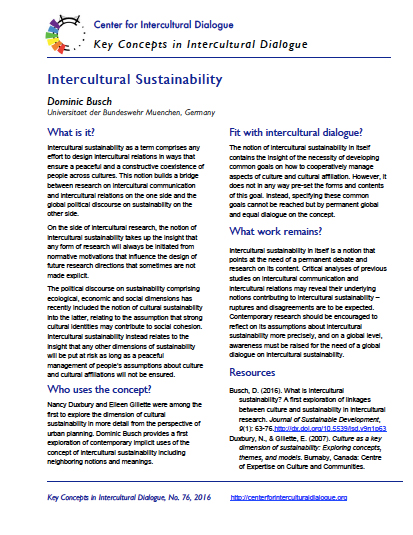
Key Concept 76: Intercultural Sustainability by Dominic Busch

Key Concepts in ICDThe next issue of Key Concepts in intercultural Dialogue is now available. This is KC76: Intercultural Sustainability by Dominic Busch. As always, all Key Concepts are available as free PDFs; just click on the thumbnail to download.Lists organized chronologically by publication date and numberalphabetically by concept in English, and by languages into which they have been translated, are available, as is a page of acknowledgments with the names of all authors, translators, and reviewers.

KC76 Intercultural Sustainability by Dominic BuschBusch, D. (2016). Intercultural sustainability. Key Concepts in Intercultural Dialogue, 76. Available from:
https://centerforinterculturaldialogue.org/wp-content/uploads/2016/01/kc76-intercultural-sustainability.pdf

The Center for Intercultural Dialogue publishes a series of short briefs describing Key Concepts in Intercultural Dialogue. Different people, working in different countries and disciplines, use different vocabulary to describe their interests, yet these terms overlap. Our goal is to provide some of the assumptions and history attached to each concept for those unfamiliar with it. As there are other concepts you would like to see included, send an email. If there are concepts you would like to prepare, provide a brief explanation of why you think the concept is central to the study of intercultural dialogue, and why you are the obvious person to write up that concept.


Creative Commons License
This work is licensed under a Creative Commons Attribution-NonCommercial-NoDerivatives 4.0 International License.

CFP International Network for Group Research (Helsinki)

International Network for Group Research (INGRoup) Conference
Eleventh Annual Conference – First held in Europe!
14-16 July, 2016 (Preconference workshops July 14)
Radisson Blu Royal Hotel, Helsinki, Finland

Submissions
Must be received by Sunday, February 1, 2016 (23:59:59, Eastern Standard Time). No extensions to the deadline will be granted.

Overview
Societies are dependent on the formation and utilization of groups and teams, making them relevant to countless aspects of life. Accordingly, scholars who study groups can be found across a wide array of disciplines (e.g., anthropology, communication, education, engineering, history, information systems, medicine, nursing, organizational behavior, philosophy, psychology, political science, public health, sociology). The Interdisciplinary Network for Group Research (INGRoup) was created to provide a context for scholars to:
*       Promote communication about groups and teams research across fields and nations
*       Advance understanding about group dynamics through research
*       Advance theory and methods for understanding groups and teams
*       Promote interdisciplinary research

The 11th Annual INGRoup Conference will be held so scholars across disciplines can come together, share information, and learn from one another. The conference program will include paper, poster, symposia, and panel sessions, and a business meeting open to all members so the future of INGRoup can be collectively planned and shaped.

Questions? Contact Program Co-Chair, Ana Passos or Caterina Santos.