Key Concept #61: Vyhavanne Translated into Belarusian

Key Concepts in ICDContinuing translations of Key Concepts in Intercultural Dialogue, today I am posting KC61: Vyhavanne, a Belarusian concept originally discussed in English by Liubou Uladykouskaja in 2015, which she has now translated into Belarusian.

As always, all Key Concepts are available as free PDFs; just click on the thumbnail of the translation to read it. Lists of Key Concepts organized chronologically by publication date and number, alphabetically by concept, and by languages into which they have been translated, are available, as is a page of acknowledgments with the names of all authors, translators, and reviewers.

KC61 BblXABAHHE_BelarusianUladykouskaja, L.(2016). Выхаванне. Key Concepts in Intercultural Dialogue, 61. Available from:
https://centerforinterculturaldialogue.org/wp-content/uploads/2016/07/kc61-d0b2d18bd185d0b0d0b2d0b0d0bdd0bdd0b5_belarusian.pdf

If you are interested in translating one of the Key Concepts, please contact me for approval first because dozens are currently in process. As always, if there is a concept you think should be written up as one of the Key Concepts, whether in English or any other language, propose it. If you are new to CID, please provide a brief resume. This opportunity is open to masters students and above, on the assumption that some familiarity with academic conventions generally, and discussion of intercultural dialogue specifically, are useful.

Wendy Leeds-Hurwitz, Director
Center for Intercultural Dialogue


Creative Commons License
This work is licensed under a Creative Commons Attribution-NonCommercial-NoDerivatives 4.0 International License.

EIUC Training for International Electoral Observers

EIUC training seminar for International Electoral Observers is now ready to accept candidatures.

EIUC has developed two three-day modules aiming at providing training to civilian staff in election observation missions at the first steps of their career (i.e. short term observers). Selected applicants will be allowed to become aware of the role, the tasks and the status of international observers, and will be given a theoretical and practical training on election observation and election observation missions functioning.

The first module (7 – 9 November 2016) will highlight the quantitative observation of the STOs. Starting with a thorough introduction on the international observation theory and legal standards the first module will analyse the practical life of a short term observer from the selection procedure to the end of mission including the observation of the polls, the filling of the forms, the reporting system and the code of the conduct. The methodology will combine frontal lecturers in plenary, working groups as well as role plays, discussions and simulation exercises.

The second module (10 – 12 November 2016) is principally intended as a complementary step for those participants who have already attended the first module. EIUC will nevertheless also accept candidatures from first time applicants to EIUC’s trainings seminars. The second module will introduce the participants to the long-term election observation by analysing in depth some of the aspects related to an international observation mission such as working relations, interviewing techniques, media and security.

EIUC will accept candidatures for each separate module or both combined. Applicants will therefore have a possibility to choose the module which is more closely related to their interests and experience or combine the two of them for a more complete understanding of the topic.

The faculty is composed by well-known international trainers and professionals with a long standing practical experience in election observation missions within international organisations such as the European Union and the Organisation for Security and Cooperation in Europe.

The deadline for sending applications is 7 October 2016 through the online application form.

For further enquiries please contact EIUC at: training.ieo[at]eiuc.org

Save

Save

Save

CFP iMean5 Conference: Language & Change (UK)

Call for Papers
iMean 5 Conference
University of the West of England, Bristol
6- 8 April 2017 (with pre-conference Workshops on 5 April)
Abstract submission deadline: 5 January 2017.

The fifth iMean conference maintains its traditional focus on meaning in social interaction, with a thematic orientation to Language and Change. We will be considering changes at the linguistic level but also how changes at a societal level affect linguistic usage and our conceptions and analysis of it. Our increasingly interconnected and fast-moving world has led to an upsurge in mobility and to the possibility of greater variation and change in language use. The linguistically diverse nature of contemporary societies has implications for social justice, with potentially differential access to the public sphere. Different contexts of use and new media may also bring new styles and manners of expression. As society changes, so must our conceptual and epistemological models and old questions and concepts require new approaches and angles.

The conference welcomes papers which focus on Language and Change, on norms and/or shifts in language usage and, more generally, on theoretical and methodological developments in research on sociopragmatics. iMean5 aims to  take a critical approach to current conceptions of ‘language and change’, focused around (but not restricted to) the following themes: ·the impact of globalisation, population mobility, the growth of cities and multiethnolects and the interrelation of  language choice, language use and social justice; ·how identities (regional, class, gender, ethnic and so on) are constructed and negotiated in and through language and how these shift from one community to another;·theory/ method aiming to forge new understandings of social class and gender identities in the 21st century and how we incorporate these in linguistic research; ·language change at phonological, syntactic, semantic or discourse levels of analysis;·the impact of new media on linguistic use. Invited plenary speakers (confirmed):
• Gisle Andersen, University of Bergen
• Christine Béal, Université Paul Valéry Montpellier 3
• Jenny Cheshire, Queen Mary, University of London
• Michael Haugh, University of Queensland
• Barbara Johnstone, Carnegie Mellon University
• Zuraidah Mohd Don, University of Malaya

In line with the iMean tradition, the conference aims to encourage multidisciplinary thinking and to create new pathways in linguistic research. The conference will, as usual, include two specialist Colloquia, an Atelier AFLS and a summative Round Table at which the keynote speakers are invited to debate the conference theme.
Invited Colloquia
iMean 5 will host two invited colloquia.
1.     Language migration and change
Convened by Jo Angouri
2.     “Just how sorry are you, mate?” Norms and Variations in im/polite language behaviour.
Convened by Kate Beeching and James Murphy

Further details will be announced by the end of October 2016 or soon after.  Atelier AFLS
Participants who would like to present in French or present specifically French data are invited to join the Atelier AFLS which will take place as part of the conference.

Round table: What’s new in Language and Change?

Submission Details:
Panel Proposals: Panel proposals are invited by 1 December 2016. Decisions about panels will be made by 15 December. Panel organisers should oversee abstracts from panel members, with up to 6 papers in a panel (2 X 90 minute slots). Individual panel members should submit abstracts, clearly marked with Panel names, to the main conference email address by 5 January 2017 as below. All abstracts (in panels and the main conference) will be subject to double blind review as always. For information on panel proposals please contact the organisers (J.Angouri[at]warwick.ac.uk and Kate.Beeching[at]uwe.ac.uk).

Individual Papers: Abstracts of no more than 350 words (max and including references, if absolutely necessary) are invited. They should be submitted to https://easychair.org/conferences/?conf=imean2017.The deadline for receipt of abstracts is 5 January 2017. Abstracts should not include the name and affiliation of the author(s). If your submission is part of a Panel, or the Atelier AFLS, or you would like to propose your paper as part of one of the Colloquia, please state this clearly at the top of your submission. Further details will be published on the iMean website soon.  In the meantime, don’t hesitate to contact Kate.Beeching[at]uwe.ac.uk or J.Angouri[at]warwick.ac.uk for further information.

ProEtnica Intercultural Festival (Romania)

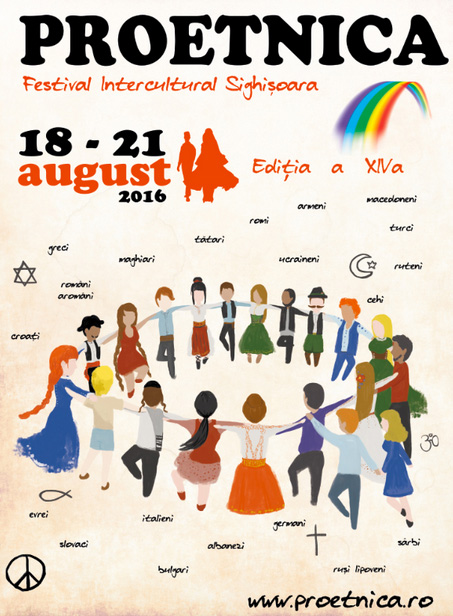
The Centre for Interethnic Youth Education Sighisoara (ibz) together with the Department for Inter-Ethnic Relations present the preliminary programme of the 14th edition of ProEtnica – Intercultural Festival Sighisoara which takes place from August 18 – 21, 2016.

Proetnica 2016

This year’s edition takes place under the patronage of the President of Romania, Klaus Werner Iohannis. There are going to be more than 50 artistic performances on the main stage as well as an arts and crafts fair featuring traditional craftworks manufactured by the national minorities. Further, a fine arts exhibition displays the works from ten contemporary artists belonging to the national minorities and is supplemented by three film screenings addressing the topic of intercultural dialogue.

In times of increased global migration, interethnic dialogue steadily gains importance within international peace negotiations. The ibz decided to dedicate this year’s edition of ProEtnica to the topic of interreligious dialogue. Eight events, i.a. scientific presentations and a symposium, address this subject matter from different perspectives and encourage further discussion on the challenges to intercultural peace in today’s world.

ProEtnica brings together more than 600 representatives of the 20 national minorities in Romania and offers them an opportunity to share their customs and actively engage in intercultural dialogue through different channels, e.g. the arts, scientific research or roundtable discussions. ProEtnica is an instrument which promotes the rights of cultural expression of the national minorities and, at the same time, strengthens cultural dialogue. Thus, ProEtnica contributes to the preservation and creation of the intercultural peace in a pluralistic and democratic society.

The ibz was founded in 2000. Its mission is to promote dialogue and interaction between people to foster mutual understanding and strengthen acceptance of ethnocultural differences.

Preliminary programme of ProEtnica –Intercultural Festival Sighisoara

Key Concept #8 Public Dialogue Translated into Turkish

Key Concepts in ICDContinuing translations of Key Concepts in Intercultural Dialogue, today I am posting KC8: Public Dialogue, which Robyn Penman wrote in English in 2014, now translated into Turkish by Kenan Çetinkaya.

As always, all Key Concepts are available as free PDFs; just click on the thumbnail of the translation to read it. Lists of Key Concepts organized chronologically by publication date and number, alphabetically by concept, and by languages into which they have been translated, are available, as is a page of acknowledgments with the names of all authors, translators, and reviewers.

KC8 Public Dialogue_TurkishPenman, R. (2016). Kamusal Diyalog. Key Concepts in Intercultural Dialogue, 8. (K. Çetinkaya, Trans.). Available from:
https://centerforinterculturaldialogue.org/wp-content/uploads/2016/07/kc8-public-dialogue_turkish.pdf

If you are interested in translating one of the Key Concepts, please contact me for approval first because dozens are currently in process. As always, if there is a concept you think should be written up as one of the Key Concepts, whether in English or any other language, propose it. If you are new to CID, please provide a brief resume. This opportunity is open to masters students and above, on the assumption that some familiarity with academic conventions generally, and discussion of intercultural dialogue specifically, are useful.

Wendy Leeds-Hurwitz, Director
Center for Intercultural Dialogue


Creative Commons License
This work is licensed under a Creative Commons Attribution-NonCommercial-NoDerivatives 4.0 International License.

CFP IMéRA Institute for Advanced Study Fellowships (France)

IMéRA, Aix-Marseille Institute for Advanced Study, is issuing its calls for applications concerning fellowships during the academic year 2017-2018.

Aix-Marseille Institute for Advanced Study welcomes high level scientists in the fields of the humanities, the social sciences and related fields for periods of three to ten months, during the academic year 2017-2018.

Deadline for applications: Friday, November 18th, midnight (Paris time, France)

Applicants may request residencies for one of the following programs:
IMéRA: call for individual applications 2017-2018
IMéRA/Inserm: call for applications 2017-2018
IMéRA/LabexMed: call for applications 2017-2018
IMéRA/OT-Med: call for applications 2017-2018
IMéRA/BLRI: call for applications 2017-2018
IMéRA/AMSE: call for applications 2017-2018
IMéRA/MuCEM: call for applications 2017-2018
IMéRA/SIRIC: call for applications 2017-2018
IMéRA: call for applications of teams 2017-2018

CONDITIONS OF ELIGIBILITY 
Conditions of eligibility differ from one call to another. It is therefore necessary to refer to the description of each call for applications.

CALENDAR
Application deadline: November 18th, 2016
Publication of results: February 2017

Save

Save

China Media Research: Integrative East-West Communications Paradigm

Call for Submissions

This special section of China Media Research invites scholars from various disciplines to submit manuscripts on the theme of Towards an Integrative East-West Communications Paradigm. A lack of philosophical integration between Eastern and Western research paradigms presents one of the main challenges in global academic research today. In addition, there is little evidence to suggest that scholars are actively addressing this issue despite the repeated calls for integration.

The fragmentation is particularly salient in communications research, which remains anchored in Western values, perspectives and constructs. This special section aims to explore how the indigenous Eastern philosophical frameworks could serve as a source of inspiration for theory building and reconstruction, and contribute towards achieving integration between Western and Eastern communications paradigms.

Following these considerations, scholars are invited to submit their original manuscripts that address the following topics, among others:
–       Cultural transformation/dialogue between East and West;
–       Paradigmatic assumptions of Chinese communication in the global context;
–       Integration of theoretical and practical aspects of the Chinese/Eastern philosophical concepts (such as harmony);
–       Yin Yang balancing as a framework for overcoming dualism;
–       Contrasting static and dynamic frameworks for cultural analysis;
–       Methods for achieving an etic-emic integration in communications research.

Submissions must not have been previously published nor be under consideration by another publication. An extended abstract (up to 1,000 words) or a complete paper at the first stage of the reviewing process will be accepted. All the submissions must be received by October 15, 2016. If the extended abstract is accepted, the complete manuscript must be received by February 15, 2017. Manuscripts should be prepared in accordance with the APA publication manual (6th edition) and should not exceed 8,000 words including tables and references. All manuscripts will be peer reviewed, and the authors will be notified of the final acceptance/rejection decision. Please visit www.chinamediaresearch.net for more information about the quarterly journal of China Media Research, which publishes both print and online versions.

Please direct questions and submissions to the CMR special section guest editor Ivana Beveridge at Ivana.beveridge[at]sunrise-education.com

Key Concept #6: Intercultural Capital Translated into German

Key Concepts in ICDContinuing translations of Key Concepts in Intercultural Dialogue, today I am posting KC#6: Intercultural Capital, originally written by Andreas Pöllmann for publication in 2014, and now translated by him into German.

As always, all Key Concepts are available as free PDFs; just click on the thumbnail to download. Lists organized chronologically by publication date and numberalphabetically by concept in English, and by languages into which they have been translated, are available, as is a page of acknowledgments with the names of all authors, translators, and reviewers.

KC6 Intercultural Capital_GermanPöllmann, A. (2016). Interkulturelles Kapital. Key Concepts in Intercultural Dialogue, 6. Available from:
https://centerforinterculturaldialogue.org/publications/

If you are interested in translating one of the Key Concepts, please contact me for approval first because dozens are currently in process. As always, if there is a concept you think should be written up as one of the Key Concepts, whether in English or any other language, propose it. If you are new to CID, please provide a brief resume. This opportunity is open to masters students and above, on the assumption that some familiarity with academic conventions generally, and discussion of intercultural dialogue specifically, are useful.

Wendy Leeds-Hurwitz, Director
Center for Intercultural Dialogue


Creative Commons License
This work is licensed under a Creative Commons Attribution-NonCommercial-NoDerivatives 4.0 International License.

Save

CFP Discourse: Multidisciplinary Perspectives – Reflections on Representation, Identity and/or (Non)Belonging

The English Language & Linguistics group at the University of Sussex is organizing a one-day colloquium on ‘Discourse: Multidisciplinary Perspectives’. We invite papers from the full range of disciplines that use discourse analysis, such as media studies, anthropology, history, linguistics, politics, psychology, gender studies, medicine, education and more.  The sub-topic of the colloquium is ‘Reflections on Representation, Identity and/or (Non)Belonging’, which we encourage participants to interpret in the broadest sense. As such, we welcome both illustrative research papers detailing discourse analyses on the topic/s, as well as position papers which help show how representation, identity and (non)belonging are understood from a discourse perspective within your particular discipline. Various perspectives are encouraged and some themes which have emerged from discussions with colleagues across disciplines include:
• representation of public/political figures or groups in the media,
• patients’ self-accounts in medicine/psychology,
• defendants’ self-presentations in criminology/law,
• negotiation of self-identity in the classroom in sociology/education or representation of values in public and/or educational texts
• identity construction in oral/written memories of war veterans and/or historical crucial moments in oral history
and much more.

We hope that the event will lead to greater understanding of how discourse is conceptualised and approached across disciplines and reveal opportunities for interdisciplinary collaboration. Depending on interest, we also envisage a selection of papers being published in a special issue of CADAAD Journal (Critical Approaches to Discourse Analysis Across Disciplines).

If you are interested in contributing a paper, please send a 300 word abstract to Roberta Piazza (r.piazza[at]sussex.ac.uk) by September 30th 2016.

CFP TESOL Indonesia Conference

Presentations are almost full for the
Inaugural TESOL Indonesia International Conference
Teaching and Learning English in Indonesia: Future Trends and Approaches
August 11-13, 2016
University of Mataram
Lombok, Indonesia

Held in the tropical oasis of Lombok, the conference will bring together English Language Professionals from around the world to share, learn and further English language teaching and research.

Lombok is easily accessible with international and domestic flights and great value for money for accommodation, food and transport.  As an added benefit, all presenters will be able to be published in an ELE journal.

Come, meet, socialize, and parley with your peers from around the world!
We currently have 800+ registrations coming from over 40 countries!

SUBMIT ABSTRACT


Save