New Zealand Discourse Conference

ConferencesCall for papers: 7th New Zealand Discourse Conference, 3-6 December, 2019, Massey University, Wellington Campus, New Zealand. Deadline: 31 March 2019.

The New Zealand Discourse Conference is a biennial event which brings together scholars working in a range of fields loosely categorised as discourse analysis. The conference welcomes contributions that consider discourse and interaction in a variety of contexts, drawing on a diverse range of theoretical and analytical approaches. Frequently addressed topics in the past have included: Political discourse, Discourse and identity, Language, gender and sexuality, Multimodal discourse analysis, Narrative, stance and positioning, Media discourse, Health communication, and Discourse and interaction in educational settings.

CID Video Competition FAQ 2019

Job adsAs people are learning of the CID Video Competition, they have been asking questions. In hopes this will help others, the questions will be posted, along with answers. As further questions are asked, they will be answered here.

Please read the entry rules carefully! If submissions do not meet the requirements, they cannot be considered for a prize until and unless they are revised. When ready, submit your video.

What exactly is intercultural dialogue, anyway?
Here’s the short answer: Intercultural dialogue requires at least two people, and they have to come from different cultural groups (international, interracial, interethnic, interfaith). It is active (people actually communicating in some way, having dialogue) rather than passive (knowledge in people’s heads). Here’s a longer answer: Key Concepts in Intercultural Dialogue #1: Intercultural Dialogue. For more details, see this list of additional resources.

What about intergenerational dialogue, is that intercultural as well?
NO, intergenerational dialogue within a single culture is not usually considered a form of intercultural dialogue. An argument could presumably be made, but that may be difficult given the short time limit for the video.

Do all forms of social media have to be addressed?
NO, at least one, but as many as you like. Remember that the point is to show how social media influence intercultural dialogue – the goal is NOT to give a history or critique of social media.

Since Google Translate helps people communicate across language barriers when using social media such as Facebook, could that be considered as a form of social media for the video competition? What about Line, a freeware app for instant communication?
YES, both would be appropriate to consider as social media in this context.

Can a group of students submit a video instead of one person?
Yes, absolutely. In fact, that is encouraged, as a way to ensure different points of view.

Can faculty members participate?
NO, this is a competition for students only. Faculty members can serve as informal advisers or critics, and are certainly asked to encourage participation, or even require participation as a course requirement if that suits their needs. But faculty members should NOT be part of the group that actually works on the video, and should NOT be the one submitting a video.

Can audiotapes be submitted in lieu of videotapes?
NO, sorry, audiotapes are NOT videotapes.

Where should videos be uploaded?

Videos should be uploaded here. You have to create an account when you get to the site, with your email, name, and a password. Videos should NOT be uploaded directly to YouTube or any other server.

Help, I don’t understand the directions when I get to the upload site!

When you click on the link, you will be asked to “Login or create an account.” The first time there, you need to create an account. That means you provide your email address, first name, last name, and make up a password which you provide twice to confirm. Then you click on “Register.” At that point you need to answer all the questions on the application. If you don’t finish the first, time, when you go back to the site you will need to choose login. Your email is your “Login ID” and the password is the same one you provided.

My students are having difficulty submitting their videos. Can a faculty member help with this step?
YES, absolutely. The goal is to have student-created videos. There’s no problem with a faculty member helping to get those videos uploaded so they can be entered in the competition. However, please do NOT do it for them – that means, the account should not be in the faculty member’s name. Let the student create an account, and then help as needed with any technical or translations issues.

My students created videos as a course assignment, so there are several to be uploaded. Does each video need to be submitted separately?
YES, absolutely. Each video, whether created by one student or by a group of students, should be uploaded separately so it can be evaluated by the judges.

Four of us worked on a video together. Do we submit it once or 4 times?
ONLY ONCE! A group video should be submitted once, with all students who worked on the video being listed as authors. Choose a student who checks their email fairly often as the one to upload the video, so if there are any questions, they will see the email and be able to respond.

Can 30-minute videos be considered?
What part of “no less than 30 seconds, no more than 2 minutes long” is unclear?

Is there a language requirement for the videos?
YES, the videos must be in English or subtitled in English. Permitting other languages would imply having judges who know all the several dozen languages currently represented on the site, which would be impossible. However, choosing to have most of the video silent, with minimal talking, or using subtitles, are appropriate ways to finesse the language requirement for those who primarily use other languages.

Do the videos have to be live action?
NO, animation was successfully incorporated into several of last year’s submissions. However, a PowerPoint slideshow is unlikely to result in an award.


American U: Kurdish Studies (USA)

“JobMustafa Barzani Scholar for Global Kurdish Studies, American University, Washington, DC. Deadline: April 1, 2019.

The School of International Service at American University invites applications for a full-time, non-tenure track faculty appointment for Fall 2019. AU is seeking candidates at all career stages who have a PhD or its equivalent, and who specialize in one or more of the following thematic areas: Kurdish history, culture, politics, and international relations;; Peaceful coexistence between the global Kurdish community and other states and peoples; and Cooperation and conflict resolution within the global Kurdish community.

The position will require the incumbent to teach the equivalent of one undergraduate or graduate course in the second semester, and if renewed, for each semester of the following year. Fellows are required to be in residence at AU and to make a presentation of research in progress to the AU community. All faculty are expected to hold office hours and participate in School and University activities and service. Applicants should share the School’s commitment to diversity and inclusion.

U San Francisco: Assoc VP of International Initiatives (USA)

“JobAssociate Vice Provost of International Initiatives, University of San Francisco, San Francisco, CA. Deadline: Open until filled (posted February 28, 2019).

The Associate Vice Provost of International Initiatives leads the university-wide effort to develop and promote academic excellence through the three aspects of internationalization: outbound (study abroad and faculty-led immersions); inbound (international students and visiting scholars); and on-campus (international curricular and co-curricular opportunities). The Associate Vice Provost (AVP) reports to the Senior Vice Provost of Academic Affairs (SVPAA) and ensures progress on key strategic goals in the development of the global classroom through faculty and student mobility and a diversified faculty and student body. Drawing on the USF mission to educate social justice leaders with a global perspective, the AVP will create a truly innovative home for global learning that brings together international and local efforts to build a sustainable and just world.

CFP Oxford Monitor of Forced Migration

“PublicationCall for Papers: Oxford Monitor of Forced Migration, vol 8, issue 1. Deadline: March 24, 2019.

Oxford Monitor of Forced Migration (OxMo) is a bi-annual, independent, academic journal seeking to engage in a global intellectual dialogue about forced migration with students, researchers, practitioners, academics, volunteers, activists, artists, as well as refugees and forced migrants themselves. OxMo welcomes submissions looking at forced migration through the lenses of law, policy, academia, and arts, alongside two sections in which field experiences and first-hand stories by people who have been displaced can be shared. For the first time, OxMo also includes space for creative expressions in the form of poetry, art, photography, as well as film, book, and theater reviews.

OxMo is particularly interested in encouraging submissions of authors from outside of Europe and North America. Submissions in languages other than English are accepted.

U College Cork PhD Studentship: International Business (Ireland)

“Studentships“PhD Studentship in International Business & International Management, Department of Management and Marketing, University College Cork, Ireland. Deadline: 1 April 2019.

The Department of Management & Marketing, Cork University Business School, University College Cork invites motivated & talented graduates with outstanding academic records to apply to our PhD Scholarship scheme within International Business & International Management. We are looking to recruit the highest calibre PhD students from across the globe. Our scholarship offers up to four years funding, covering doctoral programme tuition fees & an annual stipend of €16,000 per year (subject to satisfactory progress in studies). Teaching experience will also be provided & is part of the scholarship. Open to UK or EU students.

New Website Launched: Cosmopolis2045

Applied ICDNew website launched by CMM Institute: Cosmopolis2045.

What if a whole community treated relationships with other people as if they really mattered? What if a whole community took dialogue and deliberation seriously? And what if that community tried with all their hearts to bring about a better social world in all the myriad of ways we engage in communication with others in our world? These were the questions asked by a group of scholars and practitioners sponsored by the CMM Institute. The Cosmopolis2045 website is their answer.

The Cosmopolis2045 website depicts an imagined community set in the future (circa 2045) in which residents and leaders of the community have adopted a communication-centric view of how their own and other social worlds function. This website offers an intriguing look at a possible near future in which dialogue and deliberation are an integral part of everyday community events and are at the heart of city functioning. The website is also an information-rich resource for teaching classes on communication, especially cosmopolitan communication and for exploring the implications of a communication-centric view for a range of educational, legal, governance, and associated community practices.

CFP IICD of NCA 2019

ConferencesCall for submissions: International & Intercultural Communication Division, National Communication Association, November 14-17, 2019, Baltimore, Maryland. Deadline: March 27, 2019.

The International and Intercultural Communication Division of the National Communication Association invites submissions that examine communication in cultural, intercultural, and international contexts. Four kinds of submissions will be considered this year: (1) individual papers, (2) paper sessions, (3) panel discussions, and (4) performance sessions.

NCA’s convention theme is “Communication for Survival.” The theme invites us to engage in bold and cutting-edge approaches and perspectives in examining how communication plays important roles in survivals of various contexts. NCA Second Vice President Ono explains, “Communication for Survival can help inspire us to think about the quotidian ways communication improves lives, helping people build relationships, sustaining communities, changing society for the better, and providing peace of mind.” IICD invites rigorous and engaging submissions that examine various aspects of and topics related to communication for survival within international and intercultural contexts. Submissions that discuss international and intercultural communication research, teaching, practices, and service are strongly encouraged. The Division welcomes all theoretical perspectives and methodological approaches.

KC40 English as a Lingua Franca Translated into Greek

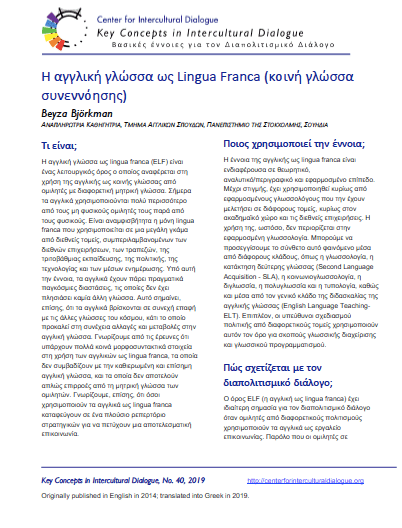
Key Concepts in ICDContinuing translations of Key Concepts in Intercultural Dialogue, today I am posting KC#40: English as a Lingua Franca, which Beyza Björkman wrote for publication in English in 2014, and which Anastasia Karakitsou has now translated into Greek.

As always, all Key Concepts are available as free PDFs; just click on the thumbnail to download. Lists of Key Concepts organized chronologically by publication date and number, alphabetically by concept, and by languages into which they have been translated, are available, as is a page of acknowledgments with the names of all authors, translators, and reviewers.

KC40 ELF_GreekBjörkman, B. (2019). English as a lingua franca [Greek]. (A. Karakitsou, trans). Key Concepts in Intercultural Dialogue, 40. Available from:
https://centerforinterculturaldialogue.org/wp-content/uploads/2019/02/kc40-ce95lf_greek.pdf

If you are interested in translating one of the Key Concepts, please contact me for approval first because dozens are currently in process. As always, if there is a concept you think should be written up as one of the Key Concepts, whether in English or any other language, propose it. If you are new to CID, please provide a brief resume. This opportunity is open to masters students and above, on the assumption that some familiarity with academic conventions generally, and discussion of intercultural dialogue specifically, are useful.

Wendy Leeds-Hurwitz, Director
Center for Intercultural Dialogue


Creative Commons License
This work is licensed under a Creative Commons Attribution-NonCommercial-NoDerivatives 4.0 International License.

Canterbury Christ Church U: Dean of International (UK)

“JobDean of International, Canterbury Christ Church University, Canterbury, England, UK. Deadline: 15 March 2019.

Canterbury Christ Church University is a modern, dynamic University with some 17,000 students across two major campuses in Kent and at partner institutions in Greece, Hong Kong and Sri Lanka. The University is now seeking to appoint to the newly created, cross-institutional role of Dean of International. Reporting to the Deputy Vice-Chancellor, the Dean will provide academic leadership across the University to achieve significant increases in inbound recruitment of international students in priority subject areas, and to establish a focused set of international strategic partnerships to underpin both inbound recruitment and transnational activity. The successful candidate will also play a leading role in driving internationalisation of the curriculum and academic portfolio, and in promoting student and staff mobility and exchange. They will sit on the University’s senior leadership group.