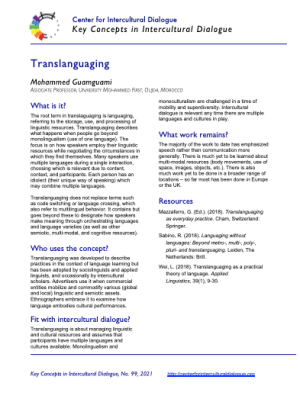
KC99 Translanguaging

Key Concepts in ICDThe next issue of Key Concepts in intercultural Dialogue is now available. This is KC#99: Translanguaging, by Mohammed Guamguami. Click on the thumbnail to download the PDF. Lists organized chronologically by publication date and numberalphabetically by concept in English, and by languages into which they have been translated, are available, as is a page of acknowledgments with the names of all authors, translators, and reviewers.

KC99 TranslanguagingGuamguami, M. (2021). Translanguaging. Key Concepts in Intercultural Dialogue, 99. Available from: https://centerforinterculturaldialogue.org/wp-content/uploads/2021/01/kc99-translanguaging.pdf

The Center for Intercultural Dialogue publishes a series of short briefs describing Key Concepts in Intercultural Dialogue. Different people, working in different countries and disciplines, use different vocabulary to describe their interests, yet these terms overlap. Our goal is to provide some of the assumptions and history attached to each concept for those unfamiliar with it. As there are other concepts you would like to see included, send an email to the series editor, Wendy Leeds-Hurwitz. If there are concepts you would like to prepare, provide a brief explanation of why you think the concept is central to the study of intercultural dialogue, and why you are the obvious person to write up that concept.


Creative Commons License
This work is licensed under a Creative Commons Attribution-NonCommercial-NoDerivatives 4.0 International License.

UNU-CRIS Research Fellow (Belgium)

“JobResearch Fellow, Institute on Comparative Regional Integration Studies (CRIS), United Nations University (UNU), Bruges, Belgium. Deadline: 31 January 2021.

UNU-CRIS is looking to recruit a Research Fellow to lead and help advance the research, reputation, and impact of the institute and, more specifically, lead the Regions and Cities Governance Lab (Re-LAB). The specific mission of UNU-CRIS is to foster a better understanding of the processes of regional integration and cooperation and their implications in a changing world order. UNU-CRIS specialises in the comparative study of regional integration, monitoring and assessing regional integration worldwide and in the study of interactions between regional organisations and global institutions. As of October 2016, UNU-CRIS is cooperating with the Vrije Universiteit Brussel and Ghent University.

As a Research Fellow and Cluster Coordinator, you will be expected to (1) champion pioneering research on the institutional dynamics of regional governance that both furthers academic study and is policy-relevant in relation to the UN and UNU’s goals, (2) seek to acquire external research funding, through both responding to calls and seed funding, while building consortiums and partnerships, and (3) manage the cluster, the responsibilities of which include: accompanying growth of research portfolio, managing cluster resources, leading a small research team, mentoring interns, quality control, and external communication.

UPenn: Global Communication Postdoc (USA)

PostdocsPostdoctoral fellowship, Center for Advanced Research in Global Communication, Annenberg School for Communication, University of Pennsylvania, Philadelphia, PA. Deadline: February 1, 2021.

The Center for Advanced Research in Global Communication (CARGC) produces and promotes scholarly research on global communication and public life. As an institute for advanced study dedicated to global media studies, we revisit enduring questions and engage pressing matters in geopolitics and communication. Our vision of “inclusive globalization” recognizes plurality and inequality in global media, politics, and culture. Our translocal approach fuses multidisciplinary “area studies” knowledge with theory and methodology in the humanities and social sciences. This synthesis of deep expertise and interdisciplinary inquiry stimulates critical conversations about entrenched and emerging communicative structures, practices, flows, and struggles. We explore new ways of understanding and explaining the world, including public scholarship, algorithmic culture, the arts, multi-modal scholarship, and digital archives. With a core commitment to the development of early career scholars worldwide, CARGC hosts postdoctoral, doctoral, undergraduate, and faculty fellows who collaborate in research groups, author CARGC Press publications, and organize talks, lectures, symposia, conferences, and summer institutes.

U Georgia: Global Health Communication (USA)

“JobAssistant Professor of Global Health Communication, Department of Communication, University of Georgia, Athens, GA. Deadline: February 15, 2021 for full consideration, but open until filled.

The Department of Communication Studies at the University of Georgia invites applications for a full-time, tenure-track assistant professor position in Global Health Communication. The starting date for this position is August 1, 2021. Candidates must hold a Ph.D. in Communication or a related field at the time of appointment. The successful candidate will have evidence of excellence in teaching and a strong research program in global health communication, including interest and training in seeking external funding. The ideal candidate will have a scholarship and teaching focus on diversity, identity, discrimination or social justice as they relate to new media and communication technologies, health campaigns, or interpersonal communication.

Translation is a Place of Resting

“Intercultural Dialogue Quotes”

Cutler-MacKenzie, Kathryn. (2020, December 15). Translation is a place of resting, of being in common. Lucy Writers.


In this article, artist and art historian Kathryn Cutler-MacKenzie describes her experience during an Erasmus exchange in Paris, including this wonderful comment about translation:

Thus when we speak of the relevance of translation today, we speak of the importance of shared conversation, shifting perspectives and creating spaces of together. Translation, like collage, is conversation, across geographical and time-bound zones: it is the space between, rather than of, voices. And in translation, just as in collage, we always lose something of the original picture – we must be content in not knowing the full picture. Indeed, speaking, thinking and making between languages has taught me that what we have now is never all that there is; in other words, that we can always surprise ourselves, that change is possible, even in the most confined of settings with the most limited of tools.

Update: UNESCO Futures of Education Focus Groups

“UNESCO”

Update, UNESCO Futures of Education focus groups organized by the Center for Intercultural Dialogue.


UNESCO Futures of EducationFirst, thanks to all those who immediately responded to last week’s invitation by saying they want to participate in a focus group on this topic, and contribute ideas to the UNESCO Commission. Participation is now closed, and we’re actively organizing to hold multiple focus groups, as a way to include as many people as possible. (UNESCO requested one focus group; we’ll be giving them three.)

Second, thanks to Nazan Haydari, member of the CID Advisory Board, who has agreed to serve as one of the focus group leaders. The other two will be led by Wendy Leeds-Hurwitz, CID Director. [update: final report now posted here]

For everyone else with an interest in the topic but who was unable to respond quickly enough to participate, the following are relevant materials to read.

Publications on education produced by prior UNESCO Commissions, which serve as the background for this one:

Faure, E., et al. (1972). Learning to be: The world of education today and tomorrow. Paris: UNESCO.

Delors, J. (1996). Learning: The treasure within; report to UNESCO of the International Commission on Education for the Twenty-first Century. Paris: UNESCO.

Elfert, M. (2015). Learning to live together: Revisiting the humanism of the Delors report. Education Research and Foresight Working Papers, 12.

UNESCO. (2015). Rethinking education: Towards a global common good? Paris: UNESCO.

Materials already produced by the current Commission:

UNESCO. (2020). Visioning and framing the Futures of Education. Paris: UNESCO.

UNESCO. (2020). Education in a post-COVID world: Nine ideas for public action. Paris: UNESCO.

Social Networking, Language Learning & Intercultural Competence

“Book NotesÁlvarez Valencia, J. A., & Fernández Benavides, A. (2019). Using social networking sites for language learning to develop intercultural competence in language education programs. Journal of International and Intercultural Communication, 12(1), 23-42. DOI: 10.1080/17513057.2018.1503318

Álvarez Valencia & Fernández Benavides examine the influence of Livemocha, a social networking site for language learning (SNSLL) on the intercultural competence of undergraduates learning English in Colombia. They define intercultural competence as “a capability that enables people from different cultural backgrounds to interact, bringing into their act of sign-making their societal, cultural, and individual knowledge about the world to make possible an effective negotiation of meanings” (pp. 25-26).

They found that:

Students decentered and opened themselves to examine their own cultural practices, their own meaning-making processes, and those of other learners of Livemocha” (p. 38)

So the answer was that it had a positive influence on both attitudes and knowledge. There were some issues with what this particular chat system permitted, but overall the results were successful.

CFP World Communication Association 2021

Conferences

Call for Papers: Communicating for Our Future, World Communication Association, virtual, 12-18 July 2021. Deadline: March 1, 2021.

The theme will be Communicating for Our Future: As our world struggles with Covid-19, the importance of communication, in its myriad forms, cannot be understated. Let’s use the 2021 conference as an opportunity to share similar experiences and come together as a community.

Virtual Conference: The 2021 conference has been reimagined to be an entirely virtual conference. The WCA recognizes that Covid-19 continues to affect all of us, and we are unable to predict what effects, if any there will be in July 2021. While we know many will want to attend a conference in person, this is not possible for many reasons. Thus, we will instead be convening the WCA conference virtually.

Synchronous or asynchronous: The Association is working to facilitate a mixture of both synchronous and asynchronous presentations. More information on presentations of papers will be forthcoming on the WCA website.

Mohammed Guamguami Profile

ProfilesMohammed Guamguami is Associate Professor of English at Mohammed Premier University, Oujda, Morocco. He is also a current part-time teacher at ALC, American Language Center, Oujda.

Mohammed Guamguami

Prior to this, he was a full-time trainer at the CRMEF, teacher training center, Oujda. His doctorate is in Languages, Cultures and Communication (2015). His specializations are: English Language Teaching, Cross-Cultural Communication and Discourse Studies.

Mohammed has been a visiting scholar at several international universities: AUT, Beirut, Lebanon; DePaul University, Chicago, IL; State University of New York, NY; and IUPUI, Indianapolis, IN.

His major publications include:

Guamgaumi, M., et al. (In press). Rethinking knowledge, inquiry and learning in the big data age: Perspectives across disciplines.

Guamgaumi, M., Zeriouh, M. & Boujemâa, E. (Eds.). (2018). Culture, society and education: An interdisciplinary reader. London, UK: Dar El Maha.

Guamgaumi, M., Zeriouh, M., & Tizaoui, H. (Eds.). (2017). English for Specific Purposes: A reader. Egypt: Dar El Maha.

Guamgaumi, M., & Zeriouh, M. (2017). Moroccan cultural identity: Difference and belonging at a post-modern age. Egypt: Dar El Maha.

Guamgaumi, M. (2016). English hegemony on ICTs: Local linguistic, cultural and educational divide. Germany: Lambert.

Guamgaumi, M. (2015). Cross-cultural communication in foreign language discourse: Towards a pedagogy of culture teaching/learning in Moroccan EFL context. Germany: Lambert.


Work for CID:

Mohammed Guamguami wrote KC99: Translanguaging and translated it into French and ArabicKC100: Transcultural Communication and translated that into French and ArabicKC102: Inclusive Communication and translated that into French, and KC103: Geoculture. He is now translating earlier concepts into French; already published are KC1: Intercultural Dialogue, KC2:Cosmopolitanism, KC3: Intercultural CompetenceKC4: Coordinated Management of Meaning, KC5: Intercultural Communication, KC6: Intercultural Capital, KC7: Intergroup Relations DialogueKC8: Intercultural Dialogue, KC10: Cross-cultural Dialogue, KC11: Intercultural Discourse and Communication, KC12: Third Culture KidsKC13: Language EcologyKC14: Dialogue, KC15: Cultural Pluralism, KC16: MigrationKC17: Multilingualism, KC18: Intractable Conflict, KC19: Multiculturalism, KC21: Reflexivity, KC22: Cultural Identity, KC26: Global-Local Dialectic, KC32: Ethno-Political Conflict, KC36: Counter-narrativeKC39: Otherness and the Other(s), KC41: Yuan, KC46: Politeness, and KC49: Intersectionality. In addition, he has translated concepts into Arabic, including KC2: CosmopolitanismKC4: Coordinated Management of MeaningKC5: Intercultural CommunicationKC6: Intercultural CapitalKC7: IGR Dialogue, and KC12: Third Culture Kids. And he wrote Constructing Intercultural Dialogues #12: Transcultural Education in Context. He also participated in a CID/UNESCO focus group for the Futures of Education Initiative, and will be participating in an expert group organized by the Center.

Durham U: International & Comparative Education (UK)

“Job

Assistant Professor in International & Comparative Education, School of Education, Durham University, Durham, UK. Deadline: 12 February 2021.

The School of Education at Durham University seeks to appoint a talented individual to the role of Assistant Professor in International and Comparative Education. Most welcome are applications from those with research and teaching interests that are aligned with the International and Comparative Education research cluster within the School.

Research in this cluster draws together the expertise from the extensive and varied international dimensions of educational research from across the department. The cluster centres on multidisciplinary, international and intercultural research which positions educational issues in an international and comparative framework. The cluster engages with methodological, epistemological and theoretical projects which advance understandings of educational issues through international and comparative lenses. Social, spatial and linguistic inequalities are central to the synergies of this group, including explorations around relational educational inequalities between the ‘Global North and Global South’.

Researchers collaborating in this cluster recognise the multiplicity of individuals’ languages, cultures, identities, histories. The collaborations in the cluster foreground youth participation, engagement and responsibility for social justice, both locally and globally. A broad range of projects across the department involve international and comparative methodologies with sites of exploration and collaboration including China, South Africa, Jordan, Brazil, Columbia, Mexico, Turkey, Australia and many contexts across Europe.

The researchers in the cluster draw on a range of perspectives in international education and comparative methodologies. This includes large scale national and international comparisons as well as research that foregrounds socially constructed, dialogic, experiential and reflexive approaches to research and learning, and approaches that give voice to people from marginalised communities, particularly around experiences of migration and mobility. Intercultural education and the role of language, culture, identity and belonging are an integral part of the cluster.