Training seminars for International Electoral Observers (Venice)

The third edition of the Training Seminar for International Electoral Observers will be held at the Monastery of San Nicolò, Lido, Venice from 13 to 18 April 2015.
Application deadline: 5 April 2015
.

The principle of holding periodic and open elections is a vital part of democratization and stabilisation of peace agreements around the world. If interested to learn about election observation missions and what the opportunities in this field are, join the EIUC (European Inter-University Center for Human Rights and Democratisation) training seminar for International Electoral Observers: a seminar combining expert discussions and a hands-on workshop.

The training seminar for graduates or professionals aims at introducing civilian staff to the profession of election observers and at delivering a complete theoretical and practical basic course to those willing to consider election observation as a possible professional step in their career. Its international faculty includes prestigious lectures in human rights, such as Armin Rabitsch who has been working in the field of elections, democratization and good governance in a variety of organizations including the UNDP, EU and OSCE/ODIHR for the past 15 years and Stephane Mondon, who has an extensive experience within the European Union, UNDP and the Carter Center.

The training seminar is organised by the EIUC and granted patronage by the Italian, Spanish and the Czech Ministry of Foreign Affairs.

EIUC has developed two five-day modules that will allow to selected applicants to become aware of the role, the tasks and the status of international observers, and will be given a theoretical and practical training on election observation and election observation missions functioning.

The first module 13-15 April 2015) will highlight the quantitative observation of the STOs. Starting with a thorough introduction on the international observation theory and legal standards the first module will analyse the practical life of a short term observer from the selection procedure to the end of mission including the observation of the polls, the filling of the forms, the reporting system and the code of the conduct.

The second module (16-18 April 2015) will introduce the participants to the long-term election observation by analysing in depth some of the aspects related to an international observation mission such as working relations, the role of the media, interviewing and reporting techniques and electoral dispute resolutions.

EIUC will accept candidatures for each separate module or both combined.

Please note that applications will be processed on an on-going basis. Interested candidates should register by compiling the online application form.

For further enquiries please contact the organizers.

Save

IPD Academy in Peacebuilding, Mediation, Intercultural Dialogue (2015)

Institute for Peace and Dialogue (IPD)
Academic Programs 2015

A) 2 International Summer Academy programs in Peacebuilding, Mediation, Conflict Resolution & Intercultural Dialogue

– I Summer Academy: 7-17 August, 2015

– II Summer Academy: 17-27 August, 2015

Place: Baar, Switzerland

B) 3 Month Certificated Academic School in Mediation & Conflict Resolution (CAS in MCR)

Date: 17 August – 17 November 2015

Place: Switzerland

Moving Memories: Remembering Conflict, Protest & Social Unrest in Connected Times (London)

*Moving Memories. Remembering and Reviving Conflict, Protest and Social Unrest in Connected Times*

The one-day seminar explores the role memories play in contemporary political conflicts, protest movements and social unrest that have become increasingly conducted through connective and ubiquitous media. It assembles a rich array of scholarly work and participatory experiences with regard to the impact of past beliefs, tactics and bonds in current times of struggle and rebellion, in terms of remembering past and reviving novel conflicts. It does so with a special focus on the production and circulation of memories for protest via digital technologies, new media and art. The day will end with a round-table discussion and book launch entitled ‘Art Activism in Post-Dictatorship Argentina’

Organized by: Jordana Blejmar (IMLR/University of Liverpool), Andrea Hajek (University of Glasgow), Christine Lohmeier (University of Munich) & Christian Pentzold (Technische Universität Chemnitz/Alexander von Humboldt Institute for Internet and Society, Berlin). Sponsored by: The Institute for Modern Languages Research (IMLR), the Institute of Latin American Studies (ILAS), University of London, and the Unit for Global Justice Funds, Goldsmiths
Date: 27 November 2014, 10:00 – 17:00
Place: School of Advanced Study, University of London, Room 243,
Senate House, University of London, Malet Street, London WC1E 7HU

Free and open to all but to attend the seminar please register with Christine Lohmeier.

The full programme and information about the talks and speakers can be accessed from here.

Programme:
Welcome and Introduction: Katia Pizzi (IMLR/Centre for the Study of Cultural Memory)

Andrea Hajek, Christine Lohmeier and Christian Pentzold – Movements, media and memory: Building blocks of a moving relation

Keynote lecture: Joanne Garde-Hansen (University of Warwick) – Iconomy and Memory: on remembering as digital, civic and corporate currency in Brazil and the UK in a time of social protest

Panel 1: Memory and Activism in Southern Europe
Andrea Hajek (University of Glasgow) – The witches are back! Mediating memories of second-wave feminism in contemporary Italy
Ruth Sanz Sabido (Canterbury Christ Church University) – Selective memories: Memory and anti- austerity protests in Spain
Respondent: Bart Cammaerts (LSE)

Panel 2: Memory and Mobilization in Eastern Europe
Félix Krawatzek (Nuffield College, University of Oxford) – Restaging Russia’s controversial past: memory in political youth mobilization
Rolf Fredheim (Girton College, University of Cambridge) – August 1991 and the memory of communism in Russia
Respondent: Terhi Rantanen (LSE)

Closing round
Pollyanna Ruiz (University of Sussex) – Technology, activism and the dynamics of intergenerational memory
Respondent: Marianne Franklin (Goldsmiths)

Roundtable and book launch – Vikki Bell’s The Art of Post-dictatorship: Ethics and Aesthetics in Transitional Argentina (Routledge, 2014)
Chair: Jordana Blejmar

Speakers:
Vikki Bell (Goldsmiths, University of London) – Post-dictatorship, before memory: Ethics & in/aesthetics
Graciela Sacco (Visual Artist) – Admissible tension
Mara Polgovsky Ezcurra (University of Cambridge) – Nudities: León Ferrari’s political bodies and/in intimate exposure
Claudia Fontes (Visual Artist) – Citizens, tourists and idiots

A wine reception will conclude the day.

Intercultural Dialogue Day

The European Federation for Intercultural Learning (the federation of AFS organizations in Europe) sponsors Intercultural Dialogue Day each year on the last Thursday of September. On that day AFS promotes intercultural dialogue and diversity through youth exchanges. It is organised by AFS volunteers across Europe and addresses public audiences in an interactive way
in order to raise awareness. In 2014 the theme is “Diversity Education.”

This year the project is also supported by the European Youth Foundation of the Council of Europe.

Save

Int’l Day of Non-Violence

The International Day of Non-Violence is marked on 2 October, the birthday of Mahatma Gandhi, leader of the Indian independence movement and pioneer of the philosophy and strategy of non-violence.

According to United Nations General Assembly resolution A/RES/61/271 of 15 June 2007, which established the commemoration, the International Day is an occasion to “disseminate the message of non-violence, including through education and public awareness”. The resolution reaffirms “the universal relevance of the principle of non-violence” and the desire “to secure a culture of peace, tolerance, understanding and non-violence”.

Introducing the resolution in the General Assembly on behalf of 140 co-sponsors, India’s Minister of State for External Affairs, Mr. Anand Sharma, said that the wide and diverse sponsorship of the resolution was a reflection of the universal respect for Mahatma Gandhi and of the enduring relevance of his philosophy. Quoting the late leader’s own words, he said: “Non-violence is the greatest force at the disposal of mankind. It is mightier than the mightiest weapon of destruction devised by the ingenuity of man”.

Int’l Day of Peace

Each year the International Day of Peace is observed around the world on 21 September. The General Assembly has declared this as a day devoted to strengthening the ideals of peace, both within and among all nations and peoples.

To mark the 30th anniversary of the General Assembly Declaration on the Right of Peoples to PeacePDF document, the theme of this year’s International Day of Peace is the “Right of Peoples to Peace”. This anniversary offers a unique opportunity to reaffirm the United Nations commitment to the purposes and principles upon which the Organization was founded. The Declaration on the Right of Peoples to Peace recognizes that the promotion of peace is vital for the full enjoyment of all human rights.

The International Day of Peace was established in 1981 by resolution 36/67PDF document of the United Nations General Assembly to coincide with its opening session, which was held annually on the third Tuesday of September. The first Peace Day was observed in September 1982.

In 2001, the General Assembly by unanimous vote adopted resolution 55/282PDF document, which established 21 September as an annual day of non-violence and cease-fire.

The United Nations invites all nations and people to honour a cessation of hostilities during the Day, and to otherwise commemorate the Day through education and public awareness on issues related to peace.

Save

Macau Roundtable on Intercultural Dialogue video

A short video documenting the Roundtable on Intercultural Dialogue held at the University of Macau on March 28-30, 2014, is now available. Briefly, the Roundtable was organized by the Departments of Communication and English at the University of Macau as well as by the Center for Intercultural Dialogue, and attended by a dozen participants, representing not only Macao, but also Hong Kong, mainland China, Taiwan, Singapore, Malaysia and Indonesia. The original post describing the Roundtable provides further details.

Global Campus of Human Rights (Italy)

Late announcement: On Monday, 28 July, EIUC will hold a one-day event aimed at raising awareness of the Global Campus and fostering debate on some of the main issues connected with the human rights of migrants. In this regard, the event will bring into focus the UN Migrant Workers Convention.

The conference, to be held at the EIUC premises in the Monastery of San Nicolò in Lido-Venezia, will feature some of the leading experts on the Convention, including academics affiliated with universities within the network of the Global Campus regional master’s programmes. It will be attended by students from all of the regional master’s programmes and will consist of lectures, panel discussions and breakout sessions where participants will have an opportunity to brainstorm on overcoming obstacles to ratification of the UN Migrant Workers Convention. The Convention is one of the ten core international human rights instruments, but since it was adopted by the UN General Assembly in 1990 it has been ratified by just 47 States.

Further information about the event is available here.

PLURAL+ Youth Video Festival

Call for Video Entries
PLURAL+ Youth Video Festival on Migration, Diversity and Social Inclusion

The United Nations Alliance of Civilizations ( UNAOC) and International Organization for Migration ( IOM) invite youth to submit original and creative videos focusing on Migration, Diversity and Social inclusion by 27 June 2014 for consideration in the 2014 PLURAL+ Youth Video Festival.

Recognizing youth as powerful agents of social change in a world often characterized by intolerance, and cultural and religious divisions, PLURAL+ invites youth to address key challenges and opportunities related to social inclusion and cohesion, migrant integration, respect for identity, diversity, and human rights, both at local and global levels. Young people up to 25 years old are invited to submit short videos of five minutes maximum in length.

PLURAL+ supports young people’s expression of their opinions by providing them with a variety of media platforms and distribution networks, including broadcasts, video festivals, conferences and events around the world. PLURAL+ not only provides young people with an effective platform to express themselves on key migration and diversity issues, but also reinforces the firm belief of IOM and UNAOC that youth are powerful and creative agents of social change.

A prestigious international jury will select three winners in each age category (9-12, 13-17, 18-25). International Jury winners will be invited to New York, all travel expenses paid, to present their work at the PLURAL + 2014 Awards Ceremony at the Paley Center for Media in December 2014.

PLURAL+ partner organizations will also award other prizes and professional opportunities, such as winning participants presenting their work at film and video festivals, conferences and events around the world.

The PLURAL+ 2014 deadline for video submission is 27 June, 2014. Further information, including guidelines, regulations, awards, and the entry form can be downloaded here and is also available on the PLURAL+ website.

You can watch PLURAL+ 2013 award winning videos here

PLURAL+ is organized by the United Nations Alliance of Civilizations and the International Organization for Migration with the collaboration of many international partners.

Roundtable on Intercultural Dialogue in Asia (Macau)


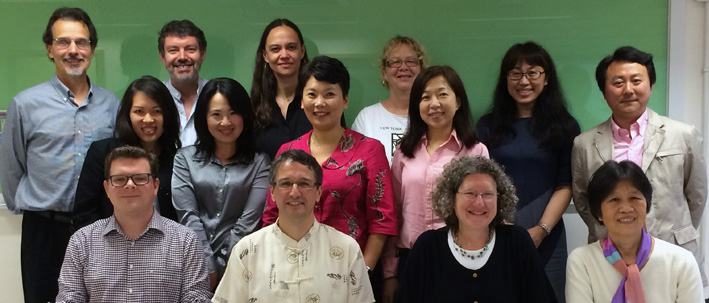
Roundtable portrait
Left to right, front row: Croucher, Sandel, Leeds-Hurwitz, L. Chen; middle row: V. Chen, Dawis, Lijadi, P. Lu, Huang, Jiang; back row: Buttny, Corbett, Witteborn, Young

The Roundtable on Intercultural Dialogue in Asia was held at the University of Macau on March 28-30, 2014. The organizers were Todd Sandel (Communication, University of Macau), John Corbett (English, University of Macau) and Wendy Leeds-Hurwitz (Center for Intercultural Dialogue). By design, this was a small event, designed to answer the question of whether, and in what ways, intercultural dialogue might be a useful term for discussing intercultural interactions in Asia. Sessions focused on such topics as what concepts aid in the study of intercultural dialogue, how intercultural competence fits with intercultural dialogue, and what needs to happen next, and various publication outlets. At least one special journal issue will result.

Martin Montgomery (Dean, Faculty of Arts and Humanities) officially welcomed participants on behalf of the University of Macau. Participants included Saskia Witteborn (Chinese University of Hong Kong), Richard Buttny (Syracuse University, currently doing research in Malaysia), Stephen Croucher (University of Jyväskylä, Finland), Ling Chen (Hong Kong Baptist University), Jiang Fei (Chinese Academy of Social Sciences), Huang Kuo (International Publishing Group, Beijing),  Aimee Dawis (University of Indonesia), Vivian Hsueh Hua Chen (Nanyang Technological University, Singapore, and University of Tasmania-Launceston, Australia), Peih-ying (Peggy) Lu (Kaohsiung Medical University, Taiwan), Melody Lu (Sociology, University of Macau), Priscilla Young (Peking University HSBC Business School, Shenzhen), and Anastasia Aldelina Lijadi (Psychology, University of Macau). Multiple masters and doctoral students in both Communication (Julie Zhong, Fiona Ng, Hazel Wan) and English (Carl, Dai Guangrong and Betty, Liu Suiling) managed some of the logistics, helping international visitors get around the city, picking up lunches, and serving as photographers and videographers. Administrative Staff, Barbara Chin (Communication) and Tina Chao (English) also spent many hours preparing documents and making travel, hotel, and other arrangements.

The highlight of the conference (at least for me) was gaining a sense of intercultural issues across Macau, Hong Kong, Taiwan, mainland China, Singapore, Malaysia and Indonesia, and simultaneously across disciplinary, theoretical and methodological boundaries. Since this was a small group, there were lots of opportunities for participants to connect, and at least one journal special issue and several new research collaborations are being planned, as well as a future conference. Most immediately, researcher profiles for more of the roundtable participants already are being posted to this website, and half a dozen have committed to writing Key Concepts in Intercultural Dialogue, to be posted over the next few weeks and months.

A short highlights video was prepared and is readily available. In addition, Aimee Dawis sent in a photo of coverage about the Roundtable in the International Daily News, a Chinese newspaper with the highest circulation in Indonesia:

International Daily News

Thanks to Aimee for arranging for this article, and to the University of Macau for being such a wonderful host institution for this event.

Wendy Leeds-Hurwitz, Director
Center for Intercultural Dialogue

Save

Save