
Key Concept #68: Social Justice by Kathryn Sorrells

Key Concepts in ICDThe next issue of Key Concepts in intercultural Dialogue is now available. This is KC68: Social Justice by Kathryn Sorrells. As always, all Key Concepts are available as free PDFs; just click on the thumbnail to download. Lists organized chronologically by publication date and numberalphabetically by concept in English, and by languages into which they have been translated, are available, as is a page of acknowledgments with the names of all authors, translators, and reviewers.
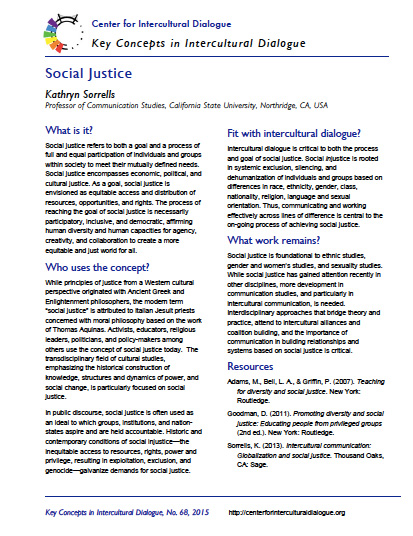
Key Concept #68: Social Justice by Kathryn Sorrells

Sorrells, K. (2015). Social justice. Key Concepts in Intercultural Dialogue, 68. Available from: https://centerforinterculturaldialogue.org/wp-content/uploads/2015/06/kc68-social-justice.pdf

The Center for Intercultural Dialogue publishes a series of short briefs describing Key Concepts in Intercultural Dialogue. Different people, working in different countries and disciplines, use different vocabulary to describe their interests, yet these terms overlap. Our goal is to provide some of the assumptions and history attached to each concept for those unfamiliar with it. As there are other concepts you would like to see included, send an email to the series editor, Wendy Leeds-Hurwitz. If there are concepts you would like to prepare, provide a brief explanation of why you think the concept is central to the study of intercultural dialogue, and why you are the obvious person to write up that concept.


Creative Commons License
This work is licensed under a Creative Commons Attribution-NonCommercial-NoDerivatives 4.0 International License.
Key Concept #67: Rhizome by Fay Yokomizo Akindes

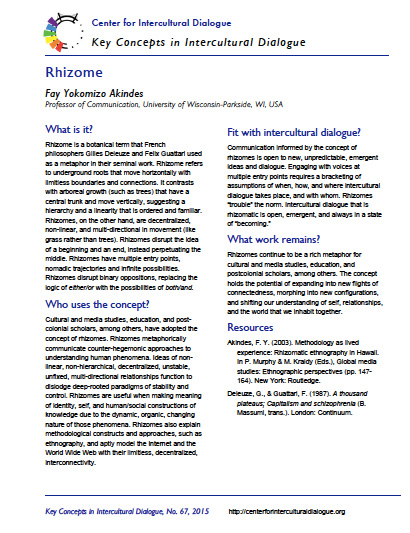
Key Concepts in ICDThe next issue of Key Concepts in intercultural Dialogue is now available. This is KC67: Rhizome by Fay Yokomizo Akindes. As always, all Key Concepts are available as free PDFs; just click on the thumbnail to download.

Key Concept 67: Rhizome by Fay Yokomizo Akindes

Akindes, F. Y. (2015). Rhizome. Key Concepts in Intercultural Dialogue, 67. Available from https://centerforinterculturaldialogue.org/publications

The Center for Intercultural Dialogue publishes a series of short briefs describing Key Concepts in intercultural Dialogue. Different people, working in different countries and disciplines, use different vocabulary to describe their interests, yet these terms overlap. Our goal is to provide some of the assumptions and history attached to each concept for those unfamiliar with it. Prior concepts are available on the main publications page. As there are other concepts you would like to see included, send an email to the series editor, Wendy Leeds-Hurwitz. If there are concepts you would like to prepare, provide a brief explanation of why you think the concept is central to the study of intercultural dialogue, and why you are the obvious person to write up that concept. Feel free to propose terms in any language, especially if they expand our ability to discuss an aspect of intercultural dialogue that is not easy to translate into English.

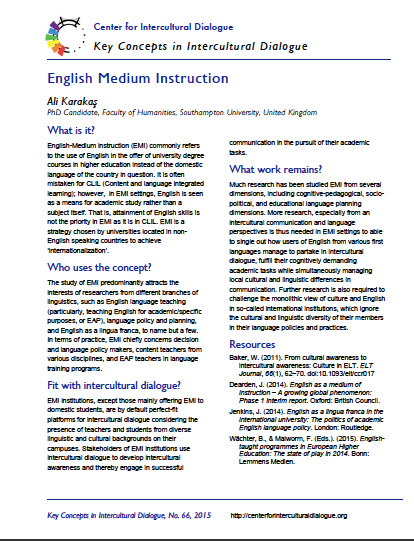
Key Concept #66: EMI by Ali Karakas

Key Concepts in ICDThe next issue of Key Concepts in intercultural Dialogue is now available. This is KC66: English Medium Instruction (EMI) by Ali Karakas. As always, all Key Concepts are available as free PDFs; just click on the thumbnail to download. Lists organized  chronologically by publication date and numberalphabetically by concept in English, and by languages into which they have been translated, are available, as is a page of acknowledgments with the names of all authors, translators, and reviewers.

Key Concept #66 English Medium Instruction by Ali Karakas

Karakas, A. (2015). English medium instruction. Key Concepts in Intercultural Dialogue, 66. Available from: https://centerforinterculturaldialogue.org/wp-content/uploads/2015/05/key-concept-emi.pdf

The Center for Intercultural Dialogue publishes a series of short briefs describing Key Concepts in Intercultural Dialogue. Different people, working in different countries and disciplines, use different vocabulary to describe their interests, yet these terms overlap. Our goal is to provide some of the assumptions and history attached to each concept for those unfamiliar with it. As there are other concepts you would like to see included, send an email to the series editor, Wendy Leeds-Hurwitz. If there are concepts you would like to prepare, provide a brief explanation of why you think the concept is central to the study of intercultural dialogue, and why you are the obvious person to write up that concept.


Creative Commons License
This work is licensed under a Creative Commons Attribution-NonCommercial-NoDerivatives 4.0 International License.
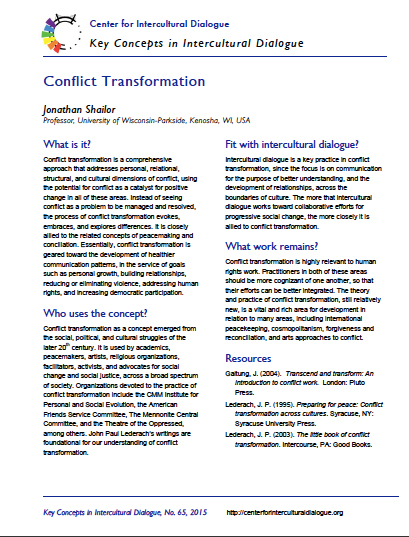
Key Concept #65: Conflict Transformation by Jonathan Shailor

Key Concepts in ICDThe next issue of Key Concepts in intercultural Dialogue is now available. This is KC65: Conflict Transformation by Jonathan Shailor. As always, all Key Concepts are available as free PDFs; just click on the thumbnail to download. Lists organized  chronologically by publication date and numberalphabetically by concept in English, and by languages into which they have been translated, are available, as is a page of acknowledgments with the names of all authors, translators, and reviewers.

Key Concept #65: Conflict Transformation by Jonathan Shailor

Shailor, J. (2015). Conflict transformation. Key Concepts in Intercultural Dialogue, 65. Available from: https://centerforinterculturaldialogue.org/wp-content/uploads/2015/05/key-concept-conflict-transformation.pdf

The Center for Intercultural Dialogue publishes a series of short briefs describing Key Concepts in Intercultural Dialogue. Different people, working in different countries and disciplines, use different vocabulary to describe their interests, yet these terms overlap. Our goal is to provide some of the assumptions and history attached to each concept for those unfamiliar with it. As there are other concepts you would like to see included, send an email to the series editor, Wendy Leeds-Hurwitz. If there are concepts you would like to prepare, provide a brief explanation of why you think the concept is central to the study of intercultural dialogue, and why you are the obvious person to write up that concept.


Creative Commons License
This work is licensed under a Creative Commons Attribution-NonCommercial-NoDerivatives 4.0 International License.
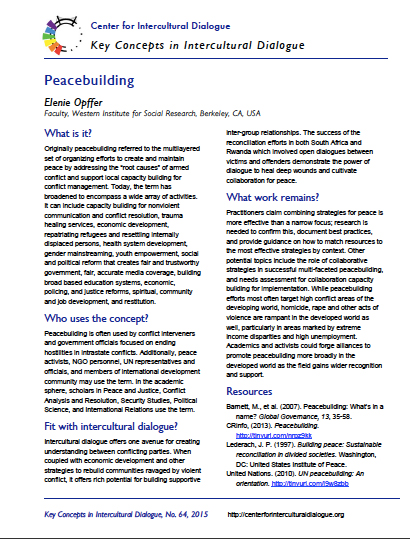
Key Concept #64: Peacebuilding by Elenie Opffer

Key Concepts in ICDThe next issue of Key Concepts in intercultural Dialogue is now available. This is KC64: Peacebuilding by Elenie Opffer. As always, all Key Concepts are available as free PDFs; just click on the thumbnail to download. Lists organized  chronologically by publication date and numberalphabetically by concept in English, and by languages into which they have been translated, are available, as is a page of acknowledgments with the names of all authors, translators, and reviewers.

Key Concept #64: Peacebuilding by Elenie Opffer

Opffer, E. (2015). Peacebuilding. Key Concepts in Intercultural Dialogue, 64. Available from: https://centerforinterculturaldialogue.org/wp-content/uploads/2015/05/key-concept-peacebuilding.pdf

The Center for Intercultural Dialogue publishes a series of short briefs describing Key Concepts in Intercultural Dialogue. Different people, working in different countries and disciplines, use different vocabulary to describe their interests, yet these terms overlap. Our goal is to provide some of the assumptions and history attached to each concept for those unfamiliar with it. As there are other concepts you would like to see included, send an email to the series editor, Wendy Leeds-Hurwitz. If there are concepts you would like to prepare, provide a brief explanation of why you think the concept is central to the study of intercultural dialogue, and why you are the obvious person to write up that concept.


Creative Commons License
This work is licensed under a Creative Commons Attribution-NonCommercial-NoDerivatives 4.0 International License.
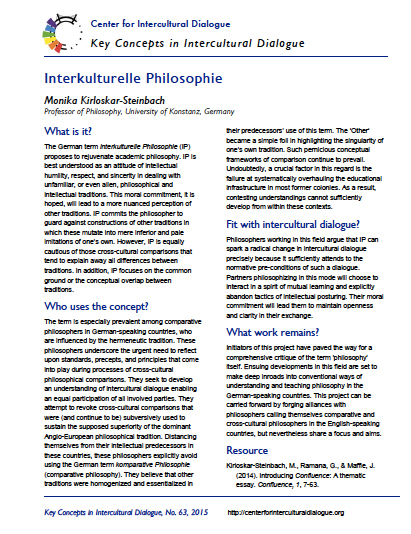
Key Concept #63: Interkulturelle Philosophie by Monika Kirloskar-Steinbach

Key Concepts in ICDThe next issue of Key Concepts in intercultural Dialogue is now available. This is KC63: Interkulturelle Philosophie by Monika Kirloskar-Steinbach. As always, all Key Concepts are available as free PDFs; just click on the thumbnail to download. Lists organized  chronologically by publication date and numberalphabetically by concept in English, and by languages into which they have been translated, are available, as is a page of acknowledgments with the names of all authors, translators, and reviewers.

Key Concept #63 Interkulturell PhilosophieKirloskar-Steinbach, M. (2015). Interkulturelle Philosophie. Key Concepts in Intercultural Dialogue, 63. Available from: https://centerforinterculturaldialogue.org/wp-content/uploads/2015/05/key-concept-interkulturell-philosophie.pdf

The Center for Intercultural Dialogue publishes a series of short briefs describing Key Concepts in Intercultural Dialogue. Different people, working in different countries and disciplines, use different vocabulary to describe their interests, yet these terms overlap. Our goal is to provide some of the assumptions and history attached to each concept for those unfamiliar with it. As there are other concepts you would like to see included, send an email to the series editor, Wendy Leeds-Hurwitz. If there are concepts you would like to prepare, provide a brief explanation of why you think the concept is central to the study of intercultural dialogue, and why you are the obvious person to write up that concept.


Creative Commons License
This work is licensed under a Creative Commons Attribution-NonCommercial-NoDerivatives 4.0 International License.
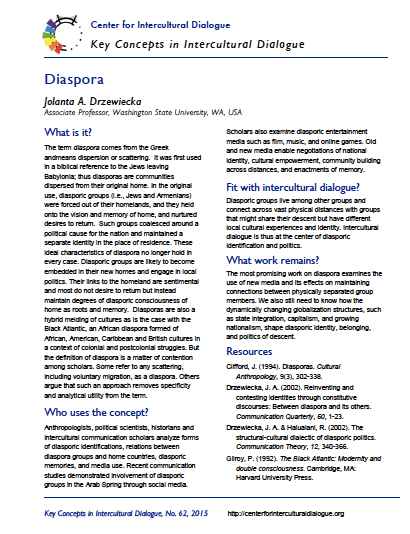
Key Concept #62: Diaspora by Jolanta A. Drzewiecka

Key Concepts in ICDThe next issue of Key Concepts in intercultural Dialogue is now available. This is KC62: Diaspora by Jolanta A. Drzewiecka. As always, all Key Concepts are available as free PDFs; just click on the thumbnail to download. Lists organized  chronologically by publication date and numberalphabetically by concept in English, and by languages into which they have been translated, are available, as is a page of acknowledgments with the names of all authors, translators, and reviewers.

Key Concept #62: Diaspora by Jolanta DrzewieckaDrzewiecka, J. A. (2015). Diaspora. Key Concepts in Intercultural Dialogue, 62. Available from: https://centerforinterculturaldialogue.org/wp-content/uploads/2015/05/key-concept-diaspora.pdf

The Center for Intercultural Dialogue publishes a series of short briefs describing Key Concepts in Intercultural Dialogue. Different people, working in different countries and disciplines, use different vocabulary to describe their interests, yet these terms overlap. Our goal is to provide some of the assumptions and history attached to each concept for those unfamiliar with it. As there are other concepts you would like to see included, send an email to the series editor, Wendy Leeds-Hurwitz. If there are concepts you would like to prepare, provide a brief explanation of why you think the concept is central to the study of intercultural dialogue, and why you are the obvious person to write up that concept.


Creative Commons License
This work is licensed under a Creative Commons Attribution-NonCommercial-NoDerivatives 4.0 International License.
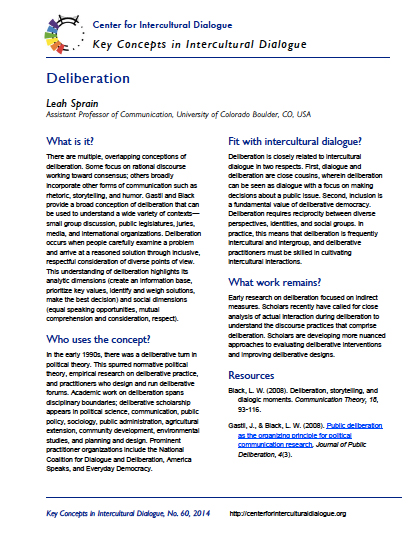
Key Concept #60: Deliberation by Leah Sprain

Key Concepts in ICDThe next issue of Key Concepts in intercultural Dialogue is now available. This is KC60: Deliberation by Leah Sprain. As always, all Key Concepts are available as free PDFs; just click on the thumbnail to download. Lists organized  chronologically by publication date and numberalphabetically by concept in English, and by languages into which they have been translated, are available, as is a page of acknowledgments with the names of all authors, translators, and reviewers.

Key Concept #60: Deliberation by Leah Sprain

Sprain, L. (2015). Deliberation. Key Concepts in Intercultural Dialogue, 60. Available from: https://centerforinterculturaldialogue.org/wp-content/uploads/2015/04/kc60-deliberation.pdf

The Center for Intercultural Dialogue publishes a series of short briefs describing Key Concepts in Intercultural Dialogue. Different people, working in different countries and disciplines, use different vocabulary to describe their interests, yet these terms overlap. Our goal is to provide some of the assumptions and history attached to each concept for those unfamiliar with it. As there are other concepts you would like to see included, send an email to the series editor, Wendy Leeds-Hurwitz. If there are concepts you would like to prepare, provide a brief explanation of why you think the concept is central to the study of intercultural dialogue, and why you are the obvious person to write up that concept.


Creative Commons License
This work is licensed under a Creative Commons Attribution-NonCommercial-NoDerivatives 4.0 International License.
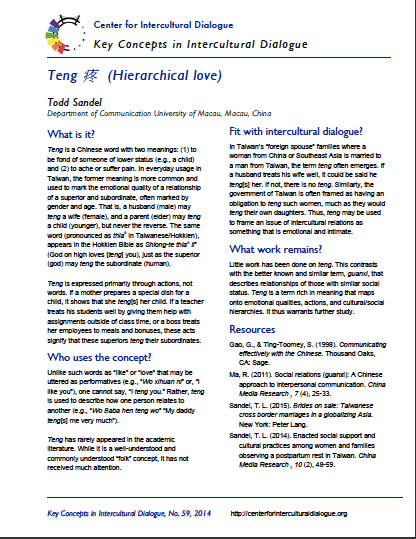
Key Concept #59: Teng by Todd Sandel

Key Concepts in ICDThe next issue of Key Concepts in intercultural Dialogue is now available. This is KC59: Teng by Todd Sandel. As always, all Key Concepts are available as free PDFs; just click on the thumbnail to download. Lists organized  chronologically by publication date and numberalphabetically by concept in English, and by languages into which they have been translated, are available, as is a page of acknowledgments with the names of all authors, translators, and reviewers.

Key Concept #59 Teng by Todd Sandel

Sandel, T. (2015). Teng. Key Concepts in Intercultural Dialogue, 59. Available from: https://centerforinterculturaldialogue.org/wp-content/uploads/2015/04/key-concept-teng.pdf

The Center for Intercultural Dialogue publishes a series of short briefs describing Key Concepts in Intercultural Dialogue. Different people, working in different countries and disciplines, use different vocabulary to describe their interests, yet these terms overlap. Our goal is to provide some of the assumptions and history attached to each concept for those unfamiliar with it. As there are other concepts you would like to see included, send an email to the series editor, Wendy Leeds-Hurwitz. If there are concepts you would like to prepare, provide a brief explanation of why you think the concept is central to the study of intercultural dialogue, and why you are the obvious person to write up that concept.


Creative Commons License
This work is licensed under a Creative Commons Attribution-NonCommercial-NoDerivatives 4.0 International License.
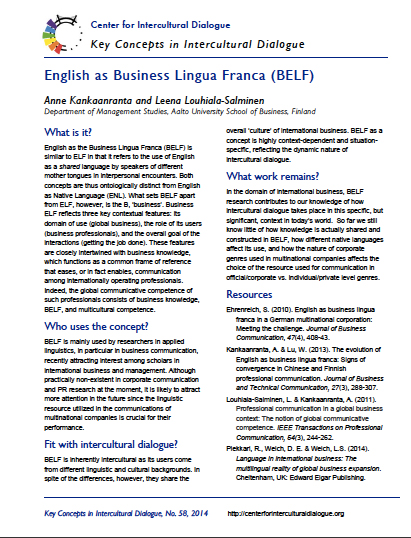
Key Concept #58: BELF by Anne Kankaanranta and Leena Louhiala-Salminen

Key Concepts in ICDThe next issue of Key Concepts in intercultural Dialogue is now available. This is KC58: English as Business Lingua Franca (BELF) by Anne Kankaanranta and Leena Louhiala-Salminen. As always, all Key Concepts are available as free PDFs; just click on the thumbnail to download. Lists organized  chronologically by publication date and numberalphabetically by concept in English, and by languages into which they have been translated, are available, as is a page of acknowledgments with the names of all authors, translators, and reviewers.

Key Concept #58: BELF by Kankaanranta & Louhiala-Salminen

Kankaanranta, A., &  Louhiala-Salminen, L. (2015). English as business lingua franca (BELF). Key Concepts in Intercultural Dialogue, 58. Available from: https://centerforinterculturaldialogue.org/wp-content/uploads/2017/01/key-concept-belf.pdf

The Center for Intercultural Dialogue publishes a series of short briefs describing Key Concepts in Intercultural Dialogue. Different people, working in different countries and disciplines, use different vocabulary to describe their interests, yet these terms overlap. Our goal is to provide some of the assumptions and history attached to each concept for those unfamiliar with it. As there are other concepts you would like to see included, send an email to the series editor, Wendy Leeds-Hurwitz. If there are concepts you would like to prepare, provide a brief explanation of why you think the concept is central to the study of intercultural dialogue, and why you are the obvious person to write up that concept.


Creative Commons License
This work is licensed under a Creative Commons Attribution-NonCommercial-NoDerivatives 4.0 International License.