Multilingual Signs and Intercultural Pedagogy

When visiting Macau, I was surprised by seeing trilingual street signs (Chinese, Portuguese and English), a rare phenomenon in the US. A recent article in ELT Journal by Chiou-Ian Chern and Karen Dooley documents how such signs can serve as a resource to language teachers and learners. They conclude: “Environmental print . . . has become a useful, if politically complex, resource for learning English in contexts where language teachers once lamented the paucity of English input outside the classroom.” (p. 122).

Chern, C.-I., & Dooley, K. (2014). Learning English by walking down the street. ELT Journal, 68(2), 113-123. Available from: http://eltj.oxfordjournals.org/content/68/2/113.full

(The full article is available to download for free as I write this, though that may temporary.)

Wendy Leeds-Hurwitz, Director
Center for Intercultural Dialogue

Yang Liu Graphic Designs: East Meets West

Academics tend to discuss cultural differences in words. Designers show them visually. Yang Liu grew up in China, but then moved to Germany, becoming a designer. One of her projects, East meets West, consists of a series of comparisons of Chinese vs. German assumptions based on  her own experiences.

Her designs have been exhibited in both China and Germany, as well as being widely available on the internet. For further information, see her own website, or one of the many articles describing her work, including these:

Aw, Jean. (2007). Interview with Yang Liu- 11.13.07. NOTCOT.

Saleme, Shawn. (2013). East Meets West : An Infographic Portrait by Yang Liu. Visual News.

Save

Clothing as a Tool of Intercultural Dialogue: New Zealand and India

New Zealand fashion students recreate modern-day wear from traditional Indian silk saris

In a unique celebration joining New Zealand and Indian cultures, 15 New Zealand Fashion Tech students won Prime Minister’s Scholarships for Asia, covering travel to the Bannari Amman Institute of Technology in India to participate in a five week Apparel and Textile Practicum. Students earned the awards by creating garments made from traditional Indian sari fabrics. The inaugural Resene Designer Selection showcased the hand-crafted silk from Southern India made especially for their garments. Four of the NZ students were Maori. The goal was to take students outside the classroom and give them an international and applied perspective.

Further information about this project is available in a New Zealand journal article entitled “A pattern for success” published in Educator Review, and in an Indian newspaper article entitled “Indian silk, New Zealand patterns”. Continuing descriptions by the students of their experiences are also available on their university’s website.

Museums in an Intercultural Context

The result of a collaboration between the Department of Cultural Management at the Universiteit Antwerpen (Flanders, Belgium) and the Department of Museum Studies at the Université du Québec a Montréal (Quebec, Canada), an intercultural tool aimed at museums in urban context has recently been published. The grid was conceived as an analytical framework for a research project entitled The city museum in an intercultural context. Fostering dialogue in culturally diverse urban environments: perspectives from Montreal, Antwerp, Ghent and Rotterdam.

Inspired by the Council of Europe’s Intercultural Cities programme, collaboration between researchers and students at both universities involved an analysis of four city museums in Quebec, Flanders and the Netherlands and how they approached intercultural dialogue.

The analytical grid produced in the context of the research project can be used by all types of museums and heritage institutions wishing to reflect upon their engagement with diverse communities. Museums may find it useful for initiating brainstorming sessions and self-assessment exercises, supporting planning processes, conducting intercultural project evaluations or facilitating benchmarking and the exchange of strategic information. Researchers in the heritage and cultural management fields may also find it useful for collecting, analysing and comparing data on issues related to diversity and intercultural dialogue in the museum sector.

The grid addresses three levels of analysis:
*Environmental analysis, including the sociodemographic environment of the city, the policy environment of the museum, the institutional environment of the museum and the governance environment of the museum.
*Museum analysis, including an institutional overview of the museum and an intercultural audit of the museum.
*Project analysis, including an analysis of projects with intercultural components.

Museum professionals and researchers may use one or several of these sections, depending on their needs. Data can be collected using a variety of means, including interviews with museum staff, examination of strategic documents and field observation.

The intercultural tool for museums is available for free.

Original article published by Asia-Europe Museum Network.

Culture is Mirriam-Webster’s 2014 Word of the Year

MERRIAM-WEBSTER ANNOUNCES “CULTURE” AS 2014 WORD OF THE YEAR

Merriam-Webster Inc., America’s leading dictionary publisher, has announced its top ten Words of the Year for 2014. This year’s list was compiled by analyzing the top lookups in the online dictionary at Merriam-Webster.com and focusing on the words that showed the greatest increase in lookups this year as compared to last year. The results, based on approximately 100 million lookups a month, shed light on topics and ideas that sparked the nation’s interest in 2014.

The Word of the Year, with the greatest number of lookups and a significant increase over last year, is culture. Culture is not associated with any one event, but instead dominated the headlines this year, on topics ranging from “celebrity culture” to “rape culture” to “company culture.” In years past, lookups for the word culture spiked in the fall, as students encountered the word in titles and descriptions of courses and books, but this year lookups have moved from seasonal to persistent, as culture has become a term frequently used in discussions of social phenomena.

“Culture is a word that we seem to be relying on more and more. It allows us to identify and isolate an idea, issue, or group with seriousness,” explains Peter Sokolowski, Editor at Large for Merriam-Webster. “And it’s efficient: we talk about the ‘culture’ of a group rather than saying ‘the typical habits, attitudes, and behaviors’ of that group. So we think that it may be the increased use of this newer sense of the word culture that is catching people’s attention and driving the volume of lookups.”

CID in The Washington Post

About CIDI was contacted a few days ago by a reporter at the The Washington Post, who asked me to discuss the comments made by Airbnb about their impact on intercultural relations. She did a fair job of representing what I said. See for yourself:

Dewey, Caitlin. (2014, November 24). How Airbnb promotes world peace. The Washington Post.

If you’ve stayed in Airbnb yourself and want to join the conversation, add a comment below.

Wendy Leeds-Hurwitz, Director
Center for Intercultural Dialogue

Comics for Equality wins Intercultural Innovation Award

This video presents the Comics for Equality project, which won the Intercultural Innovation Award 2014, a partnership between United Nations Alliance of Civilisations and BMW Group. The project was selected from more than 600 projects worldwide and will be part of one-year capacity-building program.

✔ Take a look at the website: http://www.comix4equality.eu
✔ Join them on Facebook: http://www.facebook.com/Comix4equality

The project ComiX4= is led by Africa e Mediterraneo (Italy), in partnership with NGO Mondo (Estonia), Workshop for Civic Initiatives Foundation (Bulgaria), ARCA (Romania), Grafiskie stasti (Latvia), Hamelin Associazione Culturale (associate partner-Italy) and Multi Kulti Collective Association (associate partner – Bulgaria).

The project aims to foster intercultural dialogue to combat racism, xenophobia and discrimination in Europe, with a particular focus on Italy, Bulgaria, Estonia, Romania and Latvia. In order to achieve this aim, the project seeks to involve migrants and second-generation immigrants – often the subjects of discrimination – in the creation of an artistic resource – comics – to be used to combat racism and xenophobia.

The main activities are the ComiX4= Comics for Equality Award – a competition for the best unpublished comic strip authors with migrant backgrounds, an interactive website, a “Comics Handbook” for creative workshops in informal education, an itinerant exhibition and comics’ workshops across Europe.

With financial support from the Fundamental Rights and Citizenship Programme of the European Union – 2012/

Case Studies in Intercultural Dialogue

Case Studies in ICD
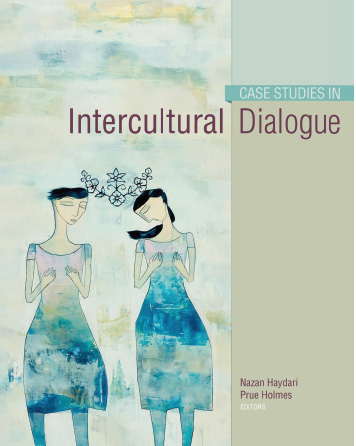
The book Case Studies in Intercultural Dialogue has just been published by Kendall-Hunt. It is edited by Nazan Haydari and Prue Holmes. The book focuses on the important and under-investigated concept of intercultural dialogue. It draws on cases of intercultural communication in which there is a dialogue, conflict or misunderstanding, and presents approaches, theories, and analytical tools that can be used to productively understand and/or resolve the issues presented in each case study.

This edited collection covers a wide range of research topics drawn from peace building, arts and media, education, anthropology, new communication technologies organizational communication, and more. The format of Case Studies in Intercultural Dialogue encourages readers to engage in discussion from different perspectives through various methodological and theoretical approaches to problems, opportunities, and ethical issues of intercultural communication.

The collection had its genesis in the NCA Summer Conference on Intercultural Dialogue, held in Istanbul in 2009, with half the chapters resulting from that event, and the other half the result of an international call for proposals. The table of contents follows:

Introduction: Contextualizing ‘Intercultural Dialogue’ and the ‘Case Study’ by Nazan Haydari & Prue Holmes

Part I: Building Spaces for Dialogue
Facilitating Intercultural Dialogue Through Innovative Conference Design by Wendy Leeds-Hurwitz

Part II: Dialogue for Peace Building and Reconciliation
Community Driven Peacebuilding Approaches: The Case of Postgenocide Rwanda by Eddah Mbula Mutua
Dialogue across the Divide: Bridging the Separation in Cyprus by Benjamin Broome

Part III: Building Dialogue in / for Education
Multiculturalism, Contact Zones and the Political Core of Intercultural Education by Susana Gonçalves
Dialogue as a Common Ground between, across and beyond Cultures and Disciplines: A Case Study of Transcultural and Transdisciplinary Communication Lectures for Graduate and Undergraduate Students by Maria Flora Mangano
Developing Cosmopolitan Professional Identities: Engaging Australian and Hong Kong Trainee Teachers in Intercultural Conversations by Erika Hepple
Challenges in International Baccalaureate Students’ Intercultural Dialogue by Gertrud Tarp

Part IV: Building Dialogue through Arts and Media
Bollywood in the City: Can the Consumption of Bollywood Cinema Serve as a Conduit/ Site for Intercultural Discovery and Dialogue? by Ruma Sen
Storms, Lies & Silence: Beyond Dialogue-Based Models of Intercultural Contact by David Gunn

Part V: Building Dialogue in/ through Research
Anthropology as Intercultural Critique: Challenging the Singularity of Islamic Identity by Tabassum “Ruhi” Khan.
Community Autoethnography: A Critical Visceral Way of “Doing” Intercultural Relationships by Sandra L. Pensoneau-Conway, Satoshi Toyosaki, Sachiko Tankei-Aminian & Farshad Aminian-Tankei

Part VI: Building Dialogue in Everyday
The Voices of Hispanic Emerging Adults in New Mexico and Oklahoma by David Duty

Part VII: Building Dialogue at the Institutional / Organizational Level
“Why did it All Go so Horribly Wrong?”: Intercultural Conflict in an NGO in New Zealand by Prue Holmes
Leadership in Intercultural Dialogue: A Discursive Approach by Jolanta Aritz & Robyn C. Walker

Part VIII: Building Dialogue through New Information Technologies
Le Francais en (premiere) Ligne: Creating Contexts for Intercultural Dialogue in the Classroom by Christine Develotte & Wendy Leeds-Hurwitz
The Potential of Diasporic Discussion Forums for Intercultural Dialogue and Transcultural Communication: Case Studies in Moroccan and Turkish Diasporas in Germany by Çigdem Bozdağ

Assessing Intercultural Competency – Part II – by Trudy Milburn

Guest PostsAssessing Intercultural Competency – Part II
by Trudy Milburn

Hello.
(Hi)
What’s your name?
(Response)
Where did you go to school?

If your student produced this as evidence of a cultural practice, how would it rate on this AAC&U Intercultural rubric criterion?

“Demonstrates sophisticated understanding of the complexity of elements important to members of another culture in relation to its history, values, politics, communication styles, economy, or beliefs and practices.”

At first blush, the interaction sequence might seem part of any typical introduction between two people who are meeting one another for the first time. Therefore, a student who produces this might appear to be “developing” on the low end of a graduated scale with a “target” level on the higher end. An instructor may evaluate the statement as evidence of a student’s initial awareness of an interactional pattern, but as lacking a nuanced understanding that its production may indicate a culturally significant pattern. However, perhaps there is more going on with this interactional sequence than one may initially assume.

If we heed Yep’s (2000) suggestion and consider both personal and broader social histories and how these intersect, we might re-consider the produced interaction from different subject positions. Consider these additional contextual features.

While traveling with students in Northern Ireland, we heard tour guides describe a greeting ritual that included the following parts: first asking, “What’s your name?” and then, “where did you go to school?” The guide explained that learning as much as you could about your interlocutors during introductions was very important throughout the tensest moments of the Conflict. It was considered vitally important to be able to quickly position a newcomer within an appropriate category, as Catholic or Protestant. Knowing relevant category could produce fear or solidarity. One guide described that he believed people with saint names were denied access to jobs. Therefore, upon meeting someone, if one heard (or did not hear) a saint name, the follow up question was used to ascertain if the individual attended a Catholic School or not. It was this practice that led one to know on which side of the Conflict the new person was most likely to be. It may have also led to further discriminatory practices.

Coming back to the notion of assessing intercultural competence, how, then does one evaluate a student who attempts to demonstrate intercultural competence by producing such an interactional sequence? While the rubric criterion above includes many features that are valuable to consider, including the social, historical and political contexts of various communicative practices, it leads us into the same trap that Yep (2000) warns about, creating cultural “others.” Even if one notices the interaction sequence from the vantage points of the interlocutors who enact it, where does the student stand in relation to this sequence? One suggestion is that as instructors, we can help students to reflect on how noticeable practices might illustrate a belief within the student’s own culture. It may be that this interaction sequence may be so typical within one’s own culture as to initially go unnoticed. In fact, as instructors who are conducting intercultural assessment, perhaps we should consider our own potential biases towards such practices and consider how our cultural beliefs influence both how we instruct as well as how we assess intercultural competency.

In my next post, I will consider the types of methods used for assessing intercultural competence as well as the role of assessors in this work.

Reference
Yep, G. A. (2000). Encounters with the ‘other’: Personal notes for a reconceptualization of intercultural communication competence. CATESOL Journal, 12(1), 117-144.

Download the entire post as a PDF.

EuroVision – Museums Exhibiting Europe (EMEE)

EuroVision: Museums Exhibiting Europe (EMEE) is a European museum development project for national and regional museums. It explores an innovative inter­disciplinary approach for museums to re-interpret their objects in a broader context of European and trans-na­tional history. The necessary theoretical and practical framework is developed, put into practice and evalu­ated by an international, trans-sectoral network brin­ging together the creative excellence of museums and cultural workers in a project based on the scientific ex­pertise of History Didactics in mediating culture. It will be presented to the visitor in the so-called ‘EuroVision Lab.’ exhibitions, using the motto: ‘One Object – Many Visions – EuroVisions’. The ‘EuroVision Lab.’ is experimental by nature and is taking place at all partner institutions. It involves a variety of different activities with public appeal (e. g. exhibition projects, cultural performances), which put into practice the concept of the ‘Change of Perspective’ (COP) for the Europeanization of regional and national museums. In order to deal with historical culture and historical identity the COP has three components:

COP 1: European re-interpretation of objects
As if they were looking through a range of different len­ses, experts and visitors discover that one and the same object can be perceived in multi-layered ways and con­texts. Hence, the COP 1 encourages visitors to actively be engaged in the European re-interpretation of objects by intersecting local, national, transnational and global perspectives.

COP 2: Activation and participation of visitors
The COP 2 practices the change of perspective between museum experts and visitors. The museum puts strate­gies to the test that lead away from its traditional pre­rogative of historical interpretation by encouraging the visitors to reflect and express their own approach to the museum contents. The steps range from the activating presentation of the objects to a synaesthetic exhibiti­on design and to accompanying cultural programmes in parts designed by visitors and even ‘non-visitors’.

COP 3: Broadening perspectives
The COP 3 is achieved by changing the perspectives by means of international and interdisciplinary exchange of ideas, expertise and objects in order to overcome the narrowness of national and Eurocentric perspectives. In order to fulfill this aim, a European network of museum experts and cultural workers will be established.

In order to implement the “Change of Perspective“, the EMEE partners developed five so called toolkits. These manuals aim to mediate between theory and practice and to offer all interested museums instructions for innovative and creative concepts that are in support of the modernization and Europeanization of museum activities. The manuals can be downloaded for free from the project’s website along with the accompanying workshops.

The EMEE project also launched the EMEE Young Scenographers Contest which calls for young designers and scenographs to make the Change of Perspective visible in exhibitions.

Contact
Universität Augsburg
Lehrstuhl für Didaktik der Geschichte
Universitätsstraße 10
86159 Augsburg
Germany

Coordination: Prof. Dr. Susanne Popp
Project manager: Susanne Schilling M.A.

Save