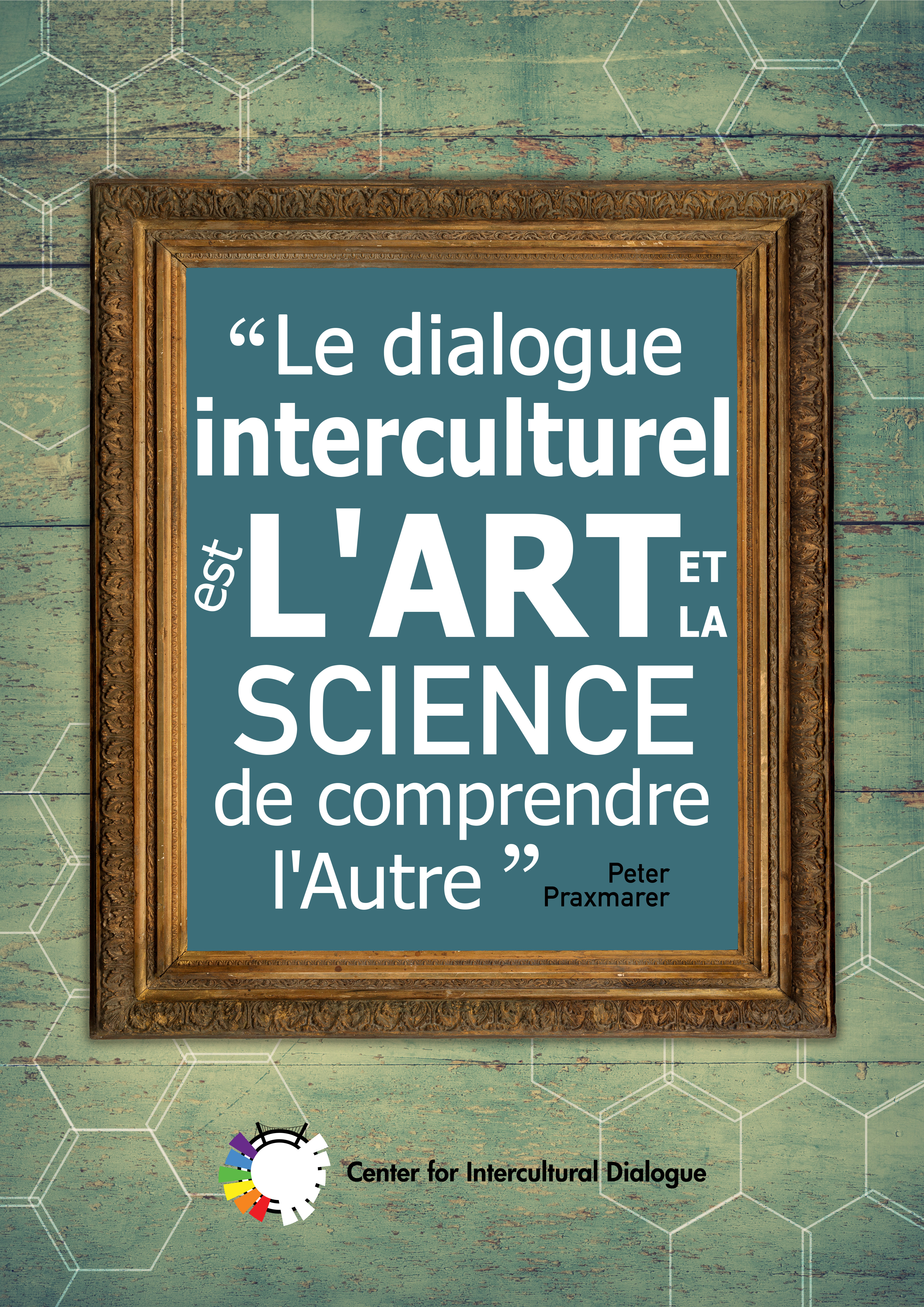
 This is the third of the posters designed by Linda J. de Wit, in her role as CID intern. The quote by Peter Praxmarer does not come from a publication, but from a Skype conversation we had on April 25, 2017. I was struck by what he said, and how nicely it summed up the concept of intercultural dialogue, and requested permission to turn the definition into a poster, and he graciously agreed. In terms of visual design, Linda indicated “art” by the picture frame, and “science” by the design in the background. Hopefully this definition will find a wide audience, because I think it does a better and more concise job of explaining intercultural dialogue than other definitions I’ve seen.
The French translation was provided by Léonie Potvin, and the graphic design work necessary to revise was by Yan Qiu. Here then is CID Poster 3: Le dialogue interculturelle.
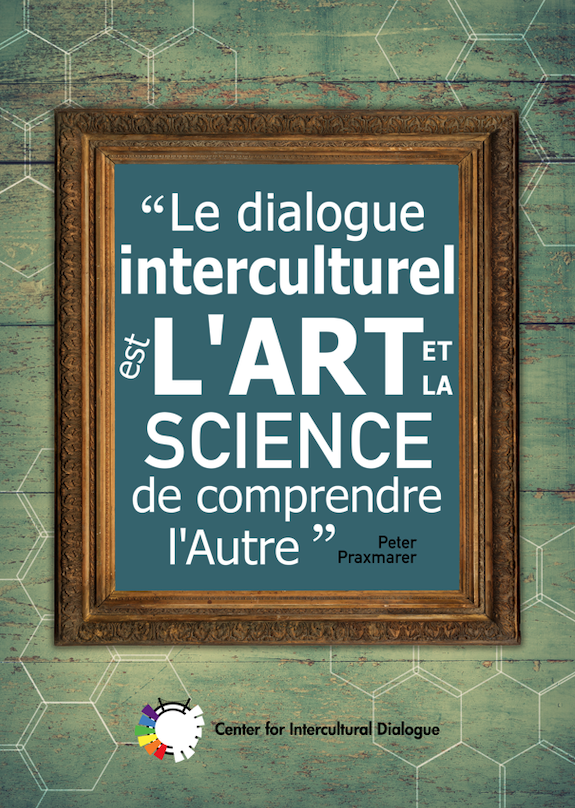
Just in case anyone wants to cite this poster, the following would be the recommended format:
Center for Intercultural Dialogue. (2024). Le dialogue interculturelle [L. Potvin, trans.]. CID Posters, 3. Available from: https://centerforinterculturaldialogue.org/wp-content/uploads/2025/11/cid-poster-3-art-and-science-french.jpg
As with other series, CID Posters are available for free on the site; just click on the thumbnail to download a printable PNG. They may be downloaded, printed, and shared as is, without changes, without cost, so long as there is acknowledgment of the source.
As with other CID Publications, if you wish to contribute an original contribution, please send an email before starting any work to receive approval, to minimize inadvertent duplication, and to learn about technical requirements. As is the case any series, posters should be created initially in English. If you want to volunteer to translate a poster into a language in which you are fluent, send in a note before starting, to receive approval and to confirm no one else is working on the same one.
Wendy Leeds-Hurwitz
Director, Center for Intercultural Dialogue
intercult.dialogue AT gmail.com

This work is licensed under a Creative Commons Attribution-NonCommercial-NoDerivatives 4.0 International License.

 Call for applications: Fellowships at the Leuphana Institute for Advanced Studies in Culture and Society, Leuphana University Lüneburg, 2026-27. Deadline: 15 January 2025.

 Multiple positions, University of California Education Abroad Program, Goleta, CA, USA. Deadline: varies by position.


 Center for Intercultural Dialogue