Fung Global Fellows, Princeton

Call for applications Fung Global Fellows Program
2015-16 Theme: Ethnic Politics and Identities

During the academic year 2015/16, the theme for the Fung Global Fellows Program will be “Ethnic Politics and Identities.”  Recent events around the world have highlighted the role of ethnic politics and identities in shaping domestic and international political arenas.  The Fung Global Fellows Program seeks applications from scholars who explore the causes, narrative modalities, and consequences of the politicization of ethnic, racial, and national divides from a comparative perspective.  Researchers working on any historical period of the modern age or region of the world and from any disciplinary background in the social sciences or humanities are encouraged to apply. For eligibility requirements and  further information see the application section of their website. Application deadline: November 1, 2014.

CFP Analysis of Dialogue Practice

Call for Papers for Journal of Dialogue Studies
Spring 2015, Volume 3, Number 1
Social Scientific and Historical Analysis of Dialogue Practice
Paper submission deadline: 11/01/2015

This is a call for papers for the Journal of Dialogue Studies, a multidisciplinary, blind-peer-reviewed academic journal published twice a year. The Journal seeks to bring together a body of original scholarship on the theory and practice of dialogue that can be critically appraised and discussed. It aims to contribute towards establishing ‘dialogue studies’ as a distinct academic field (or perhaps even emerging discipline). It is hoped that this will be directly useful not only to scholars and students but also to professionals and practitioners working in different contexts at various cultural interfaces.

The Editors would like to call for papers providing ‘social scientific and historical analysis of dialogue practice’ for the forthcoming issue. However, authors are also welcome to submit papers that address the topic of the previous issues, namely ‘dialogue ethics’, ‘critiquing dialogue theories’, or indeed any other paper that comes within the remit of the Journal as described below. All papers, regardless of their particular theme, will be considered so long as they are in line with the aims and focus of the Journal. Please see below for more information.

For the Journal‘s Editorial Team, Editorial Board, article submission guideline, style-guide and past issues please visit www.DialogueStudies.org

Papers within General Remit of Journal
The Journal publishes conceptual, research, and/or case-based works on both theory and practice, and papers that discuss wider social, cultural or political issues as these relate to the practice and evaluation of dialogue. Dialogue is understood provisionally as: meaningful interaction and exchange between individuals and/or people of different groups (social, cultural, political and religious) who come together through various kinds of conversations or activities with a view to increased understanding. Some scholars will want to question that description of dialogue, and others may be sceptical of the effectiveness of dialogue as a mechanism to produce increased understanding. The Editors of course welcome vigorous discussion and debate on these and other fundamental questions.

The Editors do not have any preference as regards the general disciplinary background of the work. Indeed contributions will be welcome from a variety of disciplines which may, for example, include sociology, anthropology, cultural studies, linguistics, the study of religion, politics, international relations or law.

Papers on ‘Social Scientific and Historical Analysis of Dialogue Practice’
The Editors invite papers on the social scientific and historical analysis of dialogue practices, including papers critically appraising the following areas:
*Where do dialogue practices come from, sociologically and intellectually?
*How has dialogue practice changed/developed over time in a particular place, religious/interreligious context and/or post conflict context?
*How have dialogue practices been shaped by overlapping areas of theory, policy and practice?
*How have dialogue practices themselves impacted upon societal issues or discourse?
*Mapping the existing field of practice and study.
*Sociological and historical analysis of the perception of the need for ‘dialogue’ given its current status as a preferred means of community engagement or management of community/intergroup tensions or conflict.
(See Fern Elsdon-Baker, JDS 1:1)

Papers on ‘Dialogue Ethics’
The Editors invite papers with a focus on dialogue and ethics, including papers critically exploring the following areas:
*Dialogic ethics as conceived by dialogue theorists such as Buber, Gadamer, Freire (and developed by others)
*Ethics espoused and/or enacted by leaders of/participants in dialogue
*Dialogue as a process of ethics formation/refinement
*Underlying and perhaps unstated values in dialogue:
*What kind of interaction is seen valid or as meaningful? What are the criteria? Who decides? (Fern Eldson-Baker, JDS 1:1)
*Where building understanding is conceived as goal of dialogue, ‘what understandings are valued and how [are] such understandings. defined’? (Michael Atkinson, JDS 1:1)
*Ethical pitfalls in the practice of dialogue

Papers on ‘Critiquing Dialogue Theories’
By dialogue ‘theories’ is meant developed, significant understandings or principles of dialogue. The Editors are open to papers exploring theories extrapolated by the author from the significant and distinctive practice of a dialogue practitioner who has perhaps not elaborated his/her ideas in writing. They invite papers which address critical/evaluative questions such as the following:
*Which dialogue theories are/have been most influential in practice?
*Do dialogue theories make sense in relation to relevant bodies of research and established theories?
*Do dialogue theories sufficiently take account of power imbalances?
*How far are dialogue theories relevant/useful to dialogue in practice?
*Do normative dialogue theories have anything to offer in challenging contexts in which circumstances often suggested as preconditions for dialogue (for example, equality, empathetic listening, the bringing of assumption into the open, safety) simply do not obtain?

The Editors welcome papers which address these questions in relation to one or more than one specified dialogue theories. They also welcome critical case studies of the application of specified dialogue theories in practice.

In all papers submitted, a concern with the theory or practice of dialogue should be in the foreground.

While the Editors do not wish to be prescriptive about the definition of dialogue, they do specify that papers should have a clear bearing on ‘live’ dialogue – actual interaction between human beings; papers which analyse written, fictional dialogue without relating this clearly and convincingly to ‘live’ dialogue are not suitable for the Journal.

Case studies should include a high level of critical evaluation of the practice in question, and/or apply dialogue theory in a way that advances understanding or critique of that theory and/or its application.

Papers should be submitted by email attachment to: journal@dialoguesociety.org and must be received by 11th January 2015 in order to allow sufficient time for peer review. Manuscripts should be presented in a form that meets the requirements set out in Journal’s Article Submission Guidelines and Style Guide. The running order for Volume 3, Number 1, listing the papers to be published in that issue, will be announced by the beginning of March 2015.

Please send any queries to the Editorial Team via journal@dialoguesociety.org

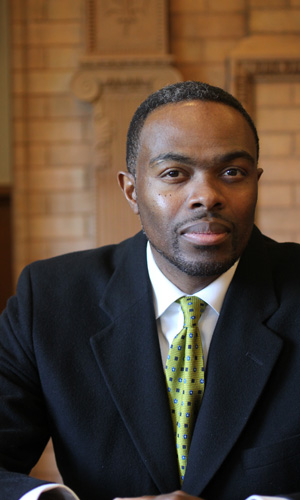
Ronald L. Jackson II Profile

ProfilesRonald L. Jackson II (Ph.D., Howard University) was born and raised in Cincinnati, Ohio. He grew up in a very proud working class family.

Ronald L. Jackson II

His mother worked during the day in the financial aid office at the University of Cincinnati, and then went to her second job as a courier for UPS. On the weekends she worked as a non-commissioned officer in the U.S. Army where she retired as a Sergeant First Class.  His father is an ordained minister who worked as a salesman and, much later after earning his doctorate degree, as owner of a tutoring business.

In articles like “Mommy there’s a N***** at the Door” published in the Journal of Counseling and Development Ron recalls countless stories of how he was mistreated as a child and young adult in Cincinnati because of the mere color of his skin.  This compelled him to write about racism and White privilege.  It also led him to explore the social construction of identity. After dabbling a bit in theories of identity Jackson decided he would create a couple of his own.  Because he was so enamored with Stella Ting Toomey’s work around identity negotiation he developed a theory that would try to make sense of what people are actually negotiating when they say they are negotiating cultural identity.  With feedback from two of his mentors, Bill Starosta and Molefi Asante, he coined “Cultural Contracts Theory.”  He reasoned that it is actually one’s worldview that is at stake in these daily and instantaneous identity negotiations. As he began to unravel the publicly assigned meanings inherent in his own identity as an African American male, he wrote extensively about Black masculinities, beginning with an essay called “Black manhood as xenophobe” published in the Journal of Black Studies.  The logical next step was to conceptualize this, so he along with one of his Penn State students Celnisha Dangerfield created the Black Masculine Identity Theory.

Currently, Ron Jackson is professor of communication at University of Cincinnati, and author of 14 books.  He has previously served on the faculty in the departments of communication at Xavier University, Shippensburg University, Penn State University, and University of Illinois.  He is also developing digital education materials for popular consumption.  His most recent books include Interpreting Tyler Perry, Black Comics: Politics of Race and Representation (which just won a Will Eisner Award for Best Academic/Scholarly Book in the Comics Industry), and Communicating Marginalized Masculinities.  Ron is also a candidate for NCA 2nd Vice President.  You can read more about his work at www.jacksonfornca.com.


Work for CID:
Ron Jackson wrote KC47: Cultural Contracts Theory.

CFP DiscourseNet Winter School (Spain)

DiscourseNet Winter School
Doing research on academic, educational and intellectual discourses
20.01.2015-24.01.2015
Valencia, Spain

Discourse Studies is a field which studies meaning- and sense-making practices in their political, social and historical contexts. The DiscourseNet Winter School brings together advanced BA and MA as well as PhD students who want to pursue research in Discourse Studies and to discuss the methodological and theoretical challenges of their thesis projects (or first ideas). Its aim is to bring young and confirmed discourse researchers together and to address practical challenges in discourse research. The event will privilege collaborative exchange and hands-on research experience in a rather informal workshop setting. Introductory lectures will be given by Johannes Angermuller (Warwick), Benno Herzog (Valencia) and Luisa Martín Rojo (Madrid).

Participants can come from linguistics, sociology, political sciences, literary and cultural studies, media and communication, education, geography and related areas in the social sciences and humanities. The DiscourseNet Winter School is free but a small contribution for coffee etc. may be charged. There are places for 15-20 students. A limited number of stipends is available for students in need of financial support for travel and accommodation. The working language is English. Participants can stay until the weekend after and join in the social activities with the group.

Applicants are expected to send in proposals which include a short letter of motivation, an abstract with one’s project (no more than one page) as well as an (academic) CV. If a stipend is needed, the organisers would expect a short explanation why financial assistance is needed (e.g. lack of institutional support). The abstract will consist of a title and a description of the proposed research project which can deal with academic, educational and intellectual discourses and/or methodological questions in discourse research.

Proposals should be sent in by the 30th of September 2014. In case of acceptance, each participant will send in a 10-page version of the research project by December 15th 2014. These longer versions will define the research object, lay out the research questions, situate the project in the field and reflect on the preferred methods. These longer versions will circulate among the participants prior to the event. During the DiscourseNet Winter School, the students will not read their papers but elaborate on specific points, practical problems and methodological challenges of their projects. If they wish, the participants can stay the weekend after and join in the social activities with the organisers in the Valencia region.

The Winter School is a Warwick-Valencia event, organised by members of DiscourseNet, an interdisciplinary and international network of discourse researchers existing since 2007. It is supported by the ERC DISCONEX project, led by Johannes Angermuller, which studies academic discourse in the social sciences and humanities. DiscourseNet regularly organizes workshops, e.g. DiscourseNet 14 in Mannheim (Germany, winter 2014), DiscourseNet 15 in Belgrade (Serbia, spring 2015), DiscourseNet 16 in Bremen (Germany, autumn 2015) and DiscourseNet 17 in Pamplona (Spain, spring 2016).

Please contact Ronny Scholz if you have questions and want to send in your application (in one single pdf file only).

Network: DiscourseNet
Organizing Committee: Johannes Angermuller (Warwick), Benno Herzog (Valencia), Francesc Hernàndez (Valencia), Ronny Scholz (Warwick)

Rosanne Teniente-Micro grant report

This slideshow requires JavaScript.

In Spring 2014, Rosanne Teniente was awarded a micro grant funded by the Association for Business Communication. The following is her report.


This past August I was privileged to have the opportunity to attend the Institute for Peace and Dialogue’s Summer Academy on Peacebuilding and Intercultural Dialogue hosted in Baar, Switzerland. IPD is an organization dedicated to conflict resolution, peacebuilding, and intercultural dialogue, and host conferences and trainings for those interested in peacebuilding and cross-cultural communication. I was there for ten days from August 17th through 27th and was partially funded through a microgrant from ABC, awarded through CID.

To say the least, it was a truly inspiring experience that I will cherish for the rest of my life. The experts invited were all very knowledgeable about their speaking topics, ranging from the Middle East conflict, non-violent communication and civil disobedience, to learning how to influence and persuade others, especially in dealing with conflict. Experts included a former French diplomat, the founder of the Pancevo peace movement in Serbia who was also directly involved in the Otpor movement that brought down Milosevic, as well as a former British colonel who worked on the Transnistrian conflict. There were also several experts in communication topics, ranging from cross-cultural communication, persuasive communication for successful negotiation, and non-violent communication. Every day had enthralling lectures, with great exercises and activities to really involve the participants.

Perhaps what really made the conference as special as it was were the other attendees. There were about thirty other participants, attending from all over the world. Everyone’s unique cultural background and experiences lent to amazing discussion and insight. One gentleman hailed from the Democratic Republic of Congo and was able to share his experiences in such a high-conflict country. Another came from Iraq and was able to eloquently explain the issues of ISIS and how his country is faring in the post-Iraq war years. Other participants were active peace practitioners, working for the United Nations, the Carter Center, and Peace Brigades International. At the end of the conference, we all agreed that one of the most rewarding aspects was that we were all blessed to have met and gotten to know each other during the time there, and to have forged such great connections with people from unlikely places.

I feel so fortunate that I was able to participate in such an event. As a graduate student and military spouse, it would have been very difficult to afford to attend the conference without funding from CID. I was also lucky that my university program was also able assist with a supplementary travel grant. While I did have to cover about half of the cost by myself, the microgrant from CID made it possible to attend, and as I said before, this will be an experience that I carry with me for the rest of my life.

EuroVision – Museums Exhibiting Europe (EMEE)

EuroVision: Museums Exhibiting Europe (EMEE) is a European museum development project for national and regional museums. It explores an innovative inter­disciplinary approach for museums to re-interpret their objects in a broader context of European and trans-na­tional history. The necessary theoretical and practical framework is developed, put into practice and evalu­ated by an international, trans-sectoral network brin­ging together the creative excellence of museums and cultural workers in a project based on the scientific ex­pertise of History Didactics in mediating culture. It will be presented to the visitor in the so-called ‘EuroVision Lab.’ exhibitions, using the motto: ‘One Object – Many Visions – EuroVisions’. The ‘EuroVision Lab.’ is experimental by nature and is taking place at all partner institutions. It involves a variety of different activities with public appeal (e. g. exhibition projects, cultural performances), which put into practice the concept of the ‘Change of Perspective’ (COP) for the Europeanization of regional and national museums. In order to deal with historical culture and historical identity the COP has three components:

COP 1: European re-interpretation of objects
As if they were looking through a range of different len­ses, experts and visitors discover that one and the same object can be perceived in multi-layered ways and con­texts. Hence, the COP 1 encourages visitors to actively be engaged in the European re-interpretation of objects by intersecting local, national, transnational and global perspectives.

COP 2: Activation and participation of visitors
The COP 2 practices the change of perspective between museum experts and visitors. The museum puts strate­gies to the test that lead away from its traditional pre­rogative of historical interpretation by encouraging the visitors to reflect and express their own approach to the museum contents. The steps range from the activating presentation of the objects to a synaesthetic exhibiti­on design and to accompanying cultural programmes in parts designed by visitors and even ‘non-visitors’.

COP 3: Broadening perspectives
The COP 3 is achieved by changing the perspectives by means of international and interdisciplinary exchange of ideas, expertise and objects in order to overcome the narrowness of national and Eurocentric perspectives. In order to fulfill this aim, a European network of museum experts and cultural workers will be established.

In order to implement the “Change of Perspective“, the EMEE partners developed five so called toolkits. These manuals aim to mediate between theory and practice and to offer all interested museums instructions for innovative and creative concepts that are in support of the modernization and Europeanization of museum activities. The manuals can be downloaded for free from the project’s website along with the accompanying workshops.

The EMEE project also launched the EMEE Young Scenographers Contest which calls for young designers and scenographs to make the Change of Perspective visible in exhibitions.

Contact
Universität Augsburg
Lehrstuhl für Didaktik der Geschichte
Universitätsstraße 10
86159 Augsburg
Germany

Coordination: Prof. Dr. Susanne Popp
Project manager: Susanne Schilling M.A.

Save

Kristen Cole Profile

ProfilesKristen Cole (PhD, University of New Mexico) is Assistant Professor of Critical Health Communication at San Jose State University in California.

Kristen Cole

Dr. Cole’s research and teaching span Rhetoric, Media and Cultural Studies. Her interests include constructions of gender and sexuality, race and ethnicity, citizenship and immigration, conflict and community, and science and technology. She investigates formations of identity and enactments of agency within marginalized communities and how these are represented in publicly mediated spaces. She utilizes rhetorical, critical/cultural, feminist, and queer approaches to media texts in order to understand the ways power is exerted and negotiated and the ways change is enacted. Her research and teaching focus on how communication at interpersonal, social, and cultural levels restricts and promotes a multiplicity of lived experiences. Her recent publications can be found in the Sage Handbook of Conflict Communication, Review of Communication and Rhetoric of Health and Medicine.


Work for CID:
Kristen Cole wrote KC33: Moral Conflict.

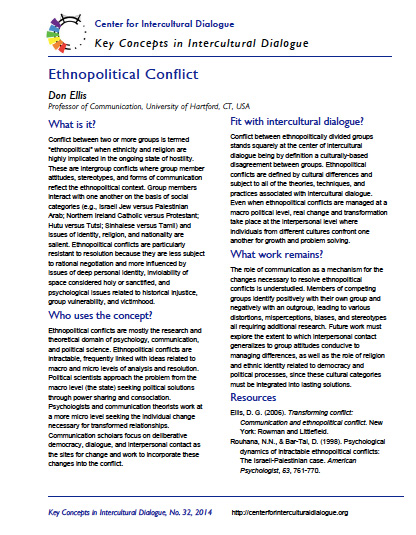
Key Concept #32: Ethno-Political Conflict by Don Ellis

Key Concepts in ICDThe next issue of Key Concepts in intercultural Dialogue is now available. This is KC32: Ethno-Political Conflict by Donald G. Ellis. As always, all Key Concepts are available as free PDFs; just click on the thumbnail to download. Lists organized  chronologically by publication date and numberalphabetically by concept in English, and by languages into which they have been translated, are available, as is a page of acknowledgments with the names of all authors, translators, and reviewers.

kc32-sm

Ellis, D. (2014). Ethno-political conflict. Key Concepts in Intercultural Dialogue, 32. Available from:
https://centerforinterculturaldialogue.org/wp-content/uploads/2014/09/key-concept-ethnopollitical-conflict.pdf

The Center for Intercultural Dialogue publishes a series of short briefs describing Key Concepts in intercultural Dialogue. Different people, working in different countries and disciplines, use different vocabulary to describe their interests, yet these terms overlap. Our goal is to provide some of the assumptions and history attached to each concept for those unfamiliar with it. Prior concepts are available on the main publications page. As there are other concepts you would like to see included, send an email to the series editor, Wendy Leeds-Hurwitz. If there are concepts you would like to prepare, provide a brief explanation of why you think the concept is central to the study of intercultural dialogue, and why you are the obvious person to write up that concept.


Creative Commons License
This work is licensed under a Creative Commons Attribution-NonCommercial-NoDerivatives 4.0 International License.

Symbolic Dimensions of Mediated Activism in Inter-Asia

Symbolic Dimensions of Mediated Activism in Inter-Asia
9/26/2014 Daylong PARGC, Penn SAS, SSRC Symposium

Location: Annenberg School for Communication, University of Pennsylvania, Philadelphia, PA, USA, Room 108
From 8:30 AM To 5:00 PM

A symposium presented by the Social Science Research Council. Co-sponsored by PARGC of the Annenberg School for Communication and Department of Sociology of the School of Arts and Sciences, University of Pennsylvania.

About the Symposium:

Symbolic Dimensions of Mediated Activism in Inter-Asia is one of many workshop discussions organized as part of the SSRC’s Transregional Virtual Research Institute (TVRI) on “Media, Activism, and the New Political in InterAsia.” Directed by Guobin Yang, this daylong workshop will explore, through comparative and historical discussions, the empirical, theoretical, and methodological issues in the analysis of the production, circulation, and impact of icons and symbols of protest and opposition in inter-Asia (China, India, and MENA). Our goal is to understand the discursive and symbolic connections and interactions of mediated activism in inter-Asia. In popular imagination, incidents of dissent and popular protest are often remembered for some critical moments with great symbolic value – the storming of the Bastille, the tank man in Tiananmen Square, the death of Neda Agha-Soltan in Iran. How are they preserved, passed down and absorbed into the repertoires of contention? How are new political symbols created and disseminated? What is the role of social media? Under what conditions do local and national political symbols become trans-local and trans-national? How do global media spectacles impinge on regional and local mobilization? These are some of the questions we will explore in this conference.

Speakers include:
Payal Arora (Erasmus University Rotterdam)
Radha Hegde (NYU)
Annemarie Iddins (University of Michigan)
Min Jiang (UNC-Charlotte)
Joe Khalil (Northwestern University in Qatar)
Marwan Kraidy (University of Pennsylvania)
Wazhmah Osman (Temple University)
Aswin Punathambekar (University of Michigan)
Steven Schrag (University of Pennsylvania)
Guobin Yang (University of Pennsylvania)
Elaine Yuan (UI-Chicago)

Please email rsvp@asc.upenn.edu to RSVP

Study of Internat’l students’ communication with host nationals

Collaboration request from Ioana Cionea, at the University of Oklahoma:
Participants needed for study on international students’ communication with host nationals

“We are currently conducting a longitudinal study in which we examine the factors that affect international students’ communication with host nationals. If you are an incoming international student (i.e., first semester in the United States) or if you know such students that you could forward this message to, we would appreciate your help with completing an online survey.

The survey has demographic questions, questions about expected communicate with host nationals, and anticipated experiences. Participation is completely voluntary. At the end of the survey, participants can enter a raffle to win Amazon gift cards.

If you have any questions or concerns about the research project you may contact any of the researchers on the team in the Department of Communication at The University of Oklahoma, an equal opportunity institution.”

Jackie Bruscella, M.A.
Bobbi Van Gilder, M.A.
Ioana A. Cionea, Ph.D.