Post-doctoral Fellowships in Intercultural Dialogue (Switzerland)

Call for Candidates: Post-doctoral Fellowships in Interreligious and Intercultural Dialogue 2015-2016

In the framework of an agreement signed in 2006 between the University of Geneva (UNIGE) and the Foundation for Interreligious and Intercultural Research and Dialogue (FIIRD), the Foundation will grant at least three post-doctoral fellowships for the academic year 2015-2016. They are intended for a research programme set up at the UNIGE, particularly in the Autonomous Department of Protestant Theology and the Humanities Department.

Funded by FIIRD, the fellowships (from 33,800 to 36,566 Swiss Francs maximum for each one) will be granted to young researchers having a doctorate when sending this application, a background in one of the three monotheistic religions (Judaism, Christianity and Islam) and wishing to specialize in the field of interreligious and intercultural dialogue.

The programme aims to set up a research group to deepen the understanding among persons of different religions and to bring forth leaders to respond to Intercultural and Interreligious challenges. Besides the attendance of course and seminars, the program consists of participation in a common bi-monthly seminar organized by FIIRD as well as the carrying out of independent research.

Period of allocation: beginning in September 2015 and continuing until August 2016 (twelve months).

Application deadline: 19 December 2014 for submission of complete files.
UPDATE as of January 7, 2015: Deadline extended to January 31, 2015

For further information about program and eligibility criteria, see the full calls in English and French.

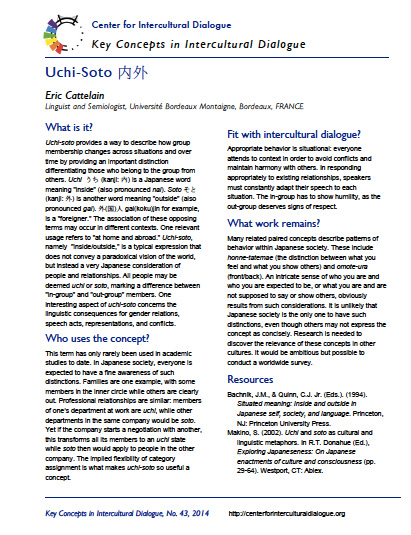
Key Concept #43: Uchi-Soto by Eric Cattelain

Key Concepts in ICDThe next issue of Key Concepts in intercultural Dialogue is now available. This is KC43: Uchi-Soto by Eric Cattelain. As always, all Key Concepts are available as free PDFs; just click on the thumbnail to download.Lists organized  chronologically by publication date and numberalphabetically by concept in English, and by languages into which they have been translated, are available, as is a page of acknowledgments with the names of all authors, translators, and reviewers.

kc43-sm

Cattelain, E. (2014). Uchi-soto. Key Concepts in Intercultural Dialogue, 43. Available from: https://centerforinterculturaldialogue.org/wp-content/uploads/2014/11/key-concept-uchi-soto.pdf

The Center for Intercultural Dialogue publishes a series of short briefs describing Key Concepts in Intercultural Dialogue. Different people, working in different countries and disciplines, use different vocabulary to describe their interests, yet these terms overlap. Our goal is to provide some of the assumptions and history attached to each concept for those unfamiliar with it. As there are other concepts you would like to see included, send an email to the series editor, Wendy Leeds-Hurwitz. If there are concepts you would like to prepare, provide a brief explanation of why you think the concept is central to the study of intercultural dialogue, and why you are the obvious person to write up that concept. And starting today, feel free to propose terms in any language, especially if they expand our ability to discuss an aspect of intercultural dialogue that is not easy to translate into English.


Creative Commons License
This work is licensed under a Creative Commons Attribution-NonCommercial-NoDerivatives 4.0 International License.

NCA 2014 in Chicago

This slideshow requires JavaScript.

The National Communication Association 100th convention was held in Chicago November 20-23, 2014. I organized a panel entitled “Intellectual Genealogy: Documenting Invisible Colleges in the Age of Digital Communication” with Theresa Castor, Robert Craig, Jay Leighter, Jefferson Pooley, Michelle Scollo and Leah Wingard. In addition, I presented two papers. “Taking a (Meta)Communication Perspective to Intercultural Dialogue” (discussing the Key Concepts in Intercultural Dialogue) was part of the panel organized by Richard Buttny resulting from the Macau conference in spring, with Todd Sandel and Sunny Lie (from that event) and the added participation of Don Ellis; Cynthia Gordon was chair. “Bringing Intercultural Dialogue to the Center” was part of a panel of past chairs of the International and Intercultural Communication Division, organized by Alberto Gonzalez, and titled “Past Challenges, Present Victories.” A photo from that event is attached; the participants were (bottom row, from left): Mary Jane Collier, Wendy Leeds-Hurwitz, Young Yun Kim, Yolanta Drzewiecka, and (top row, from left): Benjamin Broome, Carley Dodd, Donal Carbaugh, and Alberto Gonzalez.

In addition, I met with several of the CID advisory board members (Donal Carbaugh, Todd Sandel, and Charles Self). And, as is always the great benefit of large conventions such as this, I caught up with literally dozens of people I know. Far too many to name, this group included not only everyone on any of my panels, but graduate school peers and former colleagues; large numbers of professional colleagues from various contexts, including prior conferences large and small; NCA officers past, present, and future; and even a colleague met in China attending his first NCA. I also caught up with my Villanova University colleagues from  last year, this year’s Harron Chair (Raymie McKerrow), several people considering applying for next year, and a former graduate student who was presenting a paper prepared for my seminar in Social Construction Theory. Perhaps my favorite part of going to such conventions is that I also always meet lots of new people. Unfortunately, only one other photo will have to represent all these connections: the second photo above shows me with Jing Yin  and Yoshitaka Miike.

Wendy Leeds-Hurwitz, Director
Center for Intercultural Dialogue

CID in The Washington Post

About CIDI was contacted a few days ago by a reporter at the The Washington Post, who asked me to discuss the comments made by Airbnb about their impact on intercultural relations. She did a fair job of representing what I said. See for yourself:

Dewey, Caitlin. (2014, November 24). How Airbnb promotes world peace. The Washington Post.

If you’ve stayed in Airbnb yourself and want to join the conversation, add a comment below.

Wendy Leeds-Hurwitz, Director
Center for Intercultural Dialogue

CFP IMéRA residencies (France)

IMéRA : Call for applications 2015-2016
Application deadline: Wednesday, 7 January, 2015 – 23:59
IMéRA: Laboratory for Cross-disciplinary Exploration
A foundation of Aix-Marseille University, IMéRA is an Institute for Advanced Study, a unique research centre where both emerging and top-level scientists can take advantage of residence schemes to carry out innovative research projects.

IMéRA is specifically aimed at fostering cross-disciplinary projects. It receives scientists and artists of all disciplines (in residence between 3 and 12 months), as well as a few cross-disciplinary teams with joint projects for short stays (2 to 4 weeks). Research undertaken at the Institute is meant to develop interaction within social science, within science, between social science and hard, experimental and health sciences, and links between art and science. The Institute thus contributes to the emergence and development of world-class cross-disciplinary research approaches on Aix-Marseille University ground and grooms young researchers for such approaches. IMéRA also enthusiastically welcomes projects bearing on Mediterranean territories or submitted by researchers from the Mediterranean rim.

In their applications, candidates should clearly demonstrate their interest in cross-disciplinary projects on the basis of their research or itineraries, by:
*providing a list of already experienced cross-disciplinary collaborations or of publications calling for such collaboration schemes; or
*proposing to start one such collaboration and specifying its characteristics; or
*detailing expected contributions from cross-fertilisation of their own research program with perspectives and intellectual resources of other disciplines.
IMéRA gives preference to high-aspiring research projects conducive to inter-disciplinary collaboration on complex science issues or major society challenges. 

Residents carry out their research in connection with Aix-Marseille University (AMU) teams and laboratories or with partner bodies. It is advisable to include a letter of interest by an Aix-Marseille University researcher to the application.

A – SCHEDULE
Deadline: 7 January 2015 (this date included)
Duration of residences: 5 or 10 months
Residence periods (to be chosen by the candidates, several choices are possible):
*14 Sept 2015 to 12 Feb 2016 (5 months)
*22 Feb 2016 to 13 July 2016 (5 months)
*14 Sept 2015 to 13 July 2016 (10 months)

B – WHO CAN QUALIFY
This call is open to scientists and artists of all disciplines, both junior and senior, with or without official status.

To be eligible, scientist applicants must meet the following 3 conditions:
*Not to have lived in France more than 12 months during the three years preceding this call for applications;*
*Hold a Doctorate or PhD;
*Have at least two years’ post-doctoral experience in full-time research as at the call for applications deadline.

To be eligible, artist applicants must meet the following 2 conditions:
*Not to have lived in France more than 12 months during the three years preceding this call for applications;*
Carry out a research project in connection with science.

C – SELECTION CRITERIA
Application assessment criteria include, but are not limited to:
*The candidate’s quality;
*Project and researcher’s value and potential;
*Connection of project with IMéRA’s cross-disciplinary framework (capacity to link with other disciplinary domains);
*Relevance of the research project in terms of its connection with the Aix-Marseille area (potential interaction with local facilities, teams and research centres; use of local resources – field, archives, etc.).

D – LIVING CONDITIONS
1- REMUNERATION
IMéRA will pay an allowance or a salary to residents depending on their candidate status.
Scientist remuneration
Scientists fall into two classes:
*Junior: €2,300 net monthly allowance or salary;
*Senior: €3,500 net monthly allowance or salary.

Junior class: Researchers who have 2 to 9 years of  full-time research experience after obtaining the PhD (PhD training is not considered in the calculation of experience) as at the closing date of the call for applications.
Senior class: Top-level researchers with minimum 10 years’ experience in full-time research after obtaining the PhD (PhD is not considered in the calculation of experience) as at the closing date of the call for applications, and university professors.
Artist remuneration
Artists will receive a €2,300 net monthly allowance.

2. ACCOMMODATION
IMéRA provides free accommodation to residents  in a flat within the Institute premises.

3. TRANSPORT
IMéRA will pay for the residents’ ticket from their usual place of residence to Marseille and back.

4. RESEARCH MEANS
IMéRA invites residents to organise an international research seminar on a theme related to their project during their stay, with the possibility of asking several external specialists to participate.
IMéRA does not finance production means for resident artists planning to make pieces of work.

E –CANDIDATURE
Deadline: 7 January 2015 (this date included)
Applications must be in English or French.
Candidates must submit their applications EXCLUSIVELY on IMéRA’s website. Applications sent by e-mail or by post will NOT be considered.

Online applications must include
*Duly completed application form (mandatory fields);
*One sole file (to be downloaded) including:
– Curriculum Vitae with a list of publications and/or creations/exhibitions;
– Presentation of research project (maximum 5 pages) with selective bibliography;
– For junior researchers: one to three letters of recommendation;
– A letter of interest by an Aix-Marseille researcher (not compulsory).

Period of residence:
14 Sept 2015 to 12 Feb 2016 (5 months)
22 Feb 2016 to 13 July 2016 (5 months)
14 Sept 2015 to13 July 2016 (10 months)

Comics for Equality wins Intercultural Innovation Award

This video presents the Comics for Equality project, which won the Intercultural Innovation Award 2014, a partnership between United Nations Alliance of Civilisations and BMW Group. The project was selected from more than 600 projects worldwide and will be part of one-year capacity-building program.

✔ Take a look at the website: http://www.comix4equality.eu
✔ Join them on Facebook: http://www.facebook.com/Comix4equality

The project ComiX4= is led by Africa e Mediterraneo (Italy), in partnership with NGO Mondo (Estonia), Workshop for Civic Initiatives Foundation (Bulgaria), ARCA (Romania), Grafiskie stasti (Latvia), Hamelin Associazione Culturale (associate partner-Italy) and Multi Kulti Collective Association (associate partner – Bulgaria).

The project aims to foster intercultural dialogue to combat racism, xenophobia and discrimination in Europe, with a particular focus on Italy, Bulgaria, Estonia, Romania and Latvia. In order to achieve this aim, the project seeks to involve migrants and second-generation immigrants – often the subjects of discrimination – in the creation of an artistic resource – comics – to be used to combat racism and xenophobia.

The main activities are the ComiX4= Comics for Equality Award – a competition for the best unpublished comic strip authors with migrant backgrounds, an interactive website, a “Comics Handbook” for creative workshops in informal education, an itinerant exhibition and comics’ workshops across Europe.

With financial support from the Fundamental Rights and Citizenship Programme of the European Union – 2012/

Key Concept #42: Conscientização by Raúl Alberto Mora

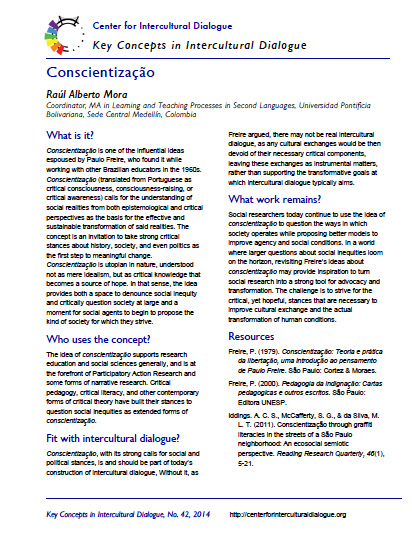
Key Concepts in ICDThe next issue of Key Concepts in intercultural Dialogue is now available, providing another word in a language other than English. This is KC42: Conscientização by Raúl Alberto Mora. As always, all Key Concepts are available as free PDFs; just click on the thumbnail to download. Lists organized  chronologically by publication date and numberalphabetically by concept in English, and by languages into which they have been translated, are available, as is a page of acknowledgments with the names of all authors, translators, and reviewers.

kc42-sm

Mora, R. A. (2014). Conscientização. Key Concepts in Intercultural Dialogue, 42. Available from:
https://centerforinterculturaldialogue.org/wp-content/uploads/2014/11/key-concepts-conscientizaccca7acc83o.pdf

The Center for Intercultural Dialogue publishes a series of short briefs describing Key Concepts in Intercultural Dialogue. Different people, working in different countries and disciplines, use different vocabulary to describe their interests, yet these terms overlap. Our goal is to provide some of the assumptions and history attached to each concept for those unfamiliar with it. As there are other concepts you would like to see included, send an email to the series editor, Wendy Leeds-Hurwitz. If there are concepts you would like to prepare, provide a brief explanation of why you think the concept is central to the study of intercultural dialogue, and why you are the obvious person to write up that concept. And starting today, feel free to propose terms in any language, especially if they expand our ability to discuss an aspect of intercultural dialogue that is not easy to translate into English.


Creative Commons License
This work is licensed under a Creative Commons Attribution-NonCommercial-NoDerivatives 4.0 International License.

CFP Communication Yearbook 40

Communication Yearbook 40
A Publication of the International Communication Association
Editor: Elisia L. Cohen
Deadline: February 15, 2015

CY 40 is a forum for the exchange of interdisciplinary and internationally diverse scholarship relating to communication in its many forms. Specifically, we are seeking state-of-the-discipline literature reviews, meta-analyses, and essays that advance knowledge and understanding of communication systems, processes, and impacts. Submitted manuscripts should provide a rigorous assessment of the status, critical issues and needed directions of a theory or body of research; offer new communication theory or additional insights into communication systems, processes, policies and impacts; and/or expand the boundaries of the discipline. In all cases, submissions should be comprehensive and thoughtful in their synthesis and analysis, and situate a body of scholarship within a larger intellectual context. For CY 40, the editorial board also welcomes essays that advance knowledge and understanding of communication research methodologies and applications.

Details
*Submit manuscripts electronically via a Word attachment to Elisia L. Cohen, Editor.

*Submissions for CY 40 will be considered from January 1, 2015 through February 15, 2015
*Use APA style, 6th edition
*Include a cover letter indicating how the manuscript addresses the CY 40 call for papers
*Prepare manuscripts for blind review, removing all identifiers
*Include a title page as a separate document that includes contact information for all authors
*Following Communication Yearbook’s tradition of considering lengthier manuscripts, initial manuscript submissions may range from 6,500 to 13,000 words (including tables, endnotes, references).
*Incomplete submissions not adhering to the above journal guidelines will be returned to authors for revision.

For more information about CY 40 or this call for submissions, please contact Elisia L. Cohen, Editor.

CFP Translation and International Professional Communication

CFP Special issue of Connexions
Translation and International Professional Communication: Building Bridges and Strengthening Skills

Guest editors:
Bruce Maylath (USA)
Ricardo Muñoz Martín (Spain)
Marta Pacheco Pinto (Portugal)

Deadline for submissions: April 10, 2015. See the complete call for papers for additional details.

The globalization and the fast mobility of today’s markets—aiming to serve as many heterogeneous settings and audiences as possible—have posited a growing need for high quality products and optimal performance in nearly all areas of everyday life. Specialists in communication play an important, albeit often hidden, role in these processes. Translators and other international professional communicators operate as mediators to facilitate understanding across global, international, national and local contexts through diverse communication channels. Translating today often involves several agents with different roles, responsibilities and skills. This entails creative work, various innovative procedures, and collaborative networks in highly technological, distributed environments. All these agents can be seen as text producers with an increasing expertise in the tools and skills of their trades to find, manage, process, and adapt information to target audiences.

Despite disperse attempts at acknowledging the importance of approaching professional communication as translation or as involving translation-related skills, translation often remains invisible both in the literature and in the training of (international) professional communicators. The extant literature in Communication Studies that actually addresses translation usually tends to emphasize, and concentrate on, localization issues, and it often draws from functional approaches to translation as production of a communicative message or instrument.

In Translation Studies, on the other hand, there is an increasing awareness of the need to tend bridges to Communication Studies in research. However, more dialogue seems necessary to fully grasp the implications and commonalities in all areas of multilingual professional communication, not the least that they are usually ascribed peripheral roles in business, technical, and scientific endeavors.

The emerging figure of the multitasked professional communicator has brought translation as part of the document production process to a different level of discussion. It is drawing increasing attention to translators’ profiles and training as competent communicators and vice versa, thus showing that the role translation plays in international professional communication, and the role of international professional communication in translator training cannot be downplayed. This issue of the connexions journal seeks to build bridges of cross-disciplinary understanding between international professional communication scholars and practitioners and translation scholars and practitioners. It aims to foster debate around the role of translation as a special kind of international professional communication and also as an integral part of other (international) professional communication instances.

CFP Joy and Sorrow of Food

Call for papers
The Joy and Sorrow of Food: An American Story

Food sustains life. We eat to satisfy hunger, but hunger often reaches beyond the physical realm to emotional, ethnic, and cultural dimensions. Not only do we eat to fuel our bodies, we eat to celebrate, entertain, and to fill voids in our lives. We eat to comfort, to occupy time, and to experience variety. Since food is fundamental to all forms of life, it is a compelling, central point for investigations of issues ranging from privilege, identity, ritual, tradition, memory, and the body across time and place.

For this issue we seek diverse perspectives that investigate the joys and sorrows of food within United States populations that have been influenced and/or impacted Europe. We are particularly interested in interdisciplinary papers that draw from cinema, music, document, visual and material culture, history, literature, philosophy, and mass media.

The European Journal of American Culture (EJAC) is an academic, refereed journal for scholars, academics and students from many disciplines with a common involvement in the interdisciplinary study of America and American culture, drawing on a variety of approaches and encompassing the whole evolution of the country.

Articles should be 6,000 to 8,000 words, inclusive of endnotes. EJAC uses Harvard style. We can include unlimited black-and-white images and figures. If it is essential that your image or images be in color, please notify us. Please submit an abstract by January 1, 2015 to the editors below.  Manuscripts will be due on March 31, 2015.

Guest Editors for the Food Issue
Caryn E. Neumann, Miami University, 4200 North University Blvd, Middletown, OH 45042
Lori L. Parks, Miami University, 1600 University Boulevard, Hamilton, OH 45011
Jennifer P. Yamashiro, Miami University, 1600 University Boulevard, Hamilton, OH 45011