Call for Nominations: Communication Yearbook Editor

The International Communication Association Publications Committee is soliciting nominations for the editor of the Communication Yearbook (CY). Self-nominations are welcome. The appointment is for four years and begins in August/September, 2015.

Communication Yearbook will be published in four issues per year, with a rapid online publication model, and bound together as a final volume at the end of the year. Each volume will publish state-of-the-art essays and synthesis of scholarship. A new section to be developed by the future editor with the support of the ICA Board of Directors will include topical review essays of significant publications in the field.

It is both highly international and interdisciplinary in scope, with authors and chapters representing the broad global interests of the International Communication Association. The new editor of Communication Yearbook enjoys the opportunity to help shape the future of this important publication outlet, which will transition more formally into a journal format for Communication Yearbook 41-44 (2016-2019) enjoying the full electronic editorial support of a publisher.

A complete nomination package includes a letter of application from the candidate which should include a mission statement for the editorship; the candidate’s vitae; 2-3 letters of support from published scholars familiar with the candidate’s work, experience and suitability for the task of journal editing; and a letter of institutional support from the candidate’s home institution. Responsibilities are detailed in the ICA Publication Manual.

Editors of ICA publications should reflect and seek to enhance the diversity of the Association in terms of their interest areas, gender, ethnicity, and national origin.

Please send your nomination package at your earliest convenience to Michael Haley, ICA Executive Director. Review of packets will begin on 1 April 2015, and continue until the position is filled.

Interculturalism in Historical Education (Warsaw)

POLIN Museum of the History of Polish Jews and the European Wergeland Centre are pleased to invite participants to the international conference Interculturalism in historical education which is organized with support from the Council of Europe and will take place on 20-22 April 2015 in Warsaw.

The conference will address the question of how to use knowledge and reflection about the past to build attitudes of openness in today’s globalizing world and harness the potential of diversity on the local level. We will look at methods of intercultural learning, civic education and education on human rights, with a focus on how to use education to prevent and combat discrimination anti-Semitism, racism and hate speech.

It is important to us to consider the perspective of both practitioners and researchers. The conference will be an opportunity to discuss, exchange, brainstorm and connect with representatives of Polish and European organizations and institutions.

We invite scholars conducting research on interculturalism and intercultural education, as well as practitioners – museum professionals, representatives of non-governmental organizations and cultural institutions, educators, teachers, those conducting projects in the field of multi- and interculturalism, as well as all those interested in the subject.

The conference program will comprise lectures, panel discussions, films and workshops. The lectures and panel discussions will be conducted by invited experts from Poland and abroad. Workshops will be conducted by experts and activists who submitted their proposals in response to an open call.

In conference program:
*Discussion panels (History and citizenship education. Diversity in Europe
– contemporary challenges) and experts lectures (History education and intercultural competences, Local history and attitudes towards “others”, Interculturalism in the city, Dealing with prejudice, discrimination and hate speech)
*Workshops with experts from Poland, Norway, Holland, Germany, Great Britain and France
*International exchange of good practices – Project Ideas Exchange (few minutes, dynamic presentations of programs executed in participants and conference patrons institutions and organizations)
*Music events – concert by Bente Kahan (Norwegian artist presents sons and tales by a European Jews) and POLIN choir performance
*Journey thought 1000-years history of Polish Jews – curator-led tour

Registration is open until 31 March 1915. Participation in the conference is free.

Supported from the Norway and EEA Grants by Iceland, Liechtenstein and Norway.


Save

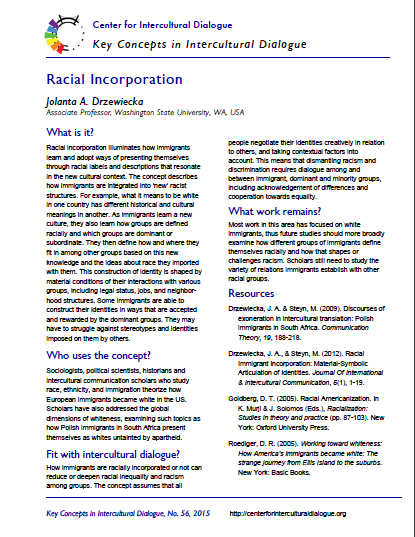
Key Concept #56: Racial Incorporation by Jolanta Drzewiecka

Key Concepts in ICDThe next issue of Key Concepts in intercultural Dialogue is now available. This is KC56: Racial Incorporation by Jolanta A. Drzewiecka. As always, all Key Concepts are available as free PDFs; just click on the thumbnail to download. Lists organized  chronologically by publication date and numberalphabetically by concept in English, and by languages into which they have been translated, are available, as is a page of acknowledgments with the names of all authors, translators, and reviewers.

Key Concept #56 Racial Incorporation by Jolanta Drzewiecka

Drzewiecka. J. A. (2015). Racial incorporation. Key Concepts in Intercultural Dialogue, 56. Available from: https://centerforinterculturaldialogue.org/wp-content/uploads/2015/03/key-concept-racial-incorporation.pdf

The Center for Intercultural Dialogue publishes a series of short briefs describing Key Concepts in Intercultural Dialogue. Different people, working in different countries and disciplines, use different vocabulary to describe their interests, yet these terms overlap. Our goal is to provide some of the assumptions and history attached to each concept for those unfamiliar with it. As there are other concepts you would like to see included, send an email to the series editor, Wendy Leeds-Hurwitz. If there are concepts you would like to prepare, provide a brief explanation of why you think the concept is central to the study of intercultural dialogue, and why you are the obvious person to write up that concept.


Creative Commons License
This work is licensed under a Creative Commons Attribution-NonCommercial-NoDerivatives 4.0 International License.

CFP Shared Histories: Media Connections Between Britain and Ireland (Dublin)

Shared Histories: Media Connections Between Britain and Ireland
A conference, to be held in Dublin, 6-7th July 2016.

The relationship between Ireland and the rest of the British Isles has a long and complex history. One key dimension has been the connections and interactions between the various media of communication – print and electronic – which have mediated this relationship. This conference seeks to address this important, but relatively neglected, topic at a timely moment in the history of Ireland, England, Scotland and Wales.

The conference organisers want to take a long view as well as look in detail at particular moments. It therefore invites papers from the sixteenth century onwards, dealing with all forms of media (print, periodical, broadcasting, ephemera) as well as with structures of ownership, regulation, distribution and identity.

The conference will examine the different kinds of media interactions from the arrival of print to the emergence of broadcasting, under what conditions they operated and to what effect.  How did these interactions take place? What were the networks through which material flowed? What were the major developments in the content and reception of the media from the sixteenth century onwards? How helpful is it to think in terms of distinctive ‘national’ media traditions? In what sense, if any, are concepts such as centre and periphery of value in thinking about these relationships, or do they need revision? How has the development of relationships between the peoples of these islands been influence by shared histories of media exchange and interaction?

Proposals of up to 400 words stating the topic in relation to the conference theme should be sent to Steven Conlon  by 1 June 2015.

The conference is jointly organised by the School of Communications, Dublin City University, the Centre for Media History Aberystwyth University, Newspaper & Periodical History Forum of Ireland , and the journal Media History. For further details, please contact Mark O’Brien, Siân Nicholas, Jamie Medhurst, or Tom O’Malley.

CFP Media and Society in Argentina and Latin America (Buenos Aires)

Contemporary Developments on Media and Society in Argentina and Latin America
November 27, 2015
Universidad de San Andrés, Buenos Aires, Argentina
Supported by this University and Northwestern University’s School of Communication
Organized byPablo J. Boczkowski andEugenia Mitchelstein

Organizers invite empirical, theoretical, and/or methodological contributions that help to expand knowledge about the interplay between media and society at the national and regional levels. Papers may refer to different types of mediated communication such as journalism; entertainment; advertising and marketing; public relations; social networks; and video games, among others.

Topics covered include the following, among others:
– Transformations in modes of content production.
– Changes in uses of media.
– Innovation and technological change.
– Economics and financing of media.
– The state, government and civil society.
– Regulation and public policy.
– Political communication and electoral campaigns.
– The role of users as content producers.

*Procedural matters*:
– The deadline for submission of abstracts is May 15th, 2015. Please submit the abstracts by email.
– The e-mail subject must be “Last Name, First Name –Media and Society 2015”.
– Abstracts must be sent as an attached file in Word format (.doc, .docx) and the file should be named “Last Name, First Name –Media and Society 2015”.
– Abstracts should not exceed 300 words (excluding the title and references).
– In the same document of the abstract the author/s should include their contact information and a short bio of no more than 75 words.
– A selection committee will review the abstracts and the authors will be notified of the outcome of this process by June 30th, 2015.
– Finalists will be asked to submit their full papers by September 30th, 2015. Paper should not exceed 7,500 words, including references.
– Abstracts and papers must be submitted in Spanish. This will also be the official language of the conference.
– Papers that are part of the conference will be subject to publication in a volume co-edited by Pablo J. Boczkowski and Eugenia Mitchelstein.

For more information, please contact the organizers or visit their website.

CFP Models of Communication (Vilnius)

Models of Communication: Theoretical and Philosophical Approaches
ECREA Philosophy of Communication Workshop
Vilnius, 8-10 October 2015

It is often claimed that the early phases of media and communication studies were dominated by a linear conception of communication, modeled as a process of transmission. The hegemony of this model may have been exaggerated – it never prevailed in studies of interpersonal communication, for instance – but it has undeniably provided a favorite target for critics of various stripes. While some communication theorists have proposed elaborations of the well-known sender-message-receiver schema, others have argued for more radical revisions of modelling rooted in e.g. semiotics, constructivism, and the ritual view of communication. At the same time, skepticism regarding the very notion of a model of communication has grown stronger; and in recent decades, the focus has often switched from first-level conceptions to second-order “meta-models” of the constellations of communication theory. What is the status and relevance of communication models today? The proliferation of new forms of mediated communication seems to require new ways of making sense of a complex and rapidly moving field. Can the established perspectives provide adequate platforms from which to address emerging questions of “social media” and “big data”? Are we actually witnessing a revival of information-theoretical perspectives in the wake of the advance of computer-mediated communications? Should models of media and communication be descriptive or prescriptive? What, if any, exemplars should provide the basis for a future media and communications curriculum? What is their scholarly, scientific, and heuristic value? For this workshop, we invite proposals that explore new models of communication and investigate various aspects of model construction as well as contributions that scrutinize the use and misuse of models in communication theory and education. In addition to papers focused on philosophical, systematic, and pragmatic issues, we welcome proposals that offer fresh perspectives on the history of communication models. Considered criticisms of the project of communication modelling are also welcome.The workshop will be take place October 8-10, 2015, in Vilnius (Faculty of Philosophy, Vilnius University), Lithuania. Please send an abstract of max. 400 words to Kęstas Kirtiklis by April 26, 2015. Notification of acceptance will be posted no later than May 22, 2015.

Confirmed Keynote Speakers
Robert T. Craig (University of Colorado Boulder)
Klaus Bruhn Jensen (University of Copenhagen)

Organising Committee
Mats Bergman, chair (University of Helsinki / University College London)
Kęstas Kirtiklis (Vilnius University)
Emanuel Kulczycki (Adam Mickiewicz University)
Carlos Roos (Ghent University / Leiden University)
Lydia Sanchez (University of Barcelona)
Johan Siebers (University of London)
Bart Vandenabeele (Ghent University)

Daan Bauwens Profile

ProfilesDaan Bauwens has an M.A. in psychology and is a journalist for the Belgian and international press, combining narrative and anthropological journalism in newspaper articles and prose.

Daan Bauwens

By way of extensive ethnography, since 2008 his research focuses strongly on the influence of culture on interpersonal and intercultural communication. His main interests are conflicting worldviews with violent or non-violent consequences, the influence of religiosity on communicative behavior and the effects of a diaspora on native cultures.

Research topics and publications include: the Israeli mindset and youth culture, the Kurdish cultural struggle in Southeast Turkey, gender and Arab-Berber conflicts in Morocco, Japanese business culture and gender issues, and the structure of political processes in Belgium and the European Union.

In 2014, Daan Bauwens received a Fulbright grant for long-term research and a series of publications on the deep effects of multiculturality and superdiversity on the urban culture of Manhattan and Brooklyn. This research takes place in 2015, with the support and collaboration of New York City ngo City Lore.

NOTE: CID facilitated the connection between Bauwens and City Lore.

CFP Memory-Nostalgia-Melancholy Workshop (Croatia)

CFP Memory-Nostalgia-Melancholy Workshop
Date: Sun 6 – Mon 7 September 2015
Venue: Hotel Lone, Rovinj, Croatia
Abstract submissions by: Fri 27 March 2015

The workshop, hosted by the School of Arts and Humanities at Nottingham Trent University, focuses on the intersections between memory, nostalgia and melancholy in contemporary culture, characterised by relentless mobility and radical displacement. Numerous critics of globalisation, transnationalism and cosmopolitanism have posited an overwhelming feeling of homelessness not only among people who have been displaced from their original home/lands, but also among those who feel estranged from their places of origin due to rapid social change or environmental decline. ‘Only the exiled have a land’, Baudrillard argued. ‘The others are nomads chasing their shadows in the deserts of culture’ (1990: 83). Arguably, homesickness is prevalent in today’s developed world, which can be—and sometimes indeed is—felt even for times and places unrelated to someone’s personal roots.

Home/land has no stable meaning and is always socially constructed, enacted and reproduced through everyday life practices and creative endeavour. This discursive homebuilding involves active memory work, and is typically associated with a nostalgic or melancholic mindset. Both linked to emotional disorders and often conflated in everyday parlance, the terms nostalgia and melancholy have distinct genealogies and have indeed been theorised as related, overlapping or semantically opposed to one another.

The following list of possible questions to be addressed is neither restrictive nor exhaustive:
– What are the interpretations of nostalgia and melancholy in different discursive and disciplinary fields?
– What is the relationship between longing and belonging?
– What is the poetics and politics of imaginative home-building?
– What is the interplay between nostalgia and melancholy?
– How are either or both of them represented, enacted and consumed in cultural texts across a variety of media and genres?
– Can either or both be mobilised to engender political and social change?
– Are either or both of them symptoms of, or cure for social problems related to globalisation and social change?
– Is the notion of a ‘forward-looking’ memory of home an oxymoron or a viable scenario?
– What are the spatio-temporal coordinates of nostalgic yearning?
– How does nostalgic yearning for ‘homeland’ relate to concrete ambitions to achieve territorial gain?

The language of the workshop is English. Contributions are invited, which build on original research, engage with relevant theories and contribute conceptual insights across a range of academic disciplines, including literary and cultural studies, anthropology, history, geography, heritage studies and memory studies.

A selection of papers will be solicited for publication in an edited monograph.

Please submit a paper title, an abstract of up to 300 words and a short biographical note to Dr Maja Mikula by Friday 27 March 2015.

Selected speakers will be notified via email by Friday 3 April and will be able to register for the workshop.

Registration is free of charge. Participants are responsible for their own travel and accommodation expenses. Pending room availability, participants will be offered a 10% discount on current online prices in any of Maistra’s hotels or resorts in Rovinj.

CFP Space, Place, and Landscape in the History of Communications (Oxford)

CFP: Space, place, and landscape in the history of communications
One-day symposium at the Weston Library, University of Oxford
Tuesday 16 June 2015

Space, place, and landscape have a significant impact on communications, on the systems of communications that succeed as well as those that fail and on the heritage of communications systems.  Recent scholarship in communications studies and the history of communications has focused on how modern electronic communications influence evolving concepts of time, space, and geography and the crucial role of communications in experiencing spatiality, temporality, spatiality and mobility.

At our one-day symposium, we wish to consider the inverse: the impact of space, place, and landscape upon communications systems and their heritage from 1700 to the present day.  We also wish to consider communications systems in transit, how changing locations impact upon the transfer of communications knowledge and technology.  We are especially interested in papers which take an interdisciplinary approach to the history of communications and use inventive methods for a broad exploration of history
of communications.

Our symposium will be convened by *Professor Robert Fox*, Emeritus Professor of the History of Science, University of Oxford and *Professor Graeme Gooday*, Head of School of Philosophy, Religion and History of
Science and Professor of History of Science and Technology, University of Leeds.

*Space, place, and landscape in history of communications * will take place at the Weston Library in central Oxford on Tuesday 16 June 2015 from 10am to 4pm.  Registration is free and we will have a small budget to cover speakers’ travel expenses within the UK but participants are asked to cover their own accommodation costs as well as travel outside of the UK.

Our conference will be of interest to historians of science and technology, historical geographers, academic historians, archivists, social scientists, students, academics in communication studies, and other more generally
interested in the history of communications and technology.  We invite proposals for thirty-minute papers on the subject of space and place in communications.

Proposals of no more than 250 words, together with the name, institutional affiliation and a brief one-page CV of the speaker should be sent to Elizabeth Bruton.  The closing date for submissions is *Friday 3 April 2015*.

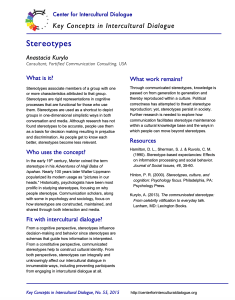
Key Concept #55: Stereotypes by Anastacia Kurylo

Key Concepts in ICDThe next issue of Key Concepts in intercultural Dialogue is now available. This is KC55: Stereotypes by Anastacia Kurylo. As always, all Key Concepts are available as free PDFs; just click on the thumbnail to download.

Key Concepts in Intercultural Dialogue 55: Stereotypes

Lists organized  chronologically by publication date and numberalphabetically by concept in English, and by languages into which they have been translated, are available, as is a page of acknowledgments with the names of all authors, translators, and reviewers.

Kurylo, A. (2015). Stereotypes. Key Concepts in Intercultural Dialogue, 55. Available from:
https://centerforinterculturaldialogue.org/wp-content/uploads/2018/11/kc55-stereotypes3.pdf

The Center for Intercultural Dialogue publishes a series of short briefs describing Key Concepts in Intercultural Dialogue. Different people, working in different countries and disciplines, use different vocabulary to describe their interests, yet these terms overlap. Our goal is to provide some of the assumptions and history attached to each concept for those unfamiliar with it. As there are other concepts you would like to see included, send an email to the series editor, Wendy Leeds-Hurwitz. If there are concepts you would like to prepare, provide a brief explanation of why you think the concept is central to the study of intercultural dialogue, and why you are the obvious person to write up that concept.


Creative Commons License
This work is licensed under a Creative Commons Attribution-NonCommercial-NoDerivatives 4.0 International License.