UNESCO Training Program in ICD

“UNESCO”
UNESCO just launched its first training program focusing on intercultural dialogue, UNESCO, Paris, France.

The United Nations Educational, Scientific and Cultural Organization (UNESCO) launched its first training program focusing on intercultural dialogue at the end of August 2025. The program targets professionals working in museums and heritage site management, in partnership with the Royal Commission for AlUla (RCU), as part of the project “Fostering Positive Social Transformations in AlUla.”

The training sessions will be held every Thursday from September 18 to October 16 between 12:00 p.m. and 2:00 p.m. GMT+2 via Zoom. Participants include representatives of museums and World Heritage sites, particularly those engaged in public interaction, learning, and education.

The program covers key concepts in intercultural communication theory and practical applications to facilitate dialogue under the “Live Museum model,” which seeks to support the role of museums and heritage sites as platforms for exchange and understanding among visitors, while drawing on heritage and handicrafts as a driving force for dialogue between diverse cultures.
NCA Pre-Conference: Analyzing Health, Digital, and Intercultural Discourse (USA)

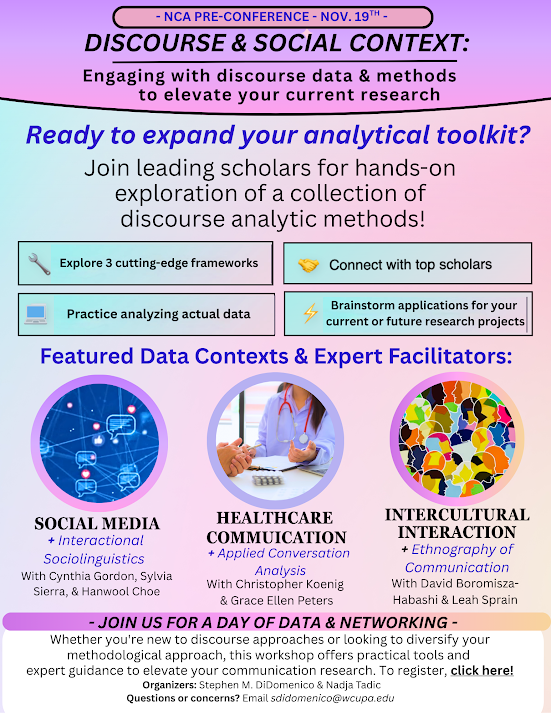
ConferencesPre-Conference: Discourse & Social Context – Engaging with Discourse Data & Methods to Elevate your Current Research, National Communication Association, Denver, CO, 19 November 2025. (preregistration appreciated but not required)

Join a team of leading scholars from the Language & Social Interaction (LSI) Division of the National Communication Association for a special 1 day Pre-Conference: “Discourse & Social Context – Engaging with Discourse Data & Methods to Elevate your Current Research.” Registration information about the pre-conference (and main conference) can be found here. The day’s activities will occur from 9am to 5:30pm at the Gaylord Rockies Resort and Convention Center in Aurora, Colorado.

The pre-conference is centered around a series of data-focused workshops, where participants from a variety of experience levels – from beginner all the way to advanced – can deepen their skills. Our primary focus will be hands-on application using a variety of methodological and analytical tools inspired by the LSI research tradition.

NCA Pre-conference 2025The agenda for the day:
• 9:00-9:30am Welcome and introductions – Stephen M. DiDomenico (West Chester U.) and Nadja Tadic (Georgetown U.)
• 9:30-10:15am Presentation on discourse analysis as an umbrella term for different LSI methods and analytic tools
• 10:15-11:45am Workshop 1: Interactional Sociolinguistics for social media
o Cynthia Gordon (Georgetown U.), Sylvia Sierra (Syracuse U.), and Hanwool Choe (U- Hong Kong)
• 11:45am-1:30pm Lunch & Networking
• 1:30-3:00pm Workshop 2: Conversation Analysis for health communication
o Christopher Koenig (San Francisco State U.) and Grace Ellen Peters (Colorado Christian U.)
• 3:15-4:45pm Workshop 3: Ethnography of Communication for intercultural communication analysis
o David Boromisza-Habashi (U-Colorado, Boulder) and Leah Sprain (U-Colorado, Boulder)
• 4:45-5:30pm Making connections & closing discussion

Call for Nominations: Editor, Journal of Communication 2026

Professional OpportunitiesCall for Nominations: Editor of the Journal of Communication. Deadline: 31 January  2026.

The ICA Publications Committee is soliciting applications for the next editor(s) of the Journal of Communication (JOC). The four-year term will begin with a transition in September 2026.

The Journal of Communication is the flagship journal of the International Communication Association, bringing to its readers the most important and cutting-edge findings in the field of communication studies. Spanning all methods and areas of scholarly inquiry, articles published in JoC are conceptually and methodologically sound, socially meaningful, clearly written, and thoughtfully argued. JoC also features the JoC Forum, which publishes multi-book review essays, as well as occasional article responses and roundtables.

More details about the journal can be found at https://academic.oup.com/joc.

The Publications Committee seeks applications from individuals or small teams of scholars from the ICA membership. The successful applicant(s) will be expected to build an editorial structure that reflects the diversity of the communication discipline around the globe. Multiple factors are considered when evaluating candidate applications, including, but not limited to:

● Clear understanding of the mission of the journal

● Clear articulation of an intellectual and operational vision for the journal
● Demonstrated openness to a range of epistemologies and methodologies appropriate for the scope of the journal
● Demonstrated interest and/or experience in theoretical development
● Demonstrated interest and/or openness to interdisciplinary work
● Demonstrated communication skills and diplomacy
● Reputation and excellence of academic output
● Editorial, managerial or administrative experience
● Tenure or advanced rank
● Institutional support

Team submissions should also demonstrate successful past collaboration and an articulation of how the workflow will be managed among team members.

UNESCO Youth for Peace 2025-6 Update

“UNESCO”
Youth for Peace: UNESCO Intercultural Leadership Programme: 50 Emerging Leaders Selected, UNESCO, Paris, France.

UNESCO’s Social and Human Sciences Sector (SHS) has selected 50 young and emerging leaders from around the world to take part in the inaugural Youth for Peace: UNESCO Intercultural Leadership Programme.

This flagship initiative brings together UNESCO’s work on intercultural dialogue and on youth as an organization-wide priority, with the aim of equipping emerging leaders with the knowledge, skills, and tools to transform dialogue into action, using intercultural cooperation as a powerful driver of peace and social cohesion in an increasingly complex world.

From an exceptional pool of 8,250 applicants from every region of the globe, a final group of 50 participants – aged 25 to 45 – was chosen through a rigorous review by an international technical jury of 22 experts – both from within UNESCO and its field offices, as well as from external academics in the field of intercultural dialogue. The final group reflects strong gender balance and geographic diversity, with participants coming from every region, and bringing together a wealth of experiences, perspectives, and innovative ideas. Coming from a wide range of backgrounds, sectors, and professions, the participants include leaders from the fields of education, arts, business, non-profit management, sport, mediation, politics, medicine, academia, culture, and strategic communication. These inspiring grantees embody the spirit of collaborative leadership needed to address the challenges of our time.

The programme officially begins on 28 August 2025, marking the start of a journey of learning, collaboration, and leadership development. Over the course of the year, each grantee will receive USD 10,000 in funding to implement innovative intercultural projects in their communities, alongside tailored training, mentoring, and peer exchange. The programme will combine customized online training with opportunities for peer-to-peer learning and will culminate in April 2026 at the UNESCO Global Youth Leaders Dialogue for Peace in Guangzhou, China.

From Recognition to Inclusion – Rethinking European Languages in Education (Germany or Online)

EventsOpen Conversation: From Recognition to Inclusion – Rethinking European Languages in Education, Humboldt-Universität zu Berlin, Germany, 26 Sept 2025. Deadline: 11 September for on-site participation; 24 September for online participation.

Across Europe, educational systems tend to focus on hegemonial national languages—German in Germany, French in France, and so on—as legitimate means for classroom interaction. It is also these languages that are associated with European nation-states, understood as “modern languages” for educational curricula, and targeted as desirable competences in “European languages” by multilingualism policies.

However, the linguistic reality of Europe is far more diverse. Languages such as Turkish, Arabic, Russian, Kurdish, and Romani are spoken daily by large communities in Europe, and in this sense they are European languages, yet they are rarely treated as valuable cultural or educational resources.

This open conversation explores how educational systems might move beyond narrow definitions of “European languages” and “multilingualism” towards practices of genuine linguistic inclusion—where all students’ languages are made visible, valued, and meaningfully integrated into educational life.

Organisers: Heike Wiese, İrem Duman Çakır, Annika Labrenz

American U in Cairo: International Relations Theory (Egypt)

“JobAssistant/Associate Professor of International Relations Theory, The American University in Cairo, Egypt. Deadline: 26 September 2025.

The Department of Political Science invites applications for a position in International Relations starting Fall 2026. This is a tenure-track position at the Assistant/Associate Professor level. Teaching responsibilities will include a combination of courses in the fields of theories of international relations including critical international relations theory, global governance and security studies. This position will involve teaching at the BA and MA levels within the Department of Political Science. It also involves MA theses supervisions. The search committee is eager to review applications of individuals with demonstrated excellence in teaching, an accomplished and active research agenda, and an interest in living and working in the Middle East.

Global Cities: Education Program Manager (USA)

“JobEducation Program Manager, Global Cities, Inc., New York, NY, USA. Deadline: 30 September 2025.

Global Cities seeks an experienced, creative, and tech-savvy Education Program Manager to join its team of accomplished educators who design and implement the Global Scholars virtual exchange program. As part of Global Cities’ collaborative and innovative team, they apply a diverse skillset to create student-centered, project-based curricula, teacher professional development, and a lively e-classroom environment for young people worldwide. Their responsibilities also include liaising with Global Scholars classroom teachers, school leaders, and education district/ministry officials, and contributing insights to initiatives for all K-12 educators interested in integrating global competency into their curriculum and instruction.

Culture as a Space for Addressing Interconnected Global Crises

Applied ICD

Culture as a Space for Addressing Interconnected Global Crises, written by Ian Thomas (Head of Research and Insights, Arts, The British Council), and published by the International Institute for Sustainable Development, is an article worth reading.

“In a fragmented global policy environment characterized by complex crises, culture possesses the ability to reshape public policy and development frameworks. It also plays a crucial role in preventing, responding to, and recovering from crises, from initiatives focused on heritage restoration to intercultural dialogue aid in post-crisis reconstruction. Community-driven cultural engagement, too, strengthens social and economic resilience.

This impact arises from culture’s ability to promote inclusivity, foster social cohesion, and encourage sustainable practices. By incorporating cultural perspectives and values into policymaking, societies can tackle challenges more effectively and establish more resilient and equitable development pathways.

Culture offers the narratives and frameworks that enable societies to comprehend themselves and their position in the world. These narratives can serve as potent instruments for shaping development priorities and advocating specific values.”

NIAS Safe Haven Fellowships 2026-27 (Netherlands)

FellowshipsSafe Haven Fellowships, Netherlands Institute for Advanced Study, Amsterdam, Netherlands. Deadline: 31 December 2025.

The NIAS Safe Haven Fellowship supports scholars at risk. The NIAS Safe Haven Fellowship is intended for scholars, artists, writers and journalists who are not able to do their work in their current location or circumstances, because of the consequences of conflict or war. The aim of the Safe Haven Fellowship Programme is to protect scholars whose work is restricted or obstructed by state or non-state entities, by offering them temporary relocation and enabling them to continue their work. Those who are facing severe infringements on their academic freedoms due to conflict or war are also welcome to apply. NIAS does not accept applicants affiliated to institutions that are boycotted by the Dutch state. Since February 2025, the University of Amsterdam (UvA) and Maastricht University (UM) are official partners of this programme.

A Safe Haven Fellowship is granted for a period of 5 months (Sept-Jan or Feb–June). Fellows are provided with an office, research facilities, communal lunch, participation in the NIAS community and commuting travel expenses or subsidized accommodation in Amsterdam. Fellows receive a stipend of of €3,500 per month.

On the date of your application, applicants must have at least three years of research experience since obtaining their doctorate if submitting a scientific proposal. In the case of an artistic or journalistic research proposal, a PhD or three years of research experience is not mandatory.

The project proposal must fit within the scope of humanities and/or social sciences.

The working language at NIAS is English. Applicants must have a good command of English to contribute effectively to the fellows group and receive input on their own research.

Princeton: Postdocs in International and Regional Studies (USA)

Postdocs
Postdoctoral research fellowships, International and Regional Studies, Princeton University, NJ, USA.  Deadline: 15 September 2025.

The Princeton Institute for International and Regional Studies (PIIRS) at Princeton University is pleased to announce the call for applications to the PIIRS Postdoctoral Fellowship Program for the 2026-27 academic year. As a leading global institution in interdisciplinary research on international issues, PIIRS is dedicated to advancing innovative scholarship that addresses the world’s most pressing challenges. The PIIRS Postdoctoral Fellows Program is integral to that mission.

They will award two postdoctoral fellowships to the 2026-27 cohort. PIIRS seeks recent PhDs in the Social Sciences who have demonstrated exceptional scholarship, congruent with the Institute’s intellectual focus, that simultaneously advances theoretical debates in their disciplinary field; creatively speaks to and engages with a multidisciplinary audience; and deepens substantive regional knowledge of specific places.

Appointments are for one year (12 months) with the possibility of renewal pending satisfactory performance and continued funding. Postdoctoral Research Associates (PDRAs) are expected to be in residence at Princeton or the local vicinity for the entire academic year or demonstrate to the program’s satisfaction the ability to be on campus on a daily basis and on short notice in order to fulfill responsibilities relating to in-person participation. The position requires PDRAs to be on campus at least four days per week.