Volunteer Translators Needed by Tarjimly

Professional Opportunities

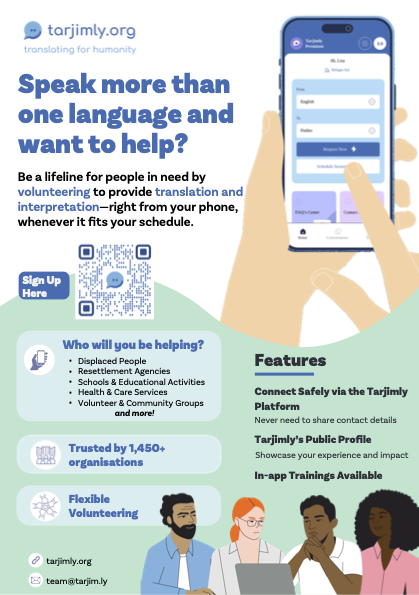
Tarjimly is a global nonprofit dedicated to removing language barriers for refugees, immigrants, and humanitarian service providers through on-demand volunteer interpretation and translation. They have asked CID to help spread the word.

Volunteering with Tarjimly enables bilingual individuals to make a profound difference by assisting refugees, migrants, and frontline workers in areas like healthcare access, legal aid, education, and resettlement services—all through a flexible, remote model.

Leaflet describing Tarjimly

Immigrant Council of Ireland: Migrant Leadership Academy 2025 (Ireland)

EventsMigrant Leadership Academy, Immigrant Council of Ireland, Dublin, Ireland, 3-5 Oct 2025. Deadline: 15 Sept 2025.

The Migrant Leadership Academy brings together migrants and refugees living in Ireland who are committed to social justice, equality and want to bring about positive change in their communities. The Academy teaches the fundamentals of activism and community organising. This year’s Migrant Leadership Academy will take place from 3-5 October in Dublin, with further sessions online.

The main objective of the Migrant Leadership Academy is to identify talented migrant and refugee leaders in Ireland and to provide them with a space for connection with fellow migrant and refugee leaders.

The space serves as a platform for reflection and skills exchange to enhance their leadership potential. The secondary aim is to support migrant and refugee leaders in designing and implementing their own social justice campaigns and/or migrant integration initiatives. Lastly, the long term objective is to increase diversity in leadership in the social justice sector, by providing access to career enhancing opportunities.

U Cambridge: Junior Research Fellowship (UK)

Fellowships

Stipendiary Junior Research Fellowship, Christ’s College, University of Cambridge, UK. Deadline: 16 September 2025.

The College invites applications for a 4 year stipendiary Junior Research Fellowship in specified areas of the Arts, Humanities and Social Sciences. It will be tenable for four years from normally no later than 1 October 2026 and is not renewable.

A Junior Research Fellowship is intended for a researcher early in their career and, in this case, is restricted to applicants in one or more of the following subject areas:

  • Classics
  • History (c. 700–c. 1450)
  • Music
  • Politics & International Studies

The Junior Research Fellowship offers an opportunity to carry out novel research in a stimulating academic environment. A successful applicant is expected to be either a postgraduate student, probably in the latter stages of research leading to a PhD degree (or equivalent), or a post-doctoral researcher who has completed their PhD Degree after 1 January 2025.

Perspectives on World Language Education as Intercultural Learning

“Associate

Perspectives on world language education as intercultural learning: A conversation with a Mandarin teacher.

I have begun a series of conversations with colleagues in various disciplines for their insights and perspectives on matters and practices in intercultural communication and dialogue. The following is the first installment of these conversations. Our special guest in this conversation is Xiaofan Chen, a veteran Mandarin Chinese teacher in New York City.

Casey Man Kong Lum, Associate Director, CID


Xiaofan, thank you very much for agreeing to share your experience and insights. To begin with, how do you conceptualize and describe world language education as intercultural education and why?

As a world language teacher, I believe we should not only focus on students’ linguistic proficiency but also their ability to interact appropriately and effectively with people from different cultures. In the classroom, teachers should guide students to compare cultures with critical thinking and to question stereotypes, and learn to communicate with meaningful context. The purpose of learning a language in this global world is not only just developing linguistic skills, but also helping students navigate in or among diverse communities and having the ability to understand and respect different cultures. This will help them become global citizens.

By extension, what do you think students should expect to learn from studying world languages and why?

Linguistically, students develop four skills—reading, writing, listening, and speaking. This allows them to explore new environments and exchange new information. Culturally, students can learn about values in life through different cultural perspectives. One of our goals is to help students realize that they can see the world from diverse perspectives.

From your experience, and from your exposure to professional colleagues in your field over the years, what have been some of the key challenges facing students (at the grade levels you’re familiar with) studying Mandarin and why?

The first challenge is definitely tones. Mandarin is a tonal language, which is very different from English. The same syllable in Mandarin can mean completely different things depending on the tone. Students often struggle to hear, repeat, and differentiate tones in Mandarin.

Secondly, learning to write the Chinese characters – as opposed to the phonetic alphabet in English, for example – is also very challenging to students. Many characters provide no phonetic clues for pronunciation, and a lot of times students need to learn both pinyin, the Chinese phonetic alphabet, and characters at the same time. This requires a lot of time spent in memorization and it can cause frustration.

Thirdly, it is very hard for students to find authentic Mandarin language environments. My students are lucky to live in one of the most culturally and linguistically diverse cities in the world (New York City) and can access real life Mandarin speaking environments, such as Chinatown in Manhattan or Flushing in Queens. Unfortunately, this is not the case for everyone. A lot of students who live in smaller cities have trouble finding people or places they can practice the language with or in. This might lead to students’ lack of motivation and to drop the class. The difficulty of not having an authentic Mandarin language environment accessible means that in some areas, Chinese programs are being cut due to low enrollments.

From your experience and from your exposure to professional colleagues in your field over the years, what do you think are some of the best practices that Mandarin teachers use for helping their students address the challenges and why?

I’ve noticed when I put tones into songs and Total Physical Response (TPR) games, students tend to get more interested and have better understanding of them (e.g., Bui, 2018). Especially with TPR games, tones become muscle memory and the games increase engagement. When learning about characters, instead of pure memorization, I like to make up stories based on the character’s shapes and sounds and use more visual aids to help students remember them. I also have found out that learning radicals – the basic components that offer clues to a character’s meaning or pronunciation – can help students memorize characters faster (e.g., Clydesdale, n.d.). Bringing students to an authentic learning environment can also help with language learning. For example, each year we have guided trips to Chinatown and Flushing. Students can practice how to order food, greet someone, or express opinions with Chinese people in real life scenarios.

What have been some of your most gratifying experiences or outcomes as a Mandarin language teacher and why?

One of the best such outcomes is when students not only develop skills in the language but also have an interest in Chinese culture beyond the classroom. Students often try to find people with whom to practice their Mandarin outside of class, learn about Mandarin popular culture through music and TV shows, and so on. Some students also try authentic Chinese food from different regions. Some even plan trips to China! These always make me feel so rewarded as a language teacher.

What advice would you give to students in world language education who aspire to become world language teachers?

My advice to aspiring world language teachers is to stay curious and be open-minded. Language is not just studying grammar and vocabulary. It is also a way to make connections, find identity, and explore culture. A lot of times we need to figure out a way to combine the language and the culture into cohesive lessons.

References

Bui, G. (2018). Total physical response. In J. Liontas (Ed.), The TESOL encyclopedia of English language teaching. Oxford, UK: John Wiley and Sons.

Clydesdale, H. (n.d.). Radicals reveal the order of Chinese characters. Asia Society. Accessible Aug 3, 2025.

Download the entire post as a PDF.

EUI: Project Assistant for Robert Schuman Centre for Advanced Studies (Italy)

“Job

Project Assistant in the Robert Schuman Centre for Advanced Studies, European University Institute, Florence, Italy. Deadline: 1 September 2025.

The Robert Schuman Centre for Advanced Studies (RSCAS) is an inter-disciplinary research centre at the
heart of the European University Institute (EUI). It was established in 1992 to complement the four EUI
disciplinary departments (Economics, History and Civilization, Law, Political and Social Sciences) with the aim to be involved in both basic and policy research, collaborate with other centres of excellence in Europe, provide opportunities for young scholars and promote dialogue with the world of practice. The Centre’s goal is to maintain an environment and support structure that fosters intellectual curiosity and excellent research. The research agenda of the Centre is currently guided by three major themes: Integration, Governance and Democracy; Regulating Markets and Governing Money; and 21st Century World Politics and Europe.

The Project Assistant will be based at the Centre for Media Pluralism and Media Freedom (CMPF) which is part of the Schuman Centre. It conducts advanced research and monitoring on media pluralism across Europe to support democracy, accountability, and fundamental rights. The CMPF is also a research and training centre that aims to develop innovative and relevant lines of research on media freedom and pluralism in Europe and beyond, and to provide knowledge support to the international, European and national policy and rulemaking processes

Stanford U: Director, Stanford Program in Santiago (Chile)

“JobDirector, Stanford Program in Santiago, Stanford University, Santiago, Chile. Deadline: 31 August 2025.

The Bing Overseas Studies Program (BOSP) at Stanford University is seeking qualified candidates for the Director position at their center in Santiago, Chile. The Director of the Stanford Program in Santiago is charged with nourishing an intellectual and social environment that is supportive of excellence and high academic standards for Stanford undergraduates. The Director is responsible for the academic and administrative management and day-to-day operation of the BOSP center and for making decisions on local resource allocations and priorities, recognizing both local practice and Stanford University operating principles.

The Stanford Program in Santiago consists of a two-quarter academic program and a shorter summer session. This position supervises staff employees and manages the employment of lecturers and tutors associated with the program. The Director has immediate responsibilities for Stanford undergraduates attending the center and for providing direction, leadership, advising and support for their needs, in close collaboration with BOSP home campus staff. This position reports to the Faculty Director at the Stanford campus in California.

CFP: Journal Special Issue on Language and Social Interaction

“Publication

Call for papers for a special issue on “Language and Social Interaction,” likely to be submitted to Language in Society. Deadline: 150 word abstract only, 29 August 2025.

Special issue editor: Trudy Milburn (Southern Connecticut State University, USA)

In 1984, the journal then known as Papers in Linguistics agreed to publish a special issue on “The ethnography of communication: Twenty years later” (Winkin & Sigman, 1984). Research in this area expanded under a new umbrella term, “Language and Social Interaction.” By 2010, Wendy Leeds-Hurwitz published The Social History of Language and Social Interaction Research. This edited volume encompassed the history of the sub-discipline LSI within Communication departments from the 1960s through the 1980s. The work was organized around the people, places, and ideas within research universities producing doctoral students. Of the original universities indicated, two continue to produce the majority of LSI scholars (UCLA and UMass), whereas others that were not on the original list (or in the volume’s review at that time) have developed. We can now find new LSI scholars from the University of Colorado Boulder, as well as institutions outside the U.S. including the University of Macau, Chinese University of Hong Kong, and Loughborough University, among many others.

As university affiliations change, so too have scholarly association affiliations. For instance, LSI has dispersed membership across many divisions in our scholarly associations. Some of its scholarship has received awards in Environmental Communication, Health Communication, International and Intercultural Communication, Religious Communication, and so on. The sub-discipline has enjoyed cross-division attention in the National Communication Association and the International Communication Association. At the same time, LSI-specific bi-annual meetings have sprung up focusing on EC research (in Omaha Nebraska, New York NY, Helskini Finland, Denver Colorado); whereas other LSI-specific gatherings include participation across methods (LANSI, EMCA, etc.)

In addition, research practices have changed substantially over the past few decades. Initially, much of the data generated and analyzed were gathered from in-person field notes and recordings. As technology has evolved, and virtual spaces have arisen, research data have been added from multiple digital sites, chat rooms, zoom meetings as well as multiple online sources.

Furthermore, analytic techniques and methods have evolved. The methods that propelled this area into prominence have shifted from the participant observation of the ethnography of communication to the sequentially based micro-analysis of conversation analysis. These areas are now supplemented with other forms of digital data. Increasingly, scholars are turning to artificial intelligence large language models that can assist in interrogating ever broader patterns in large corpuses of communicative practices.

How has, and how will, LSI adapt to this shifting landscape?

This special issue will feature collaborative articles that review current practices that have shifted historic methods while featuring novel ways to approach some of our fundamental questions.

How is communication used to:
– Recognize who we are to one another?
– Create and sustain communities?
– Bridge (mis)understandings between people with different cultural systems?
– Enable us to continue building social worlds?
– Enact change?

NOTE: If this can be prepared in time for the 29 August deadline to propose special issues of Language in Society, that is where it will be submitted. If not (and it is a very short deadline), then it will be submitted elsewhere.

References:

Leeds-Hurwitz, W. (2010) (Ed.). The social history of language and social interaction research. Hampton Press.

Winkin, Y., & Sigman, S. J. (1984). The ethnography of communication: Twenty years later. Papers in Linguistics, 17(1), 1–5.

NCA: Communication Grants 2026

GrantsGrant opportunities, National Communication Association, Washington, DC, USA. Deadline: 1 September 2025.

Applications are being accepted for NCA’s Research Cultivation Grants, Advancing the Discipline Grants, the Communication Pedagogy Grant, grants funded by the Dale Leathers Fund to Promote Communication Studies in Emerging Democracies, and the NCA President’s L.I.F.T. Grant, new as of this year. Grant recipients will be notified in mid-November, and projects are expected to begin Jan. 1, 2026.

Research Cultivation Grants facilitate first-time grant-seeking for those without prior grant experience and/or those desiring to build a foundation for future grant pursuits. RCG-funded projects should propose innovative research (such as understudied domains, novel or creative methodologies), focus on internationalization (focused on historically marginalized groups in non-U.S. contexts, for example), and/or focus on engaged scholarship (such as research mobilized in non-academic contexts of pressing social, civic, and ethical concerns, or that translates communication theory into practice). Applicants may seek support up to $12,500.

The NCA President’s L.I.F.T. Grant seeks to support NCA members who are pursuing scholarship related to threats to academic freedom, scholarship that faces censorship due to the political or ideological content of the work, scholarship related to dehumanizing language in general and/or the dehumanization of Palestinians in particular, and other work outlined in criteria for evaluation available on NCA’s website linked below. Applicants may seek support up to $10,000.

Advancing the Discipline Grants fund projects and events that support work that is focused on the discipline itself. All funded activities align with the goals of NCA’s strategic plan and have widespread impact that reaches beyond a single department, campus, or NCA unit. Applicants may seek one-time funding not to exceed $5,000.

The Communication Pedagogy Grant is designed to support communication educators in exploring innovative pedagogical practices, assessment design, and learning environments. This grant funds proposals that aim to create long-term impacts on faculty, students, or communities, particularly in marginalized spaces, and foster critical thinking and engagement with social discourses. Applicants may seek support up to $15,000.

Named for NCA’s 78th President, the Dale G. Leathers Memorial Fund Grants promote scholarship and teaching in Communication Studies to benefit emerging democracies and their peoples. The Leathers Award varies from year to year but has recently been between $500 and $600.

U Reading: Postdoctoral Research Associate in Languages & Cultures (UK)

Postdocs
Postdoctoral research associate: Nation of Refuge, Languages and Cultures, University of Reading, UK.  Deadline: 5 September 2025.

The University of Reading is seeking a Postgraduate Research Associate (PDRA) starting 01/11/2025, fixed term until 31/10/2029, full time (1FTE). This post forms part of a 4-year research project ‘Nation of Refuge’, funded by a UKRI Future Leader’s Fellowship and led by Dr Ellen Pilsworth (University of Reading). The project explores Britain’s track record of offering refuge to asylum seekers and refugees from ca. 1930 to the present, exploring the perspectives of refugees and ‘ordinary’ British citizens, and their interactions with institutions and the state, throughout the period. The successful candidate will collect and analyse mid-late twentieth-century material from mostly unpublished sources in UK archives; contribute to physical and digital exhibition curation; produce high-quality academic publications; contribute to academic symposia; and contribute to the university’s research culture.

You will have 1) a completed PhD in a Humanities subject, preferably History, Cultural/Literary Studies, or Social Sciences, 2) Expertise relevant to the topic of refuge/asylum in the UK in the mid-late twentieth century, or to post- Second World War UK immigration more broadly (including contemporary immigration/asylum), and 3) A research record commensurate to your academic experience. Relevant language skills are desirable, but not a requirement for the post. Preference may be given to candidates who have experience of working with national and international archives that are relevant to this project, particularly those relating to the Ugandan Asian Expulsion.

Wissenschaftskolleg Fellowships 2026-7 (Germany)

Fellowships

Early Career Call for Humanities and Social Sciences Fellowships, Wissenschaftskolleg zu Berlin, Germany. Deadline: 1 September 2025.

At the heart of the Wissenschaftskolleg is the idea that Fellows must have the freedom to choose their own research project. The Fellows’ only obligations are to reside at the Wissenschaftskolleg for 10 months (mid-September to mid-July), and to meet once a day for a meal and each Tuesday for the weekly Colloquium.
Such an intellectually heterogeneous atmosphere often creates a productive friction that leads Fellows to reconsider their approaches, and may lead to unexpected innovation.

The Wissenschaftskolleg invites applications from researchers in an early career stage in the humanities and social sciences for fellowships starting in the following academic year.