The Graduate School of International Studies at Université Laval, located in Quebec City, Canada, invites applications for a faculty position in teaching global issues. The selected candidate will hold the Teaching Leadership Chair in Global Issues and will work in collaboration with the Faculty of Business Administration.
The Chair is dedicated to advancing pedagogical innovation and fostering critical thinking in both teaching and research. Its goal is to train students capable of analyzing the complexity of contemporary international dynamics. The selected candidate will play a pivotal role in shaping the school’s academic programs, producing knowledge in the field of international studies, and developing innovative teaching practices that benefit not only students, but also professionals, institutions, and members of the public engaged with global challenges.
Global issues encompass a wide range of pressing and interconnected problems that define the landscape of international relations. These include the dynamics, actors, and institutions involved in collective responses to today’s global governance challenges. Areas of expertise sought by the school include, but are not limited to, the following: global health and health security; climate governance, energy, and sustainable development; conflicts below the threshold of war (e.g., cyberattacks, propaganda, subversion, disinformation, sanctions, etc.); international migration and migration policies; transformation of the international order and reform of global institutions.
The study of global issues is inherently interdisciplinary and draws on a wide range of theoretical and methodological approaches. It seeks to enhance understanding of the increasing interdependence of societies, as well as the enduring tensions between state sovereignty and the imperative for international cooperation. From a pedagogical standpoint, the Chair will use innovative and cutting-edge techno-pedagogical tools to help students engage more effectively with complex global phenomena.
A research advisor will support the Chair in developing, planning, and submitting research grant applications, while also ensuring the Chair’s outreach activities are maximized. A budget will also be allocated to provide doctoral scholarships associated with the Chair.
Birmingham Newman University are seeking an enthusiastic and knowledgeable International Student Advisor. You will be responsible for the development, promotion and delivery of the University’s mobility programmes and partnerships as part of the wider enhancement opportunities for students. You will support incoming exchange students as part of our partnership agreements, liaising closely with partner institutions and ensuring incoming students receive an appropriate induction programme and are supported during their study semester.
You will act as the primary non-academic point of contact for international students, ensuring that students have a clear understanding of the support and opportunities available to them both within the University and in the local community. Additionally, you will be a point of expertise within the University on international student matters and will create and deliver training and guidance for colleagues and students on intercultural communications, immigration requirements, and share best practice from across the sector relating to engagement with learning and teaching, and community cohesion.
“Developed by Conflict Dynamics International, Akord AI is a chatbot designed to support Sudanese peacebuilders, civil society actors, diplomats, and policy influencers. Instead of scraping the internet, it draws exclusively from a curated library of more than 3,000 resources—peace agreements, constitutional texts, case studies on women’s inclusion, and strategies from both global and local sources, in English and Modern Standard Arabic. Because Akord only draws on its curated library, it has so far avoided the hallucinations common in mainstream chatbots.”
Kinshasa’s AI Analyst
“In Kinshasa, a different experiment is unfolding. “Cocorico,” an AI chatbot developed by Kinshasa Television, isn’t just helping in the newsroom—it’s become an on-air analyst. It has weighed in on issues from the DRC–Rwanda peace talks to UN expert reports, government reshuffles, and legal cases.”
Ezikov Svyat – Orbis Linguarum plans to publish a section on academic ethics, artificial intelligence and the future of the humanities. In the last few years, we have witnessed a rapid development of artificial intelligence programmes, which have become an unavoidable factor not only in the field of technology and digital communication, but also in education, translation, literature, and art, as well as in the field of academic communication. Although they facilitate access to information and increase the opportunities for translation into different languages and for learning in a variety of fields, their use also raises many ethical issues related to copyright violations, false authorship, the generation of inaccurate and incomplete information by free and sometimes paid versions of the various AI programmes, etc.
Articles related to the proposed topic are welcome until 31st December 2025. They can be written in any of the Slavic languages, English, German, or French. All manuscripts will undergo a rigorous double-blind peer review process. Those of them that are approved will be published in 2026.
Ezikov Svyat – Orbis Linguarum is an open-access journal published by the Faculty of Philology at South-West University “Neofit Rilski” (Bulgaria). It has no publication fee and is included in databases such as ERIH+, SCOPUS, MLA, EBSCO, DOAJ, Index Copernicus, CEEOL, etc.
The International Conference on SMILE (Students Meet Internationally through Language Education) Projects and International Communication Education 2026 (SPICE2026) will take place on Saturday 7th, February 2026, at Thammasat University, Bangkok, Thailand. Papers are invited to present studies in all fields related to education involving international communication, such as:
Classroom Research
Collaborative Learning
Cooperative Learning
Curriculum Development
Evaluation of Learner Behavior
Foreign Language Education
Information and Communication Technology for Language Education
Intercultural Communication
Language Acquisition and Learning
Learner Autonomy
Teacher Education
and related areas
SPICE2026 is an international conference focusing on intercultural communication and foreign language education, the utilization of ICT, and the development of new educational programs. The main event includes practical reports from “the SMILE project” implemented from March 2025 to January 2026.
Fellowships for 2026/27, Freiburg Institute for Advanced Studies, University of Freiburg, Switzerland. Deadline: 12 September 2025.
The Freiburg Institute for Advanced Studies’ Fellowship Programmes provide a unique setting for researchers from all disciplines to fully focus on their projects within an international community. FRIAS fellowships are open to both early-career and senior researchers from Freiburg, Germany, and all over the world, supporting dedicated research time, interdisciplinary collaboration, and access to University of Freiburg resources. Fellows receive a monthly living allowance, with additional funding for accommodation and a mobility allowance to cover travel costs. Office spaces, library access, and tailored support for specific needs may also be provided. Further information is available on the specific programme pages.
Individual Early Career Fellowships. Scientists who, at the time of application, have completed their PhD within the last eight years and have at least six months of research or study experience at academic institution(s) in a country other than the one where they earned their first academic degree. Applications in all disciplines that can be supported at the University of Freiburg are welcome.
Individual Sustainable Governance Senior Fellowships for Researchers from Africa. Researchers based in an African country with a completed doctoral degree and a minimum of eight years of post-doctoral experience may apply. The fellowships are available to researchers from any nationality based in an African institution.
Senior Fellowships. Researchers with a completed doctoral degree and a minimum of eight years of post-doctoral experience may apply. The fellowships are available to researchers from any nationality and discipline based in Freiburg, Germany and abroad.
From traditional wet markets to food delivery by drone, by Casey Man Kong Lum.
I have been traveling and conducting fieldwork in China, Hong Kong, and Taiwan quite extensively recently. In particular, I spent several months on two separate trips to Shenzhen. A stone’s throw away from Hong Kong, Shenzhen is one of the special economic zones and industrial metropolises in China. It was during my months-long stay in Shenzhen that I first witnessed food delivery by drone, something I had earlier read about in food or lifestyle blogs. Incidentally, the experience has also raised some questions that are useful to my ongoing research in urban foodways, communication, and intangible cultural heritage (Lum & de Ferriere le Vayer, 2016).
One of my first drone food delivery encounters took place on a Saturday inside Huanggang Park, which is an easy 20-minute walk from the Futian’s China border crossing to Hong Kong. Covering about 17.3 hectares of land, Huanggang Park is a recreational facility very popular among residents in the neighboring communities (e.g., exercising, family picnic, group activities). The park is full of all kinds of activities over the weekend, especially on clear days.
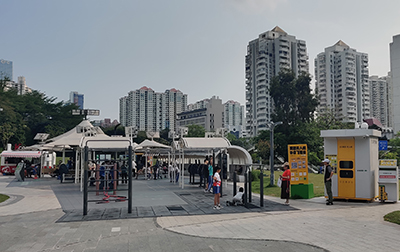
Photo 1: The drone pickup station, with yellow signs on the right
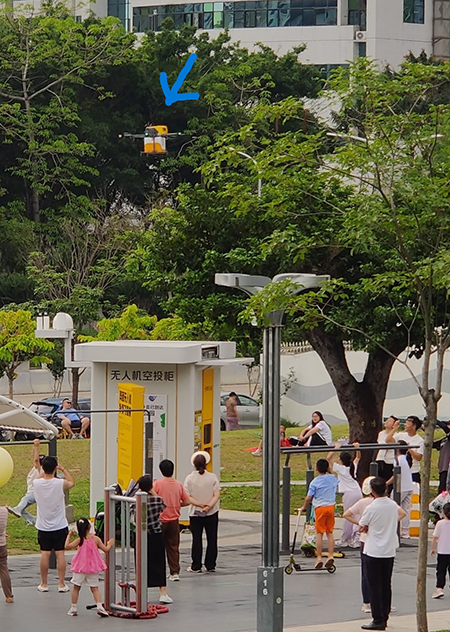
A relatively nondescript structure, the drone drop-off or pick-up station in Huanggang Park is located next to an area equipped with a number of digital exercise machines (see photo 1). The operation is run by Meituan (美团), a big food delivery platform in China with an estimated 65% of the market share. To order their take-out, the park goers use a dedicated app on their phone to scan in their account ID and food choices from an online menu. Their order would be delivered in a box to that station via a drone (see photo 2). After the box is dropped down a channel from the top of the station, the customers then use a QR code on the phone specific to their paid order to retrieve the delivery.
Photo 2: While increasingly popular, drone food delivery in Shenzhen continues to attract curious onlookers
While the e-commerce giant JD.com (Jing Dong or 京东) made China’s first drone delivery in a rural destination outside of Xi’an in November 2016 (Parmar, 2016), Meituan started its drone food delivery program in Shenzhen in 2021, four years after its own initial experimentation with the delivery method in 2017 (Yang, 2023). My initial archival research indicates that drone delivery is gaining acceptance from consumers across China. In addition to the kind of food delivery in urban settings described above, drone service can also deliver a variety of other goods, such as medical or other daily supplies; such services are especially useful to people living in hard-to-reach areas in the countryside.
Indeed, food delivery by drone is gaining popularity among consumers in China, such as those ordering take-out for a picnic in the park. However, my participant observation over more than six months seemed to suggest that drone food delivery has yet to become an everyday foodways practice as deeply ingrained as in-person food delivery. For example, currently drones cannot make delivery directly to individual apartment units in the thousands upon thousands of high-rise residential or office buildings in Shenzhen. (As a safety measure, all the balconies in the residential buildings in the community are sealed off with metal mesh.) Instead, such drone deliveries are made in pick-up venues (which may resemble vending machines) put in place by the delivery platform in a residential or office building nearby. For prompt food delivery that one can pick up at their own apartment’s doorstep, in-person delivery continues to be ubiquitous.
In fact, during our months-long stay at our hosts’ apartment in a residential high-rise across the street from Huanggang Park, I observed that the bulk of groceries were purchased from a selection of online delivery platforms. Our hosts consist of a young professional couple with their infant child and the latter’s live-in nanny and family cook. The family typically places grocery orders twice daily, once for lunch and the other for dinner. They also order cooked breakfast on some occasions if they need not go to the office early. Their orders typically consist of fresh produce and some form of protein, while in my experience in Shenzhen, customers have the option of ordering live seafood (e.g., as in shrimp are still swimming upon delivery in a sealed plastic bag). To avoid a delivery charge, a minimum purchase of about RMB38 (approx. $5.29) or RMB58 ($8.07) is required on popular grocery delivery platforms such as Xiaoxiang (小象) or Hema (河马), respectively. Otherwise, a delivery charge can be as low as RMB5 (app. $0.70).
Of course, none of the above is meant to suggest that more traditional forms of food shopping are becoming obsolete. In fact, it does not take much effort for visitors to witness and experience a multitude of food shopping practices throughout China, such as independent street vendors, small family grocers, traditional wet markets, supermarkets of all sizes having diverse corporate ownership, specialty stores that sell international products in high-end shopping malls, and so on. In fact, as house guests we often contributed various food items we acquired in traditional venues, such as neighborhood supermarkets, street vendors, shopping malls, etc.
But the proliferation and increasing presence of online food shopping and delivery platforms gives rise to some very interesting possibilities for research, such as examining the role of technological innovation in the transformation of foodways; the changing relationship or dynamic between people and their food, as well as the places or sellers in their neighborhood from which they acquire their food; issues related to class and gender in the evolving foodways; the rise of a convenience economy and changing consumer behavior in foodways; how, and the extent to which, traditional food vendors adjust to the changing food retail landscape; and so on.
Photo credit: Casey Man Kong Lum
References
Lum, C. M. K., & de Ferriere le Vayer, Marc. (Eds.). (2016). Urban foodways and communication: Ethnographic studies in intangible culture food heritages around the world. Lanham, MD: Rowman and Littlefield.
Implementation Program Manager, Constructive Dialogue Institute, New York, NY, USA (Remote). Deadline: Open until filled; posted 8 August 2025.
The Program Manager will report to the Director of Program Implementation, and work closely with the Growth team to support the successful implementation of CDI’s tools and resources on college campuses across the US. This position will focus on project management, data tracking, and platform support related to implementation of programs on college campuses. The Program Manager will need to work cross-functionally to support partner requests and challenges, and to ensure data and systems are aligned from Implementation through the whole organization. This person will at times serve as a direct contact for partners, at the direction of the Associate/Director of Program Implementation. Beyond CDI’s higher ed programming, the Program Manager will also collaborate with the larger Growth team on project management and data tracking related to implementation within other sectors (high school, public service, corporate).
The Constructive Dialogue Institute (CDI) is a non-profit dedicated to equipping the next generation of Americans with the skills to communicate and collaborate across lines of difference. They work with U.S. colleges and universities by providing curricular programming for students, professional development for faculty and staff, and strategic guidance to leadership. Our goal is to foster constructive dialogue at every level of the institution and to create the conditions for lasting organizational change.
The Lecturer/Senior Lecturer of International Relations will deliver high quality education within their field of expertise and conduct impactful research within the Humanities faculty. This role involves engaging and inspiring students through innovative teaching in Foundation and Bachelor’s courses in International Relations, providing academic support and mentorship, and contributing to curriculum development. By participating in administrative duties and outreach activities, they will foster a stimulating and supportive learning environment. The Lecturer/Senior Lecturer will ensure that the university’s academic courses uphold the highest standards of excellence and align with the institution’s mission, values, and strategic goals.
Coventry University, founded in 1843, is a forward-looking, modern institution with a proud tradition of providing high quality education. Coventry University Kazakhstan opened its doors in September 2024 to the first cohort of students at its brand-new campus, which provides world-class facilities, including interactive study spaces, a vibrant social space, a well-stocked library, and café facilities. Offering a diverse range of undergraduate and postgraduate degrees, Coventry University Kazakhstan proudly stands as the first British university campus collaboration in the heart of Astana, the capital of Kazakhstan. Coventry University Kazakhstan is the trading name of Coventry Kazakhstan LLP, which owns and operates the modern city-centre campus in Astana and, in collaboration with Coventry University, delivers Coventry University programmes.
Core fellowships, Helsinki Collegium for Advanced Studies, Helsinki, Finland. Deadline: 11 September 2025.
Helsinki Collegium for Advanced Studies was established in 2001 as an independent institute of the University of Helsinki to enhance scholarly excellence in the humanities and social sciences, promote interaction between different fields of academic research, and to further international academic cooperation. The Collegium’s fellowships are open to researchers in the humanities, social sciences, educational sciences, theology, and law, and to researchers in other fields focusing on topics related to the human sciences. The applicant’s doctoral degree must have been conferred by the application deadline.
The Collegium appoints fellows at various stages in their academic careers and from different disciplines, but has no fixed quotas for seniority, discipline, nationality or gender. The Collegium is committed to promoting equality and preventing discrimination.
Successful applicants should provide evidence of their ability to work in an international, interdisciplinary research environment and of their ability to publish at a high international level.

 Tenure track faculty position in Teaching Global Issues, Graduate School of International Studies, Université Laval, Quebec City, Canada. Deadline: 30 September 2025.




 Center for Intercultural Dialogue