Waterhouse Family Institute Research Grants 2024/25

Grants

Waterhouse Family Institute Faculty and  Doctoral Student Research Grants, 2024-5, Villanova University, Philadelphia, PA, USA. Deadline: 15 May 2024.

Waterhouse Family Institute Research Grants are available to faculty at any institution of higher education, postdoctoral researchers, doctoral candidates, and other doctoral-level scholars. However, eligibility to apply for the WFI grant program is limited to those in Communication or a closely related discipline. Although they do not limit grants to a specific methodological orientation or subdisciplinary focus, all projects supported by the WFI have two things in common: they make communication the primary, and not secondary, focus, and they engage communication in terms of its impact on the world around us, its ability to create social change.

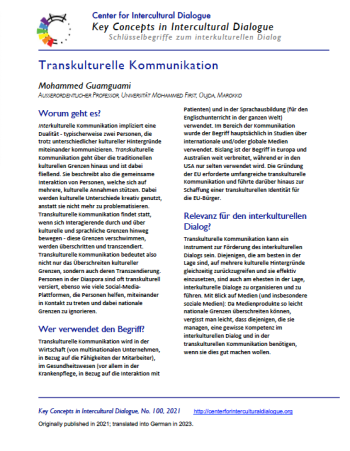
KC 100: Transcultural Communication Translated into German

Key Concepts in ICDContinuing translations of Key Concepts in Intercultural Dialogue, today I am posting KC100: Transcultural Communication, originally written by Mohammed Guamguami for publication in 2021, and now translated by Marlena Pompino into German.

As always, all Key Concepts are available as free PDFs; just click on the thumbnail to download. Lists organized chronologically by publication date and numberalphabetically by concept in English, and by languages into which they have been translated, are available, as is a page of acknowledgments with the names of all authors, translators, and reviewers.

KC100 Transcultural Communication translated into GermanGuamguami, M. (2023). Transcultural communication [German]. (M. Pompino, Trans.)  Key Concepts in Intercultural Dialogue, 100. Available from: https://centerforinterculturaldialogue.org/2023/11/13/kc-100-transcultural-communication-translated-into-german/

If you are interested in translating one of the Key Concepts, please contact me for approval first because dozens are currently in process. As always, if there is a concept you think should be written up as one of the Key Concepts, whether in English or any other language, propose it. If you are new to CID, please provide a brief resume. This opportunity is open to masters students and above, on the assumption that some familiarity with academic conventions generally, and discussion of intercultural dialogue specifically, are useful.

Wendy Leeds-Hurwitz, Director
Center for Intercultural Dialogue


Creative Commons License
This work is licensed under a Creative Commons Attribution-NonCommercial-NoDerivatives 4.0 International License.

Save

U Notre Dame: Dean, Keough School of Global Affairs (USA)

“Job Dean, Keough School of Global Affairs, University of Notre Dame, Notre Dame, IN, USA. Deadline: 6 December 2023.

The University of Notre Dame seeks a strategic and collaborative intellectual leader to serve as the next Dean of the Donald R. Keough School of Global Affairs. Founded in 2014, the Keough School plays a pivotally important role for Notre Dame. The University’s purpose is to be a force for good in the world. To that end, Keough School faculty, staff, and students pursue understanding of, and solutions to, some of the world’s most pressing challenges, including poverty, war, disease, political oppression, democratic erosion, environmental degradation, and other threats to human dignity. Keough’s eight institutes and one center are bound together by the School’s mission: to advance integral human development, a concept drawn from Catholic social thought which promotes the flourishing of every person and the whole person, so that all people can reach their full potential. This mission encompasses both fundamental research and policy applications.

In its founding decade, the School has established a strong record of success. It offers a Master of Global Affairs—a two-year professional degree—and a newly-established undergraduate major in global affairs, as well as doctoral programs jointly sponsored by the Kroc Institute for International Peace Studies and relevant departments within Notre Dame’s College of Arts and Letters. Jenkins and Nanovic Halls, a pair of conjoined buildings, opened their doors in 2018 and house the Keough School.

The Keough School recently issued its Strategic Plan 2030. The plan calls for extending Keough’s reputation as a mission-driven global public policy school drawing on the strengths of its eight institutes and one center; growing and maturing the School’s programs and co-curricular offerings; and sustaining and expanding research, public policy, and practice partnerships, as well as increased external engagement.

The Dean will join Notre Dame and lead the Keough School at a propitious moment, made all the more so by the release of the University’s Strategic Framework 2033, which sets forth ambitious goals for global reach and impact. Against this backdrop, Notre Dame seeks a Dean who will elevate the impact of the School and champion its distinctive identity; consolidate and expand its achievements; develop effective intellectual and programmatic connections across the University and beyond; ensure the organizational health of the School; and attract the social, political, and financial resources to advance the School’s work.

Institute for Study Abroad: Multiple Positions (International)

“Job Multiple positions at the Institute for Study Abroad (IFSA), (organization is based in Indiana, USA, but these positions are based in UK, Australia, and the Czech Republic). Deadlines vary by position.

  • Director, England and Wales Programmes (based in London, UK; deadline: 25 December 2023)

    The Director of England and Wales Programmes is responsible for the development and leadership of all IFSA sites in England and Wales including the following: inspiring a commitment to first in class customer service for partners and students; ensuring high-quality programming that support student learning and satisfaction outcomes; delivering business results through creative and intentional programme design to support student learning; diversifying the program offering to meet market needs; leading team’s day-to-day programme administration; and growing relationships with host universities, industry, and other partners with a goal of increased enrollment.

  • Student Experience Coordinator (one full-time or two part-time positions based in Sydney, Australia); deadline: open until filled – posted 1 November 2023).

    They are looking for an individual(s) to supports IFSA’s programs in Sydney. This position provides academic and cultural support for undergraduate students; organises co-curricular activities and contributes to the overall operations. In this position, you will work with colleagues from our sites in Australia and the Asia Pacific, the Global Health & Safety Team, Academic Programs and Student Engagement Team. You will work from home and then meet students on campus or at activities/excursions. Hours are flexible and for part-time positions, the workload can be broken up over multiple days of choice over the week.

  • Student Experience Coordinator (Prague, Czech Republic); deadline: open until filled – unclear when posted.

The Student Experience Coordinator supports IFSA’s programs in Prague. This position provides pre arrival and onsite support for students through orientations; cultural engagement opportunities to deepen the student experience; coordinates housing; organizes co-curricular activities; and contributes to overall program operations. The Student Experience Coordinator works closely with all members of the local team and Director.

WOSM/KAICIID: Dialogue for Peace

Applied ICD

The International Dialogue Centre – KAICIID and the World Organization of the Scout Movement (WOSM) have signed a new memorandum of understanding to continue the Dialogue for Peace programme.

Through the Dialogue for Peace programme, KAICIID and WOSM have increased the number of dialogue facilitators and trainers within the Scouting movement, helping Scouts acquire the skills to promote a culture of peace and create positive change in their communities. Since 2013, they have jointly trained over 1,000 people from 120 countries. The renewed partnership will seek to build on and expand the existing successes of the Dialogue for Peace initiative and other awareness activations around dialogue. The Dialogue for Peace Challenge Badge is an initiative co-designed by WOSM and KAICIID to develop competencies related to dialogue in young people to promote active listening, non-judgemental communications, and ultimately build a culture of peace.

Study of the US Institutes (USA)

Professional OpportunitiesCall for Applications: Study of the US Institutes (SUSI) either for Scholars and Secondary Educators or for Students,  activities to occur in USA, summer 2024. Deadline: 3 December 2023.

The Study of U.S. Institutes (SUSIs) are five- to six-week academic programs focusing on topics in U.S. studies for groups of foreign undergraduates, scholars, and teachers. Hosted by universities and colleges throughout the United States, the Institutes include an intensive academic residency, an educational study tour to another region of the United States, and opportunities for participants to engage with American peers. Institutes for Student Leaders also include community service activities and leadership development.

NOTE: The following are a few of the places sponsoring one of these programs for their citizens. Check the US embassy wherever you are to see if your country is as well.

Finland
Hong Kong and Macau
Mexico
Portugal
Taiwan
Tunisia

U Coimbra: PHD Research Scholarships (Portugal)

FellowshipsCall for applications: 2 positions, first stage researcher (PHD fellowship), Centre for Social Studies, University of Coimbra, Portugal. Deadline: 21 November 2023.

The Centre for Social Studies (CES) – Associate Laboratory – University of Coimbra (Portugal), opens a call for applications for 2 research scholarships in the project “PROTEMO – Emotional dynamics of protective policies in an age of insecurity,” funded by the European Commission, coordinated by Cristiano Gianolla. The project is part of the research line Democracy, Justice and Human Rights. Engaging with the centrality of the democratization of knowledge with the importance of the struggles and experiences of historically oppressed groups, the main objectives of the line are twofold. On the one hand, aims to analyse the persistence of systems of oppression that are intertwined in the structures of racism, heteropatriarchy and capitalism. On the other hand, examine the socio-legal, socio-political and socio-cultural resistances that, in the framework of the modern State and beyond, mark the present of anti-discrimination policies and the constitution of alternative grammars of dignity.

The selected candidates are expected to have the following responsibilities:

– Develop PhD research (already in progress or to begin in 2024) in the framework of the research project in one of the two research lines:

Ukraine: Investigate social representations of protection and the entangled emotions of Ukrainian refugees and also of people mobilising against the war in Ukraine;
Italy: Investigate the relationship of migration, protective policies and emotions in relation to the EU and the Italian state.

– Support the implementation of the scientific tasks foreseen in the project application, namely, literature review, document research, databases and website maintenance, drafting and editing of reports and publications, field work, data analysis and dissemination activities;

– Support the administrative activities of the project, including the organisation of events, management of communication, review and translation of documents and data, and support of the tasks necessary to implement the project.

Educating for Intercultural Dialogue, Peacebuilding, Constructive Remembrance & Reconciliation

Resources in ICD“ width=

Clarke-Habibi, S. (2020). Educating for intercultural dialogue, peacebuilding, constructive remembrance, and reconciliation: A toolkit for teachers in the Western Balkans. UNICEF Albania and Regional Youth Cooperation Office.

Although prepared specifically for teachers in the Western Balkans, this toolkit should be useful to anyone in a teaching context working with any of the major concepts. As explained in the introduction:

This Toolkit focuses on education for intercultural dialogue, peacebuilding, constructive remembrance and reconciliation. It is designed for teachers and trainers who work with adolescents (14-18 years) in formal and non-formal education settings. It may be adapted, however, for other contexts and age groups, such as for activities with older youth, for pre-service teacher training, and for teacher professional development programmes. (p. 7)

The objectives of this Toolkit are:

  1. To support teachers’ professional competences to engage adolescents and youth in intercultural dialogue.
  2. To support teachers in their use of teaching strategies and techniques, which help adolescents and youth to learn and practice open and respectful dialogue.
  3. To develop teachers’ professional competences and confidence to engage adolescents and youth in discussing controversial issues, particularly related to past and current causes of conflict in the region, and to manage all this safely and effectively.
  4. To support teachers to create ‘safe spaces’ in the classroom where adolescents and youth can explore issues that concern them freely and without fear.
  5. To support teachers’ professional competences to nurture young people’s understanding of the foundations of sustainable peace and to strengthen their agency as peacebuilding actors (p. 8).

Key Concept #9: Communicative Competence Translated into German

Key Concepts in ICDContinuing translations of Key Concepts in Intercultural Dialogue, today I am posting KC9: Communicative Competence, written by John Corbett and published in English in 2014, now translated into German by Marlena Pompino.

As always, all Key Concepts are available as free PDFs. Click on the thumbnail of the translation you wish to read. Lists of Key Concepts organized chronologically by publication date and number, alphabetically by concept, and by languages into which they have been translated, are available, as is a page of acknowledgments with the names of all authors, translators, and reviewers.

KC9 Communicative Competence in GermanCorbett, J. (2023). Communicative competence [German]. (M. Pompino, Trans.). Key Concepts in Intercultural Dialogue, 9. Available from: https://centerforinterculturaldialogue.org/2023/11/06/key-concept-9-communicative-competence-translated-into-german/

If you are interested in translating one of the Key Concepts, please contact me for approval first because dozens are currently in process. As always, if there is a concept you think should be written up as one of the Key Concepts, whether in English or any other language, propose it. If you are new to CID, please provide a brief resume. This opportunity is open to masters students and above, on the assumption that some familiarity with academic conventions generally, and discussion of intercultural dialogue specifically, are useful.

Wendy Leeds-Hurwitz, Director
Center for Intercultural Dialogue


Creative Commons License
This work is licensed under a Creative Commons Attribution-NonCommercial-NoDerivatives 4.0 International License.

Northeastern U London: Global & Intercultural Communication (UK)

“JobLecturer in Global and Intercultural Communication, Northeastern University London, UK. Deadline: 26 November 2023.

Northeastern University London wishes to appoint a part-time fixed term Lecturer to teach the first-year undergraduate Global & Intercultural Communication course running in the spring of 2024. In addition to teaching, the appointed person will also be expected to mark assessments and hold regular office hours. The appointee will teach multiple groups of up to 35 students. Teaching competency in Communication Studies to at least Level 4 (1st year undergraduate) is required.

This role is offered on a part time basis of 0.6FTE and involves up to 150 contact hours. The role requires teaching availability for at least 3 weekdays per week in term-time and consists of up to 9 hours of teaching per week in most weeks. The role is expected to start in December 2023 and end in July 2024. Teaching on the course, in person, will take place between January and April 2024.

This course focuses on theories of and approaches to the study of intercultural communication. It studies the importance of being able to negotiate cultural differences and of understanding intercultural contact in societies and institutions. The course stresses the benefits and complexities of cultural diversity in global, local, and organisational contexts.