U Fribourg: Communication Studies (Switzerland)

“JobProfessor of Communication Studies (tenured), Department of Communication and Media Research, University of Fribourg, FR, Switzerland. Deadline: 1 March, 2021.

The Faculty of Management, Economics and Social Sciences of the University of Fribourg (Switzerland) invites applications for the full-time position of Professor (tenured) in Communication Studies. The professorship is with the Department of Communication and Media Research DCM and comes with one fully funded PhD position. The appointment begins in early 2022.

The position requires a specialization in individual (micro-level) issues of communication and media research from a social scientific perspective. This includes but is not limited to research fields like media exposure, media use and media effects and/or audience studies and/or media and online communication content. Moreover, candidates should be able to contribute to teaching in other areas on the Bachelor level, for instance journalism research or media economics and media management. Finally, they should also take the digital transformation of communication and media into account in their current and/or future research and teaching activities.
UNC Ashville: University Fellow for Faculty Diversity in Sociology (USA)

PostdocsUniversity Fellow for Faculty Diversity in Sociology, Department of Sociology and Anthropology, University of North Carolina, Ashville, Ashville, NC. Deadline: Open until filled, but review begins March 1, 2021.

To support the development of a more diverse professoriate, the Department of Sociology and Anthropology at UNC Asheville invites applications for the new University Fellowship for Faculty Diversity (University Fellows) Program. The program invites pre-doctoral and post-doctoral candidates looking specifically to take on an academic position at a liberal arts institution which takes equal pride in the excellence of its faculty’s teaching and the quality of its faculty’s scholarship and creative production.

Applicants must hold a Ph.D. in Sociology or be a Ph.D. candidate nearing the completion of their degree (ABD). The University Fellow will teach Introduction to Sociology, along with other courses in the fellow’s area of expertise. While the fellow’s area of specialization is open, we are looking for a critical teacher-scholar whose teaching and research complement and enhance the department’s social justice focus. The successful candidate will have a lightened teaching load, extensive mentorship, and support for the development of their pedagogy and scholarship. The term of appointment is 2 (post doc) to 3 (pre doc) years. Following this term, the University Fellow may be offered a tenure-track position in the Department. Additional information about the University Fellowship program may be found at this link: https://academicaffairs.unca.edu/faculty-openings/university-fellowship-for-faculty-diversity/.

UNESCO Futures of Education Focus Groups Completed

“UNESCO”

The Center for Intercultural Dialogue held 3 focus groups as part of the UNESCO Futures of Education Initiative, January 28, 29, and 30, 2021.

UNESCO Futures of EducationThanks first to Nazan Haydari, member of the CID Advisory Board, who who served as moderator of one of the groups, and organized the technology through Istanbul Bilgi University.

Thanks next to all of the participants for all of their ideas. They included: Evangelos Afendras (Greece), Chukwuemeka Amajo (Nigeria), Diana Bebenova-Nikolova (Bulgaria), Giovanna Carloni (Italy), Ivett Rita Guntersdorfer (Germany), Mohammed Guamguami (Morocco), Maria Hussain (UK), Teresa Joseph (India), Emilija Jovanovska (USA/Macedonia), Lasana Kazembe (USA), Sergei Kladko (Russia), Maura Di Mauro (Italy), Katrien Mertens (Belgium), Isabel Mohedano Sohm (Spain), M. L. Papusa Molina (Mexico), Maja Nenadovic (Netherlands), Sushil Oswal (USA), Chris Peltier (France), Anne-Nelly Perret-Clermont (Switzerland), Yehuda Silverman (Canada/USA), and Arianna Vettorazzi (Netherlands/Italy).

The report synthesizing our discussions will be completed, submitted to UNESCO, and posted to this site shortly. [update: now posted here]

For everyone else with an interest in the topic but who was unable to respond quickly enough to participate, in addition to the relevant publications posted previously, UNESCO has now offered several additional possibilities:

Passive participation: you may follow the developments on their website, as they post updates.

Active engagement: there are several possibilities:

  • Take the 1-minute survey on the top 3 challenges and purposes of education
  • Write your thoughts on what they see as the one major issue for the futures of education (max 1000 words).
  • Submit an original artwork of what education might look like in 2050.

Key Concept #99: Translanguaging Translated into French

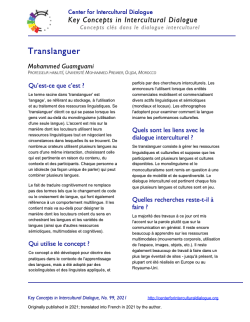
Key Concepts in ICDContinuing translations of Key Concepts in Intercultural Dialogue, today I am posting KC#99: Translanguaging, originally written by Mohammed Guamguami for publication in 2021, and now translated by him into French.

As always, all Key Concepts are available as free PDFs; just click on the thumbnail to download. Lists organized chronologically by publication date and numberalphabetically by concept in English, and by languages into which they have been translated, are available, as is a page of acknowledgments with the names of all authors, translators, and reviewers.

KC99 Translanguaging_French_v2Guamguami, M. (2021). Translanguer. Key Concepts in Intercultural Dialogue, 99. Available from:
https://centerforinterculturaldialogue.org/wp-content/uploads/2021/05/kc99-translanguaging_french_v2.pdf

If you are interested in translating one of the Key Concepts, please contact me for approval first because dozens are currently in process. As always, if there is a concept you think should be written up as one of the Key Concepts, whether in English or any other language, propose it. If you are new to CID, please provide a brief resume. This opportunity is open to masters students and above, on the assumption that some familiarity with academic conventions generally, and discussion of intercultural dialogue specifically, are useful.

Wendy Leeds-Hurwitz, Director
Center for Intercultural Dialogue


Creative Commons License
This work is licensed under a Creative Commons Attribution-NonCommercial-NoDerivatives 4.0 International License.

Save

CFP Theorizing Transcultural Communication

“PublicationCall for papers, Special Issue: Theorizing Transcultural Communication: Paradigms and Approaches, Journal of Transcultural Communication. Deadline: April 15, 2021.

Sponsored by Beijing Foreign Studies University and Published by Sage, Journal of Transcultural Communication (JTC) will be a new international academic platform dedicated to the publication of interdisciplinary researches into theories and practices of transcultural communication.
Built upon the long-standing scholarship in the arenas of cross-cultural communication, intercultural communication, and international communication, JTC focuses on transcultural communication, which is defined as a paradigmatic shift to a broader field of research concerning both differences between cultures and cultural transformations that go beyond those differences in an increasingly globalizing and networking society.

The inaugural issue, scheduled to publish in September 2021 and themed “Theorizing Transcultural Communication: Paradigms and Approaches”, is now inviting original articles. Prospective contributions are expected to define and discuss the theoretical boundary, core concepts, analytical framework, and practical implications of transcultural communication transcending the existing works in relation to the interplay between culture and communication.

In addition to the special issue, submissions are welcome to future issues of the journal.

CFP Interdisciplinary PHD Communication Conference (Turkey but Online)

ConferencesCall for papers, Interdisciplinary PhD Communication Conference (IPCC), Conference theme: Collaborations, Istanbul Bilgi University, Istanbul, Turkey, 7-8 May 2021 (Online). Deadline: 1 March 2021.

The 2021 edition of IPCC – Interdisciplinary PhD Communication Conference, realised by a group of young scholars within the PhD in Communication Program at Istanbul Bilgi University, will be held online on 7-8 May 2021 under the theme “Collaborations“. Participants will be expected to provide 15-minute presentations, followed by roundtable discussions, which encourage further inquiry into the related topics of discussion, with the audience and fellow presenters. In line with the mission of the PhD in Communication Program of Istanbul Bilgi University, IPCC prioritises solidarity. Thus, the conference promotes a platform for the co-creation of knowledge, facilitated by free-form discussion sessions.

All PhD students or candidates, as well as early career researchers with PhDs earned in the last 5 years, who are interested in examining, expressing and exploring the current and possible implications of collaborations within their field of interest, are welcome to submit their proposal and join the discussion. Contributions may include but are not limited to the topics provided.

How are we attentive to collaborations? In a time marked by biological, political, social and economic crises, the IPCC shifts its focus towards practices of solidarity, of labouring together and building new communities within the scope of communication and beyond.

Maria Cristina Gatti Profile

ProfilesMaria Christina Gatti is Associate Professor in English Studies and Linguistics at the University of Bolzano (Italy), and Deputy Director of the course in Communication Sciences and Cultures of the Faculty of Education.

Maria Cristina Gatti

She is an applied linguist interested in communication in intercultural and multilingual contexts. She is currently leading research programmes on the role of English in multilingual teaching and professional environments, language variation in transnational communication contexts and online teaching in multilingual and multicultural environments. As a discourse analyst, she is particularly interested in issues related to social interaction in intercultural communication including identity, trust development, multisensoriality, embodiment as well as cognitive-semiotic approaches to spatiality and temporality. She has presented internationally and is supervising doctoral students in these fields. Her work has been published in international journals including Discourse Studies, Humanities, and International Journal of Applied Linguistics. She was a visiting scholar at the Department of Linguistics of UC at Berkeley where she also attended the LSA Linguistic Institute. She has been a member of the Association for Business Communication for more than ten years.


Work for CID:
Maria Cristina Gatti serves on the CID Advisory Board.