UNESCO Prize for ICTs in Education

“The UNESCO King Hamad Bin Isa Al-Khalifa Prize for the Use of ICTs in Education, funded and established since 2005 by the Kingdom of Bahrain, rewards individuals, institutions, and Non-Governmental Organizations for projects and activities which demonstrate best practices in, and creative use of, ICTs to enhance learning, teaching and overall educational performance. It is UNESCO’s only prize in the field of ICT in education and seeks to recognize the organizations and individuals that are embracing ICT as a pedagogical ally and, in turn, make learning more effective. While acknowledging the importance of teaching innovations supported or enabled by ICT, it is essential that innovations ensure the security of children and promote the values and attitudes that are relevant to the building of sustainable and peaceful societies.

The theme for the 2015 Prize is Pedagogical Innovation in the Use of ICT in Teaching and Learning.

In an effort to enhance learning, ICT is increasingly being used to personalize learning, differentiate instruction, fuel learning in contexts outside of classrooms, share resources, collaborate, streamline assessment and ‘flip’ classrooms. Yet the impact of these innovations needs to be assessed, recognized and enlarged.

Two prizewinners will be designated by UNESCO’s Director-General on the basis of the recommendations of an international jury. Each winner will receive a diploma and a monetary award (USD 25,000).

Winners of the 2015 Prize will be announced and awarded during a ceremony at UNESCO Headquarters in Paris in early 2016.

To submit your application, please contact your National Commission or an International Non-Governmental Organization (NGO) maintaining official relations with UNESCO and working on the themes covered by the Prizes. The submission form can be downloaded.

The deadline for submission of all nomination files is 10 November 2015.”

Source: http://www.unesco.org/new/en/unesco/themes/icts/ict-in-education-prize/

UNESCO Links Cultural Diversity to Human Rights

© UNESCO

On 31 March, 2015, UNESCO Director-General Irina Bokova took part in a round table on the theme “Human Rights and the Protection of Cultural Diversity,” held at the University of Geneva, with the participation of the United Nations High Commissioner for Human Rights, Zeid Ra’ad Al Hussein, UNESCO Special Envoy for Intercultural Dialogue, Metin Arditi and author, psychoanalyst and university professor, Julia Kristeva.

Bokova emphasized that “cultural diversity is an expression of human rights – the persecution of minorities, religious and ethnic, and the looting and pillage of cultural heritage are part of a deliberate global strategy to eradicate history and memory, the identities and the existence of these peoples and communities, and, through them, the cultural diversity that is our common heritage.”

Arditi highlighted that “the destruction of cultural heritage is but a symptom of the destruction of the Other,” noting that “the West is living through an unprecedented intellectual crisis – we need to restore the humanities at the heart of our societies, as the cradle of ideas and intellectuals for the future. Universities have a historic responsibility here, to prepare society for its own transformation and to help people understand and live together.”

All speakers stressed the importance of teaching about religions through the humanities, as areas of knowledge and understanding, as well as debate and discussion — “in order for beliefs to not become the sole possession of fanatics and extremists.”

The General-Director concluded on the key role of education for global citizenship, as promoted by UNESCO, including education for human rights as the mainstay, stressing the need for cultural literacy and development of intercultural competences to make the most of contemporary multicultural societies and the challenges of living together.

See the original article for further details.

Recommended UNESCO Documents for Interculturalists

UNESCO sees intercultural dialogue as a central topic, and publishes frequently on related issues. In addition to the Intercultural Competences booklet that I worked on last year, which has had hundreds and hundreds of downloads from this site alone, several other publications may be of interest to intercultural scholars.

A Common Framework for the Ethics of the 21st Century

A New Cultural Policy Agenda for Development and Mutual Understanding

Asian-Arab Philosophical Dialogues on Globalization, Democracy and Human Rights

Cultural Diversity and Transversal Values: East-West Dialogue on Spiritual and Secular Dynamics

Exploring Synergies between Faith Values and Education for Sustainable Development

What UNESCO for the Future? Forum of Reflexion

World Social Science Report 2010: Knowledge Divides

My thanks to Yoshitaka Miike for these suggestions!

Wendy Leeds-Hurwitz, Director
Center for Intercultural Dialogue

Save

UNESCO research fellowships

UNESCO / Keizo Obuchi research fellowships

UNESCO invites young post-graduate researchers in developing countries with a Masters degree or equivalent, to apply for fellowships. This Research Fellowship Programme is financed by Japan through funds-in-trust dedicated to the development of human resources.


The programme, named after the late Japanese Prime Minister Keizo Obuchi, offers a total of 20 fellowships to researchers. A maximum amount between US$ 6,000 – 10,000 will be awarded to the two candidates.

The aim is to impact on capacity building and research activities in one of four fields:

*Environment, with an emphasis on Water Sciences, Water Issues, Climate Change, Engineering Capacity Building in the Developing World;
*Intercultural dialogue;
*Information and communication technologies;
*Peaceful conflict resolution.

Applicants:
Post graduate researchers, no older than 40 years, can apply through their country’s National Commission. Priority will be given to women, candidates from the least developed countries and African researchers. Each Member State may nominate a maximum of two candidates. No applications will be considered from individuals.

The Member States of UNESCO who are eligible to apply are:
Africa – 46 Member States
Arab States – 12 Member States
Asia and The Pacific – 39 Member States
Latin America and the Caribbean – 29 Member States
Europe – 13 Member States
Tokelau – 1 Associate Member State
NB: the former 15 EU Member States are not eligible to apply.

All applications must be sent to the National Commission for UNESCO of the country of origin of the candidate that will then decide whether they will submit the application to UNESCO.

Deadline: 30 August 2013

Application form, eligible countries and further information: Click here

National Directory of Unesco national commissions: Click here

Key documents: UNESCO/Keizo OBUCHI research Fellowships programme internet: Click here

Do one thing for diversity 2013

2013: Do One Thing for Diversity and Inclusion

do one thing for diversity logo

In 2001, UNESCO adopted the Universal Declaration on Cultural Diversity and in December 2002, the UN General Assembly, in its resolution 57/249, declared May 21 to be the World Day for Cultural Diversity for Dialogue and Development.

The day provides us with an opportunity to deepen our understanding of the values of cultural diversity and to learn to live together better.

In 2011, a grassroots campaign ‘Do One Thing For Diversity and Inclusion’, celebrating the annual World Day for Cultural Diversity was launched by UNESCO and the UN Alliance of Civilizations.

The 2013 campaign, by encouraging people and organizations from around the world to take concrete action to support diversity, aims:

*To raise awareness worldwide about the importance of intercultural dialogue, diversity and inclusion.
*To build a world community of individuals committed to support diversity with real and every day-life gestures.
*To combat polarization and stereotypes to improve understanding and cooperation among people from different cultures.

The campaign works through a dedicated Facebook page, serving as a platform for people around the world to share their experiences through posts and videos.

Ten simple things YOU can do to celebrate the World Day for Cultural Diversity for Dialogue and Development:

1. Visit an art exhibit or a museum dedicated to other cultures.
2. Invite a family or people in the neighborhood from another culture or religion to share a meal with you and exchange views on life.
3. Rent a movie or read a book from another country or religion than your own.
4. Invite people from a different culture to share your customs.
5. Read about the great thinkers of other cultures than yours (e.g. Confucius, Socrates, Avicenna, Ibn Khaldun, Aristotle, Ganesh, Rumi).
6. Go next week-end to visit a place of worship different than yours and participate in the celebration.
7. Play the “stereotypes game.” Stick a post-it on your forehead with the name of a country. Ask people to tell you stereotypes associated with people from that country. You win if you find out where you are from.
8. Learn about traditional celebrations from other cultures; learn more about Hanukkah or Ramadan or about amazing celebrations of New Year’s Eve in Spain or Qingming festival in China.
9. Spread your own culture around the world through our Facebook page and learn about other cultures.
10. Explore music of a different culture.

There are thousands of things that you can do, are you taking part in it?

Intercultural Competences – UNESCO

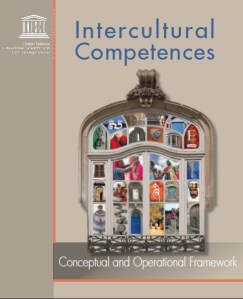
“UNESCO”UNESCO has just published “Intercultural competences: A conceptual and operational framework.” (Paris, France: UNESCO, 2013).

interculturalcomp_cover

This document is a synthesis of, and expansion upon, the numerous documents prepared for, and especially the discussion held during, the UNESCO Experts Meeting on Intercultural Competences, October 21-22, 2011, in Paris, France, organized by the Intersectoral Platform for a Culture of Peace and Non-Violence under the coordination of Katérina Stenou (who also serves as a member of this Center’s Advisory Board). The report benefited particularly from the following sources: a) five regional reports prepared by Milena Dragićević Šešić & Sanjin Dragojević, Alejandro Grimson, Prue Holmes, Melissa Steyn, and Magdi Youssef; b) a synthesis thereof by Darla Deardoff; and c) the stimulating discussions at the experts’ meeting, which included not only all of the regional report authors except Dragojević and Steyn, but also Eric Cattelain, Yolanda Onghena, Hanna Schissler, and Yves Winkin. In addition, many of UNESCO’s Chairs on Interreligious Dialogue for Intercultural Understanding joined the discussion on October 22, 2011. I drafted this report on behalf of the group, and with considerable input from the others, as well as from UNESCO staff. My thanks to Katérina Stenou for involving me in this project, and to the amazing set of international colleagues I met during the process.

This was the first time I was asked to participate in the design of a publication as well as the content, so I also thank the designers involved in the process for teaching me so much. The images of people or writing included in the report were provided by UNESCO; all of the other photographs were taken either by me or my husband on our international travels over the past several years. The cover uses a photograph of a hotel window in downtown Coimbra, Portugal, taken while I was there as a Fulbright Senior Scholar – the ultimate result of a connection made by Eric Cattelain at the experts meeting, and a good example of just the sort of expanding international network that this Center is designed to facilitate.

Wendy Leeds-Hurwitz
Director, Center for Intercultural Dialogue

(See this discussion of the document by AFS.)

Update: Now available also in Arabic, FrenchSpanish and Russian.

UNESCO conf on Education

UNESCO convened the 16th UNESCO-APEID International Conference, The Heart of Education: Learning to Live Together, in collaboration with the Ministry of Education in Thailand, the Asian-Pacific Network for International Education and Values (APNIEVE), Pearson Thailand and J.P. Morgan. The Conference was intended to facilitate discussions on leading-edge thinking about learning, reflect on the linkages between learning and social development, explore approaches and tools to enhance learning, and identify enabling policies and instruments to promote learning to live together.

More than 250 participants from 30 countries all over the world attended the Conference that was held in Bangkok from 21 – 23 November. Copies of the papers presented are now available here.

Save

2nd World Forum Intercultural Dialogue

The 2nd World Forum on Intercultural Dialogue will be held from May 29 to June 1, 2013 in Baku, Azerbaijan in partnership with UNESCO, UN Alliance of Civilizations, UN World Tourism Organization, Council of Europe, CoE North-South Center and ISESCO. The opening ceremony and the lst East-West Ministerial Conference will take place on May 30, 2013.

The program of the upcoming forum implies several sessions and side events to be prepared and led by partner organizations, including the celebration of “Do one thing for Diversity and Inclusion,” Intercultural Innovation Award ceremony for Central Asia, Black Sea and Mediterranean regions, 1st Alumni Meeting of the “Emerging Leaders Network,” the workshops “Intercultural Dialogue through History Teaching: Best Practices and Challenges,” and “Urban policies for diversity in 21st century: the Intercultural Cities paradigm,” the sessions of “Tourism as a key driver of mutual understanding and tolerance among cultures,” “The New Era of Globalization: Hybridity of cultures in a changing world” and “Capitals of Culture: Trends and roles, intercultural dialogue through faith and science,” etc.

The 1st World Forum on Intercultural Dialogue was held on April 7-9, 2011, also in Baku. More than 500 representatives from 102 countries and many international organizations, NGOs, media representatives, scholars, experts, etc. participated. Details about that event, and this Center’s participation in it, available here.

Save

UN Do one thing for diversity campaign

The United Nations Alliance of Civilizations (UNAOC) in partnership with UNESCO and various other partners from corporations to civil society is launching the world campaign “Do One Thing for Diversity and Inclusion”, aimed at engaging people around the world to Do One Thing to support Cultural Diversity and Inclusion.

Following the adoption in 2001 of the Universal Declaration on Cultural Diversity the UN General Assembly declared May 21 as the World Day for Cultural Diversity for Dialogue and Development.

This Day raises awareness on the richness of world cultures and the opportunities that cultural diversity can bring to societies.

Why does diversity matter? How to participate?

Three-quarters of the world’s major conflicts have a cultural dimension.

Bridging the gap between cultures is urgent and necessary for peace, stability and development.

The 2012 campaign, by encouraging people and organizations from around the world to take concrete action to support diversity, aims:
*To raise awareness worldwide about the importance of intercultural dialogue, diversity and inclusion.
*To build a world community of individuals committed to support diversity with real and every day-life gestures.
*To combat polarization and stereotypes to improve understanding and cooperation among people from different cultures.

Every one of us can do ONE thing for diversity and inclusion; even one very little thing can become a global action if we all take part in it.

Simple things YOU can do to celebrate the World Day for Cultural Diversity for Dialogue and Development on May 21, 2012.
*Visit an art exhibit/museum that reflects diverse cultures.
*Rent a movie or read a book from another country than your own.
*Learn another language
*Invite a family or friends in the neighborhood from another culture to have lunch/diner with you and share a traditional dish.
*Explore music of a different culture
*Invite people from a different culture to share your customs
*Spread your own culture around the world through our Facebook page and learn about other cultures
*Learn about traditional celebrations from other cultures; learn more about Hanukkah or Ramadan or about amazing celebrations of New Year’s Eve in Spain or Qingming festival in China.
*Play the “stereotypes game.” Stick a post-it on your forehead with the name of a country. Ask people to tell you stereotypes associated with people from that country. You win if you find out where you are from.

There are thousands of things that you can do, are you taking part in it?

How to join the 2012 campaign?
*”Like” us on Facebook….and start a discussion on our “wall” and get surprised with posts and videos (http://facebook.com/DoOneThingforDiversityandInclusion)
*Tell others about this day.
*Take part in the photo and slogan contests
*Organize an event or put your event under the umbrella of the Campaign

Paris-UNESCO experts meeting

On September 21-22, 2011 I participated in the UNESCO Experts Meeting on Intercultural Competences at their headquarters in Paris. My thanks to Dr. Katérina Stenou, on this Center’s Advisory Board, for including me.

The goal of the meeting was to respond to a series of regional reports (prepared by Drs. Milena Dragicevic Sesis of Belgrade, Serbia; Alejandro Grimson of Buenos Aires, Argentina; Prue Holmes formerly of New Zealand but now in Durham, UK; Melissa Steyn of Cape Town, South Africa; and Magdi Youssef formerly of Egypt, but now in London, UK) and the synthesis of these prepared by Dr. Darla Deardorff (North Carolina, USA). The other respondents were Drs. Noureddine Affaya (Rabat, Morocco), Eric Cattelain (Bordeaux, France), Yolanda Onghena (Barcelona, Spain), Hanna Schissler (Berlin, German), and Yves Winkin (Lyon, France). On the second day we were joined by a large group of UNESCO Chairs on Interreligious Dialogue for Intercultural Understanding.

We were too busy working to take photographs, but the next day I had time to see the exhibit “Go West!” (a collaboration between artists in Paris and Texas) at UNESCO headquarters.


Wendy Leeds-Hurwitz
Director, Center for Intercultural Dialogue