 Qi Wang Schlupp earned her bachelor’s degree in English at Beijing University (1997). Her master’s (Kent State University, 2001) and doctoral degrees (University of Maryland, 2006) were both in communication. She is currently Professor of Communication at Villanova University and Area Coordinator in the Interpersonal Communication specialization.

Her teaching and research interests include intercultural and interpersonal communication, with a focus on conflict management. Recently, she has also conducted and published studies in social media use and its influences on interpersonal communication. She has published research in various key communication journals and books (e.g., The SAGE Handbook of Conflict Communication, Human Communication Research, Journal of Public Relations Research, Communication Quarterly, China Media Research, etc.), and presented conference papers annually at the major scholarly communication organizations such as National Communication Association (NCA) and International Communication Associations (ICA). Her papers have won several Top Paper Awards at NCA. Her doctoral dissertation that theorized conflict avoidance strategies won the 2007 Outstanding Dissertation Award at the International Association for Conflict Management at Budapest, Hungary. She has conducted several funded research projects. Her most recent research that investigates the multinational mining industry in Peru has won the scholarship from the Arthur Page Legacy Center at PSU. She has been named as the 2013-2014 Page Legacy Scholar.
She was the 2013-2014 President of the Association for Chinese Communication Scholars (ACCS) affiliated with NCA. She also served as the Student Board Member at ICA in 2005-2006. She has launched the internship program in Shanghai for the Department of Communication at Villanova University in 2014, and also serves as the vice director of the Center for the Cross-Cultural Education and Communication for the Shanghai Academy of Social Sciences. And she served as Editor-in-Chief of the journal Negotiation and Conflict Management Research from 2019 to 2022.
Key publications
Books
Ni, L., Schlupp, Q. W., & Sha, B.-L. (Eds.). (2022). Intercultural public relations: Realities and reflections in practical contexts. Routledge.
Ni, L., Wang, Q., & Sha, B.-L. (2018). Intercultural public relations: Theories for managing relationships and conflicts with strategic publics. Routledge.
Refereed Journal Articles and Book Chapters
Ni, L., De la Flor, M., Wang, Q., & Romero, V. (2021). Engagement in context: Making meaning of the Latino community health engagement process. Public Relations Review, 47(2).
Wang, Q. (2020). Soong Ching-ling and Soong Mei-ling: For the love of one motherland. In C. C. Chao & L. Ha (Eds.), Asian women entrepreneurship (pp. 93-106). Routledge.
Ni, L., Xiao, Z., Liu, W., & Wang, Q. (2019). Relationship management as antecedents to public communication behaviors: Examining empowerment and public health among Asian Americans. Public Relations Review, 45(5).
Ni, L., Wang, Q., & Gogate, A. (2018). Understanding immigrant internal publics of organizations: Immigrant professionals’ adaptation and identity development. Journal of Public Relations Research, 30(4), 146-163.
Ni, L., Wang, Q., De la Flor, M., & Peñaflor, R. (2015). Ethical community stakeholder engagement in the global environment: Strategies and assessment. Public Relations Journal, 9(1), 1-22.
Ni L., Wang, Q., & De la Flor, M. (2015). Intercultural communication competence and preferred public relations practices. Journal of Communication Management, 19(2), 167-183.
Wang, Q., Fink, E. L., & Cai, D. A. (2015, February). Parasocial Interaction. Comm365: Celebrating 100 years of research. NCA Centennial Special Edition.
Wang, Q., & Bowen, S. P. (2014). The limits of beauty: The impact of physician sex and attractiveness on patient communication perceptions. Communication Research Reports, 31(1), 72-81.
Wang, Q., Ni, L., & De la Flor, M. (2014). An intercultural competence model of strategic public relations management in the Peru mining industry context. Journal of Public Relations Research, 26(1), 1-22.
Wang, Q., & Bowen, S. P. (2014). The limits of beauty: The impact of physician sex and attractiveness on patient communication perceptions. Communication Research Reports, 31(1), 72-81.
Wang, Q., Ni, L., & De la Flor, M. (2013). An intercultural competence model of strategic public relations management in the Peru mining industry context. Journal of Public Relations Research, 0, 1-22. doi: 10.1080/1062726X.2013.795864
Fink, E. L., & Cai, D. A., with Wang, Q. (2013). Quantitative methods for conflict communication research. In J. Oetzel & S. Ting-Toomey. (Eds.), The SAGE handbook of conflict communication: Integrating theory, research, and practice (2nd ed., pp. 41-66). Thousands Oak, CA: Sage.
Wang, Q., Fink, E. L., & Cai, D. A. (2012). The effect of conflict goals on avoidance strategies: What does not communicating communicate? Human Communication Research, 38, 222-252. doi: 10.1111/j.1468-2958.2011.01421.x
Ni, L., & Wang, Q. (2011). Anxiety and uncertainty management in an intercultural setting: The impact on organization-public relationships. Journal of Public Relations Research, 23, 269-301. doi: 10.1080/ 1062726X.2011.582205
Cai, D. A., Fink, E. L., & Wang, Q. (2010). Methods for conflict communication research, with special reference to culture. In D. A. Cai (Ed.) Intercultural communication: Sage benchmarks in communication (Vol. 2, pp. 99-120). Thousand Oaks, CA: Sage [Reprint from 2006].
Feeny, K., & Wang, Q. (2010). Comparing the perceptions of success, attributions, and motivations between the Chinese and the U.S. cultures. China Media Research, 6, 56-66.
Wang, Q. (2010). Cultural individualism-collectivism, self-construal, and multiple goal concerns in interpersonal influence situations: A cross-cultural investigation. In Y. Sun (Ed.), Intercultural studies: New frontiers (pp. 197-217). Beijing, China: Foreign Language Teaching and Research Press.
Wang, Q., Fink, E. L., & Cai, D. A. (2008). Loneliness, gender, and parasocial interaction: A uses and gratifications approach. Communication Quarterly, 56, 87-109. doi: 10.1080/01463370701839057
Cai, D. A., Fink, E. L., & Wang, Q. (2006). Quantitative methods for conflict communication research, with special reference to culture. In J. G. Oetzel & S. Ting-Toomey (Eds.), The SAGE handbook of conflict communication: Integrating theory, research, and practice (pp. 33-64). Thousand Oak, CA: Sage.
Work for CID:
Qi Wang wrote KC53: Conflict Management and then translated it into Simplified Chinese. She also has served as a reviewer for Chinese.

 Continuing translations of Key Concepts in Intercultural Dialogue, today I am posting KC#53: Conflict Management, which Qi Wang wrote for publication in English in 2015, and which Candost Aydın has now translated into Turkish.
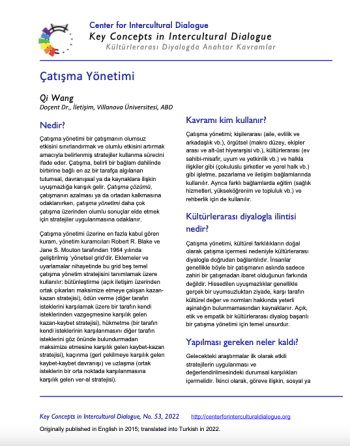 Wang, Q. (2022). Conflict management [Turkish]. (C. Aydın, Trans.). Key Concepts in Intercultural Dialogue, 53. Available from: https://centerforinterculturaldialogue.org/wp-content/uploads/2022/01/kc53-conflict-management_turkish.pdf
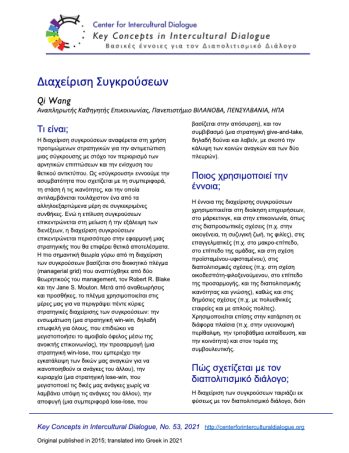

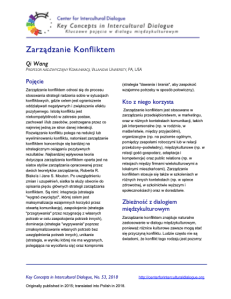
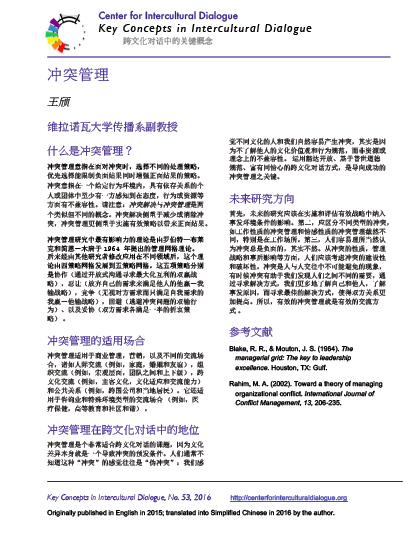

 Center for Intercultural Dialogue