
Key Concept #64: Peacebuilding by Elenie Opffer

Key Concepts in ICDThe next issue of Key Concepts in intercultural Dialogue is now available. This is KC64: Peacebuilding by Elenie Opffer. As always, all Key Concepts are available as free PDFs; just click on the thumbnail to download. Lists organized  chronologically by publication date and numberalphabetically by concept in English, and by languages into which they have been translated, are available, as is a page of acknowledgments with the names of all authors, translators, and reviewers.
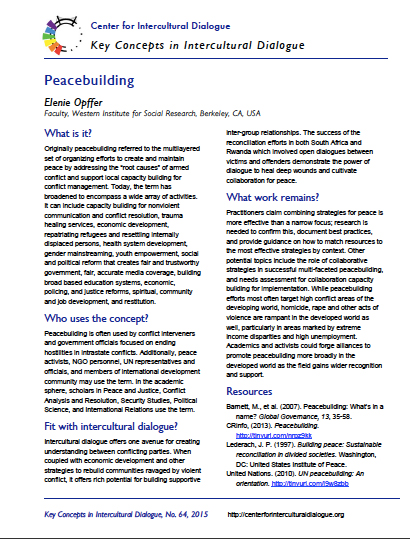
Key Concept #64: Peacebuilding by Elenie Opffer

Opffer, E. (2015). Peacebuilding. Key Concepts in Intercultural Dialogue, 64. Available from: https://centerforinterculturaldialogue.org/wp-content/uploads/2015/05/key-concept-peacebuilding.pdf

The Center for Intercultural Dialogue publishes a series of short briefs describing Key Concepts in Intercultural Dialogue. Different people, working in different countries and disciplines, use different vocabulary to describe their interests, yet these terms overlap. Our goal is to provide some of the assumptions and history attached to each concept for those unfamiliar with it. As there are other concepts you would like to see included, send an email to the series editor, Wendy Leeds-Hurwitz. If there are concepts you would like to prepare, provide a brief explanation of why you think the concept is central to the study of intercultural dialogue, and why you are the obvious person to write up that concept.


Creative Commons License
This work is licensed under a Creative Commons Attribution-NonCommercial-NoDerivatives 4.0 International License.


Elenie Opffer Profile

ProfilesElenie Opffer, Ph.D., Communications, University of Colorado, Boulder is a faculty member at the Western Institute of Social Research in Berkeley, CA. She is also affiliate faculty at California Institute of Integral Studies in San Francisco, CA and serves as a teaching fellow at the Intercultural Communication Institute’s summer intensive program.

Elenie Opffer

Her research focuses on studies investigating the intersection of cultural, gender, and/or sexual identities and the ways in which people construct, negotiate and transform their identities and communities. She is currently involved in applied research to aid peacebuilding and gender violence reduction efforts in high conflict areas of Nigeria. She serves as a senior advisor to the Center for Sustainable Development and Research in Africa, and the National Peace Summit Group of Nigeria. While she has conducted ethnographic and discourse analysis studies, her passion is for conducting action research where the results can be immediately applied to social transformation efforts. In this endeavor, she has created conflict transformation materials and LGBTQ Safe Zone Materials used in universities and communities.

Selected publications:

Opffer, E. (2010). The rhetoric of Rocky Mountain Women: Talking, trekking, and transforming a male preserve. In L.K. Fuller (Ed.), Sexual sports rhetoric globally. New York: Peter Lang.

Opffer, E. (2005). My mother is Greek and my father is plain: Growing up Greek in America. In W. Leeds-Hurwitz (Ed.), From generation to generation: Maintaining cultural identity over time. Cresskill, N.J.: Hampton Press.

Opffer, E. (1997). A Systemic Approach to school conflict resolution programs. Theory to Practice, 36(1), 46-52.

Opffer, E. (1996). Constructively confronting intractable conflict: Lessons from the Amendment II controversy. Working Paper 96-4. Boulder: Conflict Resolution Consortium, University of Colorado.

Opffer, E. (1994). Coming out in class: Notes from the college classroom. In R.J. Ringer (Ed.), Queer words, queer images: Communication and the construction of homosexuality. New York: New York University Press.


Work for CID:
Elenie Opffer wrote KC64: Peacebuilding and KC71: Safe Space, and was interviewed on these topics.

IPD Academy in Peacebuilding, Mediation, Intercultural Dialogue (2015)

Institute for Peace and Dialogue (IPD)
Academic Programs 2015

A) 2 International Summer Academy programs in Peacebuilding, Mediation, Conflict Resolution & Intercultural Dialogue

– I Summer Academy: 7-17 August, 2015

– II Summer Academy: 17-27 August, 2015

Place: Baar, Switzerland

B) 3 Month Certificated Academic School in Mediation & Conflict Resolution (CAS in MCR)

Date: 17 August – 17 November 2015

Place: Switzerland

Rosanne Teniente-Micro grant report

This slideshow requires JavaScript.

In Spring 2014, Rosanne Teniente was awarded a micro grant funded by the Association for Business Communication. The following is her report.


This past August I was privileged to have the opportunity to attend the Institute for Peace and Dialogue’s Summer Academy on Peacebuilding and Intercultural Dialogue hosted in Baar, Switzerland. IPD is an organization dedicated to conflict resolution, peacebuilding, and intercultural dialogue, and host conferences and trainings for those interested in peacebuilding and cross-cultural communication. I was there for ten days from August 17th through 27th and was partially funded through a microgrant from ABC, awarded through CID.

To say the least, it was a truly inspiring experience that I will cherish for the rest of my life. The experts invited were all very knowledgeable about their speaking topics, ranging from the Middle East conflict, non-violent communication and civil disobedience, to learning how to influence and persuade others, especially in dealing with conflict. Experts included a former French diplomat, the founder of the Pancevo peace movement in Serbia who was also directly involved in the Otpor movement that brought down Milosevic, as well as a former British colonel who worked on the Transnistrian conflict. There were also several experts in communication topics, ranging from cross-cultural communication, persuasive communication for successful negotiation, and non-violent communication. Every day had enthralling lectures, with great exercises and activities to really involve the participants.

Perhaps what really made the conference as special as it was were the other attendees. There were about thirty other participants, attending from all over the world. Everyone’s unique cultural background and experiences lent to amazing discussion and insight. One gentleman hailed from the Democratic Republic of Congo and was able to share his experiences in such a high-conflict country. Another came from Iraq and was able to eloquently explain the issues of ISIS and how his country is faring in the post-Iraq war years. Other participants were active peace practitioners, working for the United Nations, the Carter Center, and Peace Brigades International. At the end of the conference, we all agreed that one of the most rewarding aspects was that we were all blessed to have met and gotten to know each other during the time there, and to have forged such great connections with people from unlikely places.

I feel so fortunate that I was able to participate in such an event. As a graduate student and military spouse, it would have been very difficult to afford to attend the conference without funding from CID. I was also lucky that my university program was also able assist with a supplementary travel grant. While I did have to cover about half of the cost by myself, the microgrant from CID made it possible to attend, and as I said before, this will be an experience that I carry with me for the rest of my life.

TechChange course: Technology for Conflict Management

TechChange course

Course Description

During the last ten years access to mobile phones and internet has increased dramatically worldwide, including regions affected by conflict and violence. These developments provide conflict management and resolution professionals with a variety of new tools for monitoring violence, sustaining dialogue during peace processes, and localizing peacebuilding efforts. This course will cover the use of mobile phones, digital mapping, and social media in conflict management and peacebuilding. Case studies from Kenya, Syria, Uganda and Myanmar, live discussions with experts from international organizations, academia and government, and instructor moderated discussions will make up the core of the learning experience. Participants will also get hands-on experience with mapping software during a simulation the final week of the course. By the end of the course, participants should expect to have developed an understanding of how different pieces of technology work, be able to do basic assessments of technology integration for their organizations, and some basic hands-on experience with crowdsourcing technologies.

NOTE: This course is NOT offered by the Center for Intercultural Dialogue, but by TechChange. Visit their website for further information and to register.

CFP ICTs, Governance & Peacebuilding in Africa

Call for chapter proposals: ICTs, Governance & Peacebuilding in Africa

New information technologies (ICTs) such as mobile phones hold great potential to affect peacebuilding, statebuilding, governance, transparency, and accountability in Africa. ICTs ubiquity and ability to interact with older media enables citizens to experiment with innovative ways of influencing politics.  Despite strong assertions in the existing research regarding the usefulness of ICTs (and media more generally) in political and post-conflict transition, governance, and development, there is very little understanding of how people and communities in Africa actually use these ICTs, and how these uses contribute to governance and peacebuilding.

The Annenberg School for Communication at the University of Pennsylvania and the Programme in Comparative Media Law and Policy at the University of Oxford are currently seeking papers for a forthcoming workshop and an edited volume. Authors are asked to provide critical analyses of how the public uses, makes sense of, and engages with ICTs, and the relationship between ICTs, the public, and governance or peacebuilding. Strong preference will be given to chapters that provide empirical evidence for the arguments put forth. Analyses should be applicable to Africa, and chapters focused on Eastern Africa are especially welcome. Academics from African universities are particularly encouraged to apply.

Funding will be provided for successful authors to attend the workshop, which will be held either in New York, USA or Oxford, UK in June or July 2014.

For chapters incorporating empirical research, we are particularly interested in qualitative methodologies (case studies, ethnography, interviews, etc.) but all approaches are acceptable.

Contributions may focus on, but are not limited to:

• The use of crowd-sourcing in conflict-affected regions • The role of ICTs in accountability or transparency initiatives • Local perspectives on citizen ‘voice’ and the use of ICTs • The use of ICTs in transitional justice processes • The intersection or merging of old and new technologies to impact peacebuilding or governance • ICT innovation at the grassroots level

Abstracts (max. 2000 words) and author biography (max. 100 words) are due by March 6, 2014.

Please send abstracts, as well as any questions, to Libby Morgan.

Notification of selected authors: March 20, 2014
Deadline for submission of rough papers in APA format: June 15, 2014
Deadline for submission of final papers in APA format (6,000-8,000
words): August 15, 2014

This book is being funded by a grant from the Carnegie Corporation of New York and is part of a multi-year research project on ICTs, Statebuilding and Peacebuilding in Eastern Africa.

Jobs and Internships-EPLO listing

The European Peacebuilding Liaison Office (EPLO) based in Brussels, Belgium, lists all jobs and internships of their member organizations on one page of their site. For anyone interested in working internationally (some of their positions are based in Asia or Africa as well as Europe), this can be a great resource. As of today, they are listing positions in mediation in Tripoli, conflict resolution in Sub-Saharan Africa, program officer in Nepal, development officer in Brussels, communications officer in Abidjan, and more.

Summer Academy Peacebuilding & ICD

2nd International Summer Academy in Peace-building & Intercultural Dialogue
17.08 – 27.08.2014
Baar, Switzerland

IPD logo

The Institute for Peace and Dialogue is very glad to announce its next International Summer Academy in Peace-building & Intercultural Dialogue, which is going to be held in Switzerland 2014.  Its image as one of the most favourable places for traveling has made it more interesting to offer an exited and comprehensive program for our participants. Our experts, who are professionals in their fields will contribute to this event, with many years of experience in peace and conflict studies.

Nowadays unfortunately several frozen or ongoing conflicts between or within states still exist. Conflicts are different and if we look to the world mankind, how they are facing many new challenges, coupled with new dangerous situations, i.e. terrorist acts, non-legal arming of conflict sides, re-determination of borders, establishing new countries in the world map, non-providing territorial integrity, trafficking of arms, drugs and human; disputes on the implementation of transnational energy projects, democratization and false elections, revolution and internal political conflicts, armed guerrilla movements, violation and discrimination by nationalists, world economic crisis, climate change and unsafely biodiversity etc. Unfortunately the list is long. Conflicts are related and an integral part of human beings, as conflicts cause violation of human rights.

Existing conflicts weaken every kind of cooperation between nations and states. Without mutual cooperation and understanding, the future prosperity of the region would remain only as a good dream. Taking into consideration of peaceful behavior and engagements, we can make a decision on the strict belief, that opportunities for solving conflicts are feasible. Because in every conflict situation and tension forms we consequently face the below mentioned common situations:

1. Desperate situation and non-solving problems are not eternal;
2. It is possible to make common decision which both sides;
3. We can find common values, traditions and similar situation among conflict parties;
4. Protracted conflicts on the same time endanger regional development and prosperity;
5. Any mediation and negotiation actions are better than nothing.

Main Goal
The main goal of the summer academy is to support institutional academic peace education and strengthen peace-building skills and intercultural dialogue of the international society.

Language of the program
The International Summer Academy will be held in English.

Further information, and application, available from the Institute for Peace and Dialogue.

Building bridges through intergroup dialogue

The Academy for International Conflict Management and Peacebuilding is offering a practical one-week course for peacebuilding practitioners and educators. Building Bridges through Intergroup Dialogue will be held Feb 25-March 1, 2013 in Washington, D.C.

Many peacebuilders will find themselves engaging with groups who have strained relationships. Intergroup Dialogue is a creative tool practitioners can use to engage alienated groups in safe conversation about their identities with the goal of improving understanding, dismantling perceptions of the “other,” and creating alliances that can help pave the way to greater intergroup cooperation, peaceful coexistence, and equality.

In this course, participants will learn the principles and practice of Intergroup Dialogue through participation in a multiple-session, identity-based dialogue facilitated by the instructors. In addition, participants will learn the fundamentals of facilitating Intergroup Dialogue through presentations by expert dialogue practitioners, course readings, and exercises designed to build facilitation skills.

Course Requirements: Participants are expected to attend the full five days of the course and should be prepared to actively participate in six to seven two-hour dialogue sessions over the length of the course. The topic of the dialogue will depend on the make-up of the participants but will center on experiences of identity (race, ethnicity, nationality, profession, gender, political affiliation, etc.).  Participants will be expected to share and reflect on their own experiences of identity in personal and/or professional life.

The Academy for International Conflict Management and Peacebuilding is the education and training arm of the United States Institute of Peace.

Save

Peacebuilding & Intercultural Dialogue Academy

International Summer Academy on Peacebuilding & Intercultural Dialogue
1-11 September 2013, Vienna, Austria

Project Introduction

Institute for Peace and Dialogue is very glad to call interested participants for its first International Summer Academy in Peacebulding & Intercultural Dialogue, which is going to be held in the middle of Europe, Vienna. Its image as one of the most favourable places for travelling, has made it more interesting to offer an exited and comprehensive programme for our participants. We offer you a 11 day training, with a professional education from our excellent experts, who are professionals with many years of experience in peace and conflict studies.

Nowadays unfortunately several frozen or ongoing conflicts between or within states still exist. Conflicts are different and if we can look to the world mankind facing with many new challenges, but on the same time with new dangerous situations: terrorist acts, non-legal arming of conflict sides, redetermination of borders, establishing new countries in the world map, non-providing territorial integrity, trafficking of arm, drug and human; disputes on implementation of transnational energy projects, democratization and false elections, revolution and internal political conflicts, armed guerilla movements, violation and discrimination by nationalists, world economical crisis, climate change and unsafely biodiversity etc. Conflicts are related and integral part of human beings, as conflicts cause unrespect to human rights, violation and clash of rights.

Existing conflicts weaken every kind of cooperation between nations and states. Without mutual cooperation and understanding, the future prosperity of the region would remain only as a good dream. Taking into consideration of all the mentioned useful thoughts above, we can make a decision on the strict belief, that opportunities for solving conflicts are feasible. Because in every conflict situation and tension forms we consequently face with the below mentioned common situations:

1. Desperate situation and non-solving problems are not eternal;
2. It’s possible to make common decision which both sides;
3. We can find common values, traditions and similar situations among conflict parties;
4. Protracted conflicts on the same time endanger regional development and prosperity;
5. Any mediation and negotiation actions are better than nothing.

MAIN GOAL
The main goal of the summer academy is to support institutional academic peace education and strengthen peacebuilding skills and intercultural dialogue of international society.

Save