NCA Microgrants distributed

Micro Grants for Intercultural Dialogue

Earlier this year, the National Communication Association allocated funds to be distributed as micro grants for intercultural dialogue through the Center for Intercultural Dialogue, and the competition occurred throughout the fall of 2012. Far more applications were submitted than could be funded, thus demonstrating demand for this sort of grant, and interest in international travel for research purposes. All proposals went through a process of peer review, and the results are now completed. Grants will be awarded to:

Sarah Bishop
Renee Cowan
Louisa Edgerly
Andrew Spieldenner
Santoi Wagner

Follow their names to see descriptions of their projects, and learn the wide range of countries to which they will now travel and topics they will investigate.

As each project is completed, a final report describing how these scholars made contact with their local hosts, and what they did as a result of their travel, will be provided.

My thanks to all of the applicants. Hopefully that those who we are unable to fund still will be able to take their trips and conduct their research. Further grant possibilities from other sources are listed under grants. In addition, NCA provides several types of information for grant seekers, including additional funding opportunities as well as help with the process.

Thanks to members of the Advisory Board who reviewed proposals on the Center’s behalf: Donal Carbaugh (USA), Janice Hume (USA), Nazan Haydari (Turkey), and Leena Louhiala-Salminen (Finland) for their time and effort in this important effort. Thanks also NCA for providing the funding to support these important projects. This entire process will serve as a valuable pilot for future grants the Center will be pursuing, in order to fund additional projects by other Communication scholars. As further grants are obtained, they will be listed on the Center’s site.

Wendy Leeds-Hurwitz, Director
Center for Intercultural Dialogue

Grant $ for international travel

Micro Grants for Intercultural Dialogue

The National Communication Association allocated $5000 to be distributed as micro grants for intercultural dialogue through the Center for Intercultural Dialogue.

These micro grants are intended to support either or both of the two types of activities described in the mission of the Center: study of intercultural dialogues by Communication scholars, and/or participation in intercultural dialogue through academic interactions between Communication scholars based in different countries, or different linguistic and cultural regions. These grants are sufficient to provide seed funding only: no more than $1000 maximum can be awarded to any one individual. The goal is to encourage international, intercultural, interlingual collaborative research by giving enough funding to offset the cost of airfare only, while providing opportunity (and cause) for matching grants from universities.

If you already have lots of international connections, this grant is not for you – obviously you don’t need it. But if you are at a small college, or if you are a new scholar, and have not yet established significant international connections related to research, you are the intended audience for this competition. If you have been reading publications by an international scholar on a topic of potential relevance to your own research, consider a short trip to discuss ways to collaborate on a future project. If you do not know who has been doing relevant work, check the sources you’ve been reading lately, ask your colleagues, and/or think about who you know from graduate school or who you met (or heard present) recently at a conference. Find someone with similar interests who takes a different stance by virtue of being based in a different cultural context.

The intention is to support the development of new intercultural, professional connections. Thus continuing collaborations are ineligible. Those based in the US are expected to propose travel outside the country. International scholars currently living outside their country of origin are asked to establish a new affiliation in a different region rather than proposing a return to their homeland. We recognize that much interesting work can be done within a country between cultural groups, however this grant program focuses on connecting researchers who are not yet connected, across cultural regions that are typically disconnected. This rationale of cross-cultural connection must be explicit in the project description.

Applicants will need to describe their project, provide a brief resume, a short note from their department chair documenting their current status, and one from the host scholar expressing interest in holding conversations related to research. The initial deadline for review of proposals is November 15, 2012. If funds remain after the initial set of grants are awarded, March 15, 2013 will be the second deadline.

CID Grant Application NCA2012

December 18, 2012 UPDATE: The micro grants for intercultural dialogue have now been awarded, and all funding is being distributed as a result of the first round of applications, so there will not be a second round. See here for the results.

CFP Communication History

A Century of Communication Studies
CALL FOR CHAPTER  PROPOSALS
The editors (Pat J. Gehrke, University of South Carolina and William M. Keith, University of Wisconsin-Milwaukee), in cooperation with the National Communication Association, invite chapter proposals for the National Communication Association’s 100-year anniversary volume, contracted for publication by Routledge in 2014.

We invite authors to propose chapters that promise to accomplish four things:

1. Take as its central focus a clustered theme that bridges the disciplinary sub-divisions. Recommended themes include:
*Speech  / Speaking / Voice / Orality
*Identity / Identification / Self
*Context / Situation / Event
*Interdisciplinarity / Disciplinarity
*Politics / Power / Efficacy / the Political
*Science / Method / Epistemologies
*Psychology / Mind / Thought
*Body / Embodiment / Performance
*Relating / Dialogue / Discussion / Relationships
*Organizing / Sociality / Movements / Collectives
*Purpose / Goal / Outcome / Effect
*Audience / Listener / Persona / Receiver
*Media / Medium / Mediation
*Meaning / Significance

2. Give consideration to the past 100 years of the discipline, including teaching and research as appropriate. This includes finding a lineage, genealogy, or history that can weave the clustered theme into a relationship with the discipline’s history and story since the early twentieth century. Chapters should adopt a critical and thoughtful relationship to the discipline and its history, rather than offering uncritical adulation or simplistic idealization. We encourage authors to consider opportunities not only to celebrate the accomplishments of the discipline, but to explore the challenges and controversies in communication scholarship. Such studies may likewise offer perspectives on possibilities and prospects for future research, scholarship, and teaching.

3.  Use a variety of sources, as appropriate, including journals, books, and archival resources.  These sources might include our current journals back to their beginnings, journals no longer published (such as the Public Speaking Review), books, collected papers of specific scholars, and the archives of associations, departments, or institutions.

4. Proposals should include a plan for having a complete draft of no more than 8,000 words to the editors by September of 2013. 

Each chapter should cut orthogonally across the current categories and subdivisions of communication studies, drawing together diverse materials to explore the richness of the communication literature by following concepts rather than professional affiliations. Chapters need not be completely discrete and we anticipate some overlap between them. Each recommended theme is specific enough to provide a core node for the organization of a history, and a touchstone for both the authors and readers.  However, each is also broad enough and dispersed enough across the specializations within the discipline that the authors will need to account for a variety of orientations and methods in analyzing the function of that theme for communication studies. Each theme has its challenges and its insights, and each has made a strong appearance in our scholarship of teaching and learning, as well as our research. Likewise, these themes can be traced not only across the range of our sub-fields but at least back to the earliest years of the national association. Chapter proposals organized around additional themes are welcome, but should likewise meet these same general criteria.

Proposals should be 500-1000 words, submitted along with a copy of the authors’ curricula vitae, by electronic mail to Pat Gehrke at PJG@PatGehrke.net by August 15, 2012. We prefer Adobe Acrobat (pdf) file format, if possible. Microsoft Word (doc/docx) or Open Document (odt) are also acceptable. We especially encourage proposals from pairs or small groups of authors who represent a diversity of backgrounds, methods, or academic ranks. All proposals will receive confirmation of receipt within three business days. The editors will finalize the list of contributors by early September 2012.

Please direct questions or inquiries to Pat Gehrke or Bill Keith

Ethnography of Comm conference 2012

The “Ethnography of Communication: Ways Forward” conference was held June 10-14, 2012, at Creighton University, in Omaha, Nebraska. Dr. Jay Leighter was the conference organizer, together with Dr. Donal Carbaugh; the National Communication Association sponsored the event as one of its summer conferences (along with funding from several parts of Creighton University).

I presented a paper co-authored with Dr. Patricia Lambert, of the Institut Français de l’Éducation in Lyon, entitled “A Prophet Abroad? The Impact of Hymes’ Notion of Communicative Competence in France and French-speaking Switzerland.” In addition, I was invited to participate in two roundtable discussions, one on “Ethnography of Communication Theory and Methodology: Taking Stock and Ways Forward” and the other “Ways Forward: Institutes, Centers, and Affiliations.” In the latter, I was invited to present a description of this Center, which resulted in many new “likes” to the Center’s facebook page.

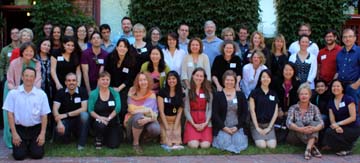
Many of those participating in the conference are included in the following photo (though certainly several critical people are missing, including Dr. Gerry Philipsen and Dr. Donal Carbaugh).

One of the pleasures of the conference for me was the presence of so many of those involved in the NCA Summer Conference on Intercultural Dialogue, held in Istanbul in 2009, which led to the creation of this Center. This included several from the organizing committee (Drs. Tamar Katriel, Donal Carbaugh, Kristine Fitch Muñoz, and Saskia Witteborn), one of the guest speakers (Lisa Rudnick) and several of the participants (Drs. Todd Sandel, Chuck Braithwaite, Evelyn Ho, Eric Morgan, and Tabitha Hart). Another was catching up with Dr. Susan Poulsen, who organized “Ways of Speaking, Ways of Knowing: Ethnography of Communication” in Portland in 1992, the predecessor conference to this one in terms of topic. Other joys of the week included having time to connect with people I had not seen in a long time, previously only had met through correspondence, or students of my colleagues who I did not know at all.

Wendy Leeds-Hurwitz, Director
Center for Intercultural Dialogue

NCA IICD distinguished scholarship awards

Call for Nominations:
NCA IICD 2012 Distinguished Scholarship Awards

Nominations are invited for the NCA Distinguished Scholarship Annual Awards by the International and Intercultural Communication Division for scholarship published during 2011 in the areas of international and intercultural communication. Up to four awards will be given for the following categories featuring work in international and intercultural communication:
· Best Book (edited or authored)
· Best Article (or Book Chapter)
· Best Dissertation and/or Master’s Thesis

Unless otherwise specified, all nomination materials must be by electronic submission only to: ymiike@hawaii.edu and must include the following:
(A) A nomination letter outlining justification for the award.
(B) For ARTICLE or BOOK CHAPTER submissions, send PDF copies only.
(C) For BOOK submissions, send three (3) copies of the complete work. (You may ask your publishers to send copies directly as part of their promo!)
(D) For DISSERTATION or THESIS submissions, mail three (3) CD-Rom copies of the complete work.

Mail hard copies (for C & D) to:
Dr. Yoshitaka Miike
Department of Communication
Humanities Division
University of Hawai‘i at Hilo
200 West Kawili Street
Hilo, HI 96720-4091, USA
E-mail: ymiike@hawaii.edu

Awards will be presented at the International and Intercultural Communication Division Business Meeting at the NCA 2012 Annual Convention in Orlando, Florida in November. Recipients of the awards will be notified by September 1, 2012 and are expected to be present for the award presentations. Self, peer, or advisor nominations accepted. Works must have been published during the 2011 calendar year.

Nomination packets must be received by April 15, 2012.

NCA 2011

On November 20, 2011 I presented “Learning to walk like a local: Applying Goffman’s theory of face to pedestrian behavior” at the National Communication Association convention held in New Orleans, LA. My co-author for the paper was Prof Yves Winkin, Director of the Institut Français de l’Education in Lyon, France, and we divided up the presentation. My thanks to Prof. Beth Haslett for organzing the panel, and inviting us to participate.

While at NCA I met with several members of the Advisory Board of the Center for Intercultural Dialogue (Profs Donal Carbaugh and Barbara Hines) as well as the Center’s Technology adviser, Dr. Brenda Berkelaar, and the President of the Council of Communication Associations, Prof. Patrice Buzzanell. I also met with dozens of scholars about the Center, participated in business meetings for several divisions of NCA and, of course, attended sessions. A number of those who participated in the NCA Summer Conference on Intercultural Dialogue in 2009 were at NCA, and I had a chance to talk with at least half a dozen. Several people made very good suggestions for additions to the website – so look for what’s new in the coming months!

Wendy Leeds-Hurwitz, Director
Center for Intercultural Dialogue

Save