How can we acknowledge the multiple languages and dialects that are present in young people’s lives? And what happens if we don’t? Following 6 years of creative collaboration between Neela Doležalová, an East London primary school and the School of Advanced Study at the University of London, this new podcast series shares insights and questions from the multilingual classroom.
What does it mean to belong? Are there different types of belonging? What is the difference between belonging and ‘fitting in’? What role does language play in a sense of belonging? Inspired by the 1000 WORDS FOR WEATHER project, Neela went back to Gearies Primary School to work on a multilingual arts project entitled 1000 WORDS FOR BELONGING. Over one year, all of the students in Year 6 explored the concept of ‘belonging’ through playwrighting, poetry and visual art. The project has been documented on instagram and through the creation of a new podcast. The project was part of a collaboration between the School of Advanced Studies, educators and local artists.
An ethnographic study of ethnic minority students’ multilingualism in rural China: A conversation with Yizhe Jiang.
I have had the good fortune of sharing a conversation recently with Professor Yizhe Jiang (at the University of Macau) about her doctoral dissertation research in Guizhou Province, China. Her research on some important aspects of multilingualism of young ethnic minority students in Rural China involved extensive ethnographic fieldwork and, in my views, its outcome can help shed light on some important aspects of our work in intercultural communication and dialogue. This is the second installment of a series of conversations with colleagues in various disciplines for their insights and perspectives on matters and practices in this regard.
Yizhe, thank you very much for sharing your research work and reflections with us. To better contextualize our conversation for our readers, what is the general focus or thesis of your Ph.D. dissertation research? How is the research focus relevant to intercultural communication or dialogue?
The title of my Ph.D. dissertation is The Nature of Multilingualism of Ethnic Miao and Dong Liushou Ertong in Rural China. This research is based on an ethnographic study of a unique group of children in Guizhou Province (貴州省), China. These children belong to the Miao (or Hmong) and Dong (or Kam) ethnic groups and live in the multiethnic and multilingual Jinping County (錦屏縣), which is part of Qiandongnan Miao and Dong Autonomous Prefecture (黔東南苗族侗族自治州) in Guizhou. They speak their ethnic languages (Miao or Dong), a regional Han Chinese dialect (Jinpinghua), standard Mandarin (Putonghua), and learn English in junior middle school. My study investigated their daily language use and functions at school, as well as their ideologies regarding these different language varieties.
Through many intercultural dialogues, the research highlighted how these children navigated various cultural contexts—Miao, Dong, and Han (the majority ethnic group in China), as well as modern and traditional, formal and informal, urban and rural dynamics.
What motivated you to pursue the subject matter? Why was researching the subject matter important to you, say, professionally and personally?
Due to significant economic disparities between major cities in eastern China and rural areas in the west, my study participants are ethnic minorities and Liushou Ertong (留守兒童), a unique group of children whose parents work in large cities for better incomes. Consequently, these children are often cared for by their grandparents and see their parents only a few times a year. Unlike their urban counterparts raised by their parents, these students show stronger proficiency in their ethnic languages, namely Miao or Dong, as they have to communicate with older relatives in their traditional villages. At school, they naturally switch between ethnic languages, Jinpinghua, and Putonghua for different communicative purposes. Intrigued by their linguistic repertoires and concerned about their living conditions, I am eager to explore their stories and share them with the outside world.
Please briefly describe your project’s field research sites and their relevance to address your questions.
A glimpse of the center of Jinping County (錦屏縣), Guizhou, China, September 2021
I took the above picture in the center of Jinping County, where two large rivers merge—part of the upper reaches of the Yangtze River. The government has implemented strict environmental protection laws and regulations. As a result, there are few large companies and factories in the area, causing most young adults to work outside the county. Consequently, many children here are Liushou Ertong, especially those living in remote villages.
All of my participants were enrolled in a suburban boarding middle school, featuring an equal representation of Miao and Dong students. Due to the accelerating pace of urbanization, fewer children remain in villages in Jinping, resulting in the closure of middle schools in remote areas. After graduating from village elementary schools in six Miao and Dong towns, these students enter the central middle school in suburban Jinping, where they spend five days a week and take a bus home on weekends.
Who were the main human subjects of your project’s field research, such as students, their families, teachers, school administrators, etc.)?
At the center of my study are four ethnic minority Liushou Ertong: Ling, Xian, Min, and Fei (pseudonyms). Ling and Xian are Miao girls from different villages in the same town, while Min is a Dong girl living half an hour away from Fei, a Dong boy from the same mountain range.
To understand the students’ language use at home, I interviewed their grandparents. I also interviewed four teachers: Mr. W, a Dong male history teacher who occasionally uses Dong in formal classes; Mr. W, the vice principal and English teacher who knows the school language policy well; Mr. P, a Dong female who served as their Chinese teacher and frequently communicated with the students’ families; and Mr. L, a Miao female English teacher who taught these students for one year. All are fluent in their ethnic languages and familiar with the students’ language habits.
What have been some of the biggest challenges facing you over the course of your fieldwork and how did you address these challenges?
First, my unfamiliarity with Guizhou Province presented a challenge, as I had never visited it before. To acclimate, I worked as an English teacher for a year, teaching 266 hours to build rapport with students and teachers while learning the local languages.
Second, transportation was an issue since many participants lived in remote villages, with some Dong students residing up to an hour and a half from downtown. The winding mountain roads often made me carsick, so I sometimes invited friends or family to drive with me. I also hosted students in my apartment for TV or homework sessions, fostering communication among diverse linguistic backgrounds.
Another challenge involved language barriers. While I gradually learned the local dialect, Jinpinghua, I struggled with Miao and Dong, which belong to different language families. This often required me to rely on student translations during interviews, necessitating repeated confirmations for clarity.
What were the most memorable moments, events, encounters, etc., that you experienced over the course of your fieldwork? Why were they memorable to you?
While reading this question, many memorable moments came to mind. One afternoon, when I was walking in the mountains with two girls, I discovered a beautiful crystal stone. A girl told me it was a flint, and they introduced me to various herbs along the path. Despite being their teacher, I learned a great deal about nature from these students.
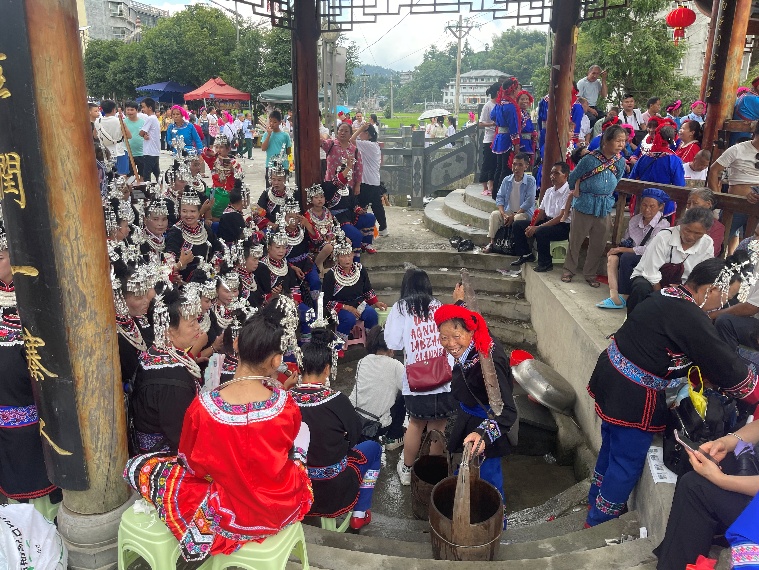
Another highlight was participating in the Miao Tasting Festival, which celebrates rice growing. Jinping is sea of folk songs, with singing competitions and activities during every traditional festival. People dressed in their ethnic attire came from various villages and even neighboring provinces. I captured a photo of some Dong and Miao people in different styles of costumes, resting and chatting by a well.
A Miao tasting festival underway in Ouli Town (偶里鄉), July 2023
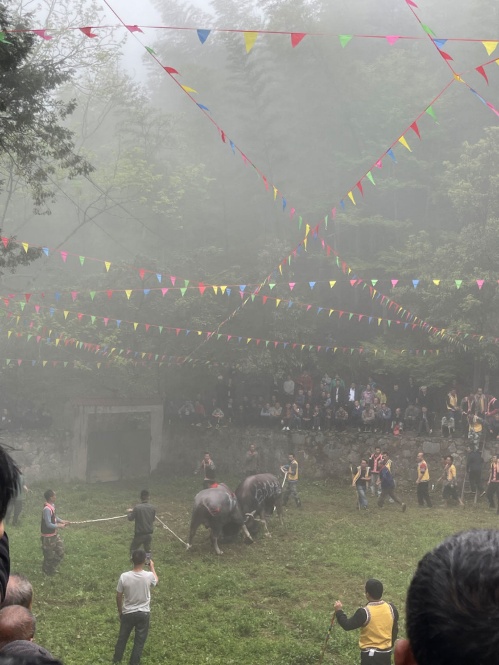
I also attended a bullfighting competition, a favorite among the Dong people, which caused traffic jams even in the mountains.
A bullfighting competition in action in Yandong Town (彥洞鄉), April 2023
The most touching moments were those spent in nature, truly experiencing “field” work. Observing students in rice fields, villages, and forests, I recorded the beautiful sounds of cicadas, birds, barking dogs, crowing roosters, and the sound of fish tails hitting the water in the rice fields, along with the elders singing Dong songs. I dedicated my thesis to this generous, poetic, and mysterious land of Guizhou Province.
What was the one most important lesson that you think you have walked away with from your ethnographic fieldwork?
I believe the most important lesson is to be patient. During my initial round of interviews with the children, they were uncertain about their use of and feelings toward different languages. I felt disappointed, fearing I might not uncover many interesting aspects.
However, as I grew more familiar with them, I discovered numerous intriguing moments. For example, Jinpinghua is commonly spoken in Miao villages near the downtown area, but it was almost inaudible in Dong towns. After spending a year at school, Dong students picked up this dialect from their Miao peers and those from downtown, eventually speaking it fluently.
What advice would you give to colleagues in the field who are interested in conducting ethnographic research in China (especially in rural China), such as things they must consider doing or preparing for and things they should avoid?
I believe the first step is to be patient, as people from these areas may be unfamiliar with being observed and interviewed. Most of them have never been interviewed before and often associate it with something serious and formal. It’s crucial to spend time with them, building close relationships that help them relax, trust you, and understand that your study is not an exam.
You also need to respect local culture and customs. For example, my students’ grandparents always cooked and waited for me to share a meal during my visits. Initially, I felt guilty, but I soon realized this was their custom. They feel sad if guests don’t join them for a meal. So, throughout the rest of my study, I always brought food or cooked with them, which provided many opportunities to observe their conversations in the kitchen.
Additionally, attending their traditional festivals and activities is always fascinating, as it allows you to witness people from different backgrounds gathering and engaging in intercultural communication.
In summary, reflecting upon my learning from Yizhe’s experience and insight, I would like to offer four Key Takeaways, as follows:
First, it is not uncommon that students in China of ethnic minority heritages are bilingual or multilingual, thus presenting unique challenges and opportunities to language or intercultural educators.
Second, rural education in China, especially in regard to world language education in rural China, remains a subject that has yet to receive an extent of academic attention it rightfully deserves.
Third, due to diverse and complex inter-regional or intra-cultural differences, conducting ethnographic research in China requires a great deal of preparation and patience even as the researchers may have come from a Chinese heritage.
Fourth, immersing oneself in ethnographic research, in the manner in which Dr. Jiang has endeavored, can be, and often is, a transformative experience for the researcher.
Special Issue Editors: Ibrar Bhatt (Queen’s University Belfast, UK); Othman Barnawi (Royal Commission for Yanbu Colleges and Institutes, Saudi Arabia); Rizwan Ahmad (Qatar University, Qatar)
Across the fields of sociolinguistics, applied linguistics, literacy studies, and linguistic anthropology, the role of religion has been present yet marginalised, and often subsumed under broader categories such as ‘identity’, ‘ideology’, or ‘cultural practice’. Despite this presence, scholarship within linguistic and cultural studies, broadly speaking, has not fully capitalised on the onto-epistemic
potential of how language and society intersect in contexts where the Islamic faith serves as a defining worldview. Engaging more deeply with such contexts offers valuable opportunities to advance research on religious multilingual and multicultural development, particularly when grounded in Islamic historicity, theology, and the distinctive features of Islamic knowledge traditions.
This special issue seeks to redress this imbalance by exploring a ‘sociolinguistics of Islam’, a conceptual and empirical orientation, as defined by Bhatt, Barnawi and Ahmad (2025), that foregrounds contexts of linguistic practice shaped by Islamic traditions, whether in Muslim-majority or Muslim-minority settings, as deserving of dedicated scholarly attention. The sociolinguistics of Islam refers to the exploration of how language and society intersect within contexts where the Islamic faith is a defining worldview shaping language, literacy, and other processes of semiosis. Building on foundational work in the ‘sociology of language and religion’ (e.g. Fishman 2006; Omoniyi 2010), and drawing inspiration from sociolinguistic analyses in religious communities (e.g. Spolsky 2014; Shandler 2006; Fishman et al. 1966), this special issue invites critical, theoretical, and empirical contributions that advance the study of language within Islamic sociolinguistic ecologies.
Editors: Fatma F.S. Said (Zayed University, UAE), Kristin Vold Lexander (University of Inland Norway), Åsa Palviainen (University of Jyväskylä, Finland)
Editors invite proposals for chapters for an innovative edited volume that interrogates and redefines the concept of “heritage” in multilingualism studies. Titled Heritage reimagined: Multilingualism, identity, and belonging across family, faith, and digital worlds, this volume will explore how heritage is constructed, challenged, and reimagined in everyday multilingual experiences. They welcome empirical, theoretical, and reflexive contributions from across disciplines, including sociolinguistics, linguistic anthropology, education, digital culture, anthropology, and religious studies.
In an era marked by global migration, digital transformation, and increasing cultural fluidity, heritage, often linked to language transmission, cultural continuity, and religious practice, can no longer be understood through static, nationalistic, or ethnocentric frames. Instead, we view heritage as dynamic and socially constructed, shaped by complex interactions within families, communities, and digital environments.
This volume addresses urgent questions about the meaning and politics of heritage in multilingual contexts, considering the lived realities of individuals navigating heritage across spaces of belonging, faith, and technological mediation.
The evolving field of Multilingual Studies integrates intercultural and interdisciplinary studies missed in traditional scholarship. Most people are multilingual or interlingual (that is, bilingual, trilingual, or simply polyglots), who cross linguistic frontiers as part of daily life or at times mix different linguistic codes as a second nature, usually to a receptively multilingual audience. Linguistic code switching (moving between languages or dialects in a single conversation) in itself brings cultures together in speech and dialogue, which, in return, stimulate further code-switching. Some of us are multilingual by training and others were born into an intercultural and interlingual environment. Multiple dimensions of multilingualism weave intercultural dialogues inherently and intimately.
The GAELFAM investigates the everyday linguistic experiences of families who reside in the Irish Gaeltacht and who use a language other than/in addition to Irish or English in the home. The PhD researcher will focus on adolescents who fit this profile and will carry out a number of tasks to enable the successful competition of their PhD thesis and viva voce examination. The PhD researcher will gain valuable skills in conducting ethnographic research in school settings, and will also present their research findings at a number of national and international conferences, as well as contribute to organising a conference at the University of Galway and a youth-led event, also to be held at the University of Galway. They will also contribute to scholarly publications and publications for a wider audience (e.g. blog posts). Garda-vetting will apply.
This Postdoctoral Research Fellowship is funded by the Norwegian Research Council and is associated with the project Indigenous Language Resilience: From learners to speakers (SPEAKERS). Applicants are expected to propose a research project closely connected to the main project. Through a comparative analysis of Sápmi and three additional cases, the SPEAKERS project investigates why and how some learners transition from learners to speakers of Indigenous or minoritized languages. In many Indigenous contexts schools are key arenas for language revitalisation; the goal of SPEAKERS is to gain a deeper understanding of what happens after students leave school. The project aims to identify and investigate key life moments or mudes that facilitate or trigger the transition from learner to speaker, compare the impact and interaction of key social environmental factors on speaker resilience, and investigate inherent tensions in language reclamation processes and how learners and speakers attempt to solve such tensions.
The postdoctoral fellow will lead one of the comparative cases, and work with other project team members on cross-case comparative analysis. The location of this case is open, and the postdoctoral fellow is encouraged to propose an individual project that builds on their previous work, while also contributing to the larger comparative project. They will consider cases relating to any minoritized language, but the project proposal must make clear how this case could inform the SPEAKERS project as a whole. The applicant must have expertise in one or more of the following disciplines: sociolinguistics, linguistics, linguistic or social anthropology, applied linguistics, education, multilingualism, and/ or Indigenous studies. Experience with fieldwork is highly desirable.
Special Issue Editors: Anastassia Zabrodskaja (Estonia) and Natalia Ringblom (Sweden)
This Special Issue welcomes manuscripts of various types, such as articles, reviews, and conceptual papers of a disciplinary or interdisciplinary nature, that seek to contribute to the analysis of language policy and practice in multilingual families from a multidisciplinary perspective. The multilingual (resp. bilingual) family is a worldwide fact, as more and more families now use more than one language. This provokes situations in which the family is faced with the problem of maintaining a heritage language (mother tongue, home, immigrant or minority language), its transmission to the next generation, or a language attrition and shift towards a dominant (societal or majority) language. Language transmits culture and history; thus, the loss of one’s heritage language can lead to the loss of inherited knowledge. As such, a conscious decision must be made by parents to pass on language, especially as children enter adolescence and become more independent, including in their language choices. Various factors influence the transmission of heritage language and culture, including: motivation (integrative and intrinsic motivation); its symbolic role; linguistic ideologies and language identity; socioeconomic status; social networks; religion; tendency towards social segregation or inclusion; language solidarity; the speaker’s environment and the value of multilingualism in specific domains (family, school, community and individual); and the use of heritage language in public space and its usefulness and cultural value.
Language, Education & Linguistic Citizenship is a two-day online summer school program.
How can educators gain a better understanding of multilingual students’ use of language?
How can they acknowledge and foster their students’ linguistic repertoires and their right to be heard?
What is the relationship between language education and linguistic citizenship?
These and other questions will be explored in this participatory short course which will involve workshops, case studies, data sessions, readings and talks. You will join participants from a range of educational settings and sectors. The summer school is organised by HELD, a team of academics and third sector language professionals, activists & policy specialists: Melanie Cooke (convenor), Dermot Bryers, Sam Holmes, Constant Leung, Ben Rampton, Anthony Tomei, and Becky Winstanley.
Enrollment is limited to 30 participants. They will give priority to people whose work seems to fit with their aims and who they think will most benefit from the summer school, based on your application form. There is a participation fee of £30 (£10 for full time students), payable when your place has been confirmed.
Recent debates of linguistic diversity have problematised paradigms such as bi/multilingualism, and code-switching for reifying static language boundaries and for their inability to account for communicative practices constructed out of a diversity of linguistic repertoires. Instead, trans- perspectives have been introduced to capture the critical linguistic diversity, especially in the context of digital platforms. This emergent trans- tradition in reflects the difficulty, if not futility, of demarcating linguistic features according to specific languages, for the fluid movement between and across languages.
Yet, this recent tradition still tends to celebrate and thus exoticize the presumed digital linguistic diversity in and from the Global South, although it is indeed ‘quite normal’, ‘unremarkable’ ‘ordinary’, ‘basic’, ‘everyday’, and by no means a new phenomenon. In so doing, scholarship inadvertently constructs and exoticizes a linguistic Other whose digital linguistic diversity are expected to be made legible according to normative epistemologies of diversity.
This lecture is based on the premise that the analytic potential of the trans- tradition can be enhanced through a stronger focus on such practices as reflective of everyday, quotidian, basic, mundane, unremarkable, banal, and ordinary occurrences, rather than of peculiar, exotic, eccentric or unconventional ones. It is important to recognise that digital linguistic diversity in and from the Global South is neither to celebrate nor to deplore, but something to observe and examine with interest like anything else, as it is inevitable that peoples and cultures have always been mixing and mingling. I conclude that ‘linguistic ordinariness’ is rather ‘diverse’ – a necessary condition of ‘linguistic diversity’ is its ‘ordinariness’.
Dr Sender Dovchin is an Associate Professor and Principal Research Fellow and Director of Research at the School of Education, Curtin University, Australia.

 1000 Words for Belonging: A Podcast about Languages and Belonging in the Classroom, Institute of Languages, Cultures and Societies, University of London, UK.
 How can we acknowledge the multiple languages and dialects that are present in young people’s lives? And what happens if we don’t? Following 6 years of creative collaboration between Neela Doležalová, an East London primary school and the School of Advanced Study at the University of London, this new podcast series shares insights and questions from the multilingual classroom.




 Center for Intercultural Dialogue