CID Poster #3: Intercultural Dialogue

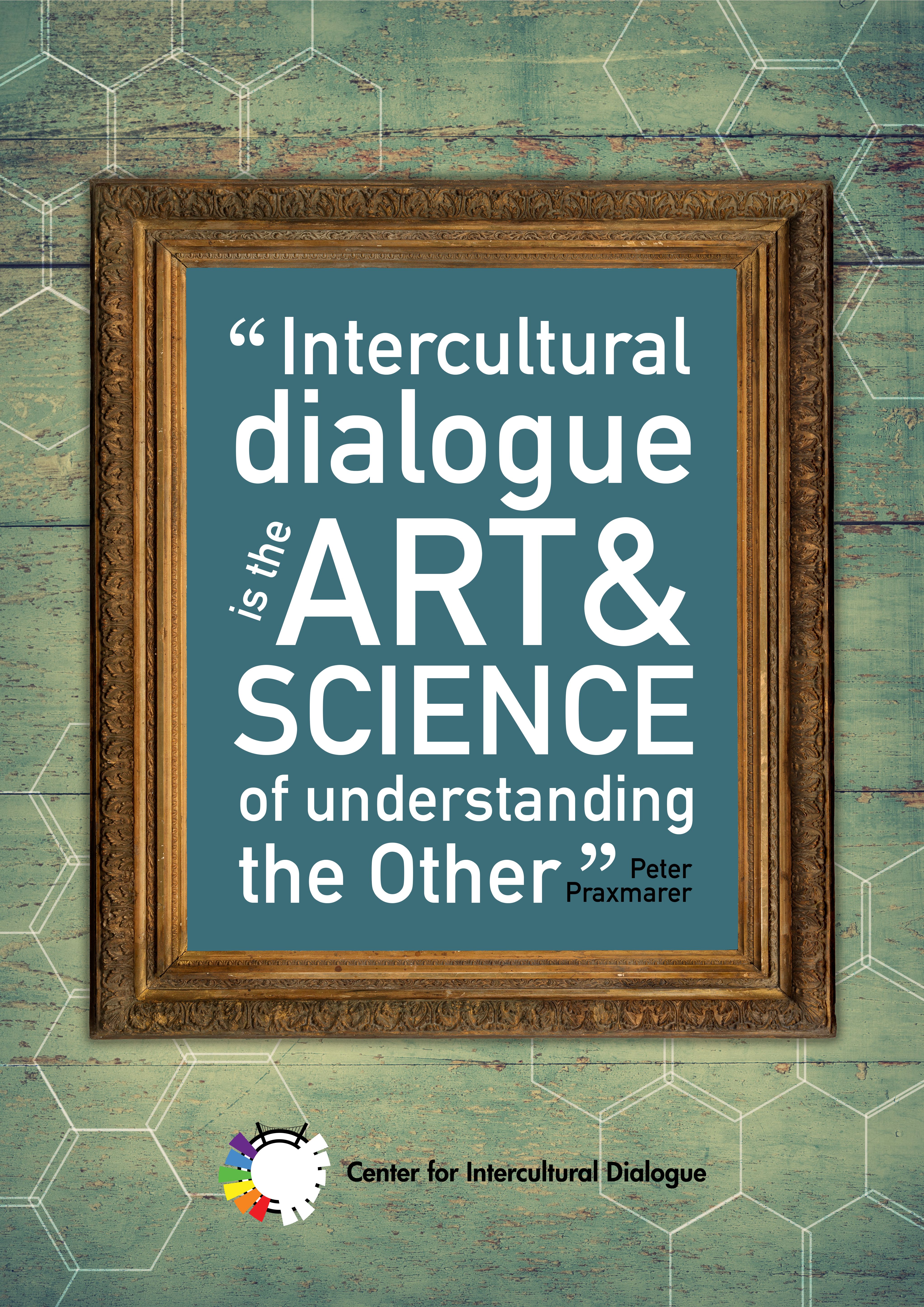
CID PostersThis is the third of the posters designed by Linda J. de Wit, in her role as CID intern. The quote by Peter Praxmarer does not come from a publication, but from a Skype conversation we had on April 25, 2017. I was struck by what he said, and how nicely it summed up the concept of intercultural dialogue, and requested permission to turn the definition into a poster, and he graciously agreed. In terms of visual design, Linda indicated “art” by the picture frame, and “science” by the design in the background. Hopefully this definition will find a wide audience, because I think it does a better and more concise job of explaining intercultural dialogue than other definitions I’ve seen.

Intercultural Dialogue definition

Just in case anyone wants to cite this poster, the following would be the recommended format:

Center for Intercultural Dialogue. (2017). Intercultural Dialogue. CID Posters, 3. Available from:
https://centerforinterculturaldialogue.org/wp-content/uploads/2017/07/art-and-science.png

As with other series, CID Posters are available for free on the site; just click on the thumbnail to download a printable PDF. They may be downloaded, printed, and shared as is, without changes, without cost, so long as there is acknowledgment of the source.

As with other series, if you wish to contribute an original contribution, please send an email before starting any work to receive approval, to minimize inadvertent duplication, and to learn about technical requirements. As is the case with other CID Publications, posters should be created initially in English. Given that translations of the Key Concepts in Intercultural Dialogue have received so many views, anyone who wishes to translate their own poster into another language (or two) is invited to provide that as well. If you want to volunteer to translate someone else’s poster into a language in which you are fluent, send in a note before starting, to receive approval and to confirm no one else is working on the same one.

Wendy Leeds-Hurwitz
Director, Center for Intercultural Dialogue
intercult.dialogue AT gmail.com


Creative Commons License
This work is licensed under a Creative Commons Attribution-NonCommercial-NoDerivatives 4.0 International License.
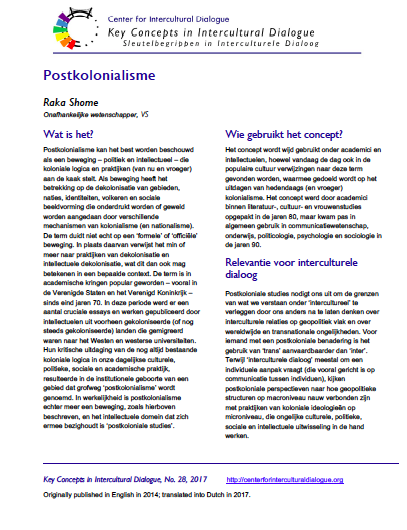
Key Concept #28: Postcolonialism Translated into Dutch

Key Concepts in ICDContinuing translations of Key Concepts in Intercultural Dialogue, today I am posting KC#28: Postcolonialism, originally prepared by Raka Shome for publication in English in 2014, and which Linda J. de Wit has now translated into Dutch.

As always, all Key Concepts are available as free PDFs; just click on the thumbnail to download. Lists of Key Concepts organized chronologically by publication date and number, alphabetically by concept, and by languages into which they have been translated, are available, as is a page of acknowledgments with the names of all authors, translators, and reviewers.

KC28 Postcolonialism_DutchShome, R. (2017). Postkolonialisme. (L. J. de Wit, Trans). Key Concepts in Intercultural Dialogue, 28. Available from:
https://centerforinterculturaldialogue.org/wp-content/uploads/2017/07/kc28-postcolonialism_dutch.pdf

If you are interested in translating one of the Key Concepts, please contact me for approval first because dozens are currently in process. As always, if there is a concept you think should be written up as one of the Key Concepts, whether in English or any other language, propose it. If you are new to CID, please provide a brief resume. This opportunity is open to masters students and above, on the assumption that some familiarity with academic conventions generally, and discussion of intercultural dialogue specifically, are useful.

Wendy Leeds-Hurwitz, Director
Center for Intercultural Dialogue


Creative Commons License
This work is licensed under a Creative Commons Attribution-NonCommercial-NoDerivatives 4.0 International License.
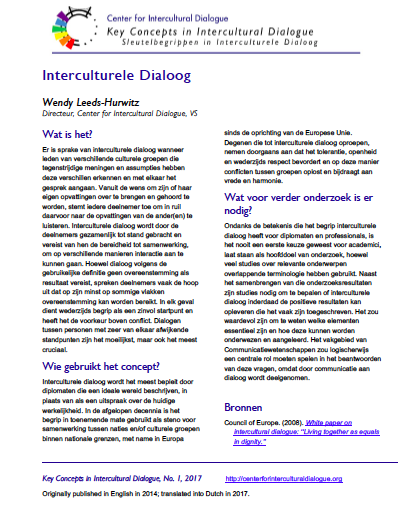
Key Concepts #1: Intercultural Dialogue Translated into Dutch

Key Concepts in ICDContinuing translations of Key Concepts in Intercultural Dialogue, today I am posting KC#1: Intercultural Dialogue, which I wrote for publication in English in 2014, and which Linda J. de Wit has now translated into Dutch.

As always, all Key Concepts are available as free PDFs; just click on the thumbnail to download. Lists of Key Concepts organized chronologically by publication date and number, alphabetically by concept, and by languages into which they have been translated, are available, as is a page of acknowledgments with the names of all authors, translators, and reviewers.

KC1 ICD_DutchLeeds-Hurwitz, W. (2017). Interculturele dialoog. (L. J. de Wit, Trans). Key Concepts in Intercultural Dialogue, 1. Available from:
https://centerforinterculturaldialogue.org/wp-content/uploads/2017/06/kc1-icd_dutch.pdf

If you are interested in translating one of the Key Concepts, please contact me for approval first because dozens are currently in process. As always, if there is a concept you think should be written up as one of the Key Concepts, whether in English or any other language, propose it. If you are new to CID, please provide a brief resume. This opportunity is open to masters students and above, on the assumption that some familiarity with academic conventions generally, and discussion of intercultural dialogue specifically, are useful.

Wendy Leeds-Hurwitz, Director
Center for Intercultural Dialogue


Creative Commons License
This work is licensed under a Creative Commons Attribution-NonCommercial-NoDerivatives 4.0 International License.
Save

Save

Amritsar: Conflict & Harmony

Guest PostsAmritsar: Conflict and Harmony
Guest Post by Linda J. de Wit

Amritsar is a medium-sized city in India serving as a tourist destination for two main reasons. First, it is the location of the holiest temple of the Sikh religion; second, it is the closest city to the Wagah border crossing with Pakistan where thousands of visitors assemble to watch the ceremonial closing of the gates every day.

The city and its surroundings have great significance in the history of Partition and the border ceremony is probably the most tangible example of the persistent tensions between the countries separated in 1947. In a remarkably aligned military drill, soldiers on both sides parade up and down, accompanied by hostile looks, aggressive hand gestures, and kicks so high they are basically standing splits. The audiences cheer every move in what almost looks like a dance-off.

When the two flags simultaneously are lowered, a single brief handshake takes place before the border gates are violently slammed shut in the neighbor’s face. The crowds applaud and shout patriotic slogans. The ceremony is a joyful event with music and dancing, having the atmosphere of a sports game. The souvenirs on the Indian side signal that the subject matter is more serious, as they boast about the “world’s largest border guarding force.” Most visitors have probably never been, and will never go, to the other side.

Back in the city, one can visit the Partition museum, the only one in the country. It recounts how the division of British India along religious lines caused millions of people to leave their homes. Amritsar’s train station saw refugees leaving in both directions, as well as packed trains arriving with no one alive, attacked because they were Muslims or Hindus.

A stone’s throw from the museum is a walled garden, Jallianwala Bagh, where a massacre took place by British forces among peaceful protesters in 1919. Gatherings had been forbidden and, without providing a warning, soldiers opened fire on the crowd for ten minutes, killing hundreds. This was one of the events that nourished the independence movement in India.

The city’s main attraction, however, is a different place, drawing more visitors than the Taj Mahal: the Golden Temple. It is the spiritual center of Sikhism because it is where the original version of the religion’s holy book lies. The Temple’s four doors symbolize that people from east, west, north and south can enter the place, irrespective of caste, creed and sex: Sikhism’s fundamental values include absolute equality and the unity of humankind.

The free information booklets distributed around the Temple describe how Sikhism holds that, in essence, all religions are an expression of the same fundamental truth. The founder of Sikhism, Guru Nanak (1469-1539), strove to bring Hindus and Muslims together: “his life and teachings were a symbol of the harmony between the two communities.”[1]

The peaceful ambience of the Temple complex is a heartening change from the city’s gloomier connotations. Tears may spring to the visitor’s eyes, due to mountains of onions being peeled by countless volunteers: every Sikh place of worship has a common kitchen distributing free meals. At the Golden Temple some 75,000 people per day share the same food, sitting together in a row on the floor.

For the moment, such harmony is, on a larger scale, still something to strive for. Last December, the Heart of Asia peace summit took place in Amritsar, but India and Pakistan did not successfully initiate a dialogue process.[2]

The significance of Amritsar in history, as in the present, remains ambiguous. The city is the backdrop of some of the most intense examples of failing intercultural and interreligious dialogue and the consequences thereof. At the same time, as the capital of Sikhism, the city is imbued with the inclusive philosophy of tolerance and unity. For all its contrasts, Amritsar ultimately is a symbol of hope of a better future.

[1] Dr. Sir Radhkrishnan, as cited in: Singh Shan, H. (2015). Sri Guru Granth Sahib. The Unique and Universal Scripture. Dharam Parchar Committee.

[2] http://www.atimes.com/inod-pak-dialogue-process-fails-launch-amritsar/

Download the entire essay as a PDF.

Save

Linda J. de Wit Profile

CID People

Linda J. de Wit holds a BSc in Political Science, a BA in Philosophy, and an MA in Global Studies.


She is connected to CID as a graphic design consultant since 2020. In 2017 she completed an internship working on projects related to CID’s publications and visual identity.

Linda has worked in development, education, and graphic design, and enjoys photography and language learning. Having lived across four continents, though most of the time in the Middle East, she developed a broad interest in intercultural communication and dialogue.

She wrote her master’s thesis about the Egyptian community in Dubai – one of the most international places in the world – from the frameworks of transnationalism and social identity theory.

You can find her design work, photography, and articles she has written on her website LindaJW.com.


Work for CID:

Linda de Wit produced 13 of the 14 CID Posters, the poster for the 2018 video competition, the current CID brochure, CID letterhead, and prepared the layout and design for In Dialogue: CID Occasional Papers. She also designed the CID Report for the UNESCO Futures of Education initiative.

In addition, she wrote two guest posts, Andalusia’s ambivalence: Between convivencia and Islamophobia, and Amritsar: Conflict and harmony, and translated KC1: Intercultural Dialogue and KC28: Postcolonialism into Dutch.