CID Poster 1: Intercultural Communication / Competence / Dialogue Translated into German

CID PostersThis poster was designed by Linda J. de Wit, and published previously; it now has been translated into German. This one provides a quick and easy way to understand, and differentiate between, the concepts of “intercultural communication,” “intercultural competence,” and “intercultural dialogue,” using a rooster and a sheep to represent members of different cultures (and she notes that the animals are vector designs by vecteezy.com).

The German translation was provided by Maria Faust, and the graphic design work necessary to revise was by Yan Qiu. Here then is CID Poster 1: Interkulturelle Kommunikation / Kompetenz / Dialog.
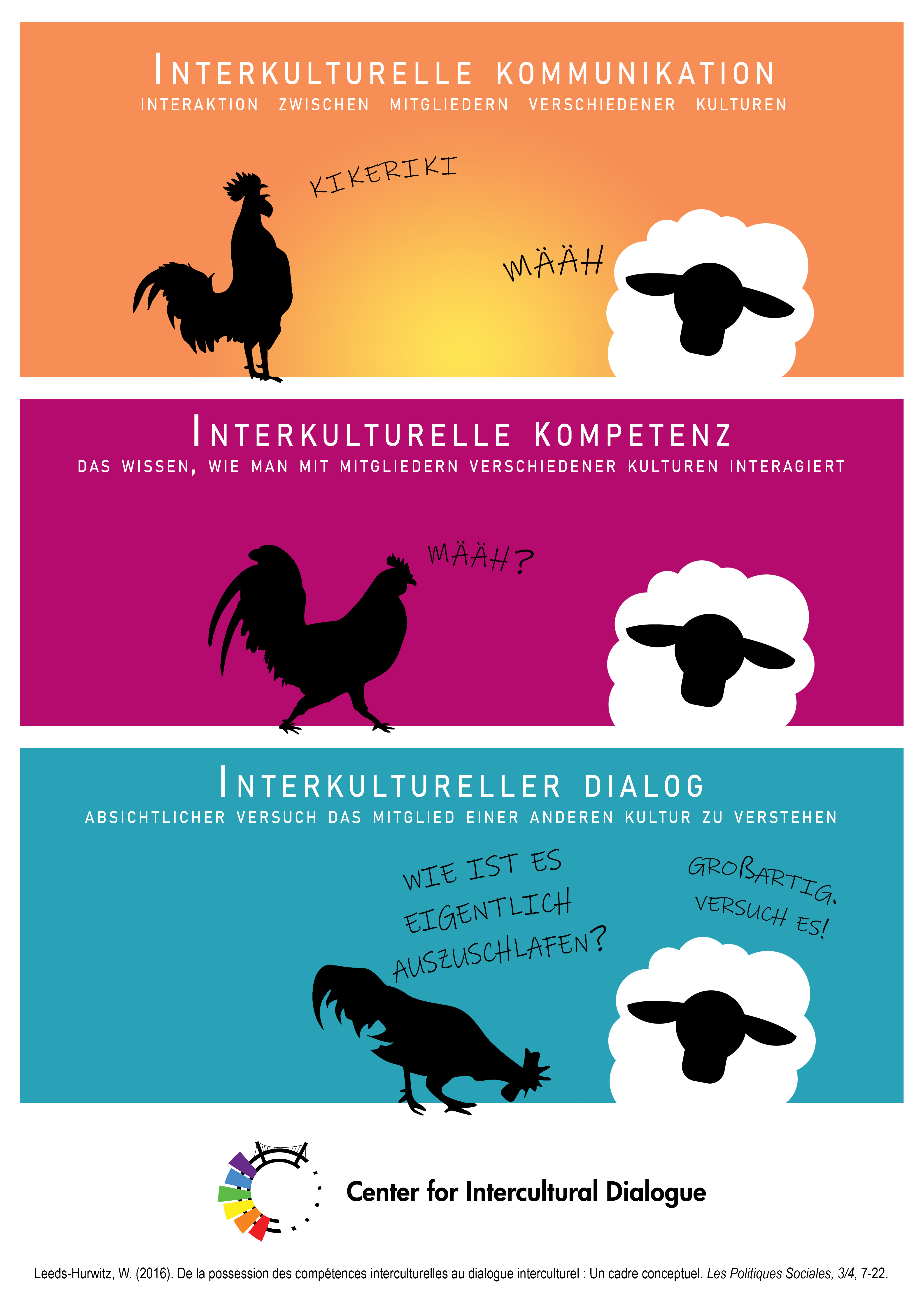
Center for Intercultural Dialogue Poster 1 translated into German

The article where these explanations of these concepts (as well as lots of other concepts) were published is:

Leeds-Hurwitz, W. (2016). De la possession des compétences interculturelles au dialogue interculturel: Un cadre conceptuel [Moving from having intercultural competencies to constructing intercultural dialogues: A conceptual framework]. Les Politiques Sociales, 3/4, 7-22.

Just in case anyone wants to cite this poster, the following would be the recommended format:

Center for Intercultural Dialogue. (2025). Interkulturelle Kommunikation / Kompetenz / Dialog [M. Faust, trans.]. CID Posters, 1. Available from:
https://centerforinterculturaldialogue.org/wp-content/uploads/2025/10/cid-poster-1-animals-german.jpg

As with other series, CID Posters are available for free on the site; just click on the thumbnail to download a printable version. They may be downloaded, printed, and shared as is, without changes, without cost, so long as there is acknowledgment of the source.

As with other CID Publications, if you wish to prepare an original contribution, please send an email before starting any work to receive approval, to minimize inadvertent duplication, and to learn about technical requirements. As is the case any series, posters should be created initially in English. If you want to volunteer to translate a poster into a language in which you are fluent, send in a note before starting, to receive approval and to confirm no one else is working on the same one.

Wendy Leeds-Hurwitz
Director, Center for Intercultural Dialogue
intercult.dialogue AT gmail.com


Creative Commons License
This work is licensed under a Creative Commons Attribution-NonCommercial-NoDerivatives 4.0 International License.
CFP UNESCO Futures of Education Ideas LAB

“UNESCO”
Call for short think pieces on What will shape the future of international cooperation for education? for the Futures of Education Ideas LAB, UNESCO. Deadline: 10 November 2025.

UNESCO’s Futures of Education IdeasLAB invites short think pieces (1500 words maximum) that reimagine, interrogate and analyze recent changes in global governance, multilateralism and international cooperation in education. They welcome contributions from all who engage with governance or education – including researchers, policy-makers, futures thinkers, public servants, private sector actors, educators, youth and civil society.

Multilateralism is in a moment of deep transition. The international system that optimistically pledged its commitments to ‘Education for All’ in 1990 appears less recognizable today. The frameworks and shared vision that once provided firm foundations for international cooperation in education have frayed, and in mid-2025 they appear more fragile than in past decades. At the same time, new imaginaries and solidarities offer opportunities to reimagine multilateralism, international cooperation and governance at all levels. How can we think about this present moment? What has changed, and what trajectories – both promising and perilous – appear ahead?

NOTE: The Center for Intercultural Dialogue held focus groups as part of the information gathering stage of the Futures of Education project, preparing what we learned as a report for UNESCO, in 2021.

UNESCO Training Program in ICD

“UNESCO”
UNESCO just launched its first training program focusing on intercultural dialogue, UNESCO, Paris, France.

The United Nations Educational, Scientific and Cultural Organization (UNESCO) launched its first training program focusing on intercultural dialogue at the end of August 2025. The program targets professionals working in museums and heritage site management, in partnership with the Royal Commission for AlUla (RCU), as part of the project “Fostering Positive Social Transformations in AlUla.”

The training sessions will be held every Thursday from September 18 to October 16 between 12:00 p.m. and 2:00 p.m. GMT+2 via Zoom. Participants include representatives of museums and World Heritage sites, particularly those engaged in public interaction, learning, and education.

The program covers key concepts in intercultural communication theory and practical applications to facilitate dialogue under the “Live Museum model,” which seeks to support the role of museums and heritage sites as platforms for exchange and understanding among visitors, while drawing on heritage and handicrafts as a driving force for dialogue between diverse cultures.

CID Poster 6: Dialogue Defined Translated into French

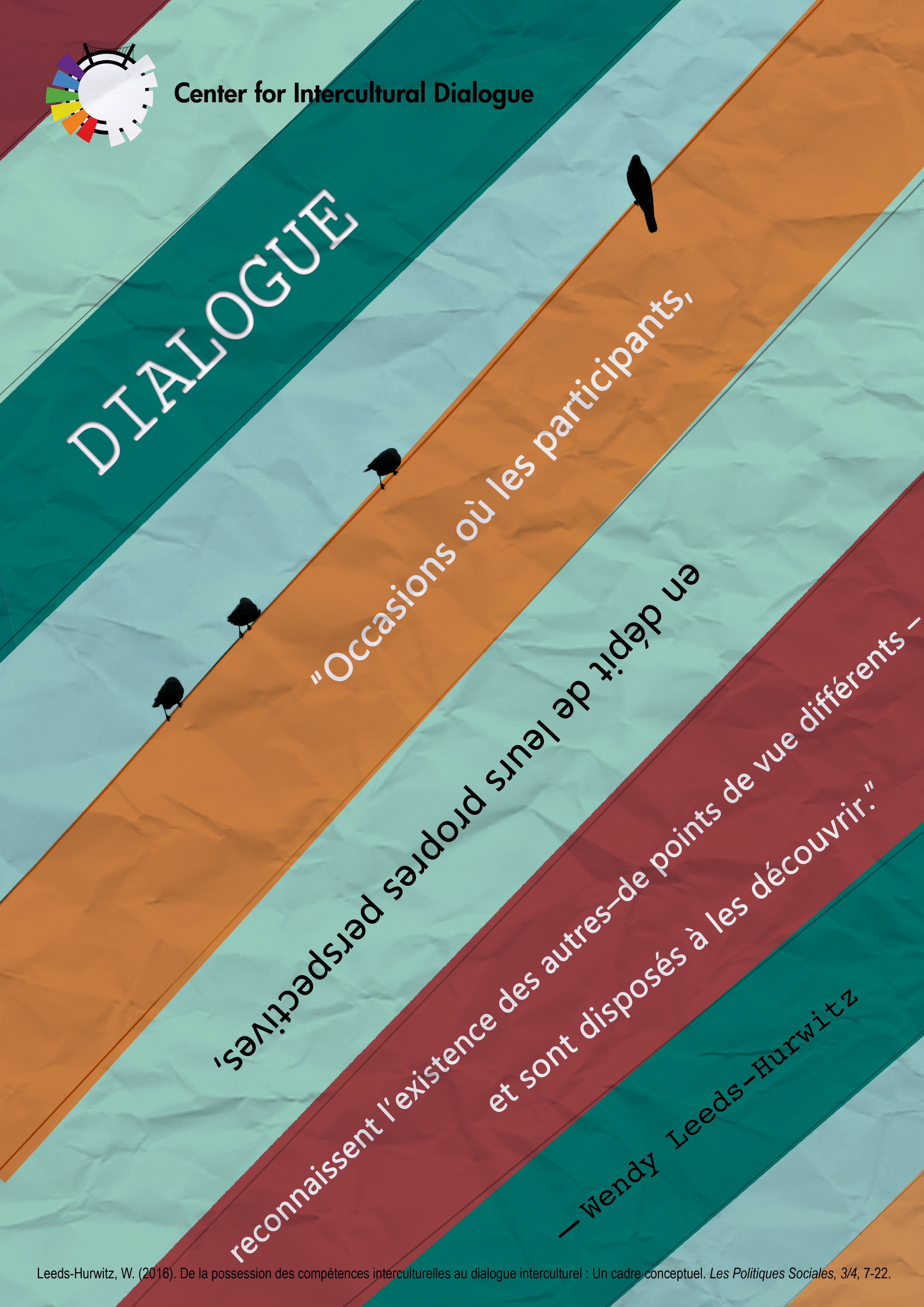
CID PostersThis is another of the posters designed by Linda J. de Wit, and now translated into French. For this poster, you literally have to look from a different perspective to read the quote; the picture of birds on a wire also represents taking different perspectives. The source of the quote is:

Leeds-Hurwitz, W. (2016). De la possession des compétences interculturelles au dialogue interculturel: Un cadre conceptuel [Moving from having intercultural competencies to constructing intercultural dialogues: A conceptual framework]. Les Politiques Sociales, 3/4, 7-22.

The French translation was provided by Léonie Potvin, and the graphic design work necessary to revise was by Yan Qiu. Here then is CID Poster 6: Définition du dialogue.

CID Poster 6: Dialogue defined Translated into FrenchJust in case anyone wants to cite this poster, the following would be the recommended format:

Center for Intercultural Dialogue. (2024). Définition du dialogue [L. Potvin, trans.]. CID Posters, 6. Available from: https://centerforinterculturaldialogue.org/wp-content/uploads/2024/10/cid-poster-6-dialogue-french.png

As with other series, CID Posters are available for free on the site; just click on the thumbnail to download a printable PNG. They may be downloaded, printed, and shared as is, without changes, without cost, so long as there is acknowledgment of the source.

As with other CID Publications, if you wish to contribute an original contribution, please send an email before starting any work to receive approval, to minimize inadvertent duplication, and to learn about technical requirements. As is the case any series, posters should be created initially in English. If you want to volunteer to translate a poster into a language in which you are fluent, send in a note before starting, to receive approval and to confirm no one else is working on the same one.

Wendy Leeds-Hurwitz
Director, Center for Intercultural Dialogue
intercult.dialogue AT gmail.com


Creative Commons License
This work is licensed under a Creative Commons Attribution-NonCommercial-NoDerivatives 4.0 International License.
CID Poster 3: Intercultural Dialogue Translated into French

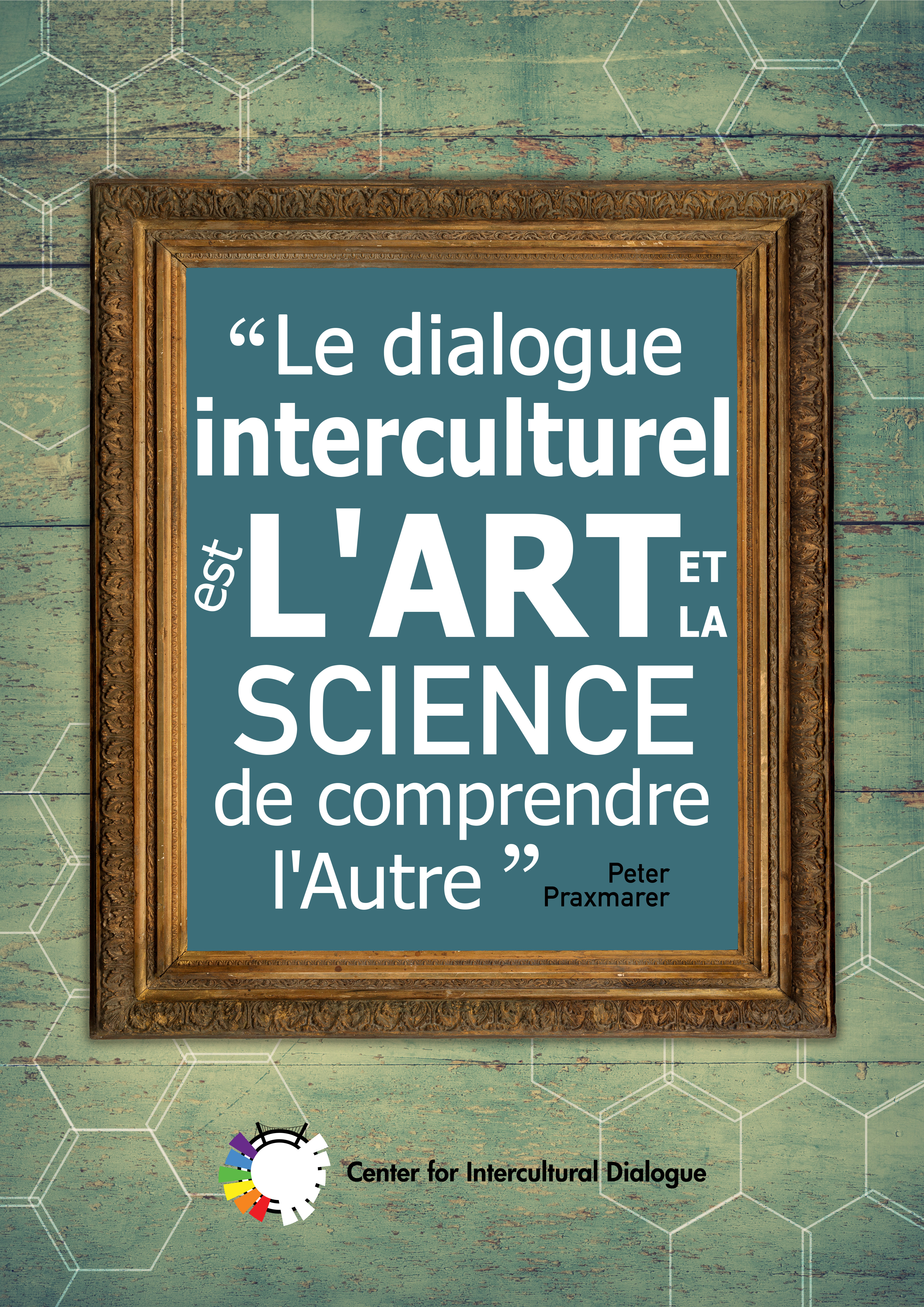
CID PostersThis is the third of the posters designed by Linda J. de Wit, in her role as CID intern. The quote by Peter Praxmarer does not come from a publication, but from a Skype conversation we had on April 25, 2017. I was struck by what he said, and how nicely it summed up the concept of intercultural dialogue, and requested permission to turn the definition into a poster, and he graciously agreed. In terms of visual design, Linda indicated “art” by the picture frame, and “science” by the design in the background. Hopefully this definition will find a wide audience, because I think it does a better and more concise job of explaining intercultural dialogue than other definitions I’ve seen.

The French translation was provided by Léonie Potvin, and the graphic design work necessary to revise was by Yan Qiu. Here then is CID Poster 3: Le dialogue interculturelle.

CID Poster 3: Intercultural dialogue translated into French

Just in case anyone wants to cite this poster, the following would be the recommended format:

Center for Intercultural Dialogue. (2024). Le dialogue interculturelle [L. Potvin, trans.]. CID Posters, 3. Available from: https://centerforinterculturaldialogue.org/wp-content/uploads/2025/11/cid-poster-3-art-and-science-french.jpg

As with other series, CID Posters are available for free on the site; just click on the thumbnail to download a printable PNG. They may be downloaded, printed, and shared as is, without changes, without cost, so long as there is acknowledgment of the source.

As with other CID Publications, if you wish to contribute an original contribution, please send an email before starting any work to receive approval, to minimize inadvertent duplication, and to learn about technical requirements. As is the case any series, posters should be created initially in English. If you want to volunteer to translate a poster into a language in which you are fluent, send in a note before starting, to receive approval and to confirm no one else is working on the same one.

Wendy Leeds-Hurwitz
Director, Center for Intercultural Dialogue
intercult.dialogue AT gmail.com


Creative Commons License
This work is licensed under a Creative Commons Attribution-NonCommercial-NoDerivatives 4.0 International License.
CID Poster 1: Intercultural Communication / Competence / Dialogue Translated into French

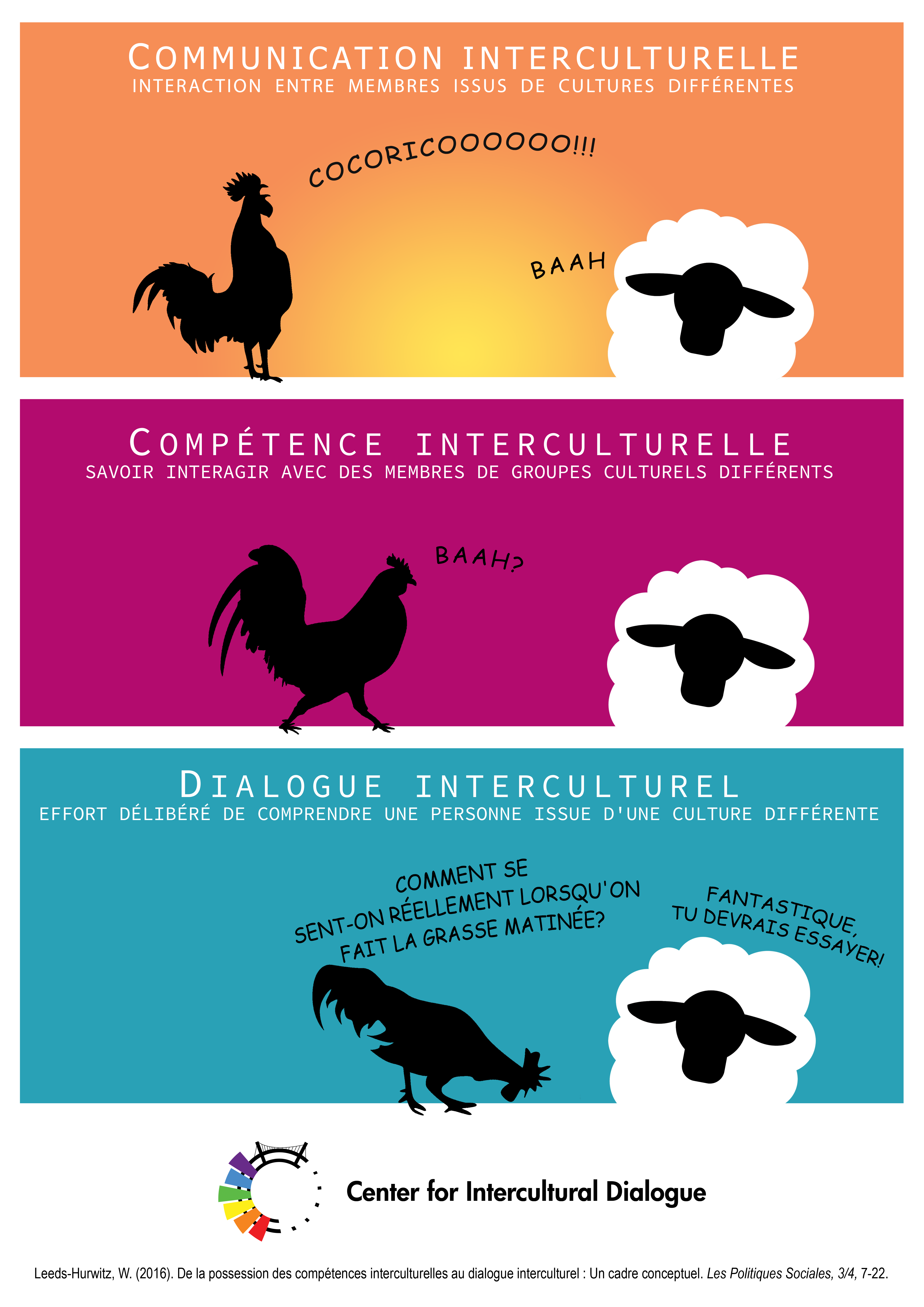
CID PostersThis is another of the posters designed by Linda J. de Wit, and now translated into French. This one provides a quick and easy way to understand, and differentiate between, the concepts of “intercultural communication,” “intercultural competence,” and “intercultural dialogue,” using a rooster and a sheep to represent members of different cultures (and she notes that the animals are vector designs by vecteezy.com).

The article where these explanations of these concepts (as well as lots of other concepts) were published is:

Leeds-Hurwitz, W. (2016). De la possession des compétences interculturelles au dialogue interculturel: Un cadre conceptuel [Moving from having intercultural competencies to constructing intercultural dialogues: A conceptual framework]. Les Politiques Sociales, 3/4, 7-22.

The French translation was provided by Léonie Potvin, and the graphic design work necessary to revise was by Yan Qiu. Here then is CID Poster 1: Communication/Compétence/Dialogue Interculturel.

CID Poster 1: Intercultural Communication / Competence / Dialogue Translated into FrenchJust in case anyone wants to cite this poster, the following would be the recommended format:

Center for Intercultural Dialogue. (2024). Communication / Compétence / Dialogue Interculturel [L. Potvin, trans.]. CID Posters, 1. Available from: https://centerforinterculturaldialogue.org/wp-content/uploads/2024/10/cid-poster-1-animals_french.png

As with other series, CID Posters are available for free on the site; just click on the thumbnail to download a printable PNG. They may be downloaded, printed, and shared as is, without changes, without cost, so long as there is acknowledgment of the source.

As with other CID Publications, if you wish to contribute an original contribution, please send an email before starting any work to receive approval, to minimize inadvertent duplication, and to learn about technical requirements. As is the case any series, posters should be created initially in English. If you want to volunteer to translate a poster into a language in which you are fluent, send in a note before starting, to receive approval and to confirm no one else is working on the same one.

Wendy Leeds-Hurwitz
Director, Center for Intercultural Dialogue
intercult.dialogue AT gmail.com


Creative Commons License
This work is licensed under a Creative Commons Attribution-NonCommercial-NoDerivatives 4.0 International License.

COE Online Course on Global Education & ICD (Portugal)

Professional OpportunitiesOnline course on Global Citizenship Education and Intercultural/Interfaith Dialogue, 7 October-3 November 2024. Deadline: 22 September 2024.

Part of the iLEGEND III project, the training course aims at providing participants with new skills and competences on Global Education, Intercultural/Interfaith Dialogue and Human Rights. It targets education practitioners in the formal and non-formal sector, media professionals and members of Civil Society Organisations and Faith-Based Organisations to:

  • reflect on Global Education, its concept, principles, and methodology;

  • analyse relevant notions related to Intercultural/Interfaith Dialogue, such as culture, discrimination, racism, majority/minority, inclusion/exclusion, etc;

  • develop specific competences focused on defusing and recognising potential conflicts, and actively promoting a culture of peace and non-violence;

  • promote networking among participants involved in global awareness-raising or educational actions.

The conceptual and methodological framework of the course is based on the Global Education Guidelines, systematised by the North-South Centre. Through a non-formal learning approach, collaborative and interactive activities and exercises allow participants to contribute to their own learning process.

The training course is fully online, hosted on HELP CoE e-learning platform. Two tutors will accompany participants during the 4-week activity. The expected workload is approximately 25 hours in total. The activity programme is structured in 4 modules (one module per week). The training course will be mainly asynchronous: this means that each participant will learn on their own schedule and pace, completing activities and exercises. At the end of the training, participants will obtain a certificate of participation.

40 participants will be selected for this activity, preferably between 18 and 30 years old, and coming from one of the North-South Centre member state, a Southern neighborhood or Sub-Saharan Africa country or a Council of Europe member state. However, a quota is available for citizens from other countries. The course will take place in English.

Translation and ICD: Words Without Borders

Applied ICD

Ito, R. (2 November 2023). Celebrating Literature That ‘Brings the World Close.’ New York Times.

Given how often the Center for Intercultural Dialogue publishes translations, it seems particularly appropriate to point out this article.

Words Without Borders, one of the few magazines in the world dedicated to literature in translation, is turning 20 at a fraught time: Around the world, wars are raging. Writers are being jailed, dissident voices silenced and books banned.

As the magazine’s staff considered its anniversary celebrations — a virtual gala on Nov. 2, following a live one on Oct. 25 — one question was pressing: How do you find words, let alone celebrate them, when bombs are dropping?

The answer, said Karen M. Phillips, the magazine’s executive editor and publisher, was right there, baked into their mission — to gather and celebrate international literature, and in doing so, strengthen the connection between readers and writers around the world. Given the current political climate, the need for such conversations has never been more vital.

“Words Without Borders does this heroic job of bringing the world close to us,” said Courtney Hodell, the director of literary programs at the Whiting Foundation, which presented one of their inaugural Whiting Literary Magazine Prizes to the magazine in 2018. “At times like this, that feels like an essential and fundamental human act.”

UNESCO e-Platform on ICD

Resources in ICD“ width=

UNESCO created an e-platform for intercultural dialogue in 2018, which recent followers may not have noticed. It is designed to be “a global collaborative hub” intended “to promote good practices  from all over the world, that enable to build bridges between people from diverse backgrounds in order to create more inclusive societies through mutual understanding and respect for diversity.”

One section presents a concepts glossary, explaining terms from intercultural dialogue to cultural identity to intercultural citizenship. These will be particularly familiar to all those who have previously read Intercultural Competences: A conceptual and operational framework from 2013, which I drafted for UNESCO (with many contributions by others named in the notes), as they all come directly from that publication.

Another section provides good practices for a wide range of topics, intended to serve as models. CID Posters and several publications (Key Concepts in Intercultural Dialogue and Constructing Intercultural Dialogues) have been accepted for inclusion.

Wendy Leeds-Hurwitz, Director
Center for Intercultural Dialogue

Cruz & Miranda: Storytelling as Media Literacy and Intercultural Dialogue

Resources in ICD“ width=Cruz, M. T., & Miranda, M. (2022). Storytelling as media literacy and intercultural dialogue in post-colonial societies. Media and Communication, 10(4), 294-304.

Based on the experience of a citizenship project about the post-colonial condition and Afro-European interculturality, this essay reflects on digital storytelling, and co-creative practices as relevant literacy and education strategies for furthering interculturality in contemporary societies. The authors propose storytelling as a tool for intercultural dialogue, in the framework of media literacy.

…we need educational strategies and literacies that continue to provide the training of imagination required for intercultural dialogue in the information society (p. 302)