U South Florida post-doc

University of South Florida Postdoctoral Scholars
Social Sciences and Humanities, 2013-14
Global Change in a Dynamic World

The Department of Communication at the University of South Florida is pleased to announce its participation in the fifth year of USF’s Postdoctoral Scholars program in the social sciences and humanities. The over-arching theme for this year’s scholars is “Global Change in a Dynamic World.”

Postdoctoral Scholars are expected to (a) contribute to one or more of the priority goals of USF’s strategic plan, (b) work closely with distinguished faculty, (c) participate in  interdisciplinary and programmatic seminar series, (d) teach two courses over a twelve-month period, and (e) continue to build an independent research record and engage in publishing refereed articles and creative scholarship.

Areas in which post doctoral scholars might work include (but are not limited to) sustainability; sustainable development; hazard and disaster management; climate change; population changes; technology and information issues; communication and language development; cultural diasporas; ethnicity, gender, and aging issues; cultural heritage and histories; citizenship; identity; health, economic, education, and environmental disparities; political economy; ethics; human rights; animal rights; peace and conflict studies; injury and violence; security and surveillance issues. Specific research and geographical areas are open, and applicants may consider both past and contemporary perspectives.

Appointments are for full time employment (40 hours per week), will begin August 5th, 2013, and be continued for a maximum of 2 years contingent upon satisfactory performance. The salary is $40,000 per year and the University contributes to a health insurance program for postdoctoral scholars and their dependents (up to $6,000). Support for travel to academic conferences will be available. Scholars are responsible for their relocation and housing expenses.

Applicants in communication must have earned a doctoral degree in communication no earlier than 2010 and successfully defended their dissertations by May 1, 2013.  The doctoral degree must be conferred prior to the first day of employment.  (Applicants must receive their doctoral degree from an institution other than USF.)

A complete application consists of (a) a cover letter stating your interest in this Postdoctoral Initiative and providing details on (i) how your research and teaching expertise would contribute to the theme of “Global Change in a Dynamic World” and the goals and aspirations of the USF Strategic Plan, (ii) the department(s) with which you would like to be affiliated, (iii) your teaching experience and courses that you would like to offer, and (iv) your long-term goals; (b) your curriculum vitae; (c) two letters of reference; (d) scanned copies of up to three of your published papers/scholarly works; and (e) scanned copies of current academic transcripts from all degree awarding institutions (original transcripts will need to be mailed by those individuals who receive formal offers).  All application materials must be sent to postdoc AT usf.edu by Friday December 7, 2012.

Additional information about the department and the university is available through our departmental Web site.  For complete details about the position, please see here.

Address any inquiries to Carolyn Ellis, Professor and Chair-Elect, Department of Communication, USF, by phone (813-974-3626) or e-mail (cellis AT usf.edu).

USF is an Equal Opportunity, Affirmative Action, and Equal Access employer.

Fordham job ads

Fordham University
Department of Communication and Media Studies
2 open positions: Department Chair and Assistant Professor

Fordham University invites applications for positions of department chair and assistant professor in the Department of Communication and Media Studies.  The department is currently in an exciting process of growth, including the curricular revision and expansion of undergraduate and graduate programs.  Both positions require a Ph.D. in communication, media studies, film studies, or a related area, and an active research program. The chair position requires distinguished scholarship, significant administrative experience, dynamic academic leadership, and excellent teaching.  The assistant professor position requires a promising research agenda and evidence of excellent teaching.  Those with a specialization in international/transnational/global communication are encouraged to apply, and an ability to teach research methods is highly desirable.  Complete job description is here. Submit application to cms AT fordham.edu with a cover letter, c.v., sample scholarship, and names of three references with contact information.  Application review begins for chair on October 15 and for assistant professor on November 15, 2012.  For information, contact Dr. Fred Wertz (wertz AT fordham.edu).

Fordham is an independent, Catholic University in the Jesuit tradition that welcomes applications from men and women of all backgrounds.  Fordham is an equal opportunity/affirmative action employer.

These fictions we call disciplines

An article growing out of research started as a Fellow at the Collegium de Lyon in 2009 has just been published:

Leeds-Hurwitz, W. (2012). These fictions we call disciplines. Electronic Journal of Communication/La Revue Electronique de Communication, 22(3-4). Available from: http://www.cios.org/www/ejcmain.htm

Abstract: Accepting that disciplines are social constructions implies expanding current practice in four directions: incorporating disciplinary history, cognate disciplines, international variations, and rival subdisciplines. Intercultural Communication serves as a concrete case study for how these implications play out. Consideration of the broader impact of these issues on the future of social construction research leads to concluding discussion of the characteristics required of more adequately prepared scholars.

Here’s a quote relevant to my work with the Center for Intercultural Dialogue:

“There can be no more literal form of alien knowledge than that produced by foreign scholars. Their research agendas have different histories, so they have developed different traditions of investigation, whether methods, theories, or topics. One result is that foreign research can be difficult to understand, requiring time and effort spent developing familiarity with the vocabulary used and assumptions made. Yet the result repays the time and effort: just as looking at the past reveals paths not taken, so does looking at research conducted in other countries.”

Wendy Leeds-Hurwitz, Director
Center for Intercultural Dialogue

Save

Eckerd College job ad

Eckerd College
4200 54th Ave. South, St. Petersburg, FL 33711

Assistant Professor of Communication, tenure track position, to start in September 2013.  PhD. in Communication required.  Eckerd College seeks an outstanding teacher/scholar with expertise in one or more of a broad range of specialties in communication, including, but not limited to: intercultural, multicultural, environmental, health, interpersonal, or public relations.  The successful candidate will be able to teach Introduction to Communication Theory, Public Speaking, Research Methods, and courses in area(s) of expertise. Teaching load is seven courses per academic year (3-1-3).  Candidates should be committed to teaching and mentoring undergraduates, and have a record of scholarship that leads to publication.

Participation in an interdisciplinary, values-oriented general education program is required, including a regular rotation in the two-semester freshman program. Eckerd College, the only independent national liberal arts college in Florida, has a tradition of innovative education and teaching/mentoring excellence. Send letter of application, vita, teaching evaluations, statement of teaching philosophy, graduate transcripts, and contact information for three references to www.eckerd.edu/hr/employment.  Applications must be complete by November 7, 2012.  Inquiries may be sent to Dr. James Janack, janackja AT eckerd.edu.  Qualified candidates must be authorized to work in the United States for the College. EOE.  Applications from women and minorities encouraged.

Do You See Ads on the Center’s Site?

About CIDToday I was notified that someone looking at this website is seeing ads on many pages. I see none, and had thought there were none appearing for others as well. After some checking on the WordPress help and users sites, it seems the more traffic generated, the more ads appear. Officially, the count is supposed to be very few, and only on a few pages. And those who have their own WordPress site don’t see any if they are logged in.

I need to know how much of an issue this is, and for how many of the people who come to this site. There is a way to pay to ensure no ads appear for anyone, it’s just a matter of money. So, if you see ads on this site, please let me know by posting a comment below. And let me know if you see them on just one page, or on lots of pages. It was the Fulbright scholar pages (see the category list in the right column) that were a problem, but there may be an issue for other pages as well.

Thanks for your help!
Wendy Leeds-Hurwitz, Director
Center for Intercultural Dialogue

UPDATE: Since it turned out that some people do see ads, the Center now pays WordPress to eliminate all ads for everyone. Thanks for your input!

U Texas Arlington job ad

THE UNIVERSITY OF TEXAS AT ARLINGTON
Announcement of Organizational Communication Faculty Position
Search Code: LIB091212COM

The Department of Communication at The University of Texas at Arlington invites applicants for a tenure-track faculty position in Organizational Communication. Located within the growing Dallas-Fort Worth Metroplex, UT Arlington is part of the University of Texas system with more than
33,000 students.

Organizational Communication, Assistant Professor
UT Arlington seeks an Assistant Professor in Organizational Communication beginning Fall 2013. Applicants with Ph.D.s are preferred; ABDs will be considered. Candidate should demonstrate a record of or potential for excellence in social scientific research, teaching, and service appropriate to the rank. Secondary areas of content specialty may include communication theory, research methods, interpersonal
communication, intercultural communication, performance studies, and/or rhetoric. The ability to contribute to the department’s M.A. in Communication is required.

University of Texas at Arlington
A Carnegie Doctoral/Research Extensive university, UT Arlington has an ethnically diverse campus with African-American, Hispanic, Asian, International, and Native American students accounting for approximately 52 percent of the student population.

The Department of Communication is the largest unit within the College of Liberal Arts with more than 900 undergraduates and 40 master’s students. The 12 departments which comprise the College of Liberal Arts offer 18 bachelor, 14 master, and 4 doctoral degrees in the broad areas of arts, humanities, languages and linguistics, and social sciences. The College of Liberal Arts supports interdisciplinary teaching and research within its 12 departments and across the university through such centers and programs as the Center for Mexican-American Studies, the Women’s and Gender Studies program, the Center for Greater Southwestern Studies, and the new Center for African American Studies.

The Department of Communication offers areas of undergraduate specialization in advertising, broadcasting, communication studies, communication technology, journalism, and public relations. The master’s program takes an integrated approach to communication with students exposed to communication studies and mass communication theories with relevant application across interpersonal, organizational, mass media, and technologically mediated settings. The Department of Communication
supports a variety of methodological and theoretical approaches and encourages collaborative experiences which cross the spectrum of communication inquiry.

The UT Arlington main campus is central to a diverse city population of more than 350,000, and is served by two major international and regional airports. The 16-county region boasts top 10 newspaper, radio, and television markets as well as a top 10 Hispanic media market. The Dallas-Fort Worth Metroplex is home to two major-market daily newspapers, more than 60 radio and television outlets, and corporate
headquarters such as Southwest and American Airlines, Texas Instruments, J.C. Penney, Frito-Lay, Dr Pepper and Bell-Textron. The area’s educational and research activity is supported by many private and
public universities, health science centers, and community colleges. Residents in the Metroplex are able to take advantage of a wealth of cultural, recreational, and professional sporting events.

All applicants should submit a letter of application, vita, three letters of recommendation, a sample of on-going research, and evidence of teaching effectiveness by email or to the address below.

Application materials should be sent to Search Committee Chair, Dr. Andrew Clark, (indicate Org. Comm. Search), Department of Communication, Box 19107, University of Texas at Arlington, Arlington, TX 76019-0107. Application materials will be accepted electronically via email to amclark AT uta.edu. Review of applications will begin October 8th and continue until the position is filled. Applicants who are selected for interviews must be able to show proof that they will be eligible and qualified to work in the United States by time of hire.  UT Arlington is an Affirmative Action/Equal Opportunity Employer. Women, minorities, veterans, and individuals with disabilities are encouraged to apply. A criminal background check will be conducted on finalists. The use of tobacco products is prohibited on UT Arlington properties.

CMM Institute Fellows Award

Applications for the 2012-2013 CMM Institute Fellows Program are due by September 30, 2012.

The three Institutions listed below are proud to announce the second annual Fellows Program for 2012-2013. We will be honoring and supporting the work of two Fellows who are engaged in research and/or practice in the broad area of taking the communication perspective. The 2013 Fellows will receive $5,000.00 and have their work featured on the websites and newsletters of the three sponsoring institutions.

If you would like to explore the 2011-2012 Fellows’ final presentations, please visit: http://www.cmminstitute.net/priorities-and-campaigns.html.

The information below provides the details of the program and the application process.

The CMM Institute for Personal and Social Evolution, Fielding Graduate University’s Institute for Social Innovation, and The Waterhouse Family Institute for the Study of Communication and Society at Villanova University Invite you to apply for the 2012/2013 Fellows Program

The CMM Institute for Personal and Social Evolution advances compassion, empathy, and civility by cultivating traditions of thinking and action based on the communication theory the Coordinated Management of Meaning (CMM). The non-profit Institute provides intellectual leadership and sponsors activities in research, theory-development, and education; the development of practice; world-wide networking and project and information sharing; and fresh insights regarding CMM’s capacity to overcome contemporary social issues and intractable conflicts.

One of the Institute’s greatest priorities is to promote research and interventions that take “a communication perspective” and contribute to the common good. By “taking a communication perspective” we mean projects that treat communication as substantive (an object in itself, not just a means of transmitting information about other things) and constitutive (its characteristics generate the social worlds in which we live).

In partnership with Fielding Graduate University’s Institute for Social Innovation and the Waterhouse Family Institute at Villanova University, we will recognize two Fellows for 2012/2013.

Fellows Program Description
A Fellow is a distinguished scholar and/or practitioner who is recognized for 1) demonstrating a unique understanding of what it means to take and apply a communication perspective; and, 2) finding creative and impactful ways of using a communication perspective to address real-world challenges.

The focus for the 2012-2013 Fellows program is “Transforming Communication.”

As we all know, social worlds are not all alike. Some support lives of compassion, love, dignity and joy better than others. Several taxonomies for naming these distinctions have been developed by theorist such as Robert Kegan and Ken Wilbur.

Communication is the generative force in the production of social worlds. The “communication perspective” directs attention to those patterns of communication. Once we look “at” communication, then we can ask the follow-up question: How can we change patterns of communication that produce less desirable social worlds in our families, schools, workplaces, and communities into those that produce more desirable social worlds?

Barnett Pearce describes this as an “upward” move (as distinguished from the “backward” and “forward” moves) in the first chapter of Making Social Worlds: A Communication Perspective (2007, Wiley-Blackwell).

We are interested in research projects that help us better understand the “upward” move. Relevant questions might include:
•     How can we identify patterns of communication that make better social worlds (or higher levels of personal and social development)?
•     How can we change patterns of communication in order to produce more desirable social worlds in our families, schools, workplaces, and communities?
Proposals that focus on innovation in dialogue and deliberation are also welcome. In this approach, new types of dialogue work would be seen as one of the methods needed to transform communication. For example, research in this area might focus on intergenerational dialogue, new tools for large-scale dialogue, and assessing the impacts of dialogic work on social issues.

Application Process
Your desire to become a Fellow is formalized by submitting a Letter of Intent (LOI) form to the CMM Institute by September 30, 2012. The letter should include a 3-page single spaced description of your proposed project, your rationale for this project, your methodology and the anticipated outcomes. The LOI can be found on the CMM Institute’s website, subcategory Fellows Program, by clicking here: http://www.cmminstitute.net/practice.html.

If you are invited to become a Fellow we will inform you by January 1, 2013 and ask that your project be completed by July, 2013. Both Fellows will present their work at a half-day seminar hosted by Fielding Graduate University in July, 2013.

Each Fellow will receive a cash award of $5,000.00 and have their work featured in the newsletters, websites, and other publications of the collaborating Institutes.

For more information, contact Kim Pearce at kimpearce AT aol.com

Ann Neville Miller Profile

ProfilesAnn Neville Miller is a Professor in the Nicholson School of Communication at the University of Central Florida.

She has published over 60 peer-reviewed journal articles, one edited volume, and numerous book chapters. Much of her work addresses critical issues concerning communication about HIV in sub-Saharan Africa, including communication of religious leaders and churches toward HIV prevention in Africa, and the role of sexual content in African entertainment media in youth sexual attitudes and behavior. She also has a long-running research interest in barriers to research productivity of African communication scholars. Dr. Miller’s study of African communication patterns arises out of over a dozen years of living, studying, teaching, and researching as an American in Kenya and Uganda. She continues to work closely with former colleagues there on a range of projects.

Dr. Miller was the receipt of a Fulbright African Regional Research Grant in 2015 and a Fulbright Specialist grant in 2017, and has served as a consultant to the World Health Organization.

Recent publications include:

Kayongo, C., & Miller, A. N. (2018). Men’s response to Obulamu campaign messages about male involvement in maternal health: Mukono District, Uganda. Health Communication, electronic publication Aug 1, 2018.

Ngula, K., Miller, A. N., & Mberia, J., K. (2018). Motivational and contextual factors related to Kenyan adolescents’ intake of sexual radio and TV content. Health Communication, 33, 724-732.
doi: 10.1080/10410236.2017.1306909

Miller, A. N., Gabolya, C., Mulwanya, R., Nabasaaka, G., Kiva, J., Nalugya, E., Lagot, S., & Chibita, M. B. (2018). The relationship between parental mediation of adolescent media use and Ugandan adolescents’ sexual beliefs, attitudes and behavior. Howard Journal of Communications, 29, 161-174. doi:10.1080/10646175.2017.1354788.

Miller, A. N., Sellnow, T., Neuberger, L., Todd, A., Freihaut, R., Noyes, J., Allen, T., Alexander, N., Vanderford, M., Gamhewage, G. (2017). A systematic review of literature on training in crisis and risk preparedness. Journal of Health Communication, 22, 612-629.
doi: 10.1080/10810730.2017.1338802

Phillip Glenn – Fulbright

Phillip Glenn
Emerson College

Fulbright Senior Scholar, Moldova

In May 2006 I traveled to the Republic of Moldova on a Fulbright Senior Scholar Grant.  A former Soviet Republic, Moldova is a small nation located north of the Black Sea, between Ukraine and Romania.  Although it faces many of the same economic, political, and social struggles that challenge other post-Soviet nations, Moldova’s situation is particularly difficult.  It is the poorest nation in Europe.  The eastern part of Moldova called Trans-Dnistrya (across the Dniester River) has been operating as a quasi-independent breakaway republic for the past twelve years and is widely known to be a regional center for trafficking in drugs, slavery, and mass weapons.  Moldovans hope someday to enter the European Union (EU), as their neighbors to the west are doing, but they recognize how much needs to change before they can do so.  The higher education system is undergoing reform in attempts to align with the Bologna Agreement that aims to provide for consistency among European universities.

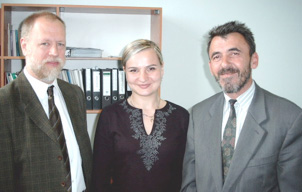
Glenn with members of the International Relations Faculty

My gracious hosts at IRIM (the International Relations Institute of Moldova in Chisinau, the capital city) set me up with multiple opportunities to lecture and meet with students on topics related to conflict, negotiation, and communication.  I attended a student-organized conference on Moldova’s prospects for joining the EU.  I met with the faculties of International Relations and Germanic Languages to discuss their curricular reform efforts.  IRIM is expanding the depth and breadth of its offerings in communication, conflict, and negotiation. These subjects appeal strongly to many students and faculty members, in part because of Moldova’s recent history and current political situation.

As a faculty member in Emerson College’s Department of Organizational and Political Communication, my teaching concerns the central role communication plays in resolving conflicts and building productive relationships.  As a Fulbright Scholar in 1995 in the Czech Republic I had previous experience with post-Communist educational institutions.  My wife Liliana is from Moldova, and from previous visits I had some acquaintance with the country and its people.  Liliana accompanied me to most lectures and meetings, and it was truly helpful having her contributions and insights.  Most Moldovans are bilingual speakers of Russian and Romanian; I speak only a bit of Russian.  Fortunately, most students understood English well, and interpreters were provided when needed.

Other activities included lectures at Moldova State University (Chisinau) and the State University at Cahul and attending an American Studies Conference.  One of the highlights of the trip was meeting with staff members from Helsinki Watch Cometitul Moldova.  We learned about their important work in monitoring human rights issues in Moldova and began exploring ways I could help provide educational opportunities to further their efforts.

The Fulbright trip was brief, but it opened doors for further exchanges of information, visits, and scholarly collaborations.  It gave me new perspectives on my own teaching and research, especially greater sensitivity to how core concepts in conflict and negotiation are shaped by cultural and historical contexts. Moldovan students and faculty, like their American counterparts, are keenly interested in learning alternative ways to resolve differences.  They see their nation clearly as needing new relationship paradigms, from the interpersonal to the international levels, and they are committed to helping bring about positive change.  Although the challenges are great, it is an exciting time.

Colordado State U job ad

Assistant Professor, Intercultural Communication

The Department of Communication Studies at Colorado State University seeks an entry-level assistant professor who specializes in Intercultural Communication.  We welcome applications from scholars who use quantitative and qualitative methods of communication scholarship.  This is an entry-level, tenure-track, nine-month appointment which starts August 16, 2013. Applicants should submit complete applications by October 15, 2012 for full consideration, although applications will be accepted until the position is filled.

The Department of Communication Studies at Colorado State University currently numbers over 600 undergraduate majors and 24 Master’s candidates and houses the Colorado State University Center for Public Deliberation. With the overall growth in the major and in the university, there has also been growth in diversity and multiculturalism. Candidates who can advance the Department’s commitment to diversity and multiculturalism through research, teaching, and outreach are encouraged to apply.

Duties include:
1.      Teach courses in intercultural communication, co-cultural communication, conflict,
communication theory, and research methods.
2.      Conduct research and publish in areas of specialty.
3.      Work collegially with a faculty who represent the broad scope of communication.
4.      Advise undergraduate majors in Communication Studies and serve on MA thesis
committees.
5.      Assume other duties normally expected of full-time faculty members at a major research
institution.

Required Qualifications
1.      Credentials and experience in Communication Studies.
2.      Specialty in intercultural communication.
3.      ABD; PhD required for appointment as assistant professor.

Preferred Qualifications:
1.      Demonstrated potential for teaching excellence.
2.      Demonstrated potential for excellence in research and publication.
3.      Use of quantitative and qualitative methods of communication scholarship.
4.      Ph.D. in hand.
5.      Ability to function collegially on a faculty committed to the rhetorical basis of the
discipline.
6.      A commitment to the liberal arts.

Please note: Once the Search Committee has identified semi-finalists, Department faculty will  have access to those candidates’ files, including letters of recommendation.

Application:
1.      Submit a letter of application and detailed curriculum vitae.
2.      Submit a list of relevant MA & PhD courses taken and course instructor name.
3.      Provide a 1 to 2 page statement of your teaching philosophy and research program.
4.      Provide for the submission of three letters of recommendation.
5.      Provide for the submission of official M.A. and Ph.D. transcripts.
6.      Additional items, such as copies of publications and evidence of teaching effectiveness,
may be requested later.

Address:
Intercultural Communication Search Committee Chair              Telephone: 970-491-6858
Department of Communication Studies                             FAX: 970-491-2160
Colorado State University                                               email: Gloria.Blumanhourst@colostate.edu
Fort Collins, CO 80523-1783

Colorado State University does not discriminate on the basis of race, age, color, religion, national origin or ancestry, sex, gender, disability, veteran status, genetic information, sexual orientation, or gender identity or expression. Colorado State University is an equal opportunity/equal access/affirmative action employer fully committed to achieving a diverse workforce and complies with all Federal and Colorado State laws, regulations, and executive orders regarding non-discrimination and affirmative action. The Office of Equal Opportunity is located in 101 Student Services. Colorado State University is committed to providing a safe and productive learning and living community. To achieve that goal, we conduct background investigations for all final candidates being considered for employment. Background checks may include, but are not limited to, criminal history, national sex offender search and motor vehicle history.