Diversity Postdoc at University of San Diego

The College of Arts and Sciences at the University of San Diego announces three openings for the Diversity Postdoctoral Fellowship. We seek to support scholars who are committed to teaching and mentoring students from communities that have historically been underrepresented in higher education, and who show promise of a distinguished research career from any discipline from the Humanities, Sciences, Math and Social Sciences. We are especially invested in supporting the early development of scholars whose research, teaching, mentoring and/or service advances the perspectives of Gender, First Nations/Native Americans, African Americans, and/or Filipino Americans.

The positions will begin in September 2014 and will be housed in any three of the following academic departments:
•         Biology
•         Chemistry and Biochemistry
•         Communication Studies
•         Ethnic Studies
•         Languages and Literature
•         Marine Sciences and Environmental Studies
•         Physics
•         Political Science and International Relations
•         Theology and Religious Studies

The Diversity Fellowship is a two-year program that offers the possibility of a one-year renewal. Fellows will teach three courses per year, and will work closely with faculty mentors inside and outside of their discipline. USD faculty will mentor the fellows’ interdisciplinary engagement with liberal arts pedagogy, and provide institutional and intellectual support for the fellows’ active scholarly research agenda.

Job Requirements
Candidates must have completed their PhD or other terminal degree within three years of the closing date. Candidates who have not yet had a tenure-track faculty position will be given priority. Awards include competitive salary, benefits package, and travel funds for conference participation.

Background check:  Successful completion of a pre-employment background check.

Additional Details
The University of San Diego is committed to academic excellence, Catholic Intellectual and social traditions, and a superior liberal arts education for scholars of all faiths. Historically, Catholic Universities have assumed responsibility for welcoming diversity and creating a public space for underrepresented groups.

The University of San Diego is an Equal Opportunity Employer.

How To Apply
Deadline for receiving all materials is January 24, 2014 by 5:00 PM PST.

Please submit one copy to iRecruitment at www.sandiego.edu/jobs and look for job#12528 and click on “apply now”. In addition, please submit one copy to usdpostdoc@sandiego.edu.


Wenshan Jia Profile

ProfilesWenshan Jia is Ph.D. and Professor of Communication and China Studies, Department of Communication Studies, Chapman University, Orange County, California.  He is also Distinguished Adjunct Professor, School of Journalism & Communication, Research Associate, the National Academy of Development & Strategy, Renmin University, China.

Wenshan Jia

His areas of research are intercultural/global communication, ethnic relations in China and Chinese media. He has published “Ethnic conflicts in China” in Handbook of Ethnic Conflict: International Perspectives,  winner of the Gudykunst Award among others.   A winner of IAIR Early-Career Award, Wang-Fradkin Professorship award, and author of Choice “Outstanding Book” titles such as The Remaking of Chinese Character and Identity in the 21st Century: The Chinese Face Practices, he is editorial board member of International Journal for Intercultural Relations and Asian Journal of Communication and served as a content expert at the 4th World Cyberspace Cooperation Summit and a guest speaker of the Pacific Council on International Policy.

Selected Publications:

Jia, W. (Ed.). (2018). Intercultural communication: Adapting to emerging global realities (2nd ed.). San Diego, CA: Cognella.

Jia, W., Jiang H., & Zhao, L. (2017). Intercultural communication and dialogic civilization for the creation of a global community. Journal of Renmin University of China, 31(5), 100-111.

Jia, W. (June 6, 2017). Now, globalization with Chinese characteristics. YaleGlobal Online.

Jia, W., & Tian, D. (2016). Chinese conceptualizations of communication: Chinese terms for talk and practice. In D. Carbaugh (Ed.), The handbook of communication in cross-cultural perspective (pp. 244-253). New York: Routledge.

Jia, W., H. Liu, R. Wang, & X. Liu (2014). Contemporary Chinese communication scholarship: An alternative emerging paradigm. In R. Fortner & P. M. Fackler (Eds.), Handbook of media and mass communication theory. Malden, MA: Wiley.

Jia, Wenshan, Y. Lee, H. Zhang (2012). Ethnic conflicts in China. In D. Landis & R. A. Roberts (Eds.) Handbook of ethnic conflict: International perspectives (pp. 177-198). Springer.

Jia, W. (2011). On the discourse of cultural China. Journal of Asia Pacific Communication, 21(2), 165-176.

Jia, W., Tian, D. & Jia, X. (2010). Chimerica: US-China communication in the 21st century. In Larry. A. Samovar, Richard E. Porter, & Edward R. McDaniel (Eds.), Intercultural Communication: A Reader (13th ed., pp. 161-170). Belmont, CA: Wadsworth.

Jia, W. (2009). An intercultural communication model of international relations: The case of China. In Y. Hao & G. Wei (Eds.), Challenges to Chinese foreign policy: Diplomacy, globalization and the next world power (pp. 319-333). Louisville, KT: University Press of Kentucky.

Jia, W., et al. (2002). Chinese communication theory and research: Reflections, new frontiers, new directions.  CT:  Greenwood.

Jia, W. (2001). The Remaking of the Chinese character and identity in the 21st century: The Chinese face practices.  CT:  Greenwood.


Work for CID:
Wenshan Jia wrote the guest post, Intercultural Neologisms for a New Revolution.

ATYA Azerbaijan youth group looking for partners

Fakhrinur HUSEYNLI writes:

We have had a youth NGO in Azerbaijan since 2002 which is interested in joining international projects and activities. If you wish, we are ready to sign partnership agreements to organize joint projects in Azerbaijan or send our active young participants to your coming activities in 2014 under Erasmus+ and other foundation programs.

If there are any small participation fees for your programs, our participants are ready to pay that amount. They will be glad to be part of your coming academic programs, workcamps, summer camps, internship, volunteer and training activities.

Thanks for your cooperation in advance. We are looking forward to cooperating with you in 2014.

Further information about ATYA:
Azerbaijan Tafakkur Youth Association (ATYA) is a national NGO working towards building better civil society. The organization is located in Absheron region (between Baku and Sumgait cities). ATYA has been mainly active in disseminating information on Human Rights Education, Peace Promotion and Civil Society Building. We look forward to creating local-international partnerships with great pleasure for organize fruitful and interesting projects for the sake of peace building, youth empowerment and civil society development.

The main purpose of ATYA is enlightenment, especially youth, on the social, scientific-cultural, legal spheres, to development thinking and to strengthen their role in civil society building.

Main activities:

  • Art and cultural exchange, conflict solution, intercultural learning and peace building;
  • NGO/Civil society and community building/development;
  • Youth empowerment, capacity building, apprenticeship and business education;
  • Advocacy, active citizenship, youth exchange and voluntarism;
  • Human rights education and promotion;
  • Healthy life style (HIV/AIDS, Tuberculosis and Malaria);
  • Environment and biodiversity education.

For more information on Azerbaijan Tafakkur Youth Association, ATYA, see this video.

Those interested in potential collaborations should contact:
Fakhrinur HUSEYNLI
Director of Institute for Peace & Dialogue

Save

Sydney 2014

On the way between the US and New Zealand, I was able to stop in Sydney, Australia for a week. Being there permitted me to connect with two people I’d never met but only talked to via email, and one I had not seen in over a decade. Between the three, there was a wide range of interests and career stages.

Lily A. Arasaratnam is Senior Lecturer in Intercultural Communication and Program Director for an MA program at Alphacrucis College in Parramatta, just outside Sydney. I “met” Lily when we both participated in an online dialogue about intercultural communication for the Journal of International and Intercultural Communication which will shortly be published. Her primary research specialization is intercultural communication competence. She is an intercultural expert both because of her PhD and her personal experience: born in Sri Lanka, raised in the Maldives, with US degrees, and now living in Australia, she lives many of the dualities others only try to understand.

Olga Kozar is currently completing her PhD in Applied Linguistics at Macquarie University in Sydney. Her research is on private one-on-one English as a second language lessons conducted via videoconferencing tools such as Skype, especially when learners and teachers have different cultural backgrounds. In her spare time she runs such a language school – with about 1000 students! She was quite helpful in providing technology-related ideas, given that she’s become such an expert. I was delighted to discover that she and Christine Develotte, a colleague from Lyon, France, who does similar work with teaching French online and who I introduced her to via email, have now met in person as well.

Penman, Leeds-Hurwitz
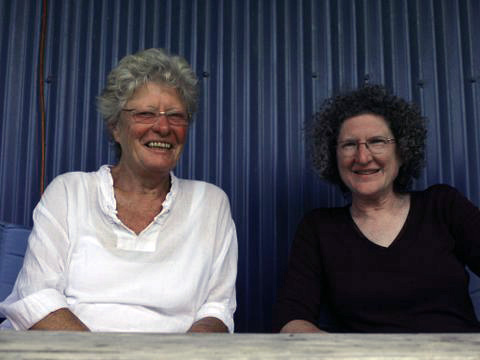
Robyn Penman, Wendy Leeds-Hurwitz

I was introduced to Robyn Penman by Barnett Pearce so long ago we don’t remember when it would have been; it was a pleasure to have a chance to catch up on the past decade. Currently active with the CMM Institute, formerly with the Communication Research Institute of Australia, Robyn is a pioneering communication scholar, widely respected both for her ability to state theory clearly (as in her early Communication Processes and Relationships, or the more recent Reconstructing Communication) and to apply that theory to practical communication problems (as in Designing Information for People, a co-edited volume). Robyn suggested that, given my current efforts to connect international scholars, my name should now be changed to Ariadne, for her association with webs and weaving.

I look forward to continuing the conversations with all these scholars.

Wendy Leeds-Hurwitz, Director
Center for Intercultural Dialogue

Save

A space of relationship for dialogue among cultures

Guest Posts

A lesson dedicated to the genocide in Burundi: An occasion of dialogue as a space of relationship among cultures
by Maria Flora Mangano.

I am happy to share with you what happened recently in my class, during a lesson dedicated to the genocide of Rwanda and Burundi. I am currently lecturing on dialogue among cultures at St. Peter’s Philosophical-Theological Institute in Viterbo, Italy.

One of the students comes from Burundi; his name is Jean. He introduced himself during the first lesson, describing his background and choice of life as a religious. One day outside of class, he mentioned the war in Burundi and the genocide of 1993. In that moment he shared with me and two Italian students what it was like to be a Tutsi. In 2 or 3 minutes he described a few images of the genocide, which he lived through when he was 12 years old; thanks to God, all his family survived. I was shocked by his words and I asked him if he would be able to share his experience with the class, proposing that the students would both listen to his story and see part of the film Hotel Rwanda together. We could organise this special and unforgettable lesson in a couple of hours.

Jean prepared a powerpoint and presented the story of his country and the story of his family and relatives during those three terrible days of the genocide. I proposed to the class not to see the entire movie (which is quite long, so we saw only the trailer) but rather to dedicate the majority of the time to Jean’s personal story. I introduced the technical vocabulary, including genocide and shoah, sharing what these terms have meant in the last century and what they mean now. The 16 students come from 9 countries; some of them did not know even where Burundi was. I asked the students to try to create a space of relationship in which they could speak without any fear of offending or to be offended.

Jean was extremely clear in explaining the historical background, presenting the political and social aspects underlying the genocide. Then he shared his story with us. I am still speechless, shocked and impressed. It was the first time that one of my students desired to share what the genocide was for him and he prepared everything in detail. One young person who survived the genocide decided to offer his experience as a gift, not in revenge. He was able to share his memories, even if these are still dramatic and negative.

Jean said that in African culture the tradition is oral, not written and for this reason it is not possible to ask to him (or others) to write about their experience. He prefers talking over writing about it, but he never did so before this, as he said that the open hurts rest open even after time and sharing.

At the end of his time, all the students were so impressed and touched they could not speak. I ask the students to take time and then to try to share with Jean their feelings, also to try to thank him in a real way. I hope it will yet happen.

I am happy to share this wonderful experience of dialogue and sharing in class. I hope to be able to publish about it in the future. As scholar, I felt that this should be our way of teaching, especially given the discipline of communication we try to teach (and learn). Let’s go ahead to try to do the best with our students and in research on this issue. I am still convinced that we may try to re-write history through dialogue.

I am sharing what happened because it is uncommon to talk about the genocide of Rwanda (and Burundi) for people who survived this. It is still too early, as Jean told me. I consider this moment an important effect of dialogue among cultures, as this student chose to share his life with the class and he prepared the lesson on his own, without any help from me. He chose what to say, also decided not to show any pictures of the genocide and he carefully chose the words to describe those days. He also chose to first present the political and historical conditions as a necessary introduction to the genocide.

Afterwards, Jean reported that he felt understood by the class, so probably he was ready to share this moment. In the days since, I have received mails from him and from the others who have expressed their appreciation for that moment. I have the feeling that we built the space for relationship as the basis of dialogue during the course, and that this moment significantly enriched this space.

Download the entire post as a PDF.

NOTE: See the response prompted by this post, by Robyn Penman.

CID and Social Media

About CIDIn addition to the Facebook group page developed several years ago, the Center for Intercultural Dialogue now has a social media presence that includes LinkedIn, Twitter, Pinterest, YouTube, and Google+.

social media logos

Nearly all of this activity is due to the efforts of Minh Cao, Assistant to the Director.  Minh also learned the required format to post on Wikipedia – an entry on CID is currently under review and will be described in a post once it is public. [UPDATE: CID is now on Wikipedia as well!]

Several colleagues have asked why a broad social media presence is valuable (and whether it is worth the considerable time it takes). The short answer is that social media permit CID to meet interculturalists on whatever platform they choose to spend their time. A further question might be: are so many people really using social media today? The answer to that comes from the Pew Internet and American Life Project which just posted their Social Media Update for 2013. They conclude:

Some 73% of online adults now use a social networking site of some kind. Facebook is the dominant social networking platform in the number of users, but a striking number of users are now diversifying onto other platforms. Some 42% of online adults now use multiple social networking sites.

Substantial thanks are due to Minh for making the CID accessible across multiple platforms in 2013. The goal for 2014 will be to determine what content best fits each of these contexts, and to expand the impact of the CID as a result.

Wendy Leeds-Hurwitz, Director
Center for Intercultural Dialogue

Miike reflection on international/cultural communication

Guest PostsOn Inheriting the Fields of International and Intercultural Communication: A Personal Reflection*
Guest post by Yoshitaka Miike

To inherit is to receive as legacy, place adequate value on and make a part of one’s life. But to be a custodian of a great legacy is to guard, preserve, expand and promote it. It is to honor it by building on and expanding it and, in turn, leaving it as an enriched legacy for future generations.

– Maulana Karenga (1996, p. 551)

The International and Intercultural Communication Division (IICD) of the National Communication Association (NCA) was founded as a commission in 1971 and later formed as a division in 1984. I am thus the 42nd incoming chair of this flourishing division. When I think about the history of the IICD and its critical role in advocating diversity and advancing internationalization within the NCA, I feel the heavy weight of the gavel that Dr. S. Lily Mendoza at Oakland University passed to me in Washington, D.C. With an eye on the 100th Anniversary of the NCA next year, I would like to offer a personal year-end reflection on how we may inherit the fields of international and intercultural communication. More specifically, I wish to suggest that we (1) “create a community of a larger memory” of our fields (to borrow Dr. Ronald Takaki’s [1998] words), (2) clarify our theoretical ideas  and practical issues without sacrificing their complexities, and (3) generate knowledge that bridges differences especially from non-U.S. and non-elite perspectives.

*Source: Miike, Y. (2013, December). On inheriting the fields of international and intercultural communication: A personal reflection. National Communication Association’s International and Intercultural Communication Division Newsletter, pp. 4-7.

Download the entire post as a PDF.

CID has Pinterest Account

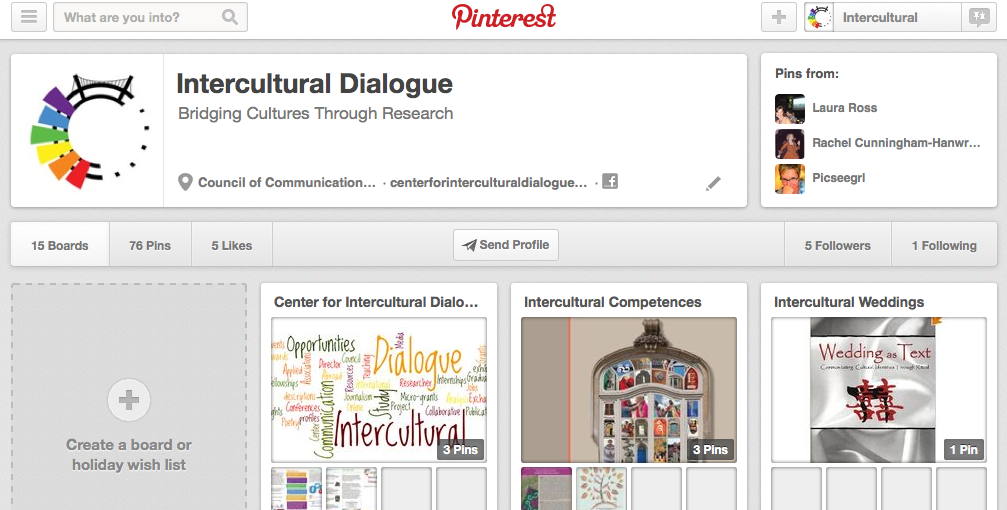
About CIDPinterest-CIDThe Center for Intercultural Dialogue recently started a Pinterest account, thanks to the efforts of Minh Cao, Assistant to the Director.

For those who prefer to access information through visual rather than verbal content, this will be a place to go to see images related to intercultural dialogue that have originally been posted to this website, or on other similar sites (such as UNESCO, UNAOC or ACIDI). Current content includes photographs, images from our publications, and word clouds used on the site. It’s also a good way to see what websites we’ve been surfing.

Language culture & mind conference Lublin 2014

Sixth International Conference on *Language, Culture and Mind*
June 24-26, 2014 Lublin, Poland

Contact: info@lcm6.umcs.lublin.pl

Deadline for *abstract submission* of individual papers and posters: *Jan 20, 2014*

The Sixth International Conference on Language, Culture and Mind (LCM VI) will be held on *24-26 June 2014* at the Maria Curie-Sklodowska University in Lublin, Poland. It will be preceded by a *Young Researchers Workshop* on 23 June 2014 (same venue), where young researchers will present their ongoing dissertation projects and other work.

The goals of LCM conferences are to contribute to situating the study of language in a contemporary interdisciplinary dialogue (involving philosophy, linguistics, psychology, anthropology, semiotics and related fields), and to promote a better integration of cognitive and cultural perspectives in empirical and theoretical studies of language.

Confirmed plenary speakers:
Nancy Budwig (Clark University, Psychology)
Henryk Kardela (Maria Curie-Sklodowska University, Linguistics)
Alan Rumsey (Australian National University, School of Culture, History & Language)
Farzad Sharifian (Monash University, Language and Society Centre)
Beata Stawarska (University of Oregon, Philosophy)

The theme for LCM VI is: *Inside/Out: Practice and Representation*
While some focus on the representational nature of language and mind, others regard them as socially embedded and embodied practices. We encourage submissions that further investigate the dynamic between practice and representation and critically examine stereotypical or mainstream conceptions of representations as internal and practices as external.

We invite abstract submissions for oral presentations, posters and symposia. (Please clearly indicate your chosen format with your submission.)

Submission guidelines and formats:
• Oral presentations
Title, name, affiliation, 400 word abstract
20 min presentation + 10 minute discussion

• Posters
Title, name, affiliation, 100 word abstract
1 minute oral presentation in the main lecture hall, preceding the poster session

• Symposia (submissions closed)
Symposium title, name and affiliation of symposium convener, an
introduction of up to 400 words explaining the theme, all symposium
abstracts, in suitable order. 90-minute symposia of 3 papers, allowing time for discussion. Up to two 90-minute symposia may be merged for proposals with 5-6 participants. Papers in each symposium should be thematically linked.

Symposium proposers should indicate whether, if a symposium is not accepted as a whole, they wish the individual abstracts to be considered as individual presentations (oral or poster)

Deadline for abstract submission of symposia: Nov 30, 2013 (closed). Deadline for abstract submission of individual papers and posters: *Jan 20, 2014. Abstracts should be submitted as .rtf, .odt or .doc attachments using EasyChair. In order to submit an abstract you have to use your existing EasyChair account or register using the link above. Detailed instructions can be found on the Language Culture and Mind VI conference website.

Important dates:
• Deadline for abstract submission (symposia): 30 Nov 2013 (*closed*)
• Deadline for abstract submission (papers, posters): *20 Jan 2014*
• Notification of acceptance (symposia): 15 Jan 2014
• Notification of acceptance (papers, posters): *28 Feb 2014*
• Last date for early registration: 30 Mar 2014
• Last date for participant registration: 1 May 2014
• Final program publication: 31 May 2014

****Young Researchers Workshop****
The LCM VI Young Researchers Workshop is a satellite event of the LCM VI conference, aimed at graduate students and junior scholars conducting theoretical or empirical research in language and communication including, but not limited to cognitive, social, affective, embodied and/or cultural perspectives. The workshop aims at providing a forum for presenting results and foster interaction and debate in the context of interdisciplinary collaboration.

Young researchers in anthropology, biology, linguistics, philosophy, psychology, semiotics, semantics, discourse analysis, cognitive and neuroscience are invited to share, and thereby enrich, their study of human natural language and communication. A specialist’s comment on each accepted
contribution makes the workshop a unique opportunity to receive expert feedback.

Contact: Roberto Bottini

Abstract specifications:
1 page, 400 words, single-spaced, font size 12 pt, Times New Roman, 2.5 cm margins on all sides. Diagrams must fit in the page.
Heading should include:
– Title of the paper
– Author(s) name
– Author(s) affiliation
– E-mail address of principal author

Abstracts for the Young Researchers Workshop presentations should be submitted as .rtf, .pdf or .doc attachments using EasyChair. A special track for YRW has been created within LCM6 EasyChair account.

Recommended UNESCO Documents for Interculturalists

UNESCO sees intercultural dialogue as a central topic, and publishes frequently on related issues. In addition to the Intercultural Competences booklet that I worked on last year, which has had hundreds and hundreds of downloads from this site alone, several other publications may be of interest to intercultural scholars.

A Common Framework for the Ethics of the 21st Century

A New Cultural Policy Agenda for Development and Mutual Understanding

Asian-Arab Philosophical Dialogues on Globalization, Democracy and Human Rights

Cultural Diversity and Transversal Values: East-West Dialogue on Spiritual and Secular Dynamics

Exploring Synergies between Faith Values and Education for Sustainable Development

What UNESCO for the Future? Forum of Reflexion

World Social Science Report 2010: Knowledge Divides

My thanks to Yoshitaka Miike for these suggestions!

Wendy Leeds-Hurwitz, Director
Center for Intercultural Dialogue

Save