SUNY Buffalo job ad (Singapore)

Instructor in Communication [Educator] at SUNY Buffalo

Applications are invited for a position teaching University at Buffalo (UB) undergraduate level courses in Communication within UB’s undergraduate programs at the Singapore Institute of Management. Singapore is a safe, multinational, English-speaking city-state located off the southern tip of the Malay Peninsula. Additional information on UB’s undergraduate program in Communication in Singapore is available online.

Available Communication courses may include those in the following areas: Communication Theory, Mass Communication, Intercultural Communication, Organizational Communication, Interpersonal Communication, Communication Technology, Advertising and Public Relations.

Positions are available beginning with the Fall 2015 semester, and the individual hired may be employed on a single-semester or a multi-semester basis. Position salary will depend on qualifications as well as number and type of courses supported. Local accommodations and round-trip airfare to Singapore are provided.

A Master’s degree in Communication, and one to three years’ experience teaching undergraduate students in a US college or university are required as is experience teaching in an intercultural context.  A Ph.D. degree in Communication or closely related field is preferred, as is additional teaching experience. Experience living and teaching in an overseas, especially an Asian environment, are a plus.

The work site is the campus of the Singapore Institute of Management, Singapore and employment in this position will be conditional upon receipt of applicable employment authorization from the Government of Singapore.

For additional information, and to apply, please visit UBJobs. All applications must be submitted via UBJobs. Applications submitted in any other manner can not be accepted

The application deadline is November 5, 2014.

This is a Research Foundation of SUNY position.

Fred Dervin Profile

ProfilesFred Dervin is Professor of Multicultural Education at the University of Helsinki (Finland). Dervin also holds several professorships in Canada, Luxembourg and Malaysia. In May 2014 he was appointed Distinguished Professor at Baoji University of Arts and Sciences (China). Dervin has been visiting professor in Australia, Canada, China, Estonia, France, Hong Kong, and Portugal.

Fred Dervin

Dervin specializes in intercultural education, the sociology of multiculturalism and student and academic mobility. He defines his work as transdisciplinary, critical and reflexive. Inspired by E. Said (1993), he believes that “(…) giving up to specialization is, I have always felt, laziness, so you end up doing what others tell you, because that is your speciality after all.” His current definition of his approach to the ‘intercultural’ reads as follows: it is about giving the power to the powerless – ourselves included – to become aware of, recognize, push through and present/defend one’s diverse diversities, and those of our interlocutors”.

Dervin has widely published in international journals on identity, the ‘intercultural’ and mobility/migration in English, Finnish and French. He has published over 20 books: Politics of Interculturality (co-edited with Anne Lavanchy and Anahy Gajardo, Newcastle: CSP, 2011), Impostures Interculturelles (Paris: L’Harmattan, 2012) and Linguistics for Intercultural Education (co-edited with Tony Liddicoat, New York: Benjamins, 2013). The following volumes are forthcoming: Researching Identity and Interculturality (with Karen Risager, Routledge, 2014), Chinese Students and Scholars in the Global Community: Challenges of Integration (special issue of Frontiers in Education, 2014), Cultural Essentialism in intercultural Relations (with Regis Machart, Palgrave, 2014). Fred Dervin is the series editor of Education beyond borders (Peter Lang)Nordic Studies on Diversity in Education (with Kulbrandstad and Ragnarsdóttir; CSP), Post-intercultural communication and education (CSP) and Palgrave Studies on Chinese Education in a Global Perspective (Palgrave with Xiangyun Du). He is the Editor-in-Chief of The International Journal of Education For Diversities. His website: http://blogs.helsinki.fi/dervin

Key Concept #37: Dialogic Listening by Robyn Penman

Key Concepts in ICDThe next issue of Key Concepts in intercultural Dialogue is now available. This is KC37: Dialogic Listening by Robyn Penman. As always, all Key Concepts are available as free PDFs; just click on the thumbnail to download. Lists organized  chronologically by publication date and numberalphabetically by concept in English, and by languages into which they have been translated, are available, as is a page of acknowledgments with the names of all authors, translators, and reviewers.

kc37-smPenman, R. (2014). Dialogic listening. Key Concepts in Intercultural Dialogue, 37. Available from:
https://centerforinterculturaldialogue.org/wp-content/uploads/2014/10/key-concept-dialogic-listening.pdf

The Center for Intercultural Dialogue publishes a series of short briefs describing Key Concepts in intercultural Dialogue. Different people, working in different countries and disciplines, use different vocabulary to describe their interests, yet these terms overlap. Our goal is to provide some of the assumptions and history attached to each concept for those unfamiliar with it. As there are other concepts you would like to see included, send an email to the series editor, Wendy Leeds-Hurwitz. If there are concepts you would like to prepare, provide a brief explanation of why you think the concept is central to the study of intercultural dialogue, and why you are the obvious person to write up that concept.


Creative Commons License
This work is licensed under a Creative Commons Attribution-NonCommercial-NoDerivatives 4.0 International License.

UNAOC Fellowship Programme call for applications

The United Nations Alliance of Civilizations Fellowship Programme is launching a call for applications for emerging leaders from Europe and North America interested in engaging with the Middle East and North Africa (MENA).

This year’s edition will invite 15 emerging leaders from Europe and North America on an exposure visit to three or four countries in the MENA region that will take place during the first half of December 2014.

The exposure visit will allow fellows to engage with prominent personalities and institutions in areas such as Government, International Organizations, civil society, media, social impact entrepreneurs, religion and culture. It is expected that through gaining a deeper understanding of the MENA region, fellows will be better able to identify bridges for communication, social business opportunities and dialogue entry points between the two regions.

The Call for Applications guidelines attached provide all details on documents required. Applications should be sent no later than 26 October 2014 11:00PM (New York time) to 2014UNAOCfellows@gmail.com (all questions should be directed to this email address).

Eligibility Criteria:
*National of a North American or European country
*26-38 years old
*Fluent in written and spoken English
*Professional activity in one of these areas: civil society organizations, traditional and social media, politics, government, community movements/initiatives, faith based organizations, social impact entrepreneurship, academia, think tanks or other field relevant to the objective of the programme.

How to apply:
Email the following documents no later than 26 October 2014 11pm (New York time) to 2014UNAOCfellows@gmail.com
1. Application form (see application guidelines)
2. CV (in English)
3. Passport scan
The Fellowship Programme is made possible thanks to a grant of the German Federal Foreign Office. For more information about the United Nations Alliance of Civilizations, see the website.


Save

CFP Intercultural Competence in Communication and Education (Malaysia)

Call For Papers
(Deadline for submissions: 31st December 2014)

International Conference on
Intercultural Competence in Communication and Education (ICCEd-2015)
8-9 April 2015

Presented by the Faculty of Modern Languages and Communication,
Universiti Putra Malaysia, Serdang, Selangor, Malaysia
In cooperation with the Department of Teacher Education, University of Helsinki, Finland and the Helsinki School of Interculturality

Plenary speakers:
*Adrian Holliday, Professor
University of Canterbury Christ Church, United Kingdom
*Fred Dervin, Professor
University of Helsinki, Finland
*Ingrid Piller, Professor
Macquarie University, Australia
*Ezhar Tamam, Professor
Universiti Putra Malaysia

About the Conference
Contradictorily the concept of intercultural competence is both polysemic and empty at the same time. Researchers, practitioners but also decision makers use it almost mechanically without always worrying about its meaning(s), the ideologies it represents, the impact(s) it has on those who are embedded in its discussions and the injustice it can (too easily) lead to such as neo-racism. A few ‘usual suspects’ – mostly derived from English-speaking researchers/practitioners who enjoy prestige thanks to the symbolic violence of English as a World Language and/or prestigious supranational support – whose work is systematically (and uncritically) mentioned have often managed volens nolens to keep mainstream global understandings of intercultural competence simplified, fuzzy, idealistic and/or unrealistic. For example the ‘faulty’ keywords of culture, tolerance and respect are still present in discussions of intercultural competence.

This call for papers is interested in new, critical and original discussions and approaches to intercultural competence that go beyond these problematic ‘macdonaldised’ models and ‘reinventing the wheel’ perspectives. The conference is interdisciplinary and covers the ‘broad’ fields of communication and education.

The organisers are looking for contributions which are questioning the most ‘influential’ models of intercultural competence and/or who have attempted (un)successfully to develop new understandings and models of intercultural competence. The organisers wish to promote the idea that failure is also inherent to intercultural competence. The question of assessment can be touched upon but the idea that intercultural competence can be summatively assessed should be abandoned. The organisers consider intercultural competence to be synonymous with multicultural competence, cross-cultural competence, global competence, etc. as these labels are also unstable and have many different meanings.

The organisers are especially interested in fresh perspectives from all parts of the world. Historical/diachronic papers ‘denouncing’ reinventing the wheel approaches as well as alternative methods and approaches are very welcome (e.g. use of bodily experiences).

The following themes (among others) can be dealt with:
–  What’s wrong with current approaches? What mistakes have been made in the past and today – especially from researchers’ perspectives?
–  What are the myths around the concept of intercultural competence?
–  Is the idea of intercultural competence a thing of the past? How does it compare to intracultural competence (if such a thing exists)?
–  Can the idea of intercultural competence be really useful for conflictual situations? How can we explain conflicts – which are necessary – beyond the usual suspect of cultural difference?
–   What can we do with old and tired concepts such as identity, culture and community when we talk about intercultural competence?
– How is Intercultural competence understood/taken into consideration in the context of Arabic/English/French/Mandarin… as a lingua franca?
– How do students and e.g. mobile students understand intercultural competence? What seems to influence them?
– How is the ‘teaching’ of intercultural competence implemented in second/foreign language classrooms? Does it echo the teaching of intercultural competence in communication/ management and vice versa?
–  (How) can we move from an individualistic approach to intercultural competence to interactive and co-constructivist ones?
– With increasing use of digital technologies, how does intercultural competence fare?
–  Can neurosciences contribute to renewing the idea of intercultural competence? What about art, music, etc.?

Proposal submission
We invite scholars and professionals to submit proposals (in English) before 31st December 2014. Abstracts should be submitted by email.
Please embed your abstract in the body of your message – no attachment!

Paper and colloquia proposals are invited.
1 Individual paper proposals (200-300 words; duration: 30 minutes including a twenty-minute presentation, with an additional ten minutes for discussion).
2 Colloquia proposals (200 words for the colloquium concept and 200-300 words on each paper, duration: 3h, max. 5 participants – conveners and discussant included)

Please note that only one paper per person can be submitted.
Abstracts will be reviewed by the scientific committee for originality, significance, clarity and academic rigour. Decisions about the submitted papers: 15 January 2015

International publications will report on the conference in 2016-2017 (information forthcoming).

Registrations fees:
Early bird (by 31 January 2015):
•    Local presenters/participants: RM400
•    Local students: RM250
•    International presenters/ participants: US175
•    International students: US145

Registration (1 February- 1 April 2015):
•    Local presenters/ participants RM500
•    Local Students: RM350
•    International presenters/participants US220
•    International students: US190

Partners:
•    Faculty of Modern Languages and Communication, Universiti Putra Malaysia
•    University of Helsinki, Finland
•    Helsinki School of Interculturality, Finland

Scientific Chairs and Chairs of the Organizing Committee:
•    Chairperson: Dr. Régis Machart, Universiti Putra Malaysia, Serdang, Selangor, Malaysia
•    Deputy Chairperson, Head of the Scientific Committee: Prof. Fred Dervin, University of Helsinki, Finland

International Scientific Committee:
•    Andreotti Vanessa, University of British Columbia, Canada
•    Baker Will, University of Southampton, UK
•    Barbot Marie-José, University of Lille, France
•    Brunila Kristiina, University of Helsinki, Finland
•    Byrd Clark Julie, University of Western, Canada
•    C. K. Raju, Albukhari International University, Malaysia
•    Du Xiangyun, University of Copenhagen, Denmark
•    Holmes Prue, Durham University, UK
•    Kaur Jagdish, University Malaya, Malaysia
•    Kyeyune Robinah, Makerere University, Uganda
•    Phipps Alison, University of Glasgow, UK
•    Risager Karen, University of Roskilde, Denmark
•    Skyrme Gillian, Massey University, New Zealand
•    Trémion Virginie, Catholic University of Paris, France
•    Tushar Chauduri, Hong Kong Baptist University, Hong Kong
•    Wolf Alain, University of East Anglia, UK
•    Zotzmann Karin, University of Southampton, U

Inga Milevica – Micro grant report

This slideshow requires JavaScript.

In Spring 2014, Inga Milevica was awarded a micro grant funded by the Association for Business Communication. The following is her report.


The first and the main scientific-practical task of my project was to participate in an international forum and represent one of the private colleges of Latvia – Alberta College. The international forum “Socio-Cultural and Linguistic Aspects in Educational and Scientific Context” took place in Kyoto (Japan) at Kyoto Sangyo University from September 25-29, 2014. During the forum I presented my paper, “Naive Argumentation of Authority.” Colleagues recognized that they have similar problems (such as plagiarism, lack of knowledge of style, unwillingness to see the limits of text, ignorance of sources of information, glorification of online information sources). Also, I received an invitation from colleagues from the University of Ural publish my research the wider format (as part of a book). I gladly accepted this invitation. Thus, the first phase of the project has been very successful.

As a result of this trip, colleagues from many countries (including Korea, Japan, Kazakhstan, Belarus and Russia) learned about my college. I received multiple invitations for cooperation between my college (Alberta College in Riga, Latvia) and national institutions from many countries on the following topics: foreign language teaching methodology, innovations of linguistic science, bilingual education opportunities and perspective, new paradigm of instructional theory, intercultural aspects of pedagogical activity, information technologies in education, and horizons of literature.

The second goal of my project was methodical planning. The partners in the forum included Kyoto Sangyo University (Kyoto, Japan), Middlebury College (Vermont, USA), University of Bologna (Bologna, Italy), Sangmyung University of South Korea (Cheonan, South Korea), Almaty Institute of Power and Communication (Alamty, Republic of Kazakhstan), International Centre of Scientific-Educational Platform of Interaction of Cultures (Yekaterinburg, Russia), and the Institute of Foreign Languages and Multimedia at University of Greifswald (Greifswald, Federal Republic of Germany). I was able to discuss important issues of cooperation (different forms of cooperation, the uniqueness of cooperation programs, the most successful and unsuccessful programs, etc.) with colleges from Japan, Korea, Kazakhstan, Russia, Germany and USA. The most successful are developing virtual forms of cooperation, many colleagues said.

My third goal in this project was educational enrichment. I teach students in Business in such courses as Communication and Ethics, and Corporate Culture. In these courses, themes of intercultural communication are greatly emphasized (with a focus on making contacts with foreign colleagues, partners, clients). I can say that I was lucky: I saw the careful attitude to the time, I saw the specifics of Japanese design space (at the university, in the hotel, as well as in the cities). Also, I watched the beginning of the Japanese builders‘ working day: they do some exercises and sing a song in a daily ritual that helps establish a working mood. Particularly interesting was listening to Japanese speech because their form of argument is different from that of Europeans.

In conclusion, I want to say thank you to both the Association for Business Communication and the Center for Intercultural Dialogue for this grant, which provided a unique opportunity in terms of work, as well as my personal and professional interests!


CFP Public Diplomacy & Development Comm

CFP Conference on Public Diplomacy & Development Communication: Intersections, Overlaps and Challenges

Public diplomacy and international development are usually considered separate fields, both for scholars and practitioners. However, for decades public and cultural diplomacy actors have received funding for activities such as scholarships, exchanges, information work and training out of official development assistance (ODA) budgets. Similarly, development organizations conduct their own international advocacy work and use culture, exchanges, training and other forms of public outreach to achieve their goals. The activities of non-traditional aid donors such as NGOs, foundations, as well as the emerging economies and South-South partnerships offer additional perspectives upon the issue.

The aim of this one-day conference is to bring interested scholars from different research disciplines together in order to explore the common ground between activities that blur the categories of PD, soft power, nation brands, international development and development communication. Each of these concepts uses communication techniques to influence foreign citizens. How can we best draw upon the insights from each field? How should we conceptualize activities that hold a dual purpose of promoting social development in fragile or developing regions while simultaneously promoting a donor country’s values, norms and foreign policies? Has the relationship between these activities intensified or changed since the decline of conditional aid?

We are particularly interested in receiving abstracts that explore theoretical approaches to these issues, and/or empirical examples that elucidate current or historical practices. Themes may include:
– Case studies of public diplomacy and/or official development actors at national, supranational and subnational levels;
– Comparisons of actors based in different regions, such as OECD DAC members, emerging economies, the Middle East;
– Comparisons with non-traditional actors such as NGOs, civil society representatives, foundations, corporations, and South-South Co-operation;
– Synergies, conflicts of interest, interplays or contradictions between PD and aid activities;
– Perspectives from recipient/partner countries, including critiques, challenges, resistance, alternatives and success stories;
– Explorations of the roles of values, norms and brands;
– Explorations of communication techniques, such as use of social media, culture, the arts, education, etc
– Comparative conceptualizations of two or more related terms, e.g. public diplomacy, cultural diplomacy, soft power, nation brands, international development, participatory communication, development communication;
– The “ODAfication” of diplomacy, public diplomacy and cultural diplomacy, contra the role of politics and advocacy in aid.

Applications are welcome from scholars and practitioners with an interest in developing knowledge of the intersection between these fields. Deadline for abstracts of 500-1,000 words: 31 October. Notification of acceptance: 14 November. The conference will be held on 27 February 2015 at the Center on Public Diplomacy, University of Southern California. The best presentations will be invited to contribute to an edited collection, which will represent the first major publication on this topic. The conference is organized by Professor Karin Wilkins (University of Texas at Austin), Dr James Pamment (University of Texas at Austin & Karlstad University), and the USC Center on Public Diplomacy. Please send abstracts and any queries by email to James Pamment..

CFP International Association for Conflict Management

IACM 2015 Call for Conference Submissions

The 28th Annual Conference of the IACM (International Association for Conflict Management) will take place from 28 June to 1 July 2015 at the Hilton Clearwater Beach, Florida, USA. This is a resort-style conference on one of the most beautiful beaches in the United States.

IACM was founded to encourage scholars and practitioners to develop and disseminate theory, research, and experience that is useful for understanding and improving conflict management in family, organizational, societal, and international settings. The conference will present new and unpublished negotiation and conflict management work.

For details, down load the full conference call.


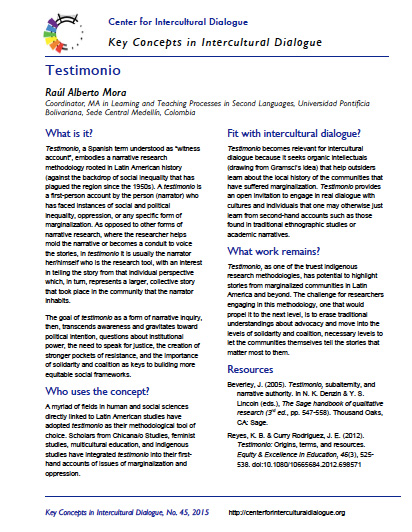
Key Concept #36: Counter-Narrative by Raúl A. Mora

Key Concepts in ICDThe next issue of Key Concepts in intercultural Dialogue is now available. This is KC36: Counter-Narrative by Raúl Alberto Mora. As always, all Key Concepts are available as free PDFs; just click on the thumbnail to download. Lists organized  chronologically by publication date and numberalphabetically by concept in English, and by languages into which they have been translated, are available, as is a page of acknowledgments with the names of all authors, translators, and reviewers.

KC36-sm

Mora, R. A. (2014). Counter-narrative. Key Concepts in Intercultural Dialogue, 36. Available from:
https://centerforinterculturaldialogue.org/wp-content/uploads/2014/10/key-concept-counter-narrative.pdf

The Center for Intercultural Dialogue publishes a series of short briefs describing Key Concepts in intercultural Dialogue. Different people, working in different countries and disciplines, use different vocabulary to describe their interests, yet these terms overlap. Our goal is to provide some of the assumptions and history attached to each concept for those unfamiliar with it. As there are other concepts you would like to see included, send an email to the series editor, Wendy Leeds-Hurwitz. If there are concepts you would like to prepare, provide a brief explanation of why you think the concept is central to the study of intercultural dialogue, and why you are the obvious person to write up that concept.


Creative Commons License
This work is licensed under a Creative Commons Attribution-NonCommercial-NoDerivatives 4.0 International License.

CFP Communications and the State: Toward a New International History

Communications and the State: Toward a New International History
International Communication Association Preconference
San Juan, Puerto Rico, May 20, 2015
Sponsor: ICA Communication History Division
Organizers: Gene Allen and Michael Stamm

In 2004, Paul Starr remarked that “Technology and economics cannot alone explain the system of communications we have inherited or the one we are creating. The communications media have so direct a bearing on the exercise of power that their development is impossible to understand without taking politics into account, not simply in the use of media, but in the making of constitutive choices about them.” Alongside Starr, historians have produced a vibrant new literature detailing the constitutive role of the state in the making of communications and the constitutive role of communications in the making and unmaking of states and empires. Indeed, communications – and the industries, infrastructures, and cultures that take shape around it – has been integral to state-related projects ranging from empire building to liberation movements and “great leaps forward.”

Though the range of state activities affecting and structuring communications is vast, it is possible to identify four broad themes in the literature: the state as communicator, the state as a regulator of communication, the state as a creator and/or subsidizer of structures of communication, and the state as an object of critique by citizens and subjects.

On the first theme, in the earliest days of print, state-building monarchs used the medium to celebrate their victories, minimize their defeats, and administer increasingly complex relationships with their subjects. Today, communications remains a key strategic function of all governments, whether democratic or authoritarian. How have these functions evolved over time?  How have they been used by different kinds of states and regimes at different times? The communication practices and requirements of, for example, the modern welfare state are very different than those of the pre-Revolutionary French monarchy.  The state in a democratic society communicates with its citizens differently than a colonial regime does with its subjects.

Along with attempts to shape public opinion, the state also restricts and regulates communication.  In democracies, this leads us to histories of licensing, censorship and other forms of repression and to histories of radical or revolutionary communication in opposition to the state. It also directs us to histories of regulatory institutions, legislation, court decisions and the myriad other ways that communication organizations have negotiated with states over access to public resources. Many of these issues have arisen in nondemocratic and colonial societies as well, though they often involve different strategies, tactics, and outcomes, and sometimes direct and violent repression.

Third, scholars have been broadening our understanding of the state’s role in creating communications networks and institutions. For example, Armand Mattelart has emphasized the importance of physical infrastructure, beginning with the systems of roads and canals constructed by the mercantilist state in the 17th and 18th centuries, in organizing communicative space. Richard John’s work on the US Post Office has been similarly influential in generating work on the state subsidy of information networks in the 19th and 20th centuries. Some scholars have taken a global and comparative approach to this theme, for example Daniel Hallin and Paolo Mancini, who recently extended their influential work on comparative media systems to include nonwestern societies. Others have interrogated how communication has been structured through the actions of supranational entities such as empires, international copyright or telecommunications conventions or agencies like UNESCO.

And finally, many scholars have examined how audience members, ordinary citizens, or colonial subjects have understood, interacted with, and responded to the state’s presence in their lives as it pertains to communication. Recent historical studies have examined such subjects as pirate radio, alternative journalism, media reform movements, public protests, court cases aimed at expanding or protecting the right to free expression, and forms of everyday resistance such as graffiti and public art. To many people in democratic societies, state power has not been seen as coincidental with justice or legitimacy. Opposition to colonial rule has often (justifiably) been more directly confrontational, though in postcolonial societies the idea of a new state can be seen as a path to emancipation. We seek to understand the various critiques and activist projects that have been generated as people communicate alongside or against the state.

Ultimately, the aim of this preconference is to bring together scholars studying diverse time periods and geographic areas with the goal of drawing conclusions about the state as an active element in the making of communications in general, rather than in one particular nation or another. We are also interested in what happens when communication systems reach across state boundaries and in historical formations that have important commonalities with states, such as alliances, kingdoms, juntas, and more.

Abstracts of 300 words (maximum) should be submitted no later than 15 November 2014. Proposals for full panels are also welcome: these should include a 250-word abstract for each individual presentation, and a 200-word rationale for the panel. Send abstracts to Gene Allen. Authors will be informed regarding acceptance/rejection for the preconference no later than December 15, 2014. In an effort to facilitate informed discussion of papers, the organizers will have the papers for this preconference posted online. For this reason, full papers will need to be submitted no later than April 15, 2015.