Peter Praxmarer Profile

ProfilesPeter Praxmarer, lic.oec.publ. (University of Zurich, 1977) and Docteur ès sciences politiques (The Graduate Institute, Geneva, 1984), is, since 2003, Executive Director of EMICC (European Masters in Intercultural Communication), a network of ten European universities specializing in intercultural communication, at Università della Svizzera italiana (USI) Lugano, Switzerland.

Peter Praxmarer
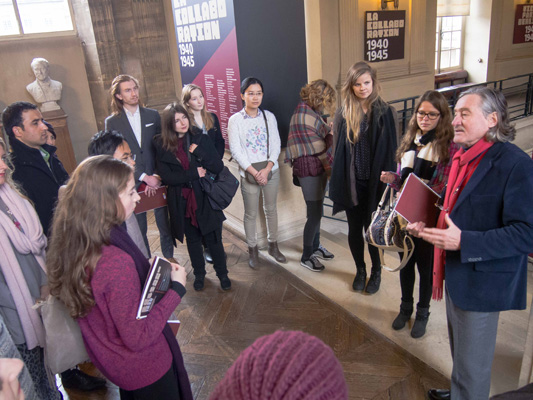
Praxmarer (right) with students of the 2014 Paris Eurocampus in the Archives nationales de France, Paris

For a number of years he taught international politics and relations in the United States (Temple University, University of Pennsylvania, Brown University and University of Rhode Island). He also was a consultant for UNITAR and the United Nations University on issues of social development, and has worked in the private sector (publishing, agriculture, art and antiques). During the wars in ex-Yugoslavia he participated in a fact-finding and assessment mission visiting UN peacekeeping forces in the Krajina region (Croatia), and served as Field and Training Coordinator with the OSCE Mission in Kosovo, for which he has also developed training programs in the field of democratization and good governance.

His main research focus is on epistemological issues (conceptualizations) in IC studies and the social sciences in general. His teaching is mainly on conceptualizations of “The Other”, as well as on intercultural communication in international organizations, and in particular peace communication in post-conflict and emergency contexts. He also works on academic cultures.

During the past ten years he has taught and lectured at more than two dozen universities in Europe and the US, and supervised a number of Bachelor and Master theses for students at different universities.

He also gives workshops and training courses in intercultural communication for different publics, including teachers at various levels, tourism professionals, immigration officials, paramedical personnel, healthcare professionals and managers.


NOTE: Peter Praxmarer passed away quite suddenly on November 5, 2017. He was a good friend to CID and will be sorely missed. A few concrete results of our frequent conversations follow. He wrote Key Concepts in Intercultural Dialogue #39: Otherness and the Other(s), translated it into both German and Italian, compiled a reader with study materials on intercultural communication competence, and prepared a poem, Languages of Peace. He wrote a guest post on Charlie Hebdo and intercultural dialogue, and responded at length to a guest post by Dominic Busch on refugees in Germany. During a Skype call with me, he came up with the concise definition of intercultural dialogue that was turned into CID Poster #3.
– Wendy Leeds-Hurwitz

Yang Liu Graphic Designs: East Meets West

Academics tend to discuss cultural differences in words. Designers show them visually. Yang Liu grew up in China, but then moved to Germany, becoming a designer. One of her projects, East meets West, consists of a series of comparisons of Chinese vs. German assumptions based on  her own experiences.

Her designs have been exhibited in both China and Germany, as well as being widely available on the internet. For further information, see her own website, or one of the many articles describing her work, including these:

Aw, Jean. (2007). Interview with Yang Liu- 11.13.07. NOTCOT.

Saleme, Shawn. (2013). East Meets West : An Infographic Portrait by Yang Liu. Visual News.

Save

CFP World Conference on Pluricentric Languages (Austria)

Call for Papers: World-Conference on Pluricentric Languages and their Non-Dominant Varieties
Organized by the International Working Group on Non-Dominant Varieties of Pluricentric Language (WGNDV)
July 08–11, 2015, University of Graz, Austria
Submission deadline: March 30, 2015
Notification of acceptance: April 15, 2015
Publication of papers: A volume of selected papers is to be published by Peter Lang Verlag, Frankfurt.
All papers for the conference and the publication will be peer-reviewed.

The conference will also have a section on language technology providing scholars the possibility to present their methods and approaches in corpus linguistics, natural language processing and the computational treatment of linguistic variation existing between and within national varieties.

The organizers of this 4th conference of the Working Group on Non-Dominant Varieties of Pluricentric Languages (WGNDV) would like to invite scholars from around the world to participate. The conference is devoted to the description of pluricentric languages and in particular of non-dominant national varieties of plc. languages. These are the varieties that are small by the number of their speakers and their symbolic power, and are not the primary norm-setting centres of the language. They may often be falsely attributed the status of a “dialect”, and have little or no codification of their norms. Typically, nd-varieties often have to legitimate their norms towards the dominant varieties etc. The previous conferences of the WGNDV have shown that non-dominant varieties around the world have many linguistic and sociolinguistic features in common. We would therefore like to deepen our knowledge and invite scholars from around the world to take part in the conference and give insight into the situation and features of as many nd-varieties and plc. languages as possible.

Objectives of the 4th conference:
The WGNDV wishes to continue in the line of the previous conferences and to extend the scope of its research. The main objectives of this conference are:
1.    To get more information about the situation of as many pluricentric languages and non-dominant-varieties in order to get empirically secure descriptions of effects of non-dominance.
*on the identity of their speakers,
*on the identity of their language communities,
*on the treatment of norms in written and spoken language,
*on the principles of codification and their spread to younger generations, and
*on methods in language-technology, how linguistic variation between and within national varieties and nd-varieties in particular can be treated and modelled computationally.

2.    To get exhaustive reports of the situation of as many plc. languages and nd-varieties around the world as possible and in particular of lesser known and researched plc. languages and nd-varieties like:
*Albanian, Aramaic, Aromunian, Basque, Bengali, Chinese, Croatian, Guaraní, Hebrew, Hindi/Urdu, Hungarian, Kiswahili / Swahili, Kurdish, Mapudungun, Occitan, Pashto, Punjabi, Quechua, Tamil, Romanian, Russian etc.
*ND-varieties of English in Europe, Americas, Africa and Asia;
*ND-varieties of French in Europe, Africa, Asia and America;
*ND-varieties of Spanish in the Americas and in Asia;
*ND-varieties of Portuguese in South-America, Africa and Asia;
*ND-varieties of German in Austrian, Belgium, Italy, Switzerland, Liechtenstein, Luxemburg; and
*Reports on the development of Russian in the former member-states of the Soviet Union

3.    To deepen the theory of plc. languages and the methods for the description of nd-varieties in particular in respect to:
*migrant varieties creating new types of pluricentricity;
*second level forms of pluricentricity within national varieties and their theoretical treatment;
*strategies for coping with language shift caused by electronic media and satellite TV spreading dominant norms to non-dominant varieties;
*the treatment of linguistic and pragmatic features of nd-varieties in education in primary and secondary schools;
*principles of codification in diglossic language communities of plc. languages, esp. the treatment of divergent linguistic forms that are common in everyday communication;
*the usage of endonormative codification strategies and their impact on the development of varieties and languages;
*measures of status planning and corpus planning etc. etc.

Important dates:
All scholars working in this field are invited to submit proposals for papers/workshops by 30th March 2015.
Notification of acceptance: 15th April 2015.

Contents of papers:
Papers (25 mins. + 5 mins. discussion) should address one or more of the above mentioned objectives of the conference as mentioned above and should thus provide:
*Information about the situation of any pluricentric language and any non-dominant-varieties in order to get empirically secure descriptions.
*To get exhaustive reports of the situation of lesser known and researched plc. languages and nd-varieties (see the list) and may be of “new” plc. languages that have not previously been identified.
*Data that deepen the theory of plc. languages and the methods for the description of nd-varieties.
*Suggestions for other topics are welcome!<

Contents of workshops:
Workshops (90 minutes long) should concern specific languages and their various non-dominant varieties, and particular methodological problems in the description of non-dominant varieties.

Abstracts:
All abstracts must be written in English and copied into the field “abstract” on the registration page or submitted via email as an attachment in Word format.
*Abstracts for 25-minutes papers should not exceed 3000 characters (1 page A4) including 4 keywords. Suggested topics for presentations can be downloaded from the conference website.
*Abstracts for 90-minutes workshops should not exceed 5000 characters (1 1/2 page A4) including 4-8 keywords. Workshop organizers should outline the overall structure of the workshop and provide names of the participants.

Conference language(s) and Sections:
The conference languages will be English and German plus the languages of the sections for specific languages if there are enough presentations to establish a section. The following sections are envisaged: English, French, German, Portuguese, Russian, Spanish, a general section and a language technology section. All presentations at the conference must be written in English, although the oral presentation can be held in the language of the section.

CFP Professional Communication, Social Justice, and the Global South

CALL FOR PAPERS
Professional Communication, Social Justice, and the Global South
Guest editors:
Gerald Savage, Illinois State University, Emeritus Faculty, USA
Godwin Y. Agboka, University of Houston Downtown, USA

Professional communicators are working all over the world. They practice in business, industry, government, charitable non‐profit organizations, non‐governmental organizations, and intergovernmental organizations. And yet, nearly all of the research on international professional communication has focused on corporate contexts in the “developed” world. Consequently, international technical communication practice and research tends to focus on barely more than half of the world’s nations included in the 2013 United Nations Human Development Index. These are nations ranked as “very high” or “high” on the human development scale. Only a few nations ranked as “medium” receive much notice—China, Thailand, Philippines, and South Africa are the most prominent.

Many of the nations regarded as “low” on the Human Development Index are sites of transnational corporate activity, of which a significant amount involves various kinds of resource development of questionable benefit to the people of those nations. However, a number of NGOs throughout the world pay close attention to the unfair, unjust, and environmentally detrimental activities of exploitative transnational corporations among indigenous and marginalized populations. These NGOs’ work includes research, legal action, and extensive documentation. Many transnational corporations also document their development and other business activities in sensitive areas of the world, some of them for purposes of accountability for their efforts at corporate social responsibility, others for purposes of denying or whitewashing egregious activities.

Only a handful of studies in professional communication, published over the past fifteen years, have addressed these issues (Agboka, 2013a, 2013b; Dura, Singhal, & Elias, 2013; Ilyasova & Birkelo, 2013; Vijayaram, 2013; Smith, 2006, 2012; Walton & DeRenzi, 2009; Walton, 2013; Walton, Price, & Zraly, 2013). This is especially troubling, considering that a wide range of other professions have given extensive attention to their roles in development activities among unenfranchised populations—such professions as engineering, medicine, agriculture, economics, business management, computer science, and geography. Professional communication scholars and practitioners have taken great pride in the part played by communication professionals in all of these fields, but too little research/ scholarship in professional communication has kept pace with the global social consciousness these other fields have demonstrated for many years regarding the impacts of their work beyond the industrialized Global North. This special issue attempts to address this need.

For this special issue we seek articles, commentaries, teaching cases, and reviews focusing on research studies, corporate, NGO, or government documentation relating to fair practices, environmental and social justice, and human rights in what is variously referred to as the Third and Fourth Worlds, Developing Countries, or the Global South. “Global South” and “Fourth World” are terms intended to include populations that are not necessarily in the southern hemisphere and that also do not include only nation states. Thus, the terms can include populations within “First World” nations, including the U.S. We especially seek proposals from scholars and practitioners who are indigenous to Global South populations or whose work connects with or affects populations in the Global South. The issue will also include several interviews with practitioners who are working in or with Global South populations.

Suggested topic areas include, but are not limited to:
• Intercultural research that takes place in Global South contexts
• Localization and translation for audiences in Global South sites
• Intersections of globalization and localization, and their associated challenges
• Workplace practices that impact specific Global South contexts
• Ethics in the context of the Global South
• Corporate, NGO, or other organizations’ documentation practices in Global South
contexts
• Curriculum design perspectives that address Global South perspectives
• The complexities of cross‐cultural collaborations between Global South and Global
North team members or among teams distributed across Global South cultures.
• Crisis communication in the contexts of the Global South
• Social justice implications of technology deployment and uses in the Global South

Proposals to be developed into
• Original research articles of 5,000 to 7,000 words of body text.
• Review articles of 3,000 to 5,000 words of body text.
• Focused commentary and industry perspectives articles of 500 to 3,000 words of body text.
• Teaching cases of 3,000 to 5,000 words of body text (deadline for submissions of manuscript proposals is February 15, 2015).
Submission procedures:
• Cover page containing your name, institutional affiliation, and email address.
• Prepare the cover page and manuscript with 1.5 line spacing and Times New Roman, 12‐point font.
• 500‐word proposal for original research articles, review articles, and teaching cases; 250‐word proposals for focused commentary and industry perspectives.
• All submissions will be reviewed by at least two readers, whether you are submitting a research article, a review article, industry perspective article, or teaching case.
• Submit via email to Gerald Savage or Godwin Agboka
• Proposals should be sent as a .docx, .doc, or .rtf file attached to an email message with the subject line: “Proposal for Special Issue on Professional Communication, Social Justice, and the Global South.”

Schedule
• Submission deadline for manuscript proposals: February 15, 2015
• Notification of proposal acceptances: March 15, 2015
• Submission deadline for first drafts of full manuscripts: June 15, 2015
• Submission deadline for revised drafts of manuscripts: November 1, 2015
• Expected date of publication: February 28, 2016.
Journal Editors: Rosário Durão & Kyle Mattson
Website: http://www.connexionsjournal.org/>www.connexionsjournal.org
connexions • international professional communication journal (ISSN 2325‐6044)

References
Agboka, Godwin Y. (2013a). Participatory localization: A social justice approach to
navigating unenfranchised/disenfranchised cultural sites. Technical Communication
Quarterly, 22(1), 28‐49.
Agboka, Godwin Y. (2013b). Thinking about social justice: Interrogating the international in international technical communication discourse. connexions: international professional communication journal, 1(1), 29‐38.
Dura, Lucia, Singhal, Arvind, & Elias, Eliana (2013). Minga Peru’s strategy for social change in the Peruvian Amazon: A rhetorical model for participatory, intercultural practice to advance human rights. Journal of Rhetoric, Professional Communication and Globalization, 4(1), 33‐54.
Ilyasova, K. Alex, & Birkelo, Cheryl (2013). Collective learning in east Africa: Building and transferring technical knowledge in livestock production. In Han Yu & Gerald Savage (Eds.), Negotiating Cultural Encounters: Narrating Intercultural Engineering and Technical Communication (pp. 103‐121). Hoboken, NJ: John Wiley and Sons.
Smith, Beatrice Quarshie (2006). Outsourcing and digitized work spaces: Some implications of the intersections of globalization, development, and work practices. Journal of Adolescent and Adult Literacy, 49(7), 596‐607.
Smith, Beatrice Quarshie (2012). Reading and Writing in the Global Workplace: Gender, Literacy, and Outsourcing in Ghana. Plymouth, UK: Lexington Books.
Vijayaram, Vaishnavi Thoguluva (2013). Learning curve. In Han Yu & Gerald Savage (Eds.), Negotiating Cultural Encounters: Narrating Intercultural Engineering and Technical Communication (pp. 61‐80). Hoboken, NJ: John Wiley and Sons.
Walton, R., & DeRenzi, B. (2009). Value‐sensitive design and health care in Africa. IEEE Transactions on Professional Communication, 52, 346‐358.
Walton, R. (2013). How trust and credibility affect technology‐based development projects. Technical Communication Quarterly, 22, 85‐102.
Walton, R., Price, Ryan, & Zraly, Maggie (2013). Rhetorically navigating Rwandan research review: A fantasy theme analysis. Journal of Rhetoric, Professional Communication and Globalization, 4, 78‐102.


Key Concept #46: Politeness by Sara Mills

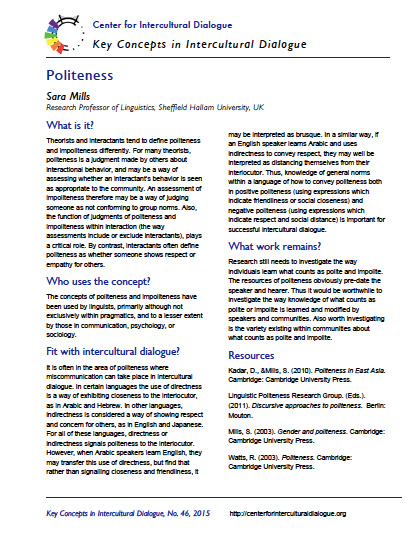
Key Concepts in ICDThe next issue of Key Concepts in intercultural Dialogue is now available. This is KC46: Politeness by Sara Mills. As always, all Key Concepts are available as free PDFs; just click on the thumbnail to download. Lists organized  chronologically by publication date and numberalphabetically by concept in English, and by languages into which they have been translated, are available, as is a page of acknowledgments with the names of all authors, translators, and reviewers.

Key Concept #46 Politeness by Sara Mills

Mills, S. (2015). Politeness. Key Concepts in Intercultural Dialogue, 46. Available from: https://centerforinterculturaldialogue.org/wp-content/uploads/2015/01/key-concept-politeness.pdf

The Center for Intercultural Dialogue publishes a series of short briefs describing Key Concepts in Intercultural Dialogue. Different people, working in different countries and disciplines, use different vocabulary to describe their interests, yet these terms overlap. Our goal is to provide some of the assumptions and history attached to each concept for those unfamiliar with it. As there are other concepts you would like to see included, send an email to the series editor, Wendy Leeds-Hurwitz. If there are concepts you would like to prepare, provide a brief explanation of why you think the concept is central to the study of intercultural dialogue, and why you are the obvious person to write up that concept. Feel free to propose terms in any language, especially if they expand our ability to discuss an aspect of intercultural dialogue that is not easy to translate into English.


Creative Commons License
This work is licensed under a Creative Commons Attribution-NonCommercial-NoDerivatives 4.0 International License.

Clothing as a Tool of Intercultural Dialogue: New Zealand and India

New Zealand fashion students recreate modern-day wear from traditional Indian silk saris

In a unique celebration joining New Zealand and Indian cultures, 15 New Zealand Fashion Tech students won Prime Minister’s Scholarships for Asia, covering travel to the Bannari Amman Institute of Technology in India to participate in a five week Apparel and Textile Practicum. Students earned the awards by creating garments made from traditional Indian sari fabrics. The inaugural Resene Designer Selection showcased the hand-crafted silk from Southern India made especially for their garments. Four of the NZ students were Maori. The goal was to take students outside the classroom and give them an international and applied perspective.

Further information about this project is available in a New Zealand journal article entitled “A pattern for success” published in Educator Review, and in an Indian newspaper article entitled “Indian silk, New Zealand patterns”. Continuing descriptions by the students of their experiences are also available on their university’s website.

IPD Academy in Peacebuilding, Mediation, Intercultural Dialogue (2015)

Institute for Peace and Dialogue (IPD)
Academic Programs 2015

A) 2 International Summer Academy programs in Peacebuilding, Mediation, Conflict Resolution & Intercultural Dialogue

– I Summer Academy: 7-17 August, 2015

– II Summer Academy: 17-27 August, 2015

Place: Baar, Switzerland

B) 3 Month Certificated Academic School in Mediation & Conflict Resolution (CAS in MCR)

Date: 17 August – 17 November 2015

Place: Switzerland

Sara Mills Profile

Profiles

Sara Mills is a Research Professor in Linguistics at Sheffield Hallam University in the UK.

Sara Mills


She has published on feminist linguistics, mainly sexism and gender and politeness. Her recent research has specifically focused on politeness, and she is also interested in how groups communicate on social media, languages, and perceptions of “management-speak.”


Work for CID:
Sara Mills wrote KC46: Politeness.

CFP Global Exploitation Cinemas (UK)

CFP
“Global Exploitation Cinemas: Historical and Critical Approaches”, an academic conference and film event organised by the University of Lincoln (UK) in association with the forthcoming Bloomsbury book series of the same name.

University of Lincoln presents …
GLOBAL EXPLOITATION CINEMAS: HISTORICAL AND CRITICAL APPROACHES

An academic conference and film event
The historic Ritz Cinema and Theatre, Lincoln (UK), 28 and 29 May 2015

CONFIRMED KEYNOTE SPEAKERS:

Eric Schaefer (Emerson College, US)
author of Bold! Daring! Shocking! True! A History of Exploitation Films, 1919-1959 (Duke University Press, 1999)
and editor of Sex Scene: Media and the Sexual Revolution (Duke University Press, 2014)

I. Q. Hunter (De Montfort University, UK)
author of British Trash Cinema (BFI, 2012) and Cult Film as a Guide to Life (Bloomsbury, 2015).

The academy’s approach to film history has undergone a significant shift in the 21st century, with previously marginalised, despised and neglected aspects of popular film being afforded unprecedented levels of attention. This process of revaluation has occurred on a global scale, highlighting the development of rich and relatively uncharted alternative film cultures and histories, including those of “exploitation” films, and in turn enabling fresh empirical and critical methodologies.

The academic conference and film event “Global Exploitation Cinemas”-which is being funded by the University of Lincoln (UK) and is working in conjunction with the forthcoming Bloomsbury book series of the same name-aims to bring together an eclectic and diverse range of approaches to exploitation cinema, welcoming any perspective that adds to the burgeoning scholarship in this field of study. Proposals which emphasise the international dimensions of exploitation cinema are especially welcome, but the conference will remain broad and inclusive in considering topics for discussion.

Potential subjects and approaches include, but are by no means limited to:
* Critical reception and/or re-assessment
* Socio-historical dimensions and debates
* Form and aesthetics
* Global and transnational perspectives
* Sexploitation
* The pornographic feature film
* Media controversies and censorship
* Publicity and advertising
* Stardom
* Directors, writers and producers
* Movements, cycles and sub-genres
* Exhibition and distribution
* Geographies
* Restoration and re-appropriation
* Exploitation in the video age
* Nostalgia
* Publishing
* “Mainstream” infiltrations
* DVD documentaries/special features
* Festivals and conventions
* Ephemera and the collector
* The internet and participatory cultures
* Neo-exploitation in the 21st century

Abstracts (of around 300 words) and some brief biographical information (of around 50 words) should be sent no later than FRIDAY 27 FEBRUARY 2015 to the conference email

Organisers:
Shaun Kimber (Bournemouth University)
Neil Jackson (University of Lincoln)
Johnny Walker (Northumbria University)
Thomas Joseph Watson (Northumbria University)

Susan Currier Visiting Prof (California)

The Susan Currier Visiting Professorship for Teaching Excellence in the College of Liberal Arts at California Polytechnic State University in San Luis Obispo, California is a residential teaching professorship that recognizes superior teaching in the liberal arts, emphasizing (where possible) the intersection between gender/women’s issues and global justice/humanitarian concerns. The goal of the Susan Currier Visiting Professorship is to bring a visiting Associate or Full Professor with a distinguished record of teaching excellence to Cal Poly for the purpose of sharing expertise and passion for teaching, social justice, and the liberal arts. It can accommodate visiting scholars on semester or quarter schedules.

The Susan Currier Visiting Professorship is a full-time, one-quarter, non-renewable appointment to cover the Fall 2015 (September 14, 2015 to December 12, 2015) OR Winter 2016 (January 4, 2016 to March 21, 2016) OR Spring 2016 (March 28, 2016 to June 11, 2016) quarter. A half-time, two-consecutive-quarter, non-renewable appointment may be considered. Funding to support the position entails a two-course teaching assignment plus assigned time for service to the university (15 units total). Service includes presentation of the annual Susan Currier Memorial Lecture (a major university-wide presentation on a topic appropriate to the visitor’s field) and other to-be-determined activities promoting excellence in teaching (e.g., participation in Cal Poly’s Center for Teaching, Learning and Technology). In accordance with CSU and university travel reimbursement guidelines, the visiting professorship provides limited funds to partially reimburse documented housing expenses during the visiting appointment, and to reimburse documented travel expenses for one trip to and from the location of the home institution. Salary is commensurate with qualifications, expertise, and experience. In addition, library privileges, some administrative support, and assistance in finding housing are provided.

The Susan Currier Visiting Professorship for Teaching Excellence will be situated in one of the following departments depending on the background of the individual selected for this position: Art & Design, Communication Studies, English, Ethnic Studies, History, Modern Languages and Literatures, Music, Philosophy, Theatre and Dance, or Women’s and Gender Studies, but it is open to applicants in other fields of study traditionally associated with the liberal arts. Ph.D. or other appropriate terminal degree is required in one of the fields of study traditionally associated with the liberal arts. Distinguished record of teaching excellence in a field related to one or more of the academic departments listed above. Preference will be given to candidates whose teaching, research, and/or service emphasizes the intersection between gender/women’s issues and global justice/humanitarian concerns.

To apply, please visit Cal Poly Jobs, complete a required online faculty application, and apply to Requisition #103492. Please attach to your electronic application (1) a cover letter, (2) resume/curriculum vitae, (3) copy of transcripts, (4) statement of teaching philosophy (one page maximum), (5) evidence of teaching excellence and effectiveness, and (6) a brief descriptive listing of possible courses (2 page maximum). In the cover letter, please identify the teaching quarter(s) available/preferred. Applicants must be prepared to provide names and email addresses for a minimum of three professional references when completing the online application. In their letters, references should address your achievements in teaching as well as your work in a field related to one or more of the departments. Cal Poly will directly solicit letters from the individuals listed by applicants. Questions should be sent to Jane Lehr, Search Committee Chair, Susan Currier Visiting Professorship, Women’s and Gender Studies Department, Cal Poly, 1 Grand Avenue, San Luis Obispo, CA 93407-0875 or the Cal Poly’s Women’s and Gender Studies Department.

Review Begin Date: January 30, 2015. Completed applications received by the review begin date (letters can be pending) will be given full consideration. Official sealed transcripts will be required prior to appointment.