Global Governance Summer School (Belgium)

For students and practitioners everywhere, the Leuven Centre for Global Governance Studies (University of Leuven) and the Dean Rusk International Law Center (University of Georgia School of Law) are delighted to announce a new opportunity to study international law and global governance. Applications are welcome for a brand-new Global Governance Summer School, spanning 3 weeks at the centuries-old University of Leuven, located in a beautiful city a short train ride from Brussels and easily accessible to many European capitals. Students in law and related disciplines, from the United States, Europe, and across the globe, are welcome to enroll. All students will receive a certificate, and U.S. law students also may earn 4 American Bar Association-approved credits.

Deadline: April 4, 2016

Through lectures, discussions, and group research projects, students will explore global governance – how state, regional, and international legal regimes, plus individuals, corporations, intergovernmental and nongovernmental organizations, networks, and other nonstate actors, interact. A range of global challenges will be discussed, such as trade and sustainable development, peace and security, trafficking and other crimes, intellectual property, the environment, human rights and the rule of law, and migration.

Four cutting-edge, English-language courses will be given. In addition, the summer course offers field trips to European and international institutions in Brussels and Luxembourg and an expert conference on global governance in Brussels. The summer school aims to bring together students from all over the world and different disciplines fostering interdisciplinary and intercultural dialogue.

This summer school is intended for:
• Advanced students in international law, international relations, international political economy, international and European studies
• Practitioners and policy experts from the international policy community who want to update their knowledge on current developments in global governance and international law

U.S.-based law students are eligible to earn 4 American Bar Association-accredited hours in the three weeks of courses.

EIUC Training for International Electoral Observers (Italy)

The Inter-University Centre for Human Rights and Democratisation (EIUC) is running a two modules Training Seminar for International Electoral Observers from 18-23 April 2016.

Target: The two modules are devoted to those applicants with no experience in election observation or to those observers who have participated to a maximum of two missions as short term observers. EIUC will accept candidatures for each separate module or both combined.

Eligibility: Lectures are conceived for an audience of graduates mainly in Law, Political Sciences, Economics, Sociology, Philosophy, Anthropology or similar who want to address international election observation from a multi-disciplinary approach that will be useful in further engagements on the field.

Faculty: it is composed by well-known international trainers and professionals with a long standing practical experience in election observation missions within international organisations such as the European Union and the Organisation for Security and Cooperation in Europe.

Methodology: the course will combine frontal lecturers in plenary, working groups as well as role plays, discussions and simulation exercises.
Training language: all courses will be held in English. It is, therefore, essential that all participants understand and speak English fluently.

Module I
Dates: 18-20 April 2016
Starting with a thorough introduction on the international observation theory and legal standards the first module will analyse the practical life of a short term observer from the selection procedure to the end of mission including the observation of the polls, the filling of the forms, the reporting system and the code of the conduct.

Module II
Dates: 21-23 April 2016
The second module will introduce the participants to the long-term election observation by analysing in depth some of the aspects related to an international observation mission such as working relations, interviewing techniques, media and security.
Deadline for enrolment: 1 April 2016 – Early bird 4 March 2016

For any general query about IEO training seminar you can drop an email or use the contact form
Location: Monastery of San Nicolò, Venice Lido (Italy)
Training Responsible: Demetrio Lazagna
Project Manager: Alberta Rocca

Max Planck Institute for Psycholinguistics job ad (Netherlands)

Research Scientist position in the Psychology of Language Department
Max Planck Institute for Psycholinguistics
Expires: 1st April 2016

The Max Planck Institute for Psycholinguistics (Nijmegen, the Netherlands) is offering a Research Scientist position in the Psychology of Language Department led by Prof. Antje Meyer.

The MPI for Psycholinguistics is a leading research institute with a stimulating environment and excellent facilities and resources. The research of the institute is entirely devoted to the question of how we acquire, produce, and understand language. Its investigations are highly multidisciplinary, uniting anthropology, linguistics, psychology, neuroscience, computer science, and genetics. For further details of our research, please see our website.

The position is available to new PhDs as well as more senior researchers. Candidates should have, or shortly expect to obtain, a PhD in psychology, cognitive neurosciences, or linguistics. Further requirements are a strong background in experimental psychology or experimental psycholinguistics and excellent statistical skills. The successful candidate is expected to develop her/his own research projects and to contribute to the research program of the department, specifically either to research into the cognitive processes underlying dialogue or the bases of individual differences in language skills.

The position is available from June 2016 for up to five years. The institute provides state-of-the art research and training facilities (including EEG, eye tracking, virtual reality labs) as well as a conference and travel budget. The Max Planck Society is an equal opportunity employer.

Electronic applications should be sent to Evelyn Veen.

Applications should include:
• 2-page statement of research interests
• CV
• List of publications
• Contact details for up to three referees

Review of applications will start on March 1, 2016 and will continue until the position is filled.

CFP Languages and Cultures in 21st Century Transnationality (UK)

Languages and Cultures in 21st Century Transnationality CFP
Languages and Cultures at Sheffield Hallam University,
City Campus, Sheffield, S1 1WB
Friday 9 and Saturday 10 September 2016
Abstract deadline: 31 March 2016

The concept of transnationality is increasingly common currency in the globalized world.

Modern Languages, both implicitly or explicitly, deals with the transnational aspects of cultures and, as a discipline, it is hence ideally suited to have societal impact on the construction of transnational education. Intercultural citizenship, in particular, is becoming a sine qua non in the Twenty-First Century. Modern Languages poses multicultural and multilingual questions about identity, subjectivity and alterity of past, present and future. As academics we represent institutional power and theoretical knowledge; we are mediators between theoretical processes of conceptualization and practical moments of interpretation; information brokers and hence in the fortunate positions to bring about social change.

The aim of the conference is to bring together scholars from Applied Linguistics, Intercultural Studies and European Cultural Studies to create intercultural and interdisciplinary synergies that go beyond national borders, linguistic silos or academic canons, and thus echo practices of human mobility. Themes of particular interest in the three streams include, but are not limited to:

Applied Linguistics:
• CLIL (Content and Language Integrated Learning), technology-enhanced learning, film as teaching tool
• language acquisition, language planning
• learner autonomy, student engagement
• multilingualism, translation
• discourse analysis

Intercultural Studies:
• citizenship, identity, multiculturalism, nationhood, race
• intercultural awareness, communication, competence, education, management
• tourism, postcolonialism
• international student migration

European Cultural Studies:
• the transnational currency of popular cultural products
• translations, transpositions, transmediality
• synergies/dialogues across national cultures
• intersections of culture with other fields/disciplines (history, law, literature, sociology, technology)
• dialogues across sociocultural strata (e.g. popular and elite cultures)
• fluidity of identity

We invite proposals for 20-min papers; proposals for panels/symposia are also welcome. 250-word abstracts should be submitted by 31 March 2016 to Dr Anja Louis. Abstracts should include the author’s name, affiliation and email address. Please specify ‘Languages and Cultures Conference’ in the subject of your email. We will acknowledge receipt of all abstracts submitted. If you do not receive a reply from us within two weeks, you should assume we did not receive your email.

PhD Research Project: 3 Faith Forum and Peace

PhD Research Project exploring the role and impact of 3 Faith Forum in fostering peaceful relations
Coventry University – Centre for Trust, Peace and Social Relations
Closes: 31st March 2016

PhD research project exploring the role and impact of 3 Faith Forum in fostering peaceful relations.
Full-Time – three years fixed term

The Centre for Trust, Peace and Social Relations (CTPSR) builds on the strong track record of scholars at the University on human security, peace studies and social relations. CTPSR brings together expertise from across the social sciences and humanities to drive progressive change and strengthen human security and resilience.

CTPSR is committed to achieving excellence through a stimulating multi-disciplinary research environment. Currently with 30 PhD students, CTPSR’s Doctoral Training Programme delivers a first year of quantitative and qualitative methods training, equipping research students to undertake primary research in year two. Throughout the three years our research students receive training covering academic writing, specialist analytical software and attendance at conferences, as well as two intensive summer schools.

Coventry University is offering one full-time PhD studentship to a well-qualified individual, to start in September 2016. The studentship will support our partnership with 3FF (Three Faiths Forum), one of the leading interfaith and intercultural organisations in the UK.

Proposals are invited for a PhD project exploring the role and impact of 3FF in fostering peaceful relations. We welcome proposals that will provide new insights about the difference 3FF’s work makes to the communities it works with, including young people, schools, universities, students, religious groups, members of Parliament, women and local communities. We welcome proposals that are interdisciplinary, innovative and use participatory research methods. Proposals should challenge existing ideas, expand current thinking and contribute to change within 3FF and the communities it works with.

The PhD studentship will be based within the Faith and Peaceful Relations Research Group, one of six research groups in the Centre for Trust, Peace and Social Relations. The PhD student will work 6 hours per week as a Research Assistant within the research group. Students are supervised by three supervisors. For information about potential supervisors, visit the CTPSR website.

The studentship will cover UK/EU or overseas fee equivalence plus a bursary of £14057 per annum for three years.

Candidate specification:
• a taught Masters degree in a relevant discipline, involving a dissertation of standard length written in English in the relevant subject area with a minimum of a merit profile: 60% overall module average and a minimum of a 60% dissertation mark
• the potential to engage in innovative research and to complete the PhD within a three-year period of study
• a minimum of English language proficiency (IELTS overall minimum score of 7.0 with a minimum of 6.5 in each component)
• a first or good upper second class undergraduate degree in a related social science or in the humanities and a strong interest in pursuing research in this field
• skills in quantitative and qualitative methods

Enquiries may be addressed to:
Dr Kristin Aune

Application information can be found in our how to apply section. Applicants are advised to read the following information (3FF information sheet) prior to submit a formal application.

UK/EU/International students with the required entry requirements

Application deadline date: 31 March 2016


Nanyang Technological U job ad: Language and Communication (Singapore)

Assistant Professor in Language and Communication (tenure-track)
Nanyang Technological University – School of Humanities and Social Sciences
Closes: 31st March 2016

Young and research-intensive, Nanyang Technological University (NTU Singapore) is ranked 13th globally. It is also placed 1st amongst the world’s best young universities.

The School of Humanities and Social Sciences at NTU is inviting applications for Assistant Professor in Language and Communication (tenure-track).

Candidates should possess a PhD in English Linguistics, Applied English Linguistics, English for Academic Purposes, Technical Communication, or a similar subject, with a strong research agenda. Candidates with teaching and research experience in at least one of the following areas are welcome to apply:
• Research writing for PhD theses and research publications;
• English for academic purposes;
• E-learning and web-based (or ‘blended’) learning programmes.

The successful candidate will assist in the design and implementation of courses in discipline-specific English and Technical Communication for students in various Schools and Colleges across the University. He or she will also be expected to carry out research and to publish in leading journals in the field, as well as providing leadership in developing the activities of the Centre.

Emoluments
The salary will be very competitive and will commensurate with qualifications and experience. The University offers a comprehensive fringe benefit package.

Application Procedure
To apply, please refer to the Guidelines for Submitting an Application for Faculty Appointment and email your application package (consisting of a cover letter, curriculum vitae, personal particulars form, teaching and research statements, three selected reprint/preprints of publications, and the names and email addresses of three potential referees) to: lcc search email.

Applications may also be submitted by regular mail to:
Head, Language and Communication Centre
School of Humanities and Social Sciences
Nanyang Technological University
14 Nanyang Drive, #02-19
Singapore 637332

Enquiries about the position may be addressed to:
Head, Language and Communication Centre
Professor Kingsley Bolton

Closing date of applications: 31 March 2016

Only shortlisted candidates will be notified.

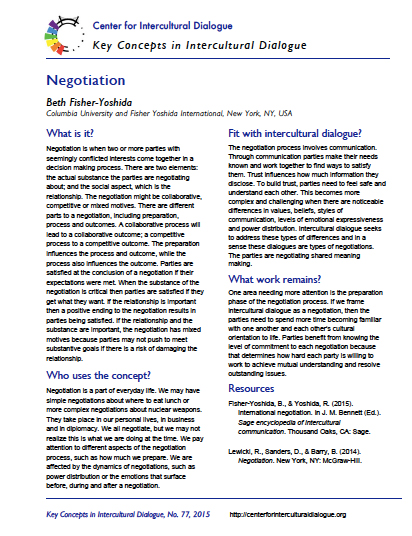
Key Concept #77: Negotiation by Beth Fisher-Yoshida

Key Concepts in ICDThe next issue of Key Concepts in intercultural Dialogue is now available. This is KC77: Negotiation by Beth Fisher-Yoshida. As always, all Key Concepts are available as free PDFs; just click on the thumbnail to download. Lists organized chronologically by publication date and numberalphabetically by concept in English, and by languages into which they have been translated, are available, as is a page of acknowledgments with the names of all authors, translators, and reviewers.

Key Concept 77 Negotiation by Beth Fisher-YoshidaFisher-Yoshida, B. (2016). Negotiation. Key Concepts in Intercultural Dialogue, 77. Available from:
https://centerforinterculturaldialogue.org/wp-content/uploads/2016/03/kc77-negotiation.pdf

The Center for Intercultural Dialogue publishes a series of short briefs describing Key Concepts in Intercultural Dialogue. Different people, working in different countries and disciplines, use different vocabulary to describe their interests, yet these terms overlap. Our goal is to provide some of the assumptions and history attached to each concept for those unfamiliar with it. As there are other concepts you would like to see included, send an email to the series editor, Wendy Leeds-Hurwitz. If there are concepts you would like to prepare, provide a brief explanation of why you think the concept is central to the study of intercultural dialogue, and why you are the obvious person to write up that concept.


Creative Commons License
This work is licensed under a Creative Commons Attribution-NonCommercial-NoDerivatives 4.0 International License.

CFP International Rhetoric Workshop: Crossing Traditions, Reimagining the Political (Sweden)

CFP: International Rhetoric Workshop: “Crossing Traditions: Reimagining the Political”
Uppsala University, Sweden
17-19 August 2016

The International Rhetoric Workshop (IRW) invites PhD students and emerging scholars to participate in developing the study of political rhetoric and its theoretical traditions. At beautiful Uppsala University, Sweden, we will meet in the last days of summer to advance rhetorical scholarship on “Crossing Traditions: Reimagining the Political”. The theme seeks to engage with questions of how various traditions of rhetorical theory meet and merge within global rhetorical practices, and how these crossings can change and develop the concept of the political. The IRW seeks to bring the diverse global community of rhetoric scholars together in a collaborative setting.

Contemporary rhetorical studies include the study and criticism of contemporary persuasive practices, theoretical discussions on the conditions for communal meaning-making, and historical studies of rhetorical practices and rhetorical thinking in different times and places. The emphasis rhetorical studies places on cross-fertilization between these different forms of inquiry opens opportunities to take on the challenges posed by contemporary politics. The workshop theme seeks to be true to this characteristic of rhetorical studies, and focuses on the crossings of various rhetorical traditions and how global rhetorical practices can change and develop our conception of the political and its possibilities.

The concept of the political has been a keystone in rhetorical thought since its instigation in ancient Greece. With world-wide communication and instant circulation, recurring crises and ever-increasing risk, environmental global challenges, and the racializing, sexualizing, and gendering of bodies, the importance of rhetoric at its intersection with the political continues to increase. It is simply not possible to imagine the political without also taking into consideration rhetorical practices that negotiate all of these issues. Examinations of the political and its materialization in particular contexts and advances in theoretical models that better fit today’s world are therefore much needed.

Suggested themes or questions to be furthered at the workshop:
– Geographically structured traditions of rhetorical practices: their local, regional, and national contestations.
– How these traditions crosses boundaries: how they are compared, merged or intersected with other specific practices globally.
– How various rhetorical scholarships on political practices and political theories change and merge across academic traditions.
– Rhetorical conditions of possibility for the political to emerge.
– How rhetoric’s multifaceted, transnational intellectual history has crossed borders: its ancient heritage, its Arabic-European transformations, its mutation into post-colonial settings and histories of thought.
– How rhetoric’s continuous engagement with political, philosophical, and aesthetic thought is played out in global political settings.

Format and participants
The format consists of a three-day workshop at Uppsala with an opening keynote address on each day; breakout sessions in which workshop participants review and discuss drafts of ongoing research with faculty; and faculty discussion panels on topics relevant to the theme.

IRW will include three keynote addresses from internationally recognized scholars working in the intersection of rhetorical and political thought: Debra Hawhee (Penn State University, USA), Kari Palonen (University of Jyväskylä, Finland), and Philippe-Joseph Salazar (University of Cape Town, South Africa).

The core activity of the workshop will be engaged discussion and development of participants’ work-in-progress. Papers will be pre-circulated to a small group of about 5-6 workshop participants and one member of the invited faculty and everybody is expected to have constructive suggestions and comments on each other’s work.

IRW will also have panel sessions, led by the invited faculty, on methodological and theoretical topics relating to the theme. The invited faculty consists of: Mats Rosengren (Uppsala University, Sweden), María Alejandra Vitale (University of Buenos Aires, Argentina), Jiyeon Kang (University of Iowa, USA), Jairos Kangira (University of Namibia), Dilip Gaonkar (Northwestern University, USA), Anne Ulrich (University of Tübingen, Germany), Alan Finlayson (University of East Anglia, UK) and our three keynote speakers. They work in the fields of postcolonial intellectual history, securitization, neo-liberal forms of governmentality, the changing forms of protest movements, the challenge of the political to continental thought, and national political rhetoric at the intersection of geopolitical rhetorical practices.

In keeping with the small and informal setting, IRW will accept 50-60 participants based on quality of research, geographical spread, and relevance to the workshop theme. Abstracts should be no longer than 300 words and submitted through the form below. Abstract submission is open to PhD students and emerging scholars who have received their PhD no earlier than January 2014.

How to apply
Deadline for abstract submission: 30 March 2016.

Please note that if an abstract is accepted for the conference, a full draft paper of your work-in-progress should be submitted by 30 June 2016. Final papers should be 4000-6000 words in length, excluding notes and references.

Letter of acceptance will be sent no later than 20 April 2016.

Registration fee (includes participation in the workshop with pre-circulated paper, one informal dinner, as well as breakfast and lunch for three days): 100 EUR

To submit your abstract, please follow this link to the submission form.

Countering Violent Extremism and Interfaith Programming in Tanzania Grant (US DOS)

Countering Violent Extremism and Interfaith Programming in Tanzania
US Department of State
Bureau of Democracy, Human Rights and Labor
DRLA-DRLAQM-16-055
Due: March 29, 2016

Project Description
The U.S. Department of State Bureau of Democracy, Human Rights and Labor (DRL) announces an open competition for organizations interested in submitting applications for projects that mitigate religious tensions between communities in Tanzania.

DRL’s goal is to mitigate tensions between communities and address drivers of marginalization that exacerbate religious tensions and may contribute to conditions that could lead to violent extremism in Tanzania. Proposals should address and mitigate community tensions, religious or otherwise, and address the drivers of marginalization especially with regards to countering violent extremism. The program approach should seek a durable political process as a solution, including, but not limited to: (1) support at the civil society level including religious leaders and youth on ways to bring together diverse constituencies to promote messages of peace, coexistence, and (2) assisting the implementation of legislation that promotes tolerance and religious diversity.

Projects should have the potential to have an immediate impact leading to long-term sustainable reforms, and should have potential for continued funding beyond DRL resources. DRL prefers innovative and creative approaches rather than projects that simply duplicate or add to efforts by other entities. This does not exclude projects that clearly build off existing successful projects in a new and innovative way from consideration. DRL also strives to ensure its projects advance the rights and uphold the dignity of the most vulnerable or at-risk populations.

Activities that typically are not considered competitive include:
• The provision of large amounts of humanitarian assistance;
• English language instruction;
• Development of high-tech computer or communications software and/or hardware;
• Purely academic exchanges or fellowships;
• External exchanges or fellowships lasting longer than six months;
• Off-shore activities that are not clearly linked to in-country initiatives and impact or that do not relate to security concerns;
• Theoretical explorations of human rights or democracy issues, including projects aimed primarily at research and evaluation that do not incorporate training or capacity-building for local civil society;
• Micro-loans or similar small business development initiatives;
• Activities that go beyond an organization’s demonstrated competence, or fail to provide clear evidence of the ability of the applicant to achieve the stated impact;
• Initiatives directed towards a diaspora community rather than current residents of targeted countries.

The authority for this funding opportunity is found in the Foreign Assistance Act of 1961, as amended (FAA).

B. Federal Award Information
DRL anticipates having approximately $600,000 available to support successful applications submitted in response to this NOFO, subject to the availability of funding.

Applications should not request less than $300,000 and no more than $600,000. Applicants should include an anticipated start date between June 2016 – August 2016 and the period of performance should be between 18-24 months.

CFP Still Living and Practicing Social Enterprise (Scotland)

Still Living and Practicing Social Enterprise: The Methodological Potential of Ethnography
Friday 17th June 2016
Glasgow Caledonian University

Social enterprise, as a field of study, has provoked scholarly engagement ranging from spontaneous celebration to critical engagement. However we lack a deep understanding of how the optimistic and politically powerful, yet ambiguous and elusive ideal is lived in social practice. Ethnography, ethnomethodology and workplace studies offer the methodological potential to carve out local experimental practices of social-problem solving, and to capture the ways managers, staff and/or target groups reflect on their engagement in entrepreneurial activities. Such insights are essential for (1) developing multilayered, contextualised views on social enterprise (2) understanding the temporal, spatial and cultural dynamics of social entrepreneurship, and (3) taking sufficient account of the effects of social entrepreneurial policies on vulnerable target groups.

Ethnography also offers the potential to move the debate around social enterprise beyond idealized concepts and managerial views. Since emerging from the field of Anthropology, ethnography has been employed to study, in particular, the social realms of colonized, deprived, and marginalized groups of people. It has proven analytical strength in unraveling the contradictory, paradoxical aspects of human practice and the subtle workings of power. Social enterprise – as an organizational form comprising competing logics of social inclusion and management practice – demands an appropriate set of methods that makes room for complexity and counter-discourse, that considers social enterprise within its wider (political) context, and that attends to the longitudinal and spatial dimensions of organizational behavior which, to date, have been neglected in much of the academic literature. Potential questions which might be studied from an ethnographic perspective include: What are the long-term effects of social entrepreneurial practices? How do organizational actors sustain their social values in times of economic pressure? Which hopes and expectations motivate clients to participate in social entrepreneurial projects and how do they experience “personal improvement”? Under what circumstances do these initiatives fail or succeed?

In the second annual workshop to explore the use of ethnographic methods within social enterprise research we are interested in methodological and empirical work pursuing an ethnographic approach to social enterprise. We welcome methodological reflections and empirical contributions in the form of a single case study, a multi-sited ethnographic framework, or an auto-ethnography of being a social enterprise practitioner. Of particular interest, and stemming from discussion in the initial workshop, is work that seeks to explore the ways that the current political discourse of social enterprise is used and interpreted, challenged or supported by actors within the sector.

Abstracts: Send abstracts of no more than 800 words via email by 5pm on Friday 18th March
Venue: Centre for Executive Education (CEE) room 6, Glasgow Caledonian University, Cowcaddens Road, G4 0BA