Job Ad University College London (Applied Linguistics & TESOL)

Lecturer in Applied Linguistics and TESOL
UCL Centre for Applied Linguistics, UCL Institute of Education
University College London (UCL), UK
Closing Date: 7 Jul 2016

Duties and Responsibilities
Applications are invited for a Lectureship in Applied Linguistics and TESOL. The successful candidate will be expected to contribute to the Masters programmes in Applied Linguistics and TESOL (including MA in TESOL Pre Service), especially in second language acquisition, bilingualism and multilingualism, corpus linguistics, sociolinguistics, discourse analysis, intercultural communication and/or research methods. The supervision of PhDs, research activities and administrative responsibilities of the Centre the Department, the Institute and UCL generally.

Key Requirements
The postholder will have a PhD in Applied Linguistics, TESOL or a relevant subject. Experience in teaching and supervision in a higher education institution and proven ability to undertake research and produce publications of high quality.

Further Details
The post is available from the 1st September 2016 or as soon as possible thereafter.

If you have any queries about the post, please contact Professor Li Wei li.wei [at] ucl.ac.uk
To apply, please go to UCL jobs website and apply online.
For technical queries, contact Jackie Gadd: j.gadd [at] ucl.ac.uk

Int’l Conference on Communication & Management (Greece)

Call For Papers 3rd Annual International Conference on Communication and Management (ICCM2017)

The Communication Institute of Greece (COMinG) invites you to submit your paper at the 3rd Annual International Conference on Communication and Management (ICCM2017)
24 -27 April 2017, Athens, Greece.

Important deadlines:
Deadline to submit abstracts

Deadline to Register & to submit Full Papers : specified at your Acceptance Letter sent to you after submitting the Registration Form

The conference (!): 24 -27 April 2017

For more information : info [at] coming.gr

To register (submit an abstract): submit your abstract using the abstract template.

The aim of this cross-disciplinary conference is to bring together academics, students, researchers and professionals from different disciplines and cultural backgrounds, encourage them to present their work, exchange and collaborate. Academics and professionals can participate by presenting a paper, chairing a session, organising a panel, or even by being an observer.

*Dr Rudy R. Pugliese, Head of the Mass Communication part of the conference, Professor, School of Communication, Rochester Institute of Technology, New York
Dr Christian Schnee, Head of the Political Communication, Political Marketing part of the conference, in collaboration with with
*Dr Carolin Rekar Munro, Associate Professor of Leadership, Faculty of Management, Royal Roads University, Canada
Dr Omoregie Charles Osifo, Head of the Management part of the conference, Assistant Professor of Public Management at the University of Vaasa Finland, in collaboration with
*Dr David H.Hartmann Professor, Department of Operations and Supply Chain Management, University of Central Oklahoma, USA
*Dr Ané Pearman, Head of the cultural communication part (Intercultural Communication) of the conference, Assistant Professor, Communication, Humanities Division, Tidewater Community College, USA, in collaboration with
Dr Catherine Herrgott (intangible cultural heritage), Associate researcher, Phonetics and Phonology, University of Paris III, Sorbonne Nouvelle, Paris, France, and the other members of the conference scientific committee are waiting for your abstracts!

You can submit your abstract (about 300 words) at registation@coming.gr using the abstract template http://coming.gr/index.php/paper-guidelines/ or use http://coming.gr/index.php/abstract-submiting-form/ (using the abstract template given!)

Decisions will be made within two (2) weeks after your submission. In case you do not receive an acknowledgement of your registration, please contact us via email at info [at] coming.gr

Deadline to register and to submit full papers will be specified at your acceptance letter, in case your abstract is accepted.

In case you would like to participate without presenting a paper, i.e. organise a panel (session, mini conference), chair a session, review papers to be included in the conference proceedings or books, contribute to the editing of a book, or any other contribution, please send an email to Dr. Margarita Kefalaki, President of Communication Institute of Greece (mke [at] coming.gr).

All accepted papers will be published in the conference proceedings online with ISBN number. Selected papers will be published at the Journal of Media Critiques [JMC] and/or the Cambridge Scholars and/or the Journal of Management and Training for Industries.

The registration fee is €300 (euro), covering access to all sessions, 2 lunches, coffee breaks and conference material. In addition, a number of cultural activities are organised such as a Greek Night entertainment with dinner, an educational tour around Athens (includes the Acropolis), a social dinner, a Greek islands’ cruise and a one-day visit to Delphi. For details concerning the social program, please click at Conference Social Program

The conference will take place at the 5 * Metropolitan Hotel in Athens. A special price is reserved for ICCM2017 conference participants (you will get more information after your acceptance at the conference).

For more information please visit http://coming.gr/index.php/call-for-papers/ or send an email at info@coming.gr 

DNA and Cultural Diversity

In an unusual effort to encourage intercultural dialogue, Momondo, the online flight search company, is giving away 500 DNA kits to discover participants’ genetic background and the places their ancestors came from, and then 17 trips, traveling to those countries.

Here’s what they say:

Let’s Open Our World
“We only have one world, but it’s divided. We tend to think that there are more things dividing us than uniting us. momondo was founded on the belief that everybody should be able to travel the world, to meet other people, and experience other cultures and religions. Travel opens our minds: when we experience something different, we begin to see things differently. To celebrate the colourful diversity of the world, we invite you to join The DNA Journey. We hope it will inspire you to explore your own diversity and discover how you are connected to the rest of the world.”

Win Your DNA Journey
“1. WIN A DNA KIT AND FIND OUT HOW DIVERSE YOU ARE
All you have to do is tell us why you should win a DNA kit (a simple saliva test), by August 16th 2016. If you win a DNA kit, you can take the next step towards winning the journey of your life.

2. WIN A JOURNEY OF YOUR LIFE
When you get your DNA results, shoot a short video of how you react to seeing where you’re from for the very first time – who knows what emotions you’ll capture! Your video is your ticket to winning a journey of your life: a trip to every country you’re from, or a trip to your favourite country found in your DNA.”

The project has been jointly developed with Ancestry, the genealogy company.

McKenzie Postdoctoral Fellowships (Australia)

McKenzie Postdoctoral Fellowships 2017
University of Melbourne, Australia

The McKenzie Postdoctoral Fellowship Scheme has been established to attract outstanding recent doctoral graduates to the University. The Fellowship Scheme aims to recruit new researchers who have the potential to build and lead cross-disciplinary collaborative research activities inside and across faculties. The objectives of the 2017 program are to attract talented recent doctoral graduates in areas of research priority for the University. They should promote research that aligns with the Research at Melbourne initiative.

Funding
The University will fund the Fellowships for a three year appointment commencing at Level A.6 in the University salary band plus superannuation. Fellows will receive an additional $25,000 to be spent on project costs over the term of their Fellowship. Awards will be for a maximum of three years commencing 1 January 2017, but the start date may be deferred up to 30 June 2017.

Eligibility
Applicants must have evidence of the award of a PhD from a university other than the University of Melbourne by the closing date. The date of award is considered to be the date of the official notification letter. The PhD must have been awarded no earlier than 1 January 2014. The McKenzie Postdoctoral Fellowships are intended for applicants who do not hold a fixed term or continuing appointment of greater than one year duration at the University of Melbourne.

Applicants may be drawn from any field in which the University has research strength, and must have an ability to contribute to research collaborations and programs across faculties or disciplines
Applicants will be required to provide a declaration of support from the department/school in which they would be located if successful, but the criteria for selection will be university-based
Assessment will take account of achievement relative to opportunity.

Applications close: 26 September 2016, 11.59pm (AEST)

McKenzie Fellowship questions and primary email:
mckenzie-application [at] unimelb.edu.au

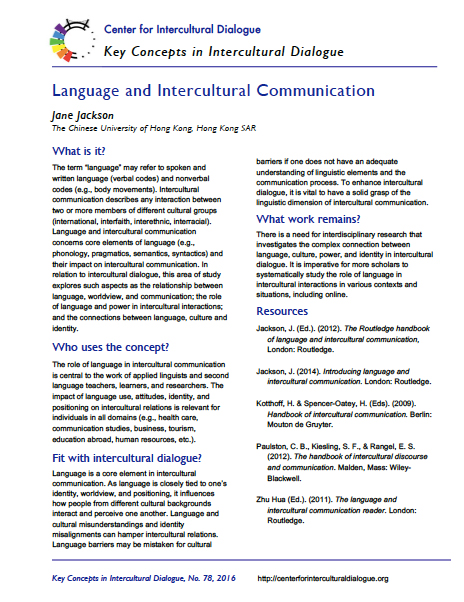
Key Concept #78: Language and Intercultural Communication by Jane Jackson

Key Concepts in ICDThe next issue of Key Concepts in intercultural Dialogue is now available. This is KC78: Language and Intercultural Communication by Jane Jackson. As always, all Key Concepts are available as free PDFs; just click on the thumbnail to download. Lists organized chronologically by publication date and numberalphabetically by concept in English, and by languages into which they have been translated, are available, as is a page of acknowledgments with the names of all authors, translators, and reviewers.

KC78 Lg & ICCJackson, J. (2016). Language and intercultural communication. Key Concepts in Intercultural Dialogue, 78. Available from:
https://centerforinterculturaldialogue.org/publications

The Center for Intercultural Dialogue publishes a series of short briefs describing Key Concepts in Intercultural Dialogue. Different people, working in different countries and disciplines, use different vocabulary to describe their interests, yet these terms overlap. Our goal is to provide some of the assumptions and history attached to each concept for those unfamiliar with it. Prior concepts are available on the main publications page. As there are other concepts you would like to see included, send an email. If there are concepts you would like to prepare, provide a brief explanation of why you think the concept is central to the study of intercultural dialogue, and why you are the obvious person to write up that concept.

Wendy Leeds-Hurwitz, Director
Center for Intercultural Dialogue


Creative Commons License
This work is licensed under a Creative Commons Attribution-NonCommercial-NoDerivatives 4.0 International License.

Save

David Myers Research Fellow (Australia)

David Myers Research Fellow
La Trobe University, Melbourne, Australia
Deadline: 17 June 2016

Prestigious David Myers Fellowship Program
3 year, fixed-term appointment based at any campus
Make a significant contribution to your discipline at an international level

La Trobe University’s success is driven by people who are committed to making a difference. They are creative and highly motivated, pursue new ideas and create knowledge. La Trobe is among the top 100 universities in the world under the age of 50 (Times Higher Education Rankings 2016), one of Australia’s research leaders, and the largest provider of higher education to regional Victoria. Our teaching and research address some of the most significant issues of our time and we’re passionate about driving change to benefit the communities we serve.

La Trobe University’s 2013 – 2017 research strategy encourages innovation, specialisation and collaboration. It focuses on cultivating a modern, vibrant research culture – a culture that values academic freedom; a culture that attracts and retains exceptional staff and outstanding students; a culture that cuts across traditional disciplinary boundaries to address global problems; a culture that fosters the very best research and attracts game-changing partnerships; a culture that engages with the local community in Northern Melbourne, in regional Victoria, in Australia and internationally.

In 2017 La Trobe University will celebrate its 50th anniversary and in celebrating both our founding Vice Chancellor and our future, the College of Arts, Social Science & Commerce will fund a set of David Myers Research Fellowships for a period of 3 years. Up to 6 Research Fellowships (post-doctoral research fellowships) ranging from Level A to Senior Research Fellow will be appointed.

La Trobe strives to promote, recognise and support researchers who demonstrate exemplary performance.

The positions
The Research Fellows will propose and undertake projects aligned with areas of research strength, Research Focus Areas (RFAs), Disciplinary Research Programs (DRPs) or active Research Centres. This will include the following:
Conduct and publish, high quality, high impact research and other scholarly activities under limited supervision either independently or as part of a team.
Obtain, or assist in obtaining, research funding from external sources.
Form productive research partnerships
Participate in professional activities including presentations at conferences and seminars in field of expertise.
Provide advice within the field of the employee’s research to Honours and postgraduate students.

In addition, the Senior Research Fellow will also;
Provide leadership in research related activities
Make a significant contribution to the discipline at the national and international level, demonstrated by a strong record of published work or other scholarly activities.
Supervise Higher Degree by Research (HDR), students.
Contribute to building a robust and ambitious research culture within La Trobe

The candidate
To be successful in the role you will have a PhD in a relevant discipline and possess demonstrated relevant academic experience. You will also possess:
Evidence of high quality and/or high impact research conducted and published, relative to opportunity;
Sound analytical skills with an ability to communicate complex information clearly in English both orally and in writing;
Demonstrated ability to supervise, or co-supervise, honours and postgraduate students; and
Demonstrated ability to work collaboratively and productively with staff and students from a diverse range of backgrounds.

Closing date: 17th June, 2016.

Position Enquiries: Office of the Associate Pro Vice-Chancellor (Research)

Please address the following questions and attach this with your application.
Outline your proposed research project
How does your research relate to Key or Developing Research Strengths in the College or RFAs or DRPs
Please outline your contribution to your discipline/s and to research excellence so far (relative to opportunity) and the likely future impact.

Please include your CV and referee details.

Postdoctoral Research Fellow (Australia)

Postdoctoral Research Fellow in Humanities
University of Queensland
Brisbane, Australia
End of advertisement period: 09 Jun 2016
Ref: 499093

The Faculty of Humanities and Social Sciences (HaSS) is a large comprehensive Faculty with a broad academic profile and substantial research achievements. Teaching in the Faculty is underpinned by substantial research performance and several specialized fields of research were judged at the highest level (5 ranking) in the most recent Excellence in Research Australia (ERA) evaluation that concluded at the end of 2015. These research achievements internationally are reflected in the 2016 Leiden rankings (based on impact, not reputation), where the Humanities and Social Sciences at UQ ranks 21st in the world on the quantum of publications in ranked journals, placing us first in Australia and in the Oceania region (for the full data-set see http://www.leidenranking.com). The quality of our overall Faculty’s performance is also evident in the QS Top Universities Rankings for 2015 which places Social Sciences at UQ at 30th in the world, and Humanities in the top 50.

The Faculty’s Executive Dean is Professor Tim Dunne, who continues to be active in his field of political science alongside his leadership role.

The role
The successful appointee will provide assistance to the Executive Dean on a variety of research related tasks. In addition to research support, the successful applicant will prepare course materials for a new Masters course that is under development using the case study method. The post-holder will author or co-author the course materials as well as assist in the delivery and management of the course, including assisting the Executive Dean in promoting his research, and that of Political Science and International Studies/Humanities and Social Sciences, by managing his personal website and assisting with his social media profile.

The person
Applicants should possess a PhD specialising in one or more of the following areas: Internal Relations, Peace and Conflict Studies, or related field. Applicants should have at least two years’ full-time experience (during the PhD and/or otherwise), or its equivalent , in a relevant area of expertise. Experience in collaborative writing of scholarly papers and dissemination of research findings in relevant academic outlet is also required.

Remuneration
This is a full-time, fixed term appointment for 2.5 years at Research Academic Level A. The remuneration package will be in the range $79,170.68 – $84,985.56 p.a., plus employer superannuation contributions of up to 17% (total package will be in the range $92,629.69 – $99,433.10 p.a.).

Enquiries
To discuss this role please contact Professor Tim Dunne on +61 7 336 51822 or execdean@hass.uq.edu.au.

CFP Listening in Mediated Contexts

Call for Papers: International Journal of Listening
Fall Issue 2017: Special Issue on Listening in Mediated Contexts
Editor-in-Chief: Margarete Imhof
Guest Editors: Dr. Debra L. Worthington & Dr. Shaughan Keaton

The growth of social media and evolving technology have significantly impacted who people listen to as well as how and when they listen.  In this Special Issue, the International Journal of Listening explores the impact of social media and other technology on listening processes. The goal of the issue is to highlight exceptional articles that explore the nature of listening in mediated contexts. Mediated contexts are broadly construed, including mobile phone communication, Facebook, Skype, YouTube, Instagram or any combination of these and other popular platforms and devices. Articles may explore the impact on or relationship to individual communication styles, characteristics of mediated interaction from both the sender and receiver’s perception, social cognition, as well as the impact of new technology on individual, group and public listening processes.  Papers from various perspectives and diverse fields are welcome:  intrapersonal/ interpersonal communication, doctor-patient communication, sports communication, romantic relationships, education and instruction. Papers with a cross-cultural or international focus are particularly welcome.

Examples of themes, include:
–         Listening attitudes and behavior in social media
–         Listening in online teaching environments.
–         Social cognition and person perception in social media
–         Intercultural differences in the perception of mediated communication
–         Supportive listening via social media
–         Individual choices between voice and short messaging
–         Medium and message reception
–         Generational differences in listening to social media messages

All full length manuscripts will be submitted through https://mc.manuscriptcentral.com/ijl.  The length of articles should be no more than 6,000 words (not including references and appendices). The journal plans to publish up to six research articles in the special issue. Additional accepted articles will be published in later issues of the journal.

Submission deadline: October 1st, 2016
Expected publication: Fall 2017

Inquiries about the special issue should be directed to Dr. Debra L. Worthington.  Please use the subject line: ILJ Special Issue on Listening and Mediated Contexts.

Toussaint Nothias Profile

Profiles

Toussaint Nothias is a postdoctoral fellow at the Digital Civil Society Lab. He holds a PhD in Media and Communication from the University of Leeds.

Toussaint Nothias

His research explores journalism, social media and civil society in Africa. In the past, he has conducted interviews among foreign correspondents to understand how the global image of Africa is produced. He has also done research with Kenyan journalists to examine their work practices and the impact of social media on their reporting of elections, terrorism, and the ICC investigation in Kenya. His postdoc fellowship project, titled Free Basics and the African Digital Civil Society, looks at the implementation of Facebook’s initiative to provide free Internet across various African countries, and its impact on local media production and civil society groups. The project engages a range of debates about digital advocacy and activism in the Global South, tech corporation’s investments in network infrastructures, net neutrality, civic engagement and social media platforms in politically volatile contexts. In parallel, Toussaint is developing a sharable, open-source tool at the intersection of technology, journalism, and scholarship. The Africa Stereotype Scanner (ASTRSC) deploys digital technologies to scan for damaging stereotypes and implicit biases in reporting about Africa. In 2017, Toussaint organized the workshop “African Media Studies in the Digital Age” at Stanford, and in 2018 he received the Stuart Hall Award from the IAMCR for his work on Twitter in Kenya.

Selected publications:

Nothias, T. & Cheruiyot, D. (2019) A “hotbed” of digital empowerment? Media criticism in Kenya between playful engagement and co-optionInternational Journal of Communication, 13, 136-159.

Nothias, T. (2018) How Western journalists actually write about Africa. Journalism Studies, 19(8), 1138-1159.

Paterson, C., & Nothias, T. (2016). Representation of China and the US in Africa in online global news. Communication, Culture, Critique, 9(1), 107-125.

Nothias, T. (2016). Mediating the distant Other for the distant audience: How do western correspondents in East and Southern Africa perceive their audience. In M. Bunce, S. Franks & C. Paterson (Eds.), Africa’s media image in the 21st century: From the “heart of darkness” to “Africa rising.” Routledge: London.

Nothias, T. (2014). Hopeful, rising, new: Visualizing Africa in the age of globalisation. Visual Communication, 13(3): 323-339.

Nothias, T. (2014). Afro-pessimism in the French and British press coverage of the 2010 South African World Cup. In T. Chari & N. Mhiripiri (Eds.), African football, identity politics and global media narratives: The legacy of the FIFA 2010 World Cup (pp. 285-304). Basingstoke, UK: Palgrave MacMillan.

Internet Governance Forum Academy Fellowships

Call for applications
IGF Academy Fellowships
iRights, in cooperation with the Association for Progressive Communications (APC) and LIRNEasia, with the financial support of the German Ministry for Economic Cooperation and Development, are pleased to announce the call for applications for a fellowship to the Internet Governance Forum (IGF) Academy.

We are looking for national champions in the field of freedom of expression and / or Internet governance. The fellowship will enable fellows to receive mentoring from internationally renowned experts in the Internet governance process, to participate in a regional workshop with champions from other countries, and to participate in the global Internet Governance Forum (IGF) in Guadalajara, Mexico, from December 4th to 10th.

About the academy
The project seeks to foster and enhance freedom of expression on the Internet and inclusive and transparent national Internet governance and policy processes through the creation and/or consolidation of multistakeholder, national Internet Governance structures in Africa and Asia. To achieve this, the IGF Academy will bring together eight national champions from four African countries (Namibia, South Africa, Congo Brazzaville, Togo) and eight national champions from four Asian countries (Myanmar, Sri Lanka, Bhutan and Bangladesh).

The IGF Academy Fellowships
The fellowship will provide experienced individuals with the opportunity to:
> receive mentoring from internationally renowned Internet governance practitioners
> deepen their understanding of Internet governance issues and processes
> expand their networks nationally, regionally and globally
> develop a strategic roadmap to strengthen existing or initiate inclusive national Internet Governance processes in their countries
> peer learning with experts from their country, their region and cross-regionally
> participate in a regional training event
> participate in a training event at the global IGF
> participate in the global UN IGF 2016 in Guadalajara
> be part of a (cross)regional and UN global dialogue on freedom of expression and information preparing for the UN Internet Governance Forum (IGF)

Fellowships will be awarded through a competitive process. Applications will be accepted until the 12th of June 2016, 22:00 GMT.

We encourage you to apply and forward the information about this programme to individuals who have a passion for freedom of expression and a broad understanding of a multistakeholder dialogue.

The fellowship period runs from June – December 2016.

Successful applicants will receive assistance and funding for travel, accommodation and meals to attend:
> One training event in their region (3 days), dates and location to be determined
> The UN Internet Governance Forum, Guadalajara, Mexico and a one-day pre-IGF workshop, December 4- 10 2016

Criteria for selection
Selection for the Fellowship is competitive. The selected candidates must provide a clear motivation for participating in the academy, including demonstrating a strong sense of what they intend to accomplish, how Internet Governance may help to foster freedom of expression in the long term in their home country and how they intend to apply the regional and global experiences from the trainings and the global UN IGF in their own national project.

Two fellows per country will be selected, one of them experienced in the human rights field, the other with experience in Internet governance processes.

In order to qualify applicants must be based in one of these countries:

    • Namibia,
    • Republic of the Congo,
    • Togo,
    • South Africa,
    • Myanmar,
    • Sri Lanka,
    • Bhutan,
    • Bangladesh

and be able to demonstrate that they
> are proficient in English (oral and written)
> are committed to the use of the Internet as a driver for development, democracy and human rights and Internet governance
> are self-motivated and able to work independently
> have fundraising and resource mobilisation skills at a national level
> have the capacity to build networks and to convene stakeholders from a variety of sectors

Depending on their profile (freedom of expression / Internet governance), candidates must have a proven track-record in
> human rights work (especially freedom of expression) at a national level
> Internet governance and/or public policy, especially in national regulatory ICT processes

In case you have further questions regarding the application process, please contact IGF directly by email at igf-academy [at] iRights [dot] info.