Institute of Current World Affairs Fellowships 2017

The Institute of Current World Affairs (ICWA) Fellowship Program

An ICWA Fellowship represents a generous investment in the future of a Fellow. The ultimate aim of the ICWA Fellowship program is to cultivate deep expertise in foreign countries and cultures. We achieve this by supporting a Fellow over a two year period, during which she or he carries out an immersive program of self-designed, independent study abroad.

ICWA’s mission is to identify and cultivate rare potential, so we are looking for promise, curiosity, and enthusiasm in our candidates. We consider whether a candidate is ready for the rapid personal growth that the Fellowship makes possible. Candidates with a passion for their project country and who are sufficiently prepared to take advantage of the opportunity we offer, have the best chance of being awarded an ICWA Fellowship. Extensive professional experience in the proposed area is not always necessary; Fellowships are aimed at developing advanced knowledge and professional skills, not awarding research or reporting opportunities to those who already possess them.

Strong candidates generally propose topics for the Fellowship that are compelling. Given our interest in achieving wide geographic distribution over time, we generally are less inclined to select projects in countries where we currently or very recently have had a Fellow. We are naturally drawn to areas of the world and topics that are less well understood and that are relevant to the United States. These could include thematic Fellowships, for example examining questions related to economic development or the environment that could be effectively pursued using the method of our Fellowships. Candidates are encouraged to browse ICWA’s archives to see the kind of projects that the Institute has supported.

REQUIREMENTS
Language Skills
We expect candidates to have the necessary language skills to allow to them to carry out their proposed project. Candidates proposing to go to China, Russia, Indonesia, India, or Brazil, for example, should have proficiency in Chinese, Russian, Bahasa, Hindi (or another relevant language) or Portuguese. It is too costly and time consuming to start from scratch, so we expect enough language proficiency so that candidates are able to function in the local language within a few months of arriving in the country. Exceptions have been made for unusual languages or situations, but these are rare.

Criteria for Consideration
Candidates must be under 36 years of age at the time of the due date for the initial letter of interest.

U.S. citizenship is not a requirement, but candidates must show strong and credible ties to U.S. society. A proposed Fellowship must hold the promise of enriching public life in the United States by enhancing the understanding of foreign countries, cultures, and trends. Public service, social activism or contribution to wider understanding in the United States is our ultimate purpose, out of a belief that the public can benefit from the knowledge and wisdom that our Fellows acquire.

Restrictions
While we expect candidates to design projects of topical interest, Fellowships are not aimed at covering news events. We do not send Fellows into war zones, or places where intense security concerns prevent Fellows from interacting with the local populace.

Fellowships are not scholarships. We do not support degree programs at universities, the writing of books, or research projects aimed at answering specific questions in a particular academic discipline.

Applicants must have excellent written and spoken English language skills and must have completed the current phase of their formal education. We do not accept applications from currently enrolled undergraduate students.

FELLOWSHIP ACTIVITIES
Fellows are required to write monthly newsletters, which are made available through our website to Institute members and other interested parties, including family, friends and professional associates of the Fellows. While the Institute has funded and will continue to fund artists, performers, and others who find various ways to participate in the societies they study, the immediate fruits of the Fellows’ learning are communicated principally through writing. Fellows should be prepared to share their experience with a general, well-educated audience, and not only with specialists in their field. Fellows work closely with the Executive Director, who serves as writing coach, editor, and mentor.

While many Fellows go on to pursue political or social causes at home and abroad, the purpose of a Fellowship is to learn about other societies, not to change them. Fellows are not permitted to engage in overtly political activities during their Fellowship. The Institute does not accept any government funds. Fellows must preserve that independence, in letter and in spirit.

Fellows should not expect to return to the United States during the two years of their Fellowship. ICWA Fellowships are immersive; a vital component of the Fellowship experience is remaining, without interruption, in the area of study for the duration of a Fellowship.

FINANCIAL SUPPORT
The Institute provides full financial support for its Fellows and their immediate families. “Full financial support” does not mean unlimited financial support, and Fellows are expected to live and spend modestly. The Institute provides Fellows with sufficient funding to allow them and their families to live in good health and reasonable comfort and to fulfill the purposes of the Fellowship.

Fellowship Opportunities
Donors’ Fellowship: The generous support received from contributors enables ICWA to appoint a Donors’ Fellows every two years. Topics and areas of study are unrestricted.

Fellows with appropriate topics may receive support from specially endowed funds, including:
John Miller Musser Memorial Forest & Society Fellowships offer people with graduate degrees in forestry or forest-related specialities an opportunity to broaden their understanding of the relationship of forest-resource problems to humans, including policy-makers, environmentalists, farmers, scientists and forest-product industrialists.

John O. Crane Memorial Fellowships provide support for study in East Europe and the Middle East.

APPLICATIONS AND DEADLINES
Those interested in applying for an Institute of Current World Affairs Fellowship should send an initial Letter of Interest and a resume to the Institute via email. (Post is also accepted.)

In your letter of interest, tell us what you would do if you had a two-year, self-designed Fellowship overseas and why you’re the right person to carry it out. There is no fixed length for the letter of interest. Take the space that you need to make a cogent case for yourself. Please indicate your age, as applicants must be under the age of 36 at the time that the letter of interest is due.

Selected Fellows are expected to depart for their Fellowship within six months of their selection.

This is a competitive process. The strongest applicants will be invited to submit a more detailed application.

Deadlines
To be considered for the June 2016 Fellowship appointment, letters of Interest are due on March 1, 2017.

Applications are not considered on a rolling basis.

We are unable to respond to all inquiries, but will certainly answer those that fit our Fellowship requirements.

Email: apply[at]icwa.org

For applications via post: 
Institute of Current World Affairs
1779 Massachusetts Ave. NW, Suite 615
Washington, DC 20036

CFP (E)-Racing Voice and Identity

Call for Chapter Proposals– (E)-Racing Voice and Identity: Communal and Divisive Aspects of Digital Media
Editors: Cerise L. Glenn & Roy Schwartzman (University of North Carolina at Greensboro).

Synopsis:
Digital media, also termed “new media,” is increasingly being used to shape racial discourses, particularly as they connect to issues of voice, identity, agency, activism, and resistance. This book will address the synergy of social media with voice, identity, and activism as they pertain to race, as well as social media’s power to widen or constrict the divides on contemporary perceptions of race. The book’s overarching focus examines how digital media shapes new understandings of traditional constructs of race, identity, community, and divisiveness, as well as how it provides new avenues for voice and
coordination of racial discourses.

Potential topics for individual chapters may include, but are not limited to:
Enacting Racial Identity and Fluidity: Racial Boundaries and Ambiguities
Learning and performing race in digital spaces
(Re)defining personal or collective racial identity via digital media
Authenticity and authority in online media
Race and class based digital divides
(Mis)representations of racial identities or behaviors online
(E)-Racing History: Remembrance and Inclusivity
Social media as tools to address social (in)justice
Roles of digital media in preserving/revising history
Digital tools in promoting legacies of racial inclusivity or marginalization
Corporate and other organizational appropriation of racial histories
Social Justice, Voice, and Mobilization
Coordination of collective action through social media
Digital dialogues centering on race and justice
Digital ways of engaging race in conjunction with other identities (e.g., gender, class, sexuality, nationality)
Interpersonal, community, national, or international methods of (dis)empowerment using digital tools
New media as ways of connecting specific ethnic groups with social causes
Media Convergence and Audience Interaction
Roles of race in online fandom and entertainment
How interactive media challenge or reinforce stereotypes
Audience appropriation of new media to rearticulate identities via mashups, remixes, etc.
Subversion of mainstream media treatments of race

Other topic areas relevant to the book’s overall theme are welcomed. All theoretical and methodological approaches are invited for consideration.

Deadline for receipt of chapter proposals and supporting materials: 1 August 2016

Proposals should be no more than 500 words plus include a complete chapter title and 3-5 keywords. In the abstract, please include: topic, explanation of material to be analyzed and/or theoretical approach, as well as preliminary findings/ theoretical points. A brief (2-3 page) CV should be included for every author. Email proposal and CV in MS Word (.doc or .docx) format to: clglenn[at]uncg.edu AND roypoet[at]gmail.com

Authors of accepted abstracts will be invited to submit full manuscripts for consideration due: 1 November 2016

#100andchange MacArthur Foundation grant

#100andchange is a MacArthur Foundation competition to award a $100 million grant for a single proposal designed to help solve a critical problem affecting people, places, or the planet. The competition is open to organizations working in any field of endeavor anywhere. Applicants must identify both the problem they are trying to solve, as well as their proposed solution, and competitive proposals will be meaningful, verifiable, durable, and feasible.

It would be wonderful if some of the people working on the issue of intercultural dialogue were to prepare applications!

Royal Roads University job ad (Canada)

Program Coordinator
School of Humanitarian Studies
Royal Roads University
Victoria, BC, Canada
Closing date: Monday, July 11, 2016 – 17:00

As the Program Coordinator for the School of Humanitarian Studies, you will play a major role in implementing the School’s strategic plan.  You will be expected to be well versed in the practical aspects of the School’s focus and be responsible for helping establish and maintain administrative processes, and assist with the development of School guidelines and procedures consistent with University objectives.  You will need to be an independent self-starter who is able to help administer the School’s programs and interact with the various internal and external stakeholders at RRU.  As well, as the Program Coordinator you may be a prime contact for requests for information from School staff, faculty (core and associate), students (prospective, current and alumni) and the University support areas on a daily basis for designated programs.

You will work with the School Manager to provide administrative leadership, ensuring that the planned programs and activities in the School are effectively managed to support the achievement of the University’s goals.

Qualifications:
To be well suited for this role you will possess the following qualifications and competencies:
This position requires a highly-motivated and self-directed person who can assist in the organization of support staff work processes and workloads, in addition to scheduling independent activities.  Active participation will be required in School meetings and other activities.
• An undergraduate degree or other relevant educational credential (college certificate or diploma) plus 5 years of related experience in the administration of academic programs (or equivalent combination of education and experience)
• Demonstrated financial coordination and contract administration skills and experience; accounting skills are an asset
• Ability to coach/mentor and provide day-to-day direction to program support staff,  and provide support for their recruitment, selection, orientation and training
• Demonstrated project management and organizational skills
• Office management skills and experience, including developing, implementing and monitoring policy and procedures
• Strong verbal and written communication abilities, including editing skills
• Strong interpersonal development and leadership capabilities including  networking and advocacy skills
• Demonstrated conflict resolution and team building skills; ability to maintain a professional attitude, acting with tact and diplomacy under pressure
• Knowledge and understanding of the University’s requirements,  methods, culture and processes, or a willingness to learn them within a reasonable amount of time, as well as knowledge or experience in continuing education and adult learning principles
• Strong technical background in the use of software programs  such as Microsoft Office suite of programs as well as other RRU systems (e.g., Agresso, our event planning software)
• Solid analytical, critical-thinking and problem-solving abilities
• Ability to work flexible hours on a pre-planned basis, including evening and weekend hours. Ability to travel to domestic and international locations as required by program
• Experience working with social media as a business tool as well as  webpage design and management would be an asset

This is a regular full-time position working 37.5 hours per week.  The position has been evaluated at Grade 3 and the recruitment range starts at $42,864.00 per annum.  The University is pleased to offer a comprehensive benefits package.

Application submission information:
To apply please forward your cover letter and curriculum vitae (preferably in electronic format) to: rru-career-opportunities@royalroads.ca with a subject line of: 16-051-P0124 – Last name, First name
or mail to:
Human Resources – Career Opportunities
Royal Roads University
2005 Sooke Road
Victoria, BC   V9B 5Y2
Fax:  (250) 391-2570
Tel:  (250) 391-2511
The competition began on June 16, 2015 and will close on July 11, 2016; however, the competition will remain open until a successful candidate is found.

While Royal Roads University values all applications we receive, only those candidates short-listed for further consideration will be contacted. RRU is an equal opportunity employer, committed to the principle of equity in employment. All qualified candidates are encouraged to apply; however, Canadians and permanent residents will be given priority consideration.

If you are sending your application via e-mail, please ensure that your electronic file is saved in MS Word or Adobe PDF format.

Key Concepts in Intercultural Dialogue in Translation!

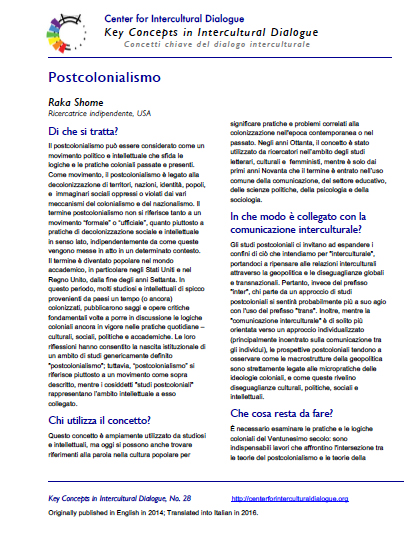
Key Concepts in ICDI was recently asked about the possibility of translating some of the Key Concepts in Intercultural Dialogue into other languages than English. This is a great idea, and I was happy to agree. The first one appears today, KC#28: Postcolonialism, originally written by Raka Shome for publication in English in 2014, now has been translated into Italian by Miguel Ángel Guerrero Ramos. My thanks to Paola Giorgis for serving as Italian editor.

As with the originals, all translations of Key Concepts will be made available as free PDFs; just click on the thumbnail to download. Lists organized chronologically by publication date and numberalphabetically by concept in English, and by languages into which they have been translated, are available, as is a page of acknowledgments with the names of all authors, translators, and reviewers.

KC28 postcolonialism-ItalianShome, R. (2016). Postcolonialismo. Key Concepts in Intercultural Dialogue, 28 (M. A. Guerrero Ramos, Trans.) Available from:
https://centerforinterculturaldialogue.org/2016/06/20/key-concepts-in-intercultural-dialogue-in-translation/

If other scholars would be interested in translating any of the other Key Concepts, please send me an email. If I do not already know you, please send along a short CV that includes information about your language skills. If you are fluent in a language other than English and do not have time to create a translation yourself but would be interested in serving as a reviewer for someone else’s draft, let me know that. As a rule, I will assume that all authors will at least be enrolled in masters’ coursework, if not further along.

And, as always, if there is a concept you think should be written up as one of the Key Concepts, whether in English or any other language, propose it. As of this writing, 78 have been published in English, but words from Chinese, Portuguese, Japanese, Spanish, Belarusian, German and Arabic have also been introduced (with the discussion provided in English). Authors of the non-English words will, for obvious reasons, receive first choice of now translating their discussion into the same language as the concept.

As is all typical in academic publishing, there is no funding for this project. Rather than financial compensation, you gain a line on your CV, and the pleasure of having your work read by many colleagues (total views of the publications page have nearly reached 5000 as of this writing, a figure which does not include views of each post introducing a new concept, which can stand in the hundreds). And, at one page, these are particularly quick and easy to write up in the first place, and should be equally quick to translate or review.

Please do not begin work on a concept or a translation until you receive approval. Not only would it be a waste of time to inadvertently duplicate effort, but there are a few basic rules and a template to follow, which will be shared after your proposal has been approved.

Wendy Leeds-Hurwitz, Director
Center for Intercultural Dialogue


Creative Commons License

This work is licensed under a Creative Commons Attribution-NonCommercial-NoDerivatives 4.0 International License.

Save

Save

IAMCR 2017 (Colombia)

IAMCR 2017
Cartagena, Colombia

On Friday 20 May 2016 IAMCR president, Janet Wasko, and Uniminuto Rector, Leonidas López Herrán signed a Memorandum of Understanding that will see IAMCR’s 2017 conference taking place in Cartagena, Colombia from 16-20 July.

The theme of the conference will be New Discourses and New Territorialities: Cultural and political mutations and communication. The local organising committee, chaired by longtime IAMCR member Amparo Cadavid, Dean of Uniminuto’s Faculty of Communication, is preparing an exciting academic and social programme what will, among other things, expose participants to some of the new communication work emanating from Latin America, Colombia and the beautiful Caribbean city of Cartagena.

The host Institution is Corporación Universitaria Minuto de Dios – UNIMINUTO, School of Communications, in cooperation with other Colombian and Latin American universities and institutions such as CIESPAL (Centro Internacional de Estudios Superiores en Comunicación para América Latina – International Centre for Advanced Studies in Communication in Latin America), FESCOL (Friedrich Ebert Stiftung in Colombia), la Universidad Javeriana, the Universidad del Norte, the Universidad de Cartagena, the Universidad Tecnológica de Bolivar and the Fundacion para el Nuevo Periodismo Iberoamericano (the foundation that was established by Nobel prize winner Gabriel Garcia Marquez, a longtime resident of Cartagena).

Global Pluralism Award 2016

The new Global Pluralism Award recognizes pluralism in action. It celebrates the extraordinary achievements of organizations, individuals and governments who are tackling the challenge of living peacefully and productively with diversity.

The Award is presented once every two years to individuals, organizations, governments and businesses of any nationality. Through their remarkable and sustained achievements, awardees contribute to building more inclusive societies in which human diversity is protected.

Three awardees will be given $50,000 each to further their work in support of pluralism. Award funds must be used for non-profit activities. Awardees will be required to submit a budget with the proposed way in which the funds will be used.

Presented by the Global Centre for Pluralism, an international research and education centre located in Ottawa, Canada, the Award aims to

  • Raise the international profile of pluralism, defined as a principle of respect for diversity,
  • Identify and disseminate innovative and successful approaches to pluralism globally, and
  • Recognize and raise the profile of exemplary organizations, individuals or other entities seeking to advance pluralism.

A wide range of disciplines
Nominees must demonstrate remarkable and sustained achievement in any of the wide range of disciplines related to pluralism. These disciplines include:
*legal reform
*human rights
*democracy promotion
*social cohesion
*education
*ethnic relations
*conflict resolution
*peacebuilding
*migration and integration
Please note that the above is not an exhaustive list.

International Nominees
Eligible nominees from all countries are eligible, including:
*individuals (e.g. artists, journalists, academics, policy-makers, filmmakers, etc.);
*civil society organizations (e.g. professional associations, faith-based organizations, labour unions, non-profit research or educational institutions, local community groups, non-governmental organizations, foundations, think tanks, etc.);
*social enterprises;
*corporations;
*educational, research and policy institutions (public or private);
*local/municipal, regional or federal/national branches of governments, etc.
Please note that the above is not an exhaustive list.

Do you know a pluralism champion?
Award nominations are now being accepted. Nominate or apply before the August 31, 2016 deadline. Nominations for the Award can only be submitted online. Nominations are accepted from nominators or candidates themselves.

The international jury of experts selecting the awardees is chaired by the Rt. Hon. Joe Clark, former Prime Minister of Canada.

USAID Public Diplomacy Grants (Sri Lanka and Maldives)

The U.S. Embassy in Sri Lanka and Maldives welcomes grant applications for programs that address key development issues in Sri Lanka and Maldives to strengthen democratic institutions, promote ethnic/religious reconciliation and gender equality, provide sustainable economic growth through entrepreneurship and job skills training, foster media freedoms and promote transparency, strengthen environmental protection, and/or address transnational problems.

Deadline: 30 September 2016

Grant proposals will be accepted in three primary categories based on funding levels. Successful proposals will impact one of the issues highlighted above. In evaluating proposals, emphasis will be placed on the size of the budget, experience of the grantee on implementing programs, and diversity of audiences affected by the program.

Categories of awards:
Category 1: $1000 – $9990: To conduct a series of classes or workshops on one of the key development issues above. Recommended for organizations with experience working in the subject matter but little or no past partnerships with the U.S. Embassy.  Proposals can also include cultural or thematic events or informational products, such as a concert or printed/virtual/online guidebooks. Individual trainers seeking to hold regularly weekly classes or form activity clubs should apply under this category.

Category 2: $10000 – $24900: To conduct extended training for a diverse audience and/or produce material to raise awareness of one of the key development issues above.  Recommended for organizations with substantial experience working in the subject matter and with past successful projects with the U.S. Embassy.  Programs can include broad campaigns to support these development goals, workshops bringing international expertise, and other relevant projects.

Category 3: $25000 – 40,000: To conduct extended training for a diverse audience and/ or produce material to raise awareness of one of the key development issues above.  Recommended for organizations with extensive experience working in the subject matter and past successful projects with the U.S. Embassy and other international donors.  NOTE: This category is highly competitive.

CFP Intercultural Communication for Western States Communication Association (Utah)

Call for Papers and Programs
INTERCULTURAL COMMUNICATION INTEREST GROUP
WESTERN STATES COMMUNICATION ASSOCIATION
2017 Convention – Salt Lake City, Utah
February 18-21, 2017

Conference Theme: Centralizing Marginality, Marginalizing the Center

Reflecting on nascent activity in social and political contexts brings to the fore various tensions: in particular, that of the margin(s) and the center. Multiple and significant strides, as well as setbacks, in society communicate particular rights, groups or populations moving from the margins to the center of a controversy. In those instances, we must inquire if what we observe are efforts to centralize marginality or efforts to marginalize the center. Similarly, for some of us, the experience of being marginalized, living on the margins, or working on/at the margins are familiar. Those experiences likely produce an array of communicative approaches and tactics of survival, regardless of the settings in which we exist.  Alternatively, our positionalities as teachers, scholars or (un/documented) citizens likely have us occupy spaces that both centralize and marginalize us. We may (un)knowingly center particular epistemologies in the classroom and in scholarship, adopt ontologies that carry the potential to shift how we study that which we do, and/or embrace pedagogies that require we rethink how marginality and the center manifest in our classrooms.

The 2017 WSCA conference theme “Centralizing Marginality, Marginalizing the Center” asks participants to think in diverse and innovative ways about the relational natures of margin(ality) and center (centrality). This theme encourages us to consider the ways that centralizing marginality carries the potential to reshape how we think about, study, and teach processes of communication. When marginality is centralized, what foundational theories are we encouraged to reconsider from the position of the margins? Which, if any, approaches to communication call for marginalizing the center in order to bring to light new ways of producing scholarship? Alternatively, we might reflect upon does the center need to be marginalized? If so, in what instances and why? Finally, the conference theme asks us to think of the dialectic of margin/center as the fulcrum of communicative activity and scholarly activity.

The Intercultural Communication Interest Group encourages papers and programs that explore this year’s conference theme, “Centralizing Marginality, Marginalizing the Center.”  Open to different topics relevant to Intercultural Communication, ICIG especially invites submissions from teachers, scholars, and practitioners who examine work within international contexts and topics that challenge Western constructs and performances of culture, identity, gender, queerness, and other identity markers in various environments.  ICIG also supports co-sponsored programs with other interest groups that consider the conference theme.

The deadline for submission is September 1, 2016. Please send competitive papers and program proposals electronically to: Dr. Richie Neil Hao (Columbia College Hollywood), Chair/Program Planner, Intercultural Communication Interest Group. Email: icig.wsca [at] gmail.com

I. COMPETITIVE PAPERS
A. All authors are encouraged to send their papers to the Intercultural Communication Interest Group for competitive selection. Papers should reflect the conference theme and may include research employing any methodology, theoretical developments, critical analysis as well as critiques. Please submit each paper to only one interest group. All papers should be submitted by e-mail attachment as .doc or .pdf file format to the ICIG email account (icig.wsca [at] gmail.com) by September 1, 2016. Your electronic submission should include two separate attachments (see B).

B. Submitted papers should include the following:
Attachment 1: Cover Page
a.     The paper’s title
b.     Names of all authors, affiliation(s), email address(es), phone number(s)
c.     Any audio-visual requests. This information should be included for each author. Equipment availability is extremely limited. See the WSCA policy on Audio-Visual Equipment at Conventions in the Policies and Procedures Manual on the website
Attachment 2: Paper with all author identification removed
a.    A 100-200 word abstract of the paper (with title appearing on this page);
b.    A maximum of 30 pages of text;
c.    No information in the paper that identifies the author(s) beyond that which
appears on the title page.

C. Student/Debut Papers: The Intercultural Communication Interest Group welcomes student and debut papers. If your paper is a student or debut paper please note this on the title page under the title of the paper. In addition, please indicate whether each author is a bachelors, masters, or doctoral student.

II. PROGRAM PROPOSALS
A. Program proposals should focus on a unifying theme relevant to research, theory, or instruction in the area of intercultural communication. Programs may consist of a chair, individual presenters, and a respondent in a format traditionally presented at conferences. However, debates, round table discussions, performance activities, or other unique formats are encouraged. Innovative program proposals, especially those that provide opportunities for interaction among participants and attendees, are encouraged. Programs co-sponsored with other interest groups are also welcome. Programs that relate to and extend the convention theme are encouraged.

Proposals should be submitted as .doc or .pdf file to ICIG email account (icig.wsca [at] gmail.com) by September 1, 2016, and should include:
a. Thematic title of the panel and 150 word abstract
b. Names, addresses, phones, e-mail addresses, and affiliations of all participants
c. Up to 400 word rationale for the panel
d. Title and brief description/abstract of each presentation on the panel
e. Equipment needed for panel (keeping in mind that equipment may be limited)

If you have any questions, please contact to Dr. Richie Neil Hao (Columbia College Hollywood) at rhao [at] columbiacollege.edu.

CID has Passed 2000 Subscribers!

About CIDThanks to all of you who have subscribed to the Center for Intercultural Dialogue’s website, we have crossed the 2000 mark!

2000 followers

This number includes those who have followed through WordPress (available only to those with their own WP sites), those who have signed up for email notifications, as well as those who follow through Facebook, Twitter, or Google+. WordPress cannot directly track those who have joined the CID LinkedIn group (currently at 274 members), or who follow on YouTube or Pinterest, so the actual number of subscribers in fact now totals 2349! It took 3 1/2 years to reach 1000, but only another 2 years to pass 2000. Likes on Facebook, retweets on Twitter, and sharing of posts all expand our reach, and are much appreciated.

Profiles and the CID publication series Key Concepts in Intercultural Dialogue receive considerable numbers of views, as do guest posts (which you can access through the word cloud at the bottom left of any page). Even the Wikipedia article on CID is read half a dozen times each day.

As the number of followers has increased, email sent to CID has increased as well. The largest single number of viewers are from the US, but it is people outside the US who most often write in with requests of various sorts. As an example, the past week brought emails from Colombia, Switzerland, Nigeria, Greece, and New Zealand; the week before that from Ghana, Hong Kong, Malta, Belgium and Serbia. I try to answer all emails within a few days, and to post relevant information that is submitted about conferences, publication opportunities, fellowships, grants, post-docs, etc. within a week, though occasionally there is a longer line.

I very much appreciate your support.

Wendy Leeds-Hurwitz, Director
Center for Intercultural Dialogue
intercult.dialogue [at] gmail.com