National University of Singapore 6 job ads

Six tenure-track Assistant Professor Positions at National University of Singapore

The Department, a part of the globally ranked Faculty of Arts and Social Sciences at NUS and ranked first in Asia, offers degree programs at the undergraduate, masters and doctoral levels, and is home to cutting-edge multi-disciplinary scholarship on digital media studies. Remuneration and work support provided are internationally competitive.

The Department of Communications and New Media (CNM) at the National University of Singapore seeks outstanding candidates for six tenure-track Assistant Professor Positions. Successful candidates must demonstrate a record of excellence in research in one or more of the
following broad areas.

Position 1. Assistant Professor Tenure-track position in Public Relations and Strategic Communication [#2016.01.01]

We seek a scholar with expertise in one or more of the following areas: 1) public relations, corporate communication, strategic communication, and/or digital and social media. A thorough grounding in theory, research, and practice related to public relations and/or strategic communication is required.

Position 2. Assistant Professor Tenure-track position in Health Communication [#2016.01.02]

We seek an engaged scholar with demonstrated expertise in health communication broadly defined. Areas of teaching and research interests include but are not limited to: culture and health, health campaigns, health promotion, health information seeking, patient-provider communication, health risk perception and behavior, social support, e-health, and/or health care advocacy.

Position 3. Assistant Professor Tenure-track position in Organizational Communication [#2016.02.03]

We seek a scholar with expertise in organizational communication, leadership, and/or new communication technologies. In particular, research and teaching interests in gender, diversity, and organizational culture in STEM (Science, Technology, Engineering, and Mathematics) fields are desired.

Position 4. Assistant Professor Tenure-track position in New Media and Political Communication [#2016.02.04]

We seek a scholar with expertise in- activism, elections and campaigns, power and politics, collective action, social movement, civic engagement, public opinion, and/or political psychology and behavior.

Position 5 Assistant Professor in Qualitative Communication Research Methods [#2016.01.05]

We seek a scholar with expertise in qualitative research methods in communication. Areas of teaching and research interests include but are not limited to: health communication, organizational communication, digital media studies, social change communication, development
communication, science communication, and/or performance studies.

Position 6 Assistant Professor in Critical/Cultural Studies and New Media [#2016.02.06]

We seek a scholar with expertise in critical/cultural studies of new media. Areas of teaching and research interests include but are not limited to: digital rhetoric and digital humanities, cultural studies of new media, political economy of new media, postcolonial theories of new media, new media mobilities, digital Marxist theory, performance studies and new media, new media policies and regulations, and/or digital ethics.

Please submit: (1) Research and teaching interest statements, (2) Curriculum Vitae including publications and teaching experience, (3) names, affiliates, and contact details of PhD supervisor and three other references, (4) selected copies of up to 2 journal/conference articles or book chapters representing best work. Please indicate on your application the position you are applying for. These appointments are set to commence in 2017.

A Ph.D. in Communication or relevant fields is required. Candidates who are at the ABD stage and can show clear evidence of PhD completion are also welcome to apply. We strongly uphold the principle of nondiscrimination and encourage every qualified individual to apply. Review of applications will begin on 31 August 2016 and continue until the positions are filled. Enquiries and applications should be sent to Gayathri Dorairaju at cnmcareer[at]nus.edu.sg

CFP Roles of Communication on a Regional Conflict

Journal of Asian Pacific Communication (JAPC) Special Issue Call for Papers
The Roles of Communication on a Regional Conflict: Antipathy, Nationalism, and Conflicts in Territorial Disputes among China, Japan, and South Korea

Submissions are encouraged from scholars that use different theoretical and empirical approaches to the special issue of Journal of Asian Pacific Communication on the role of communication (e.g. legal, diplomatic, and public discourses) in territorial disputes among China, Japan, and South Korea. Territorial disputes between China and Japan over Diaoyu (Chinese) or Senkaku (Japanese) island and between Japan and South Korea over the Dokdo (Korea) or Takeshima (Japanese) island have escalated particularly in recent years and given rise to concerns about peace and security in the region. The special issue will examine the roles of communication and discourse on their political, cultural, historical, and economical aspects of the territorial disputes with a focus on the key internal and external factors shaping current and future relations. The articles will examine communication and discourse in institutional and political settings, i.e., in and around organizations, in the media, and on the internet. They will focus on how use of language and non-verbal symbolic systems in specific, esp. institutional, communicative contexts, including face-to-face diplomatic interactions/conversations, news release, and popular cultural texts such as films, music, animation, television drama, etc. impact the territorial disputes.

(1) News Coverage on the Disputes: Articles may examine how news media cover the disputes and the accompanying debates on international and domestic levels by conducting content (quantitative) or textural (qualitative) analysis of newspaper articles or broadcasting news contents in two territorial disputes among three nations (or comparative studies). They may also examine how media represent conflict and its potential impact on the audience.

(2) Public Opinion and Propaganda: Although territorial disputes are one of the most fraught issues among states, how public opinion and official and unofficial propaganda on territorial disputes varies within states and what explains the variation are often overlooked. Some articles may examine the dynamics of messages and see how public prioritizes and processes nationalistic, historical, and economic considerations over such disputes. They may hypothesize, for example, that younger generations are more likely to support some level of compromise while older generations would take a more a hawkish stance.

(3) Political and Diplomatic Communication: There are inevitable political aspects in disputed territories. The role of the U.S. can be an explosive force in these disputes. Although the U.S. may maintain the neutrality in the territorial disputes among three nations, the U.S. concerns that China’s muscle in the region could escalate the conflicts with neighboring Vietnam, Malaysia, and Philippine and Japan. The U.S. may support their territorial disputes in order to counter China’s regional hegemonic ambition. The papers may examine rhetorical aspects of political communication (emails, news releases, press conferences, legal action threats, languages of peace and conflicts) in these disputes.

(4) Role of Social Media and Bloggers: Angry and reasonable participants of social media have escalated various international conflicts including the territorial disputes. Papers may analyze social media, internet, and cyber warfare on the disputes among three nations and see how these disputes are mediated, produced, received, and reconstituted.

(5) Role of Popular Cultural Texts: These disputes have been constructed and deconstructed through comics, television dramas, films, dance, theaters, and music in three nations. They are also largely consumed and shared in internet. Papers may explore how these popular cultural texts can personalize and frame the disputes and make the readers to frame of references in their opinions on the topic. Or analyze the texts based on power, ideology, and discourses.

All manuscripts will be reviewed as a cohort for this special issue. Manuscripts must be submitted here. All submissions will go through a regular double-blind review process and follow the standard norms and processes. The deadline for submissions is October 15, 2016. Submissions should be emailed to Eungjun Min, emin[at]ric.edu.

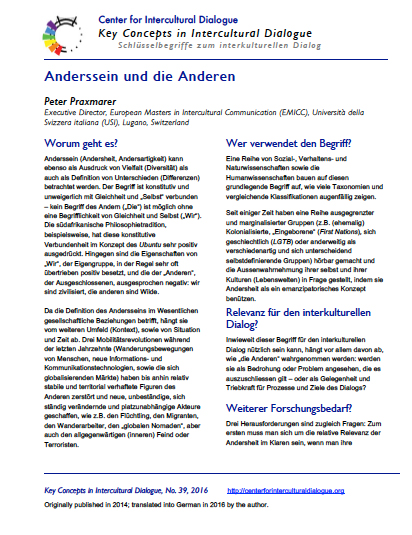
Key Concept #39: Otherness Translated into German

Key Concepts in ICDContinuing translations of Key Concepts in Intercultural Dialogue, today I am posting KC#39: Otherness and The Other(s), originally written by Peter Praxmarer for publication in English in 2014, now translated by him into German. While translating, he has taken the opportunity to slightly revise and update the original English version as well.

As always, all Key Concepts are available as free PDFs; just click on the thumbnail to download. Lists of Key Concepts organized chronologically by publication date and number, alphabetically by concept, and by languages into which they have been translated, are available, as is a page of acknowledgments with the names of all authors, translators, and reviewers.

KC39 Otherness_GermanPraxmarer, P. (2016). Anderssein und die Anderen. Key Concepts in Intercultural Dialogue, 39. Available from:
https://centerforinterculturaldialogue.org/wp-content/uploads/2016/08/kc39-otherness_german.pdf

If you are interested in translating one of the Key Concepts, please contact me for approval first because dozens are currently in process. As always, if there is a concept you think should be written up as one of the Key Concepts, whether in English or any other language, propose it. If you are new to CID, please provide a brief resume. This opportunity is open to masters students and above, on the assumption that some familiarity with academic conventions generally, and discussion of intercultural dialogue specifically, are useful.

Wendy Leeds-Hurwitz, Director
Center for Intercultural Dialogue


Creative Commons License
This work is licensed under a Creative Commons Attribution-NonCommercial-NoDerivatives 4.0 International License.

CFP Journal of Communication Special Issue

Call for Papers: Ferments in the Field
Ferments in the Field: The Past, Present and Futures of Communication Studies

In 1983, Journal of Communication (JoC) published the special issue “Ferment in the Field” (Volume 33, Issue 3, co-edited by George Gerbner and Marsha Siefert). The issue focused on “questions about the role of communications scholars and researchers, and of the discipline as a whole, in society” (Gerbner & Siefert, 1983, p. 4). The 35 contributions reflected “on the state of communications research today; the relationship of the researcher to science, society, and policy; the goals of research with respect to social issues and social structure; and the tactics and strategies for reaching their goals” (ibid). In 1993, two comparable JoC issues were dedicated to “The Disciplinary Status of Communication Research” (Volume 43, Issues 3-4, co-edited by Mark Levy and Michael Gurevitch). In 2008, a JoC special issue discussed “Epistemological and Disciplinary Intersections” (Volume 58, Issue 4, edited by Michael Pfau).

More than three decades after the original Ferment issue, it is again time to reflect on disciplinary transformations in communication studies. By calling this new special issue Ferments in the Field, we see historical continuity in our efforts along JoC’s tradition of inviting communication scholarship to reflect upon itself. Meanwhile, we ask questions with a special eye on the increasing complexity and diversity of the field:
• What does the field of communication research look like?
• What have been the key tendencies and developments in communication(s) research and its subfields?
• How has the field developed in the past decades? What have been long-term continuities and discontinuities since the 1980s?
• What is the actual and desirable role for communication studies in contemporary academe and society?
• What is the status of theory, methods, critique, ethics, and interdisciplinarity in our field?
• What is the status of critical research and theories?
• How should the field position itself vis-à-vis key contemporary processes and challenges?
• What does the future of communication studies look like?

With these questions in mind, we hope to encourage authors to revisit the classic “ferment” themes as identified by past contributions to JoC. It is our belief that past arguments and issues need to be re-examined given new developments in communication in contemporary societies, changing media systems and communication processes, the digitization of communication, global and regional crisis, and the dynamics of knowledge production in academic institutions around the world.

Contributions to a new edition of “Ferments in the Field” should be provocative essays that offer bold ideas with broad implications for the field as a whole and areas of specializations. This special issue speaks of ferments in the plural in order to spur reflections beyond established academic boundaries and stimulate discussions that encourage scholars to think beyond comfort zones. From multiple theoretical, methodological, and disciplinary perspectives, it asks about the continuities and discontinuities in communication research in an attempt to initiate a new round of debates about the past, present and futures of the field.

The special issue will be published in 2018. The editors are Professor Christian Fuchs (University of Westminster) and Professor Jack Qiu (Chinese University of Hong Kong).

Authors are welcome to submit extended abstracts to the Editors by December 1, 2016. Extended abstracts should have a length of 400-1,000 words (excluding tables, figures, and references). Abstracts should be submitted to c.fuchs[at]westminster.ac.uk and jacklqiu[at]cuhk.edu.hk.

After the editors review the abstracts, authors will be informed about acceptance or rejection by early February 2017. In reviewing abstracts, special attention will be given to whether the proposed pieces take a broad view on the past, present and future of communication studies from specific angles. Subsequently, authors who were asked to submit complete papers will need to submit their manuscripts by May 2, 2017. Each manuscript should not exceed 4,000 words (including tables, figures, and references). Manuscripts should be submitted to http://mc.manuscriptcentral.com/jcom. Please indicate submission for the special issue “Ferments in the Field” in the cover letter.

Extended abstracts and manuscripts must conform to JoC guidelines, including the use of APA 6th edition.

Besides extended abstracts and manuscripts, the editors welcome expression of interest in reviewing submissions. Questions and comments should be directed to Jack Qiu and Christian Fuchs.

Key Concept #63: Interkulturelle Philosophie Translated into Marathi

Key Concepts in ICDContinuing translations of Key Concepts in Intercultural Dialogue, today I am posting KC#63: Interkulturelle Philosophie, originally written by Monika Kirloskar-Steinbach for publication in English in 2015, has now been translated into Marathi by Pradeep Prabhakar Gokhale.

As always, all Key Concepts are available as free PDFs; just click on the thumbnail to download. Lists of Key Concepts organized chronologically by publication date and number, alphabetically by concept, and by languages into which they have been translated, are available, as is a page of acknowledgments with the names of all authors, translators, and reviewers.

KC63 Interkulturelle Philosophie_MarathiKirloskar-Steinbach, M. (2016). Interkulturelle philosophie [Marathi]. Key Concepts in Intercultural Dialogue, 63. (P. P. Gokhale, trans.). Available from:
https://centerforinterculturaldialogue.org/wp-content/uploads/2016/08/kc63-interkulturelle-philosophie_marathi1.pdf

If you are interested in translating one of the Key Concepts, please contact me for approval first because dozens are currently in process. As always, if there is a concept you think should be written up as one of the Key Concepts, whether in English or any other language, propose it. If you are new to CID, please provide a brief resume. This opportunity is open to masters students and above, on the assumption that some familiarity with academic conventions generally, and discussion of intercultural dialogue specifically, are useful.

Wendy Leeds-Hurwitz, Director
Center for Intercultural Dialogue


Creative Commons License
This work is licensed under a Creative Commons Attribution-NonCommercial-NoDerivatives 4.0 International License.

Pradeep Prabhakar Gokhale Profile

Profiles

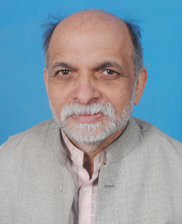
Pradeep Prabhakar Gokhale is Dr. B. R. Ambedkar Research Professor at the Central University of Tibetan Studies, Sarnath (Varanasi), India.

GokhaleHe retired in 2012 as Professor of Philosophy from the University of Pune after 31 years of teaching. His research areas include classical Indian philosophies: Buddhism, Lokāyata, Yoga, Jainism; Indian epistemology and logic; Indian moral philosophy; social philosophy and philosophy of religion: Ambedkar’s thought and contemporary Buddhism.

Authored books in English are: Inference and fallacies discussed in Indian logic; Vādanyāya of Dharmakirti: The logic of debate; Hetubindu of Dharmakirti: A point on probans; Recollection, recognition and reasoning: A study in the Jaina theory of Paroksha Pramana (co-authored); and Lokāyata/Cārvāka: A philosophical inquiry. Authored books in Marathi are: Viṣamatecā Puraskartā Manu; and Tattvacintaka Cārvāka. Edited books in English are: The philosophy of Dr. B. R. Ambedkar; Studies in Indian moral philosophy: Problems, concepts and perspectives (co-edited); and Buddhist texts and traditions (co-edited). Edited books in Marathi are: Vjñānāce Tattvajñāna (co-edited); and Bauddha-vicāradhārā. In addition he has around 45 (English) and 60 (Marathi) publications in various academic journals and anthologies. In addition, he has worked in different editorial capacities (1979-2011) for the quarterly philosophical journal in Marathi, Paramarsha, published by the department of Philosophy, University of Pune, and is presently a member of the editorial boards of Paramarsha and Paramarsha (Hindi).


Work for CID:

Pradeep Prabhakar Gokhale translated KC63: Interkulturelle Philosophie into Marathi.

Central College (Iowa) Job Ad: Conflict Resolution

Assistant Professor of Communication Studies (Conflict Resolution, Negotiation, and/or Peace Communication) at Central College

Full-time, tenure-line appointment beginning August 2017.

QUALIFICATIONS: Candidates should have a PhD (ABD may apply) in Communication Studies or relevant field and some evidence of scholarly productivity.

POSITION: Candidates should be committed to undergraduate teaching and have an understanding of and appreciation for the liberal arts environment. Responsibilities for this position include teaching introduction to communication theory and a presentation course in addition to developing and teaching upper level courses in conflict resolution, negotiation and/or peace communication. Applicants should have research and teaching interests in these areas of communication as they apply to interpersonal, intergroup, organizational, community, national, or international contexts. Specific foci may include, but are not limited to, negotiation, mediation, peace communication, conflict/dispute resolution, and/or multicultural or international dialogue. The successful candidate will be expected to participate in curriculum development and be able to teach the College’s first-year or senior-year interdisciplinary seminar. In addition to teaching, all
faculty at Central College are expected to participate in the life of the college and to demonstrate an ongoing commitment to professional development.

The Communication Studies Department provides students with a broad-based exposure to the process of creating messages, meaning and relationships in a broad array of contexts. In an effort to cultivate critical thinking, clear writing, articulate speaking and proficiency
with technology, our students study communication within a variety of contexts, particularly those related to media citizenship, civic responsibility, professional engagement, and personal relationships. Through a combination of theoretical grounding and applied experience, we prepare our majors for a range of careers, enable them to participate
productively in a democratic culture, and instill in them a desire for life-long learning. This position represents a new area of emphasis for the department and one which affirms Central’s commitment to this interdisciplinary focus area. The faculty in the department and across the Central campus interact in an academically stimulating and congenial environment with a focus on student success. 100% of communication studies majors complete at least one internship and 66% participate in one of Central’s off-campus domestic or international semester programs.

APPLICATION PROCEDURE:
To apply for this position please visit www.central.edu/jobseekers/. Review of applications will commence September 15, 2016, and will continue until the position is filled. Candidates recommended for employment are subject to a background investigation. Please submit the following materials online:

1. a letter of application relating your qualifications to the position. Please discuss your interest in developing as a teacher and scholar in an undergraduate, liberal arts college
2. a curriculum vita
3. copies of undergraduate and graduate transcripts
4. a one-page statement of teaching philosophy

Three confidential letters of reference addressing the candidate’s qualifications and official transcripts can be sent electronically to centraldean@central.edu or mailed to: Vice President for Academic Affairs & Dean of the Faculty, Central College, 812 University, Pella, Iowa 50219.

University of Maryland Baltimore County Job Ad: Intercultural Communication

Tenure-Track Assistant/Associate Professor of Intercultural Communication

The Department of Modern Languages, Linguistics, and Intercultural Communication at the University of Maryland, Baltimore County (UMBC) is filling a tenure-track position at the rank of Assistant or Associate Professor in intercultural communication in any of the following languages: Arabic, Chinese, French, German, Japanese, Korean, Russian or Spanish. The department has been a pioneer in incorporating intercultural communication into its language pedagogy, enriching both the fields of language pedagogy and intercultural communication.

Teaching responsibilities will include courses in intercultural training, other areas of critical intercultural communication, and language courses in the selected candidate’s modern language at the undergraduate and graduate levels. The candidate will also participate in the supervision of theses and scholarly papers in the department’s interdisciplinary MA program in Intercultural Communication.

UMBC has a strong commitment to increasing faculty diversity. We are especially proud of the diversity of our student body and we seek to attract equally diverse faculty. Successful candidates must be able to work in a multicultural environment and support diversity and inclusion reflecting our student body. Furthermore, the successful candidate should embrace our vision and mission, and be committed to inclusive excellence and diversityMembers of minority groups, women, veterans and individuals with disabilities are strongly encouraged to apply.

Qualifications
We are searching for a candidate with expertise in any of the following languages: Arabic, Chinese, French, German, Japanese, Korean, Russian or Spanish. Candidates should have in hand a PhD in intercultural communication or a closely related field, experience in intercultural training, and native or near-native proficiency in at least one of the modern languages above. We welcome applications from applied linguistics, translation and transcultural studies, critical intercultural communication, and other fields that engage with intercultural modern language studies. Employment is contingent upon the candidate’s obtaining and maintaining appropriate visa status, if applicable. For more information about the MLLI department and the INCC program, please consult http://mlli.umbc.edu.

Application Instructions:
Please prepare a writing sample (one or two pages) that communicates a vision for the history, theories, and methodologies of the field as well as your agenda for research, teaching, training, service, and outreach.

Please submit all materials (including a two-page letter of application, CV, writing sample, unofficial graduate transcripts and three letters of reference) via Interfolio (position number 36255) by October 15, 2016. For questions, please contact:

Dr. Edward Larkey, Search Committee Chair (larkey[at]umbc.edu)
Department of Modern Languages, Linguistics and Intercultural Communication
University of Maryland, Baltimore County

Equal Employment Opportunity Statement
UMBC is an Equal Opportunity/Affirmative Action Employer

Conflict Management Questionnaire

Call for participants
Seeking American respondents who are 18 or older to fill out a conflict management questionnaire

Dr. Eura Jung, Steven Young, and Rita Nassuna are researchers from the University of Southern Mississippi and are conducting research comparing the influences of personality, culture, and gender on conflict styles. They are checking to see which factor has the most significant impact on an individual’s conflict management style. If you are 18 or older, please help by taking the 10-15 minute survey. The researchers sincerely appreciate your help.

This project has been reviewed by the Institutional Review Board, which ensures that research projects involving human subjects follow federal regulations. Any questions or concerns about rights as a research participant should be directed to the chair of the Institutional Review Board, The University of Southern Mississippi, 118 College Drive #5147, Hattiesburg, MS 39406-0001, (601) 266-6820. If you have any questions about this survey, please email the researcher Dr. Eura Jung at eura.jung[at]usm.edu. Your time and input are greatly appreciated!

Key Concept #72: Intertextuality Translated into French

Key Concepts in ICDContinuing translations of Key Concepts in Intercultural Dialogue, today I am posting KC#72: Intertextuality, originally written by Michele Koven for publication in English in 2015, which she has now translated into French. This is the first concept to be published in French, but several others are in process.

As always, all Key Concepts are available as free PDFs; just click on the thumbnail to download. Lists of Key Concepts organized chronologically by publication date and number, alphabetically by concept, and by languages into which they have been translated, are available, as is a page of acknowledgments with the names of all authors, translators, and reviewers.

KC72 Intertextuality_French_v2Koven, M. (2016). Intertextualité. Key Concepts in Intercultural Dialogue, 72. Available from:
https://centerforinterculturaldialogue.org/wp-content/uploads/2021/05/kc72-intertextuality_french_v2.pdf

If you are interested in translating one of the Key Concepts, please contact me for approval first because dozens are currently in process. As always, if there is a concept you think should be written up as one of the Key Concepts, whether in English or any other language, propose it. If you are new to CID, please provide a brief resume. This opportunity is open to masters students and above, on the assumption that some familiarity with academic conventions generally, and discussion of intercultural dialogue specifically, are useful.

Wendy Leeds-Hurwitz, Director
Center for Intercultural Dialogue


Creative Commons License
This work is licensed under a Creative Commons Attribution-NonCommercial-NoDerivatives 4.0 International License.